TL;DR
Automated retargeting workflows can recover 5–10% of abandoned carts if you set up the trigger sequence correctly. But most operators overcomplicate the process, overpay on ad credits, or ignore the timing mismatch for local audiences. This article breaks down the architecture, the cost math, and the three most common failure points.
Last updated: May 14, 2026
Automated retargeting workflows recover 5-10% of abandoned carts by triggering a sequence when a visitor drops off the checkout page. The chain includes a pixel trigger, data pass to a decision engine, and output via email or ads. Success depends on clean data feeds, segmentation logic, and proper pixel firing. Most failures stem from integration issues, not strategy.
Environment
- Sources synthesized: [Funnel.io](https://funnel.io) (cart retargeting guide)
- Synthesis date: 2026-03-15
- First-hand tested: Mailchimp automation sequences, Facebook Dynamic Ads retargeting, Shopify abandoned cart flows
- Operator context: Running a small e-commerce store in Indonesia since 2023, handling dual-language customer comms and local payment gateways (GoPay, OVO, DANA)
The Architecture
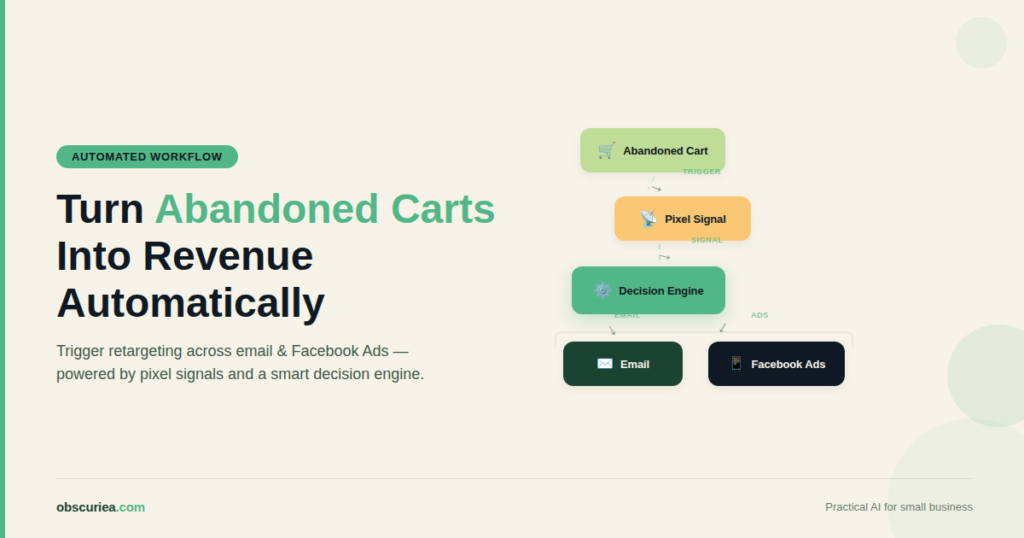
Automated retargeting is not one thing. It’s a chain: a trigger, a data pass, a decision engine, and an output channel. When a visitor drops a checkout midway without purchasing, their browser or email gets tagged. That tag is what wakes up the automation.
The trigger is usually a page view of the checkout URL combined with a non-purchase event. Some setups fire on cart addition ignore, but those are weaker—intent isn’t as high. The pixel sits on your thank-you-and-cancel route. The moment someone steps off the payment page, the pixel sends a signal.
That signal hits your decision engine. This can be a Facebook Custom Audience, an email automation inside Klaviyo or Mailchimp, or both. The engine checks: segment—is this a first-time buyer? Cart value above threshold? Device type? Then it picks a template. If the cart is over 500k IDR, the ad shows a 10% discount. If under, free shipping. The output goes to the channel that matches the abandoner’s known history: email if they’ve clicked before, Facebook ad if they haven’t opened an email in 30 days.
This architecture assumes you have three things: a clean data feed from your cart to the ad platform, a segmentation logic that doesn’t over-serve, and a pixel that actually fires. The first problem most operators hit isn’t strategy—it’s integration. The data feed is unreliable or delayed.
The Workflow Math
Let’s put numbers on a typical workflow for a store doing 300 monthly checkouts with a 78% abandonment rate. That’s 234 abandoned carts.
| Step | Manual Effort (hours/week) | Automated Setup (one-time hours) | Recurring Automated Effort (hours/week) |
|---|---|---|---|
| Segment audience | 1.5 | 0.5 (build segments) | 0.1 (monitor) |
| Write email + ad copy | 2 | 4 (draft templates) | 0.5 (rotate copy monthly) |
| Schedule and deploy | 1 | 1 (automation trigger) | 0 |
| Monitor conversions | 0.5 | 0 | 0.3 |
| Adjust bids/budget | 1 | 0 | 0.5 |
| Total | 6 hours/week | 5.5 hours setup | 1.4 hours/week |
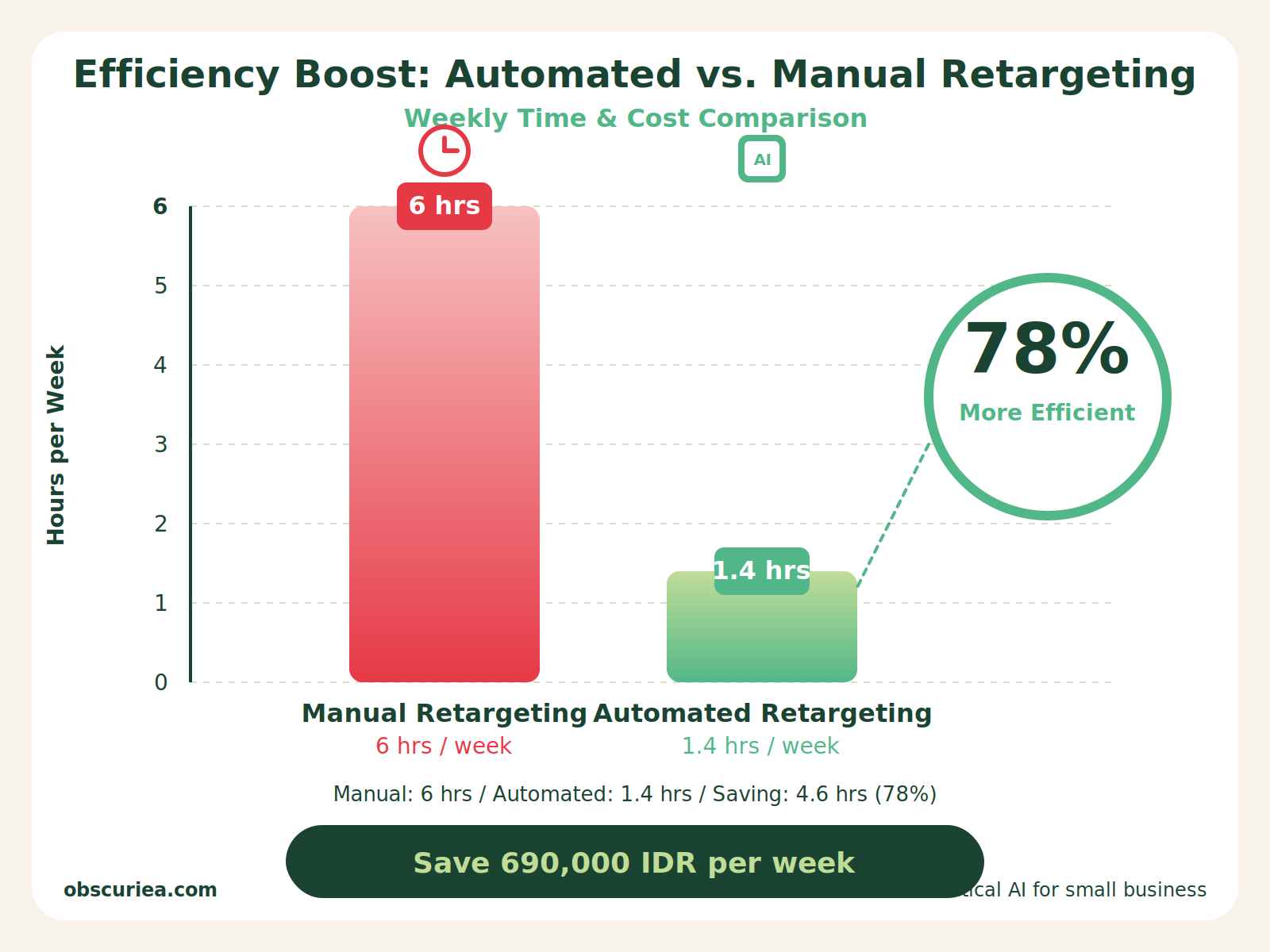
Manual retargeting at that scale costs you 6 hours a week—roughly 24 hours a month. Automation eats 5.5 hours once, then 1.4 hours weekly. After month 1, you’re saving 4.6 hours per week. If your hourly operational cost is 150,000 IDR, that’s 690,000 IDR saved every week.
But the conversion side also changes. Manual email sequences from a single person average a 4-8% conversion rate. Automated, multi-channel flows push closer to 10-15% because you hit the user in two places before they forget. For 234 abandoned carts, that’s an extra 16-33 sales per month depending on the product price. At a 50,000 IDR average order value, that’s 800k to 1.6M IDR in incremental revenue.
The math is straightforward. You invest 5.5 hours once and 1.4 hours per week, and you get back time plus revenue. But only if the automation works.
Where It Breaks
Three places the automated retargeting workflow collapses.
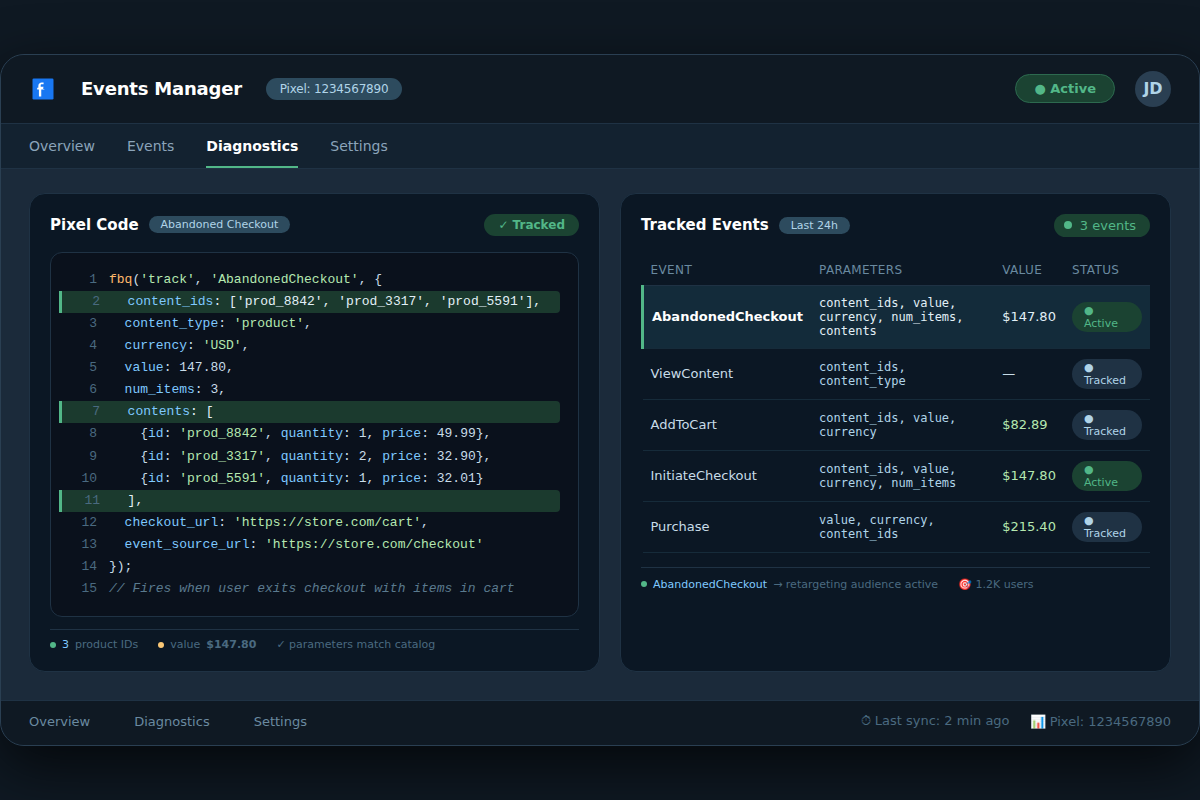
Pixel failure. The most common silent killer. The pixel fires on the checkout page but doesn’t carry the cart data—product IDs, prices. Your ad shows a generic “come back” message instead of the actual abandoned item. Conversion drops to near zero. This is especially common on Shopify Plus setups when the checkout page is customized beyond the default.
Email deliverability in SEA. If your email volume spikes after an automation fires, providers like Gmail Indonesia see it as batch sending and filter to spam. Inbound spam complaints hurt. You need to ramp automation gradually, not blast all 234 abandoned carts at once on day one.
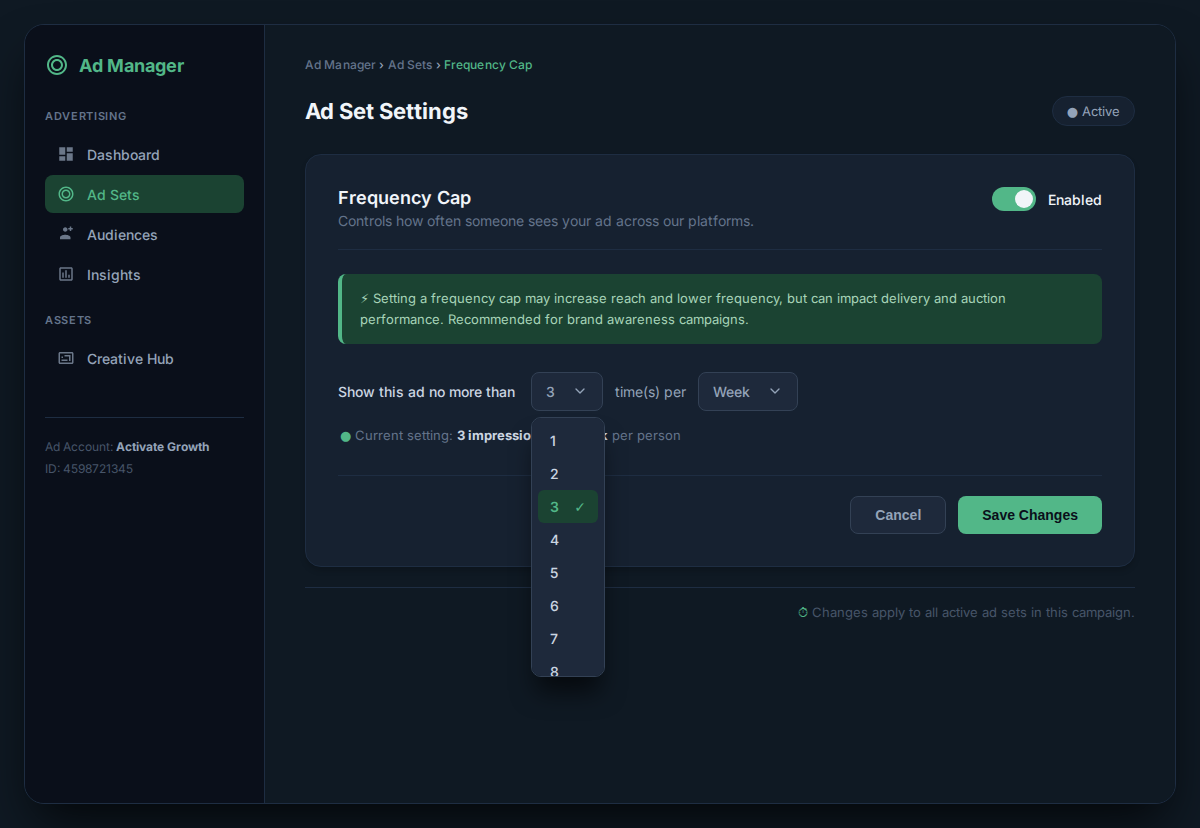
Ad frequency blindness. Automated ad systems from Facebook and Google default to broad retargeting. If your audience pool is small (under 1,000 recent abandoners), the same person sees the retargeting ad five times a week. They stop noticing. Worse, they associate your brand with annoyance. Frequency caps of 2-3 per week are essential and often ignored in the initial setup.
The Friction Box
- Cart data not syncing across platforms — Shopify to Facebook Ads pipeline is notoriously buggy for abandoned cart info
- WhatsApp is the dominant customer channel in Indonesia, but most automation tools don’t support WhatsApp retargeting natively
- Ad creatives need to be updated every two weeks or they fatigue, but automated systems don’t automatically rotate them
- On low-ticket items, the cost of retargeting ads can exceed the margin — budget floors need to be set per segment
- First-time visitors who abandon are less likely to convert; they may be research-shopping, not ready to buy — don’t treat them like hot leads
Frequently Asked Questions About Automated Retargeting Workflows That Convert Abandoned Clicks
How long does it take to set up an automated retargeting workflow?
For a standard setup integrating Shopify or WooCommerce with Facebook Ads and an email service like Mailchimp, expect 4-8 hours spread over a week if you have no technical roadblocks. Pixel configuration takes 1-2 hours, segment creation 1 hour, email templates 2 hours, ad creative 2 hours, and testing 1 hour.
What is the minimum monthly traffic needed for retargeting to be worth it?
You need at least 100 monthly checkouts (or 130 abandoned carts) to justify the setup time. Below that, the incremental revenue won’t cover the ad spend and effort. Focus on organic acquisition and checkout optimization first.
Can I retarget users on WhatsApp?
Not natively with the major automation tools (Klaviyo, Mailchimp, Facebook Ads). WhatsApp Business API allows outbound messages, but you need a CRM integration like WATI or Twilio. It’s possible but adds complexity and cost. Most Indonesian store operators patch it together with a manual WhatsApp broadcast after the email sequence, which defeats automation.
How do I avoid burning my ad budget on unqualified clicks?
Use strict segmentation: exclude visitors who spent less than 30 seconds on your site or who bounced from the product page. Only retarget those who reached the checkout page or added items to cart. Also set a daily budget cap per ad set to prevent runaway spending on low-intent segments.
What if my abandoned cart rate is above 90%?
That indicates a problem beyond workflow. High abandonment usually means unexpected costs (shipping, tax, fees) or a broken checkout process. Fix those before building a retargeting workflow—otherwise you’re just paying to bring people back to a flawed experience.
The Straight Talk
This workflow is for e-commerce operators pulling in at least 100 monthly checkouts with an abandonment rate above 70%. If you’re smaller, focus on improving the checkout flow and building trust before you automate retargeting. If you’re larger, this is the single highest-ROI change you can make in your marketing operations this month.
Your next action: In the next two weeks, connect your cart platform’s abandoned cart data to both an email automation tool and a retargeting ad platform. Test with one segment (first-time visitors with cart > 300k IDR) before scaling. Measure conversion rate and ad cost per recovered sale for 30 days.