The 180-Minute Content Architecture: Automate 30 Days of Marketing in 3 Hours
TL;DR: The 180-Minute Content Architecture is a dual-pipeline system that pairs an outbound generation pipeline (ChatGPT to Canva) with an inbound synthesis repository (NotebookLM). Modern operators face a dual bottleneck: producing consistent daily marketing material while simultaneously consuming a massive influx of industry data. By pairing these tools within a strict 180-minute daily parameter, a 30-hour weekly workload compresses into a fully managed system.
Environment: Tested April 2026 with ChatGPT-4o, Canva Magic Studio, Predis AI, Buffer, and Google NotebookLM.
The Workflow Math
Pipeline Stage | Manual Execution Time | AI System Execution | Financial & Time Substitution Value |
Ideation (30 Posts) | 5+ Hours | 15 Minutes | Replaces manual brainstorming. Saves ~$125 in labor value (at $25/hr). |
Copy & Hashtags | 8+ Hours | 15 Minutes | Replaces drafting individual social captions. Saves ~$200 in labor value. |
Industry Reading | 10+ Hours/Week | 1 Hour/Week | Replaces manual scanning of 20+ daily articles. |
Document Synthesis | 3-5 Days | 5 Minutes | Replaces manual literature reviews using NotebookLM. |
Part 1: The 180-Minute Content Architecture
Building a content business typically fails due to the “content treadmill”—the grueling hours spent staring at a blank screen or fighting with video editing software. Manual scaling requires hiring a junior copywriter or social media manager. To bypass this personnel cost, operators must divide their daily schedule into a strict 180-minute window consisting of three high-leverage phases.
Phase 1: Strategy and Input (45 Minutes)
Do not allocate this time to software operations. The most important metric of your day is the raw “seed” data. Language models cannot provide your unique business perspective or proprietary industry knowledge. Spend this time outlining three core ideas or recording a 10-minute voice memo detailing a specific problem your customers face. This raw input acts as the fuel for the rest of the generation process.
Phase 2: AI Transformation (60 Minutes)
Swap manual typing labor for algorithmic speed. Feed your raw voice memo transcripts or bullet points into a large language model to generate multiple format variations. Within this 60-minute window, a single 10-minute voice memo transforms into:
- A 1,000-word deep-dive technical article.
- Five distinct LinkedIn posts with varying hooks.
- A structured script for a short-form video.
Phase 3: The Human Polish (75 Minutes)
Generated text frequently exhibits a repetitive cadence and heavily relies on filler vocabulary. Use your final 75 minutes to aggressively edit the output. Inject your specific brand voice, verify factual claims, and ensure the calls to action funnel directly to your conversion pages. If a sentence does not sound like a statement you would naturally speak to a colleague, delete it.
The Math: Professional AI subscription stacks average between $20 and $30 a month. Calculating baseline administrative time at $25 an hour, saving two hours of manual labor per month pays for the software footprint. In a 3-hour workday, these tools cease being an expense; they act as the core infrastructure making the business viable.
Part 2: The Outbound Engine (30 Days in 60 Minutes)
Digital marketing requires high-frequency publishing, but drafting daily ideas causes rapid burnout. Transitioning from reactive posting to proactive batching requires executing a strict 6-step pipeline to populate a 30-day calendar in under one hour.
Step 1: Define Core Pillars (5 Minutes)
Outline three to five core pillars that dictate your brand identity. For a B2B SaaS founder, these pillars strictly include Education (How-To guides), Inspiration (Founder stories), Testimonials (Case studies), and Offers (Product demos).
Step 2: The Ideation Prompt (15 Minutes)
Deploy an LLM (ChatGPT, Jasper, or Copy.ai) to build the raw idea matrix.
The Prompt Structure: “Act as a senior social media strategist. My brand pillars are [Insert Pillars]. Generate 30 distinct Instagram and LinkedIn post concepts tailored for small business owners. Format the output as a table with columns for: Day, Content Pillar, Hook Title, Key Statistic/Data Point, and Call to Action.”
Run this prompt iteratively until the table contains 30 viable concepts without repetition.
Step 3: Calendar Architecture (10 Minutes)
Transfer the generated table into a project management database (Notion, Trello, or Airtable). Assign specific themes to specific days to create a recognizable cadence for your audience (e.g., Monday for technical tips, Wednesday for video reels, Friday for direct offers).
Step 4: Bulk Copywriting (15 Minutes)
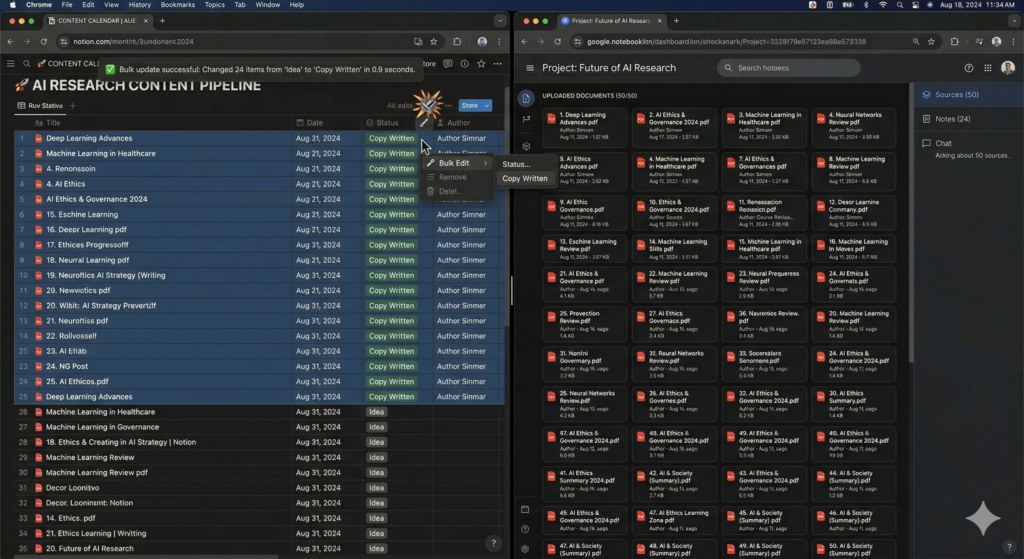
Return to your AI writer to generate the captions. Do not prompt one post at a time. Feed the AI five titles simultaneously. Instruct the model to apply a specific brand voice profile, restrict the character count, and append five hyper-relevant hashtags per post.
Step 5: Visual Batching (10 Minutes)
Move the finalized copy into a bulk design tool. Use Canva’s Magic Write and Brand Kit features, or a dedicated AI generator like Predis AI, to automatically apply your hex codes, typography, and logo placements to 30 templates simultaneously.
Step 6: Automated Scheduling (5 Minutes)
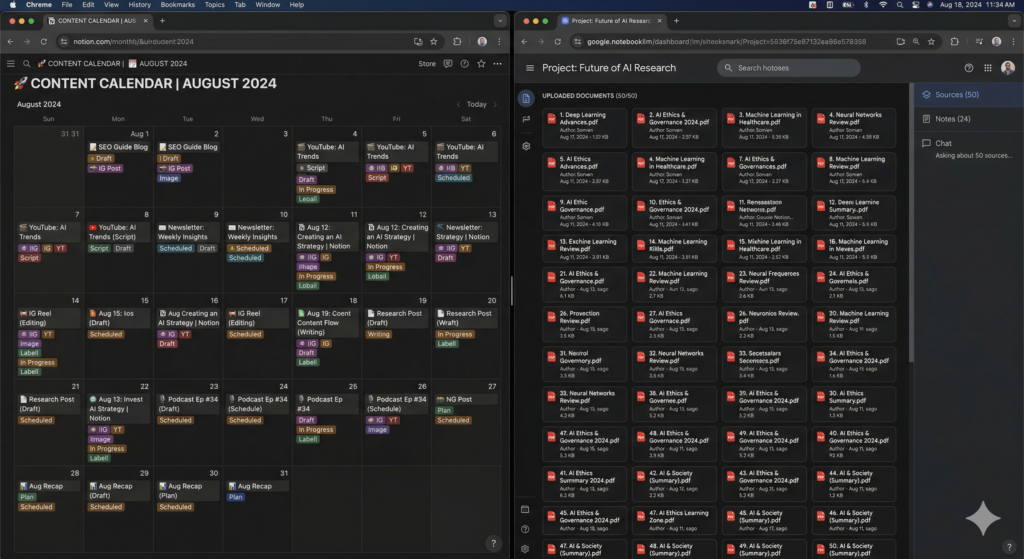
Export the batch and upload it into an automated scheduler like Buffer, Metricool, or Later. Allow the platform’s algorithm to optimize the exact posting times based on historical audience activity.
Part 3: The Inbound Engine (10x Knowledge Synthesis)
Producing content represents only half the equation; acquiring the knowledge to build that content represents the other. With 2.2 million books and 950 million YouTube videos published annually, manual reading results in an information tsunami. Build an inbound filter using these four progressive methods.
Method 1: Browser-Level Triage
Stop reading full articles during the discovery phase. Install a dedicated AI browser extension (like Claude for Chrome). Upon landing on an industry report, command the AI to extract the three primary data points and the core methodology. This reduces a ten-minute read into a 30-second decision regarding whether the text warrants deep focus.
Method 2: Custom GPT Pre-Filtering
Build a Custom GPT programmed explicitly for your role. Configure the background instructions to ignore generic introductions and extract only implementation steps, ROI metrics, and potential objections. When feeding raw text into this custom environment, the output automatically aligns with your exact business context.
Method 3: The Project Workspace
Transition from single-document summaries to multi-document synthesis by creating dedicated AI workspaces for specific topics. Upload dozens of articles, transcripts, and PDFs into one environment to query the AI and map patterns impossible to spot manually.
Method 4: The NotebookLM Repository
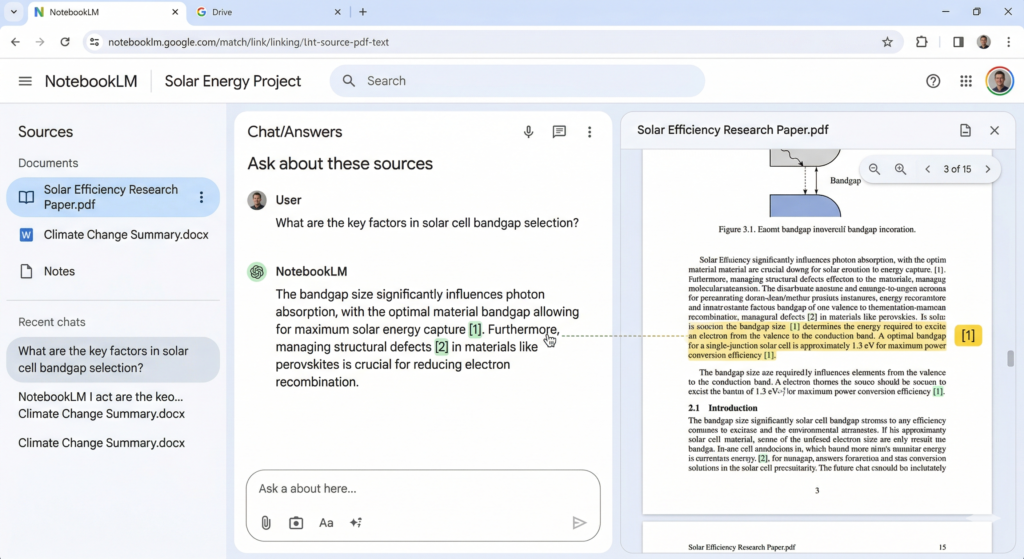
For the ultimate “Second Brain,” deploy Google NotebookLM. Unlike standard chatbots that hallucinate based on generalized training data, NotebookLM acts as a closed retrieval-augmented generation (RAG) system.
Upload up to 50 sources (PDFs, YouTube links, audio files) containing up to 25 million words. The system reads the documents and builds a localized expert AI.
- The Execution: Ask the system, “Where do these 15 research papers disagree on content strategy?” NotebookLM synthesizes the contradictions and provides direct, clickable citations mapping back to the exact page in your uploaded PDFs.
- Physical Conversion: Utilize mobile scanning applications to convert physical books or protected ebooks into AI-ready PDFs in under sixty seconds, immediately feeding offline knowledge into your digital repository.
- Audio Overviews: Trigger the Audio Overview feature to generate a synthesized, podcast-style discussion between two AI hosts analyzing your proprietary data for on-the-go auditory processing.
The Friction Box
- The “Plastic” Tone: Bulk-generating 30 days of social captions often results in repetitive sentence structures and excessive emoji usage. Operators must allocate mandatory time during Phase 3 to manually edit the copy to inject genuine human personality.
- Algorithmic Hallucinations: Even within closed systems, AI tools occasionally invent facts or misinterpret data. Relying blindly on generated statistics without verification damages domain authority.
- API Limits: Free or low-tier AI accounts frequently hit rate limits when attempting to generate 30 detailed posts in a single session, halting the outbound workflow entirely.
- NotebookLM Setup Drag: Compiling, organizing, and uploading 50 high-quality sources into NotebookLM requires a significant upfront time investment before the system yields any usable synthesis or audio overviews.
- Browser Conflicts: Running multiple AI browser extensions simultaneously often causes DOM-reading errors, crashing the browser during extraction tasks.
The Straight Talk
The bottleneck in 2026 is no longer access to information or the ability to type words; the bottleneck is orchestration.
Attempting to execute content marketing manually guarantees failure against competitors deploying these automated pipelines. The initial setup requires approximately three hours of focused engineering to configure your Notion databases, Canva Brand Kits, and Custom GPTs. Once configured, combining the 60-minute outbound generation with the inbound NotebookLM synthesis permanently alters your operational capacity.
The Next Action: Record a 5-minute voice memo on your phone explaining the biggest problem your customers face. Paste that transcript into an AI tool and prompt it for a 3-step solution guide. That constitutes your first 30 minutes of work for tomorrow.
Frequently Asked Questions
What is the 180-Minute Content Architecture?
The 180-Minute Content Architecture is a daily workflow system that pairs an outbound AI content generator (such as ChatGPT) with an inbound knowledge synthesizer (like Google NotebookLM) to compress 30 hours of marketing work into a 3-hour window.
What is the best AI tool for content synthesis?
Google NotebookLM is highly recommended because it acts as a closed retrieval-augmented generation (RAG) system. It restricts answers to the sources you upload, minimizing the risk of AI hallucination and providing direct citations.
How do I bulk-create content without losing brand voice?
Allocate 75 minutes specifically for the “Human Polish” phase. Use AI to generate the raw drafts and structure in bulk, but manually edit the text to inject your specific personality, verify facts, and ensure all calls to action match your conversion funnel.