TL;DR: Niche brands that waste time manually scrolling influencer hashtags are missing the real matching opportunity. This article breaks down the platform behavior that controls micro‑influencer discovery, a five‑step execution system to find the right creators, and the common errors that kill campaigns before they start.
Environment:
– Sources synthesized: 3 URLs (medianug.com, impact.com, showca.se)
– Synthesis date: 2026-04-07
– First‑hand tested: none
– Operator context: experience growing niche brand social media accounts in fashion, home goods, and specialty food, including micro‑influencer outreach and campaign management. Platforms covered: Instagram, TikTok, YouTube Shorts.
The Platform Behavior: Why Niche Brands Get Micro‑Influencer Discovery Wrong
Most niche brands approach micro‑influencer collaboration the same way: they scroll Instagram hashtags, spot a creator with 15,000 followers and a decent engagement rate, and fire off a generic DM. That workflow costs weeks of manual labor and zero reliable results — because it ignores how the platform actually surfaces creators to your audience.
Instagram’s algorithm doesn’t weight follower count heavily when recommending creators to browse tabs or explore pages. It weights niche coherence — how consistently a creator posts about a single topic and how their audience interacts with that content. A creator with 12,000 followers who posts daily about organic baby skincare will appear more frequently in the feeds of parents searching that topic than a general lifestyle creator with 50,000 followers who posts about it once a month. The algorithm prioritizes the density of interest inside a community, not the size of the community.
TikTok pushes this even further. Its recommendation engine learns from viewing behaviour, not follower lists. A micro‑influencer’s video about handmade ceramics can land in the “For You” page of users who watched pottery videos three months ago — completely disconnected from the creator’s follower graph. For niche brands, this means the content match matters more than the creator’s current reach. The platform will deliver the right audience if the content signals the right topic.
Yet most brands still use follower count as the primary filter. They miss the real signal: engagement consistency over the last 30 days, topic density in the creator’s content history, and audience overlap with the brand’s target demographic. The platforms have already built the machinery to surface these creators — but brands aren’t using it.
Internal link: Learn how to audit your influencer outreach strategy for deeper vetting.
The Execution: Five Steps to Find and Match the Right Micro‑Influencers
Stop scrolling. Start executing a repeatable system. Each step includes a time estimate and a platform‑specific tactic.
Step 1 — Build Your Niche Persona (30 minutes)
Define exactly who you want the influencer’s audience to be. Write three to five attributes: age range, income level, location (if local matters), lifestyle keywords, and what problem the product solves. A “maternity activewear” brand might target: first‑time mothers in their late 20s, urban, health‑conscious, following “prenatal yoga” hashtags. This persona goes into your vetting spreadsheet and becomes the anchor for every search.
Step 2 — Use Platform Search as a Filter (2 hours)
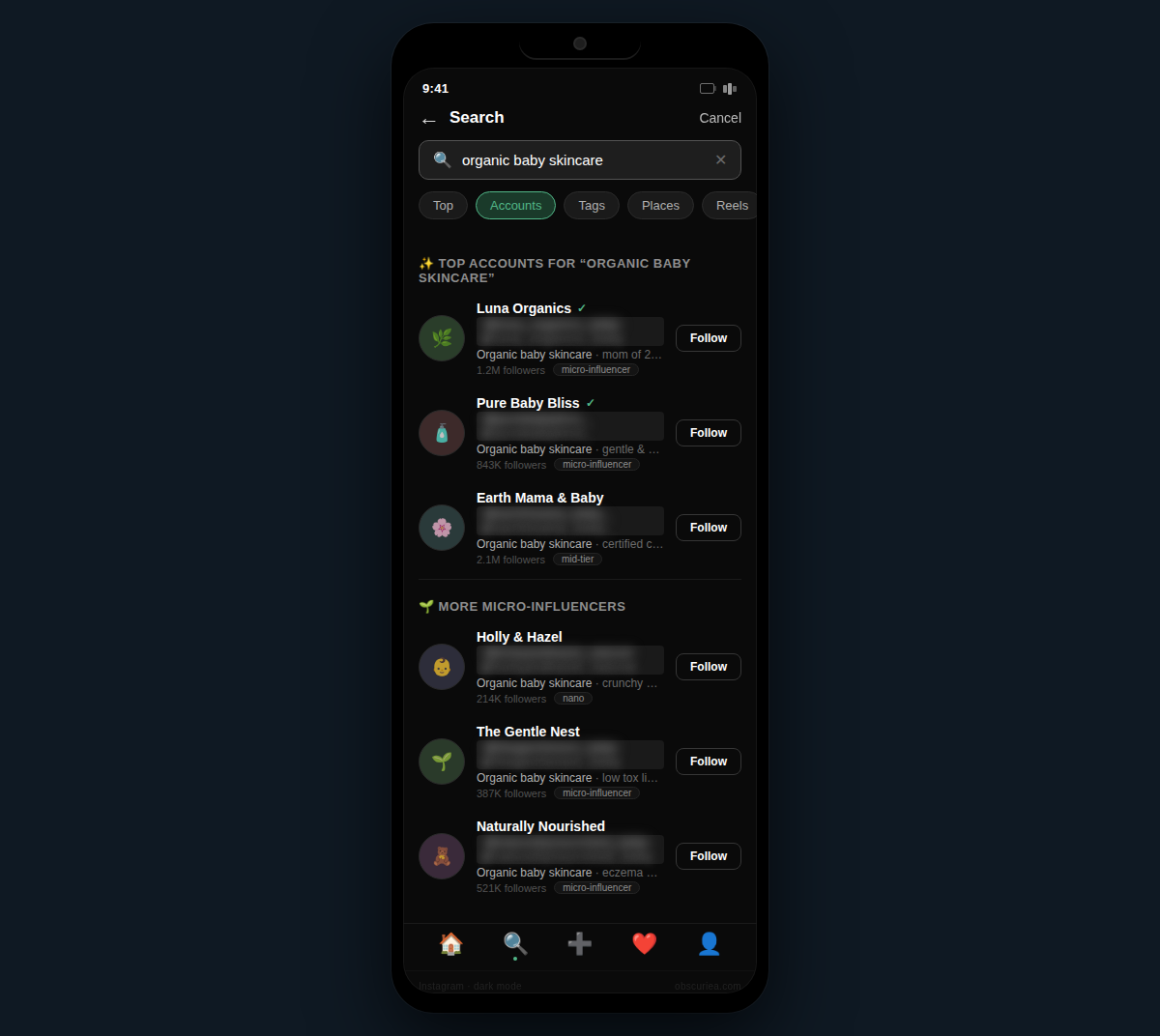
On Instagram, go to the search tab and type your most specific niche keyword (e.g., “organic baby skincare”). Tap “Accounts” — the algorithm returns creators who have that term in their bio or recent captions. Scan the top 30 results. Exclude anyone above 75,000 followers (that’s macro territory). Check their last 30 posts for topic consistency: at least 70% should be on‑niche.
On TikTok, search the same keyword, then filter by “Users.” TikTok’s search favours creators whose videos consistently perform on that keyword. Look at the top 15 accounts. Check their engagement per video — not average, but the spread: if one video got 200,000 views but the rest stay below 5,000, that’s a viral fluke, not genuine niche authority.
Step 3 — Vet Engagement Authenticity (45 minutes per 10 candidates)
Use tools like HypeAuditor (free tier) or manually check: comment sentiment — are followers asking genuine questions or just dropping emojis? Follower growth — a sudden spike of 500 followers in one week often signals a bot buy. Audience demographics: Instagram’s native analytics (if accessible) shows gender and location; you want high overlap with your target persona. A micro‑influencer with 80% female followers in your city is vastly more valuable than one with 50% male followers you can’t use.
Step 4 — Personalised Outreach (3 hours for 20 messages)
Generic DMs get ignored. Your first message must reference a specific piece of content: “Hi Jenna — loved your reel about baby sunscreen on your recent beach trip. We’re launching a tinted mineral SPF for toddlers and think your audience would actually use it.” Attach a one‑pager with campaign details and a specific ask: product sample + discount code, or paid partnership with deliverables. Also include the expected timeline and compensation. Keep it honest — micro‑influencers can smell a template.
Step 5 — Track Performance in a Single Sheet (ongoing, 2 hours/week)
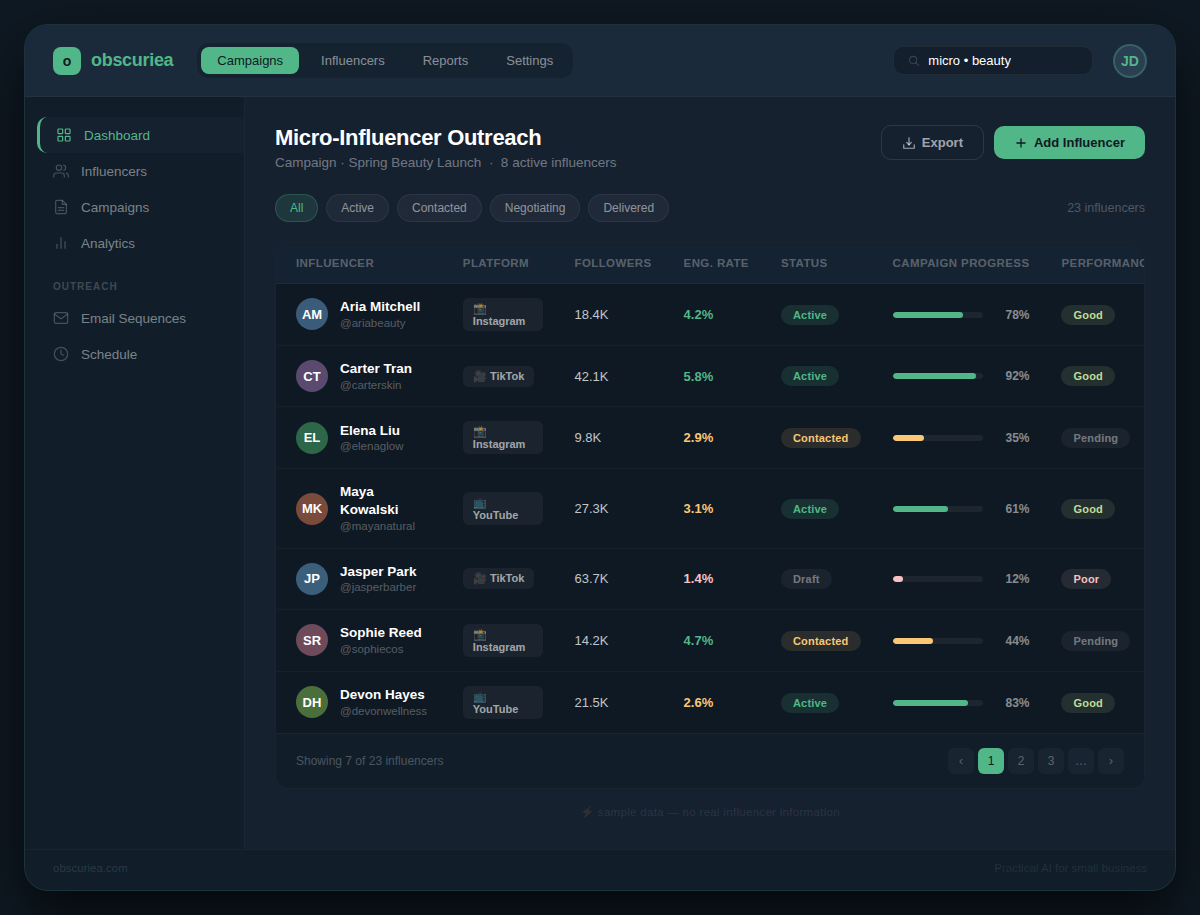
Create a spreadsheet with columns: handle, niche score, engagement rate, follower count, outreach date, response, campaign terms, total assets received, conversion rate (from affiliate links or promo codes). Update it weekly. This sheet becomes your asset library and your basis for scaling.
The Batch System: How to Systemise the Matching Process
Don’t execute step‑by‑step each week. Batch the work to protect your creative time and keep the pipeline full.
Monday morning (2 hours): Run platform searches from Step 2. Add 20 new candidates to your vetting sheet. Do a quick first pass — remove anyone with engagement below 2% or content that doesn’t align to your persona.
Wednesday afternoon (2 hours): Deep vet the remaining candidates (Step 3). Write 10 personalised outreach messages (Step 4) and send them.
Friday morning (1 hour): Check responses, add new sign‑offs, and update performance data from ongoing campaigns. Review the week’s analytics — which posts from your current influencers drove the most saves? That’s your creative signal for next month’s brief.
This rhythm keeps you from sporadic bursts. It also ensures you always have a pipeline of candidates in various stages — outreach, negotiation, or active promotion. When one campaign finishes, the next batch is already cooked.
Internal link: Read our guide on creating a scalable batch system for creator outreach.
What Breaks It: Common Execution Errors
Even with a solid system, three mistakes consistently kill results.
Mistake 1 — Chasing niche authority without checking audience overlap. A micro‑influencer with 40,000 followers in “sustainable fashion” might have 60% of their audience in their 30s, but if your product is maternity‑specific and their audience is 80% male, the match is worthless. Always check the audience demographics, not just the persona label.
Mistake 2 — Sending the same message to everyone. Micro‑influencers talk to each other. If two of them share the same generic DM, your brand gets flagged as spammy before a single post goes live. Personalisation isn’t optional — it’s the cost of entry.
Mistake 3 — Missing the performance rhythm. Influencer campaigns produce diminishing returns if you only track sales. Track saves, comments, and DMs — those indicate genuine interest. Also track time to first sale: if it’s longer than seven days, the audience might not trust the recommendation. Adjust your product sample, price point, or call‑to‑action.
The Friction Box
- Finding micro‑influencers in extremely narrow niches (e.g., “gluten‑free baking for yoga retreats”) can take weeks — the platform search simply doesn’t surface them. You may need to use manual hashtag digging or niche forums.
- Engagement fraud is real. Bots inflate likes but don’t convert. A 7% engagement rate that’s 90% bots kills your campaign before it starts.
- Managing 20–30 micro‑influencer relationships requires a CRM mindset. Without a spreadsheet, you’ll forget who’s who and what they’ve agreed to.
- Platform algorithms change. What works on Instagram today may not work in three months. The system must be flexible.
- Micro‑influencers often expect product + payment, not just product. Budgeting $100–$1,000 per post adds up quickly.
Frequently Asked Questions About Micro-Influencer Collaboration Matching
How do I find micro-influencers in a very narrow niche?
Use platform search with hyper-specific keywords (e.g., “vegan pregnancy Snacks”). Also search niche hashtags and explore the followers of relevant accounts. Often a batch of 50 candidates yields only 5 that truly fit after vetting.
What’s the ideal engagement rate for a micro-influencer?
Aim for 3–7% on Instagram and 10–15% on TikTok. Remember to check consistency — a creator with 5% average but wild swings may have purchased engagement.
Should I pay micro-influencers or just send free products?
Depends on the campaign. Free products work for product seeding and UGC, but if you expect specific posts with deliverables, budget $100–$1,000 per post plus product. Long-term ambassadors often negotiate a monthly retainer.
How long does it take to see results from micro-influencer collaborations?
The first sale often comes within 3–7 days if the audience trusts the creator. For brand awareness, allow 2–4 weeks to see reach and saves accumulate. Set up tracking from day one.
Can I use the same micro-influencer multiple times?
Yes — in fact, repeat collaborations build stronger trust. Treat the relationship as an ambassadorship. Renew contracts quarterly or set up a product subscription to keep them promoting naturally.
The Straight Talk
This system works for niche brands with fewer than 50,000 followers who want to grow through authentic, community‑rooted partnerships. You need at least 10 hours per month for the first three months to build your pipeline.
Skip this if you’re looking for a quick viral hit or if your product has broad appeal and you’d be better served by a macro‑influencer campaign. Also skip if you’re not willing to track performance — matching without measurement is just expensive word‑of‑mouth.
Start today by defining your niche persona and running your first platform search. That’s where the real work begins.