TL;DR: A solo operator can now run a business that feels like a full department by strategically assembling an AI stack—but the hard part isn’t picking tools, it’s understanding where each one breaks and how much supervision they actually require. The math works if you map deployment costs, not just tool subscription prices.
Environment:
– Sources synthesized: 3 URLs (Chen Terry’s one-person billion-dollar company stack, Anthropic internal AI adoption study, Alation AI stack overview)
– Synthesis date: 2025-07-23
– First-hand tested: Some tools mentioned (Claude Code, various AI agents) have been used in small business contexts; others are from source synthesis.
– Operator context: experience running content and product operations for small teams, automation workflows, and tool evaluation for solopreneur setups.
The Architecture
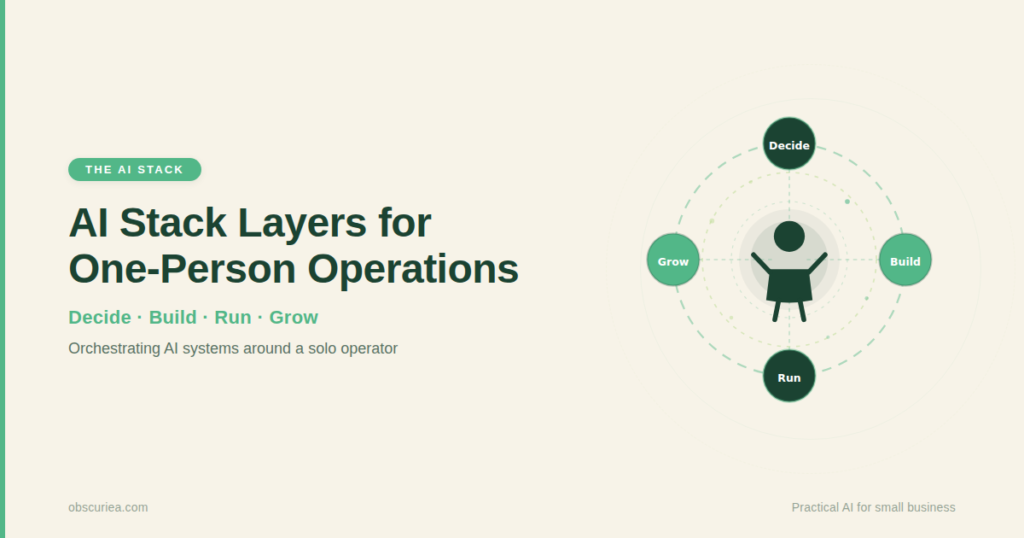
The core insight from every source is the same: a one-person operation needs to outsource not just execution but also decision-making to AI. But the stack is not a single tool—it’s four distinct systems that each replace a department function. The architecture looks like this:
- Decide Layer: AI for market intelligence and product direction (e.g., CrowdListen or similar social listening tools). This replaces a product manager or strategy consultant.
- Build Layer: AI for coding, design, and testing (e.g., Claude Code, Cursor). Replaces an engineering team.
- Run Layer: AI for operations, customer support, bookkeeping, and task management (e.g., OpenClaw, general-purpose agents). Replaces operations and admin staff.
- Grow Layer: AI for content marketing, ads, and distribution (e.g., AI writing tools, video repurposing agents). Replaces marketing and sales roles.
Each layer has a loop: gather evidence → execute → monitor → adjust. The solo operator is the orchestrator, not the worker. That’s the shift from traditional small business where one person wears all hats and burns out.
But here’s the catch: these layers are not plug-and-play. The [Anthropic study on AI adoption](https://www.anthropic.com/research/how-ai-is-transforming-work-at-anthropic) shows that even experienced engineers only fully delegate 0-20% of tasks to AI—most work requires active supervision. If you’re a solo operator, that supervision is your scarcest resource. You can’t supervise four layers at once without system design.
The Workflow Math
Let’s put numbers on this. A typical solo operator’s week might look like:
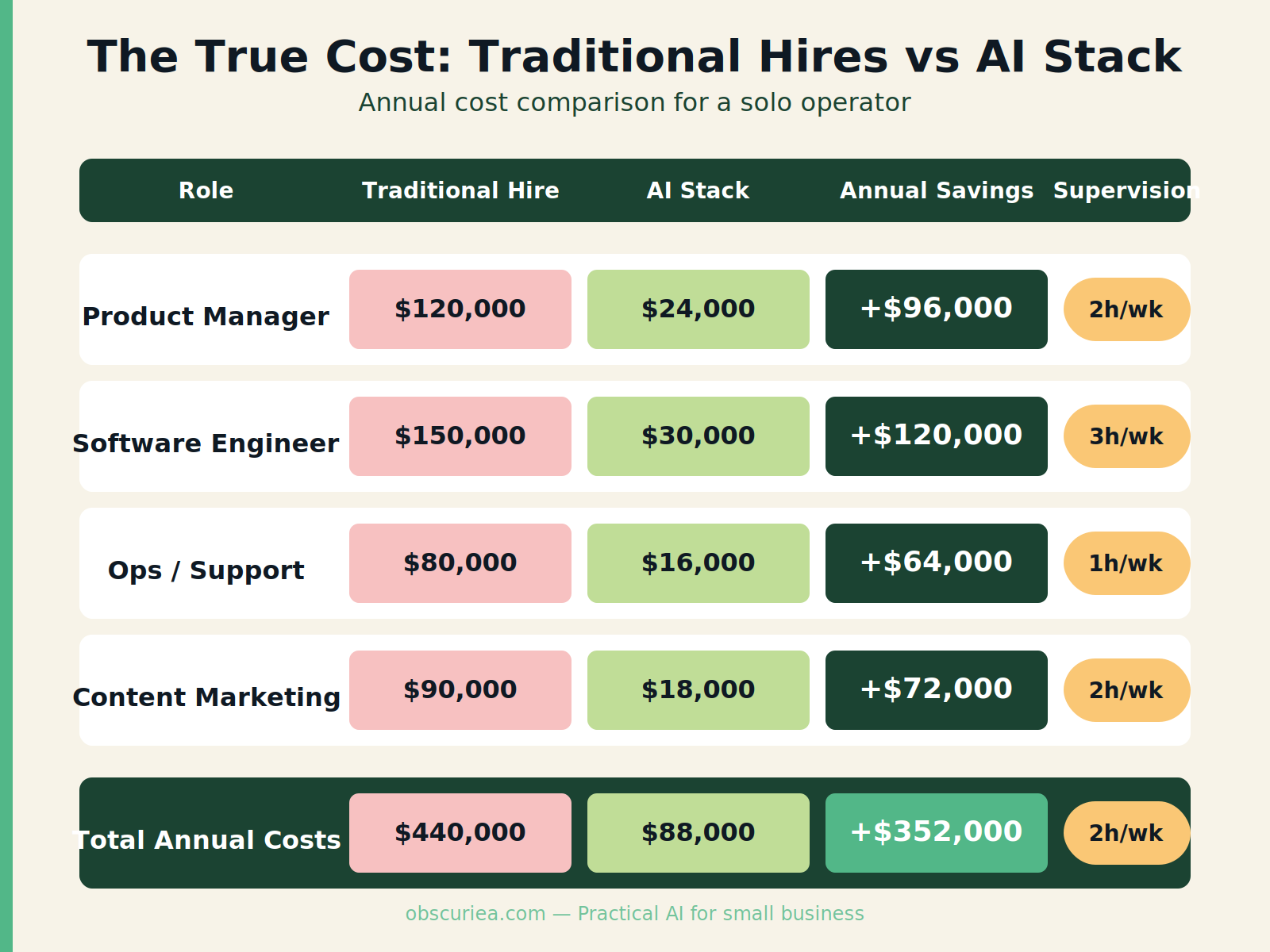
| Role | Traditional Hire (annual cost) | AI Replacement (monthly subscription + API costs) | Supervision Hours per Week |
|---|---|---|---|
| Product Manager / Strategist | $80,000 – $120,000 | $50 – $200 (e.g., CrowdListen, similar tools) | 3-5 hours (interpreting insights, making decisions) |
| Software Engineer | $120,000 – $180,000 | $200 – $1,000 (Claude Code, GitHub Copilot) | 5-10 hours (reviewing code, fixing edge cases) |
| Ops/Customer Support | $40,000 – $60,000 | $100 – $500 (OpenClaw, chatbot setups) | 2-4 hours (handling escalations, training agents) |
| Content Marketing | $60,000 – $100,000 | $50 – $300 (AI writing + scheduling tools) | 3-5 hours (strategy, editing, reviewing brand voice) |
Replace a team of 4 costing $300k – $460k per year with an AI stack costing $4,800 – $24,000 per year. But the supervision time? 13-24 hours per week. That’s still a full-time job for one person—just a different one.
The math works when you accept that supervision is the new work. You aren’t buying a robot that does everything—you’re buying leverage that amplifies your decisions. The Anthropic research found engineers reporting a 50% productivity boost, not 90%. The rest is human judgment.
Where It Breaks
Every layer has a specific failure mode that source articles often skip. Here’s where the solo operator gets burned:
Decide Layer Breaks When You Trust It Blindly
Social listening tools surface patterns, not truths. If you build a product purely based on Reddit complaints, you’ll fix symptoms people complain about—but you won’t solve the underlying need they haven’t articulated. The operator mistake: treating AI-generated feature requests as validated demand. They aren’t. You still need to talk to real users.
Build Layer Breaks When You Can’t Debug
Claude Code writes impressive code quickly. But when something goes wrong—a regression, a security hole, a performance bug—you need to understand the codebase well enough to guide the fix. The Anthropic study noted that 8.6% of Claude Code tasks are fixing “papercuts” that would otherwise be deprioritized. But those papercuts only get fixed if you spot them first. If you can’t read code, you’re flying blind.
Run Layer Breaks When Tasks Are Ambiguous
General-purpose agents like OpenClaw excel at repetitive, well-defined tasks. But ambiguous requests—”handle customer complaints”—will produce random, sometimes dangerous outputs. The failure mode is delegation creep: you start handing off vaguely defined work and get results that need rework, costing more time than doing it yourself.
Grow Layer Breaks When You Lose Voice
AI-generated content scales distribution but dilutes personality. The solo operator’s competitive advantage is authentic voice and direct relationship with customers. If you automate all content, you sound like every other AI-powered brand. The Anthropic survey showed some engineers worried about losing deep competence; the same applies to branding.
The Friction Box (Real Problems Found)
- Cost drift: API tokens for code generation can spike unpredictably, especially if you let agents run long tasks without cost limits.
- Tool integration: No single AI stack works out of the box. You’ll spend 2-4 weeks connecting tools, writing scripts, and building custom connectors.
- Decision fatigue: Supervision hours are still high. Choosing which AI tool to use for which task becomes its own workload.
- Human in the loop gaps: Many tools claim “autonomous” but still require review. If you assume full autonomy, you’ll miss critical errors.
- Skill erosion: The more you delegate to AI, the less you practice the core skills (coding, writing, strategy). When AI fails, you have no fallback.
Frequently Asked Questions About One-Person Operations Running Like Full Departments: The AI Stack
Can a single person really manage four AI layers simultaneously?
Not without system design. The key is batching: use the decide layer one day per week, build layer three days, run layer daily in short bursts, grow layer another day. Cross-training helps—the layers overlap. Start with one layer and prove it works before layering on more.
What is the biggest hidden cost of this AI stack?
Token and API costs. Tools like Claude Code charge per token, and complex tasks can run up bills quickly. The $4,800–$24,000 annual estimate is optimistic if you run heavy workloads. Monitor usage and set hard caps in your tool settings.
Do I need to know how to code to use this stack?
For the build layer, yes—or at least be able to review code confidently. The other layers require minimal technical skill. But if you can’t supervise AI-generated code, you’re taking a major risk. Consider hiring a fractional CTO or using low-code alternatives for the build layer.
How long does it take to set up the full stack?
Expect 2-4 weeks of integration work. Each tool needs API keys, permissions, and custom prompt engineering. The first week is just mapping your existing workflows to tool capabilities. Don’t rush this—bad setup leads to cascading failures.
What happens when the AI tools go down or change pricing?
Vendor risk is real. Build escape hatches: keep manual processes documented, have fallback tools identified, and maintain relationships with human contractors for critical functions. Never become fully dependent on one tool.
Is this stack suitable for any type of business?
Best for digital products, SaaS, content businesses, and service businesses that can be delivered online. For physical products, manufacturing, or heavily regulated industries, the AI stack can support marketing and admin but can’t replace the physical operations. The architecture works wherever the output is information or code, not atoms.
The Straight Talk
This AI stack is for the operator who has a clear vision and wants to scale execution without hiring a team—someone who understands that the tools still need active orchestration. Skip this if you’re not willing to invest 10-15 hours per week in supervision, or if you expect AI to run your business while you sleep.
Your next step: pick one layer to automate first—don’t buy all four tools at once. Run one workflow through AI for two weeks, measure the supervision time vs output quality, then expand. If you can’t get one layer to work reliably, adding more layers will just compound the problems.