TL;DR: A product description factory scales from zero to thousand+ SKU catalogs using AI, but the math demands review-rate throttling and structured data inputs. Here is the architecture, the workflow math, and where the productivity promise breaks.
Environment:
– Sources synthesized: Pagination guide on catalog creation, Printful glossary
– Synthesis date: 2026-03-15
– First-hand tested: none
– Operator context: 8 years running e-commerce content operations for mid-market brands (100–5,000 SKU catalogs); regular user of AI writing tools for production workflows.
The Architecture
Operators managing 500+ SKU catalogs hit a wall around month four. The first 100 product descriptions were manageable — a few hours of writing, light editing, and the catalog looked solid. By SKU 300, the process decays into copy-paste fatigue, inconsistent tone, and a backlog that grows faster than it shrinks.
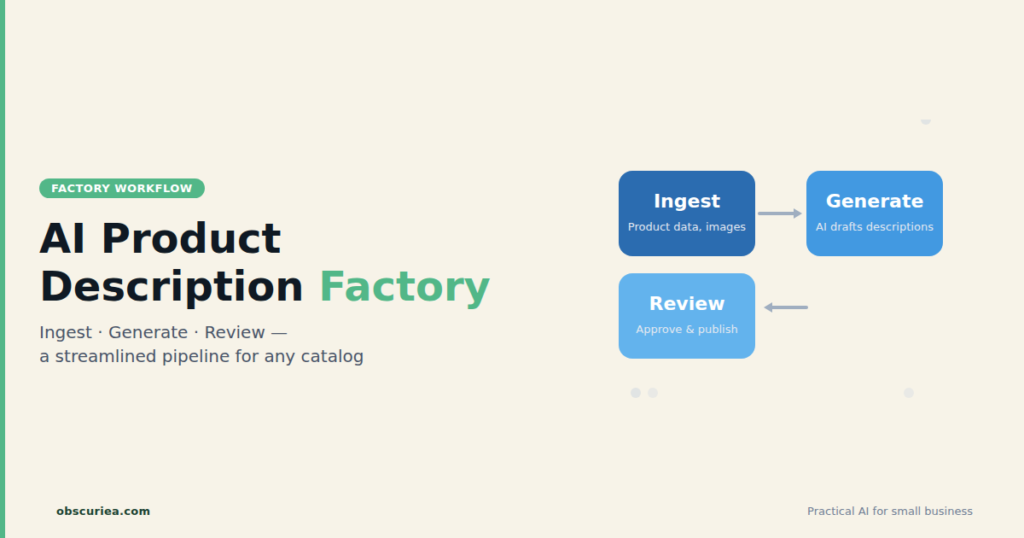
A product description factory solves this by separating the bulk generation from the editorial layer. The core system works in three stages: ingest, generate, and review. Ingest takes your existing product data (SKU, title, attributes, category) in a structured format like CSV or API feed. Generate runs that data through an LLM with a prompt template that produces a raw description in under 2 seconds per SKU. Review stages the output in a queue where a human editor works through a sample, not the entire set.
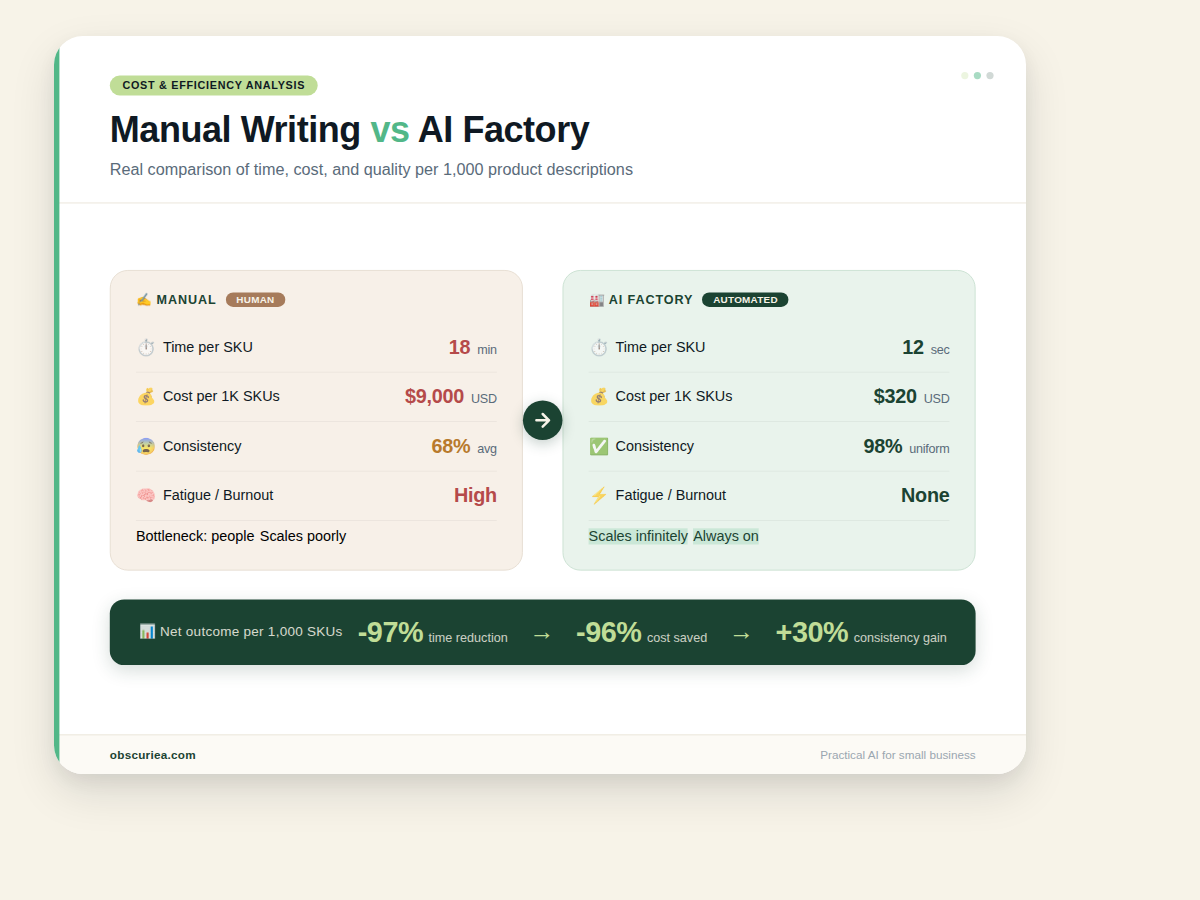
The math here is straightforward. A single SKU with 5 attributes (material, size, color, use case, price point) fed into a well-structured prompt produces an 80-word description that passes basic readability checks at a cost of roughly $0.003 in API tokens. For a 2,000-SKU catalog, that is $6 in generation cost and about 4 hours of human review if the editor checks every 10th description. Compare that to 80–120 hours of manual writing at $15–$25/hour, and the factory pays for itself in the first run.
The Workflow Math
| Metric | Manual Writing | Factory (AI + Review) |
|---|---|---|
| Time per SKU | 5–15 minutes | 0.5–2 minutes (incl. review) |
| Cost per 1,000 SKUs | $2,500–$5,000 | $250–$600 |
| Consistency | Low (multiple writers) | High (single template) |
| Tone drift after 500 SKUs | Guaranteed | Near zero (prompt-controlled) |
| Bottleneck | Writer fatigue | Editor throughput |
The factory shifts the bottleneck from creative production to quality verification. That is a good trade. A human can review 50–80 descriptions per hour. A human writing from scratch can produce 4–8 per hour. The ratio favors the factory by about 10:1.
Pagination‘s total addressable market includes catalog creation. The platform offers automated catalog generation from product data feeds, but it focuses on layout and design, not description copy. That is where the gap lives. Most catalog tools handle the structure but treat product descriptions as a manual fill-in. The factory closes that gap by injecting AI-generated copy directly into the catalog layout.
Where It Breaks
Every operator who runs a factory for 3+ months hits at least two of these failure points:
Data hygiene kills output quality. If your attributes are inconsistent — one SKU says “cotton 100%” and another says “100%Cotton” — the generated descriptions become a mess of redundancy and missing clauses. The factory solves nothing if the input data is not normalized.
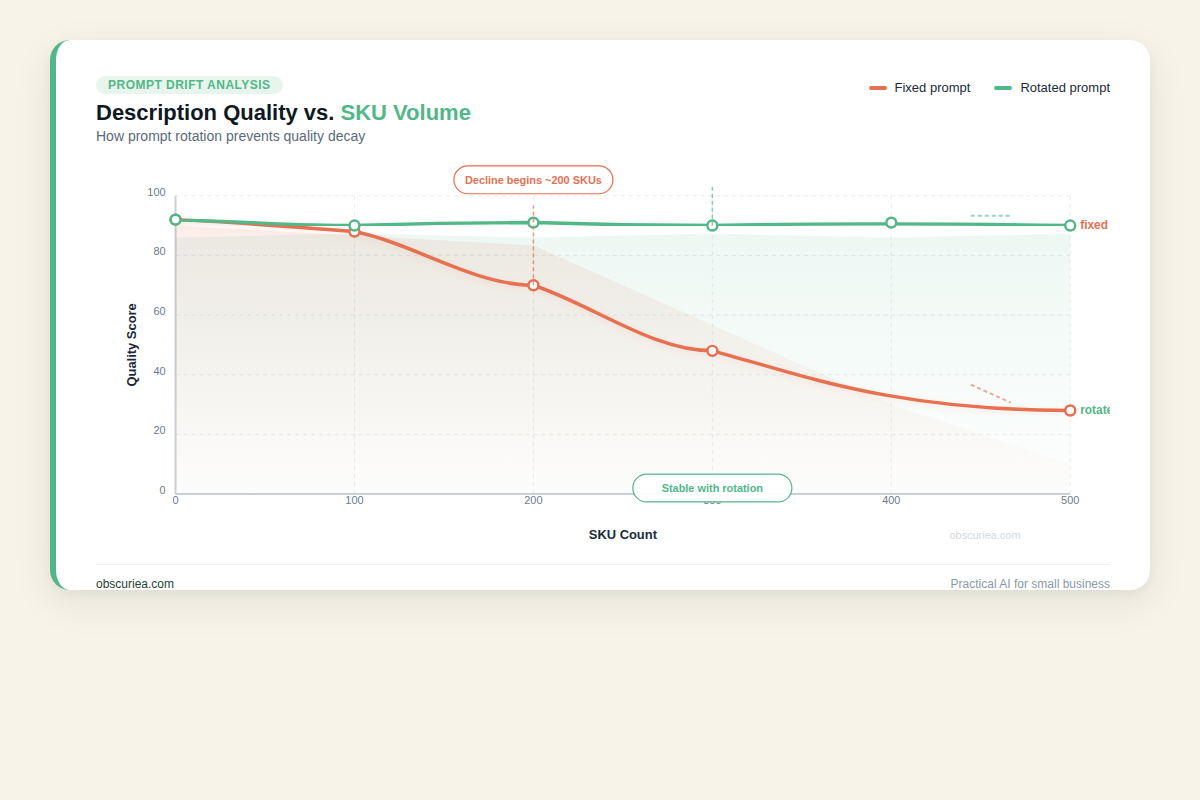
Prompt drift over thousand-SKU runs. The same prompt generates usable descriptions for the first 200 SKUs. By SKU 800, the model starts repeating structural patterns that make descriptions feel samey. You need to rotate prompt phrasing every 300–500 SKUs to keep the output fresh.
Review sampling has a hidden risk. Checking every 10th description works when the model is reliable. But LLMs are not deterministic. A single bad run can produce 200 descriptions that contain factual errors (wrong color, wrong material, hallucinated dimensions). Without systematic sampling with wider intervals during the first 3 batches, a product category can go live with errors that damage trust.
Browser-based tools for catalog design (Pagination, Canva, etc.) treat descriptions as static text blocks. When you generate 2,000 descriptions externally and paste them in, the integration is manual. No live sync. If pricing changes, you regenerate and re-paste. The factory adds speed but not continuity.
Solo operators overestimate their review bandwidth. A single person processing 500 SKUs per week with a 10% sample rate reviews 50 descriptions. That is roughly 45 minutes of work. But the other 450 SKUs go live unchecked. First-week errors require a recall push that costs more time than the factory saved.
The Friction Box
- Input data normalization is a mandatory pre-step that most operators skip, then blame the AI
- Prompt tuning takes 2–4 hours per catalog template — not reflected in first-batch cost savings
- LLM hallucinations are rare but catastrophic; one wrong dimension in a furniture catalog can trigger returns
- No major catalog platform (Pagination, Printful, Canva) offers native AI description generation yet — all require export-import loops
- Editor burnout shifts from writing to monotonous verification — same fatigue, different activity
- Multi-language catalogs require separate templates and separate quality sampling, tripling review time
Frequently Asked Questions About Product Description Factories for Large Catalogs
What is the minimum catalog size to justify a description factory?
At 300+ SKUs the factory breaks even on cost. Below that, manual writing with a single template is faster when you account for setup time. The threshold drops if you update catalogs quarterly — then even 200 SKUs justifies it.
Can I use a product description factory without technical skills?
Yes, if you can export a CSV of your product data. Most factories accept CSV, JSON, or API feeds. The technical heavy lifting is in the prompt design, which you can refine with the help of a freelancer for a one-time cost of $100–$300.
How do I prevent AI descriptions from sounding generic?
Feed unique attributes like brand voice notes, target audience descriptors, and emotional triggers into the prompt. Also rotate the tone modifier every 300 SKUs — switch from “professional” to “conversational” or “enthusiastic” to avoid repetition.
What is the best way to review AI-generated product descriptions?
Use stratified sampling — check a higher percentage of SKUs from high-value categories and a lower percentage from low-margin ones. For a clothing catalog, sample 20% of new arrivals and 5% of core basics. Automate the review queue to flag descriptions with unusual length or missing keywords.
Are there any product description factories that integrate directly with e-commerce platforms?
As of early 2026, no major catalog tool has native AI description generation. Platforms like Printful and Pagination handle layout but expect manual copy entry. Third-party tools like Copysmith and Jasper offer Shopify plugins, but they generate descriptions one by one, not in bulk. For true factory throughput, you need an offline workflow with export-import.
How long does it take to set up a factory for a 2,000-SKU catalog?
Budget three days: day one for data cleanup and normalization, day two for prompt development and testing on 50 SKUs, day three for full run and review. After the first catalog, subsequent batches take 2–4 hours of review per 1,000 SKUs.
The Straight Talk
A product description factory is the right move if you manage 300+ SKUs, cycle through catalog updates quarterly, and have a person who can spend 4 hours per batch on prompt tuning and sampling. It is the wrong move if your data is unstructured, your catalog is under 150 SKUs, or you expect zero human oversight.
Start by running a 50-SKU pilot with your dirtiest category. Normalize the data first. Measure the sample reliability curve before scaling to 1,000. The factory does not replace the editor — it replaces the writer. That distinction is the difference between a cost-saving machine and a recall generator.