TL;DR: Writesonic operates as a multi-layered content creation ecosystem powered by GPT-4o and Claude 3.5 Sonnet. The platform accelerates production by generating citation-backed drafts in seconds directly alongside live SEO data, but users face restrictive credit limits, robotic browser extension outputs, and an interface cluttered with over 80 individual templates.
Environment: Tested April 2026 with Writesonic AI Article Writer 6.0, SEO Checker, Chatsonic, and the Writesonic Chrome Extension.
Writesonic Pricing Plan
Plan | Price | Core Function | Time & Value Substitution |
Free | $0 | 25 one-time credits. | Replaces basic trial generation; insufficient for production. |
Lite | $39 /mo | 15 articles/mo + basic SEO audits. | Replaces manual drafting for solo creators. |
Standard | $79 /mo | Unlimited AI Agent generations + GSC integration. | Replaces keyword clustering tools and manual GSC analysis for small teams. |
Professional & Advanced | $199 – $399 /mo | 100-200 articles/mo + full API access + deep GEO analytics. | Replaces manual brand monitoring and scales high-volume agency operations. |
The Architecture of the “Zero-Tab” Workflow
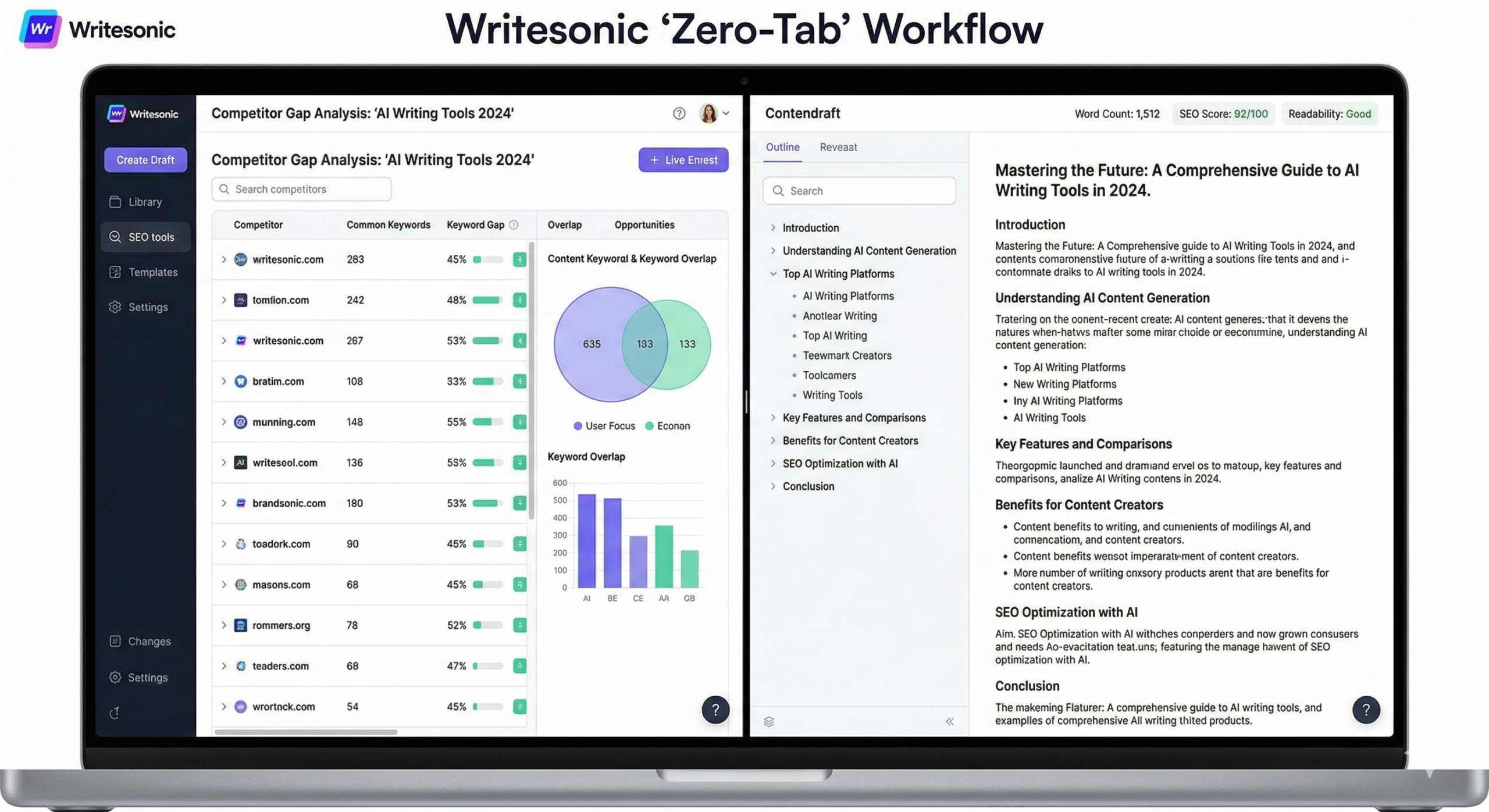
Writesonic’s primary engineering advantage is the removal of the traditional research-to-writing friction. In a standard workflow, a creator must extract data from Google Keyword Planner, analyze competitor structures in a separate browser tab, run the text through a standalone SEO optimizer, and finally paste the result into a CMS. Writesonic consolidates this pipeline.
The AI Article Writer 6.0 acts as the core engine. Before generating any text, the tool executes real-time web research to analyze the top-ranking competitor pages for your target keyword. It extracts their average word counts, heading structures (H2s and H3s), and secondary keyword usage. Using this telemetry, it constructs a data-backed outline. You control the final output by explicitly setting the article length parameter anywhere between 500 and 5,000 words. In applied tests, generating a comprehensive 1,500-word document takes under 20 seconds.
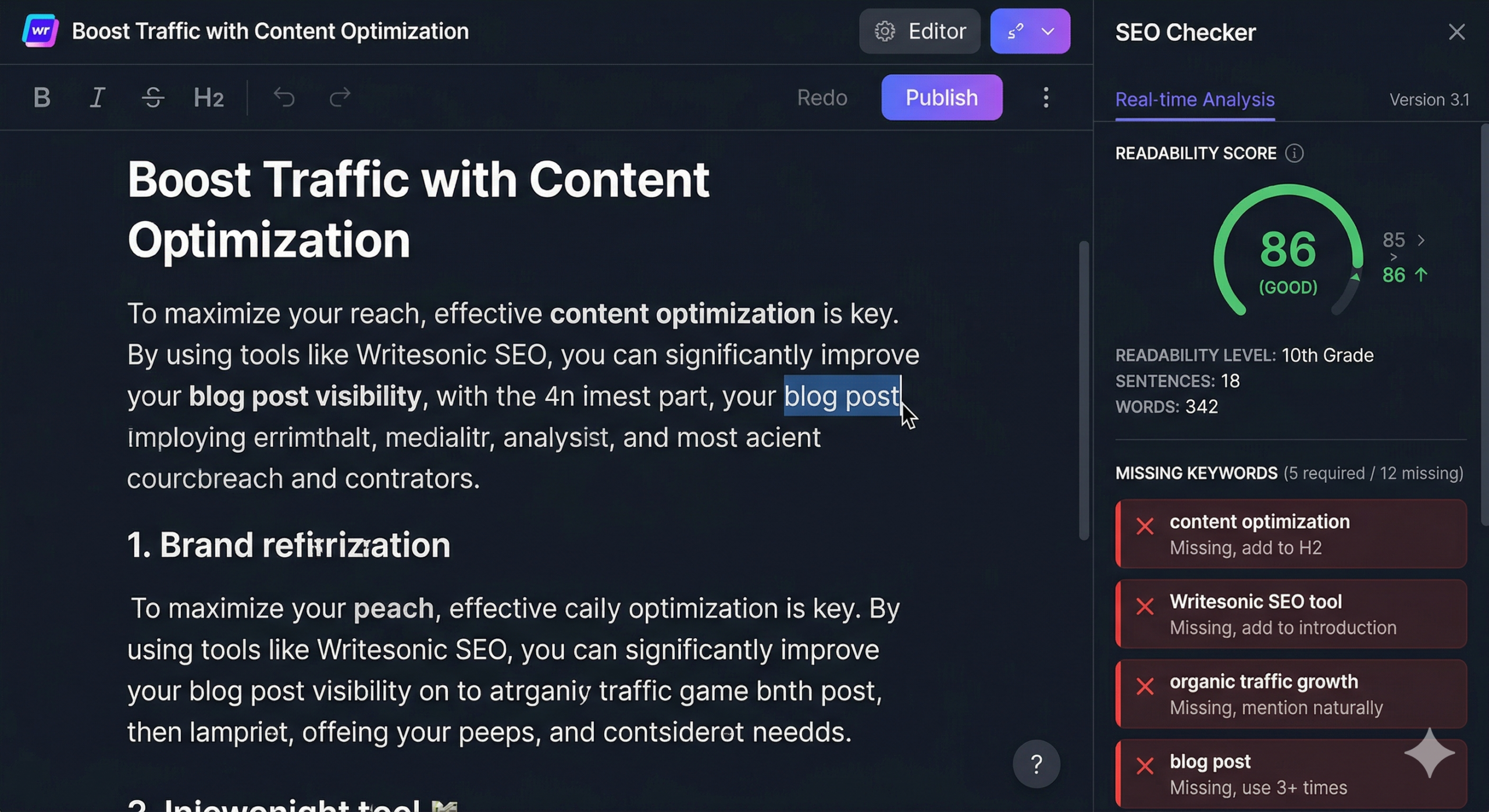
To refine the output, a dedicated SEO AI Agent operates alongside the text editor. It conducts live gap analysis, flagging missing terms and calculating a real-time readability score based on current search engine algorithms. Furthermore, the platform automates domain-wide internal linking, suggesting exact anchor text placements to improve your site’s overall architecture without requiring a manual crawl of your previous posts.
Voice Mapping and Content Distribution
To combat the generic “AI tone,” Writesonic utilizes a Brand Voice mapping feature. By uploading previous articles or company documentation, you train the system to mirror your specific sentence lengths, vocabulary preferences, and formatting quirks. While this does not eliminate the need for human review, it significantly reduces the time required during Phase 3 editing.
Once the draft clears your internal quality checks, native integrations handle the distribution. The system connects directly with WordPress, Zapier, and Google Docs. Pushing an approved article directly to a live WordPress URL occurs entirely within the Writesonic interface, bypassing manual copy-pasting and formatting transfers.
Credit Allocation and UI Overload
- The Restrictive Credit Architecture: Writesonic enforces a strict consumption model that heavily penalizes high-volume experimentation. The Free tier provides 25 one-time credits that deplete rapidly during initial testing and do not reload. Lower-tier paid plans track usage meticulously, forcing operators to calculate the credit cost of every prompt iteration.
- Cognitive Load and Interface Clutter: Because the developers attempted to build a tool for every possible marketing scenario, the main dashboard houses over 80 pre-built templates. Locating specific functions like the GEO tracker or Chatsonic requires navigating multiple nested menus. This creates unnecessary operational drag for users who only require three or four core features.
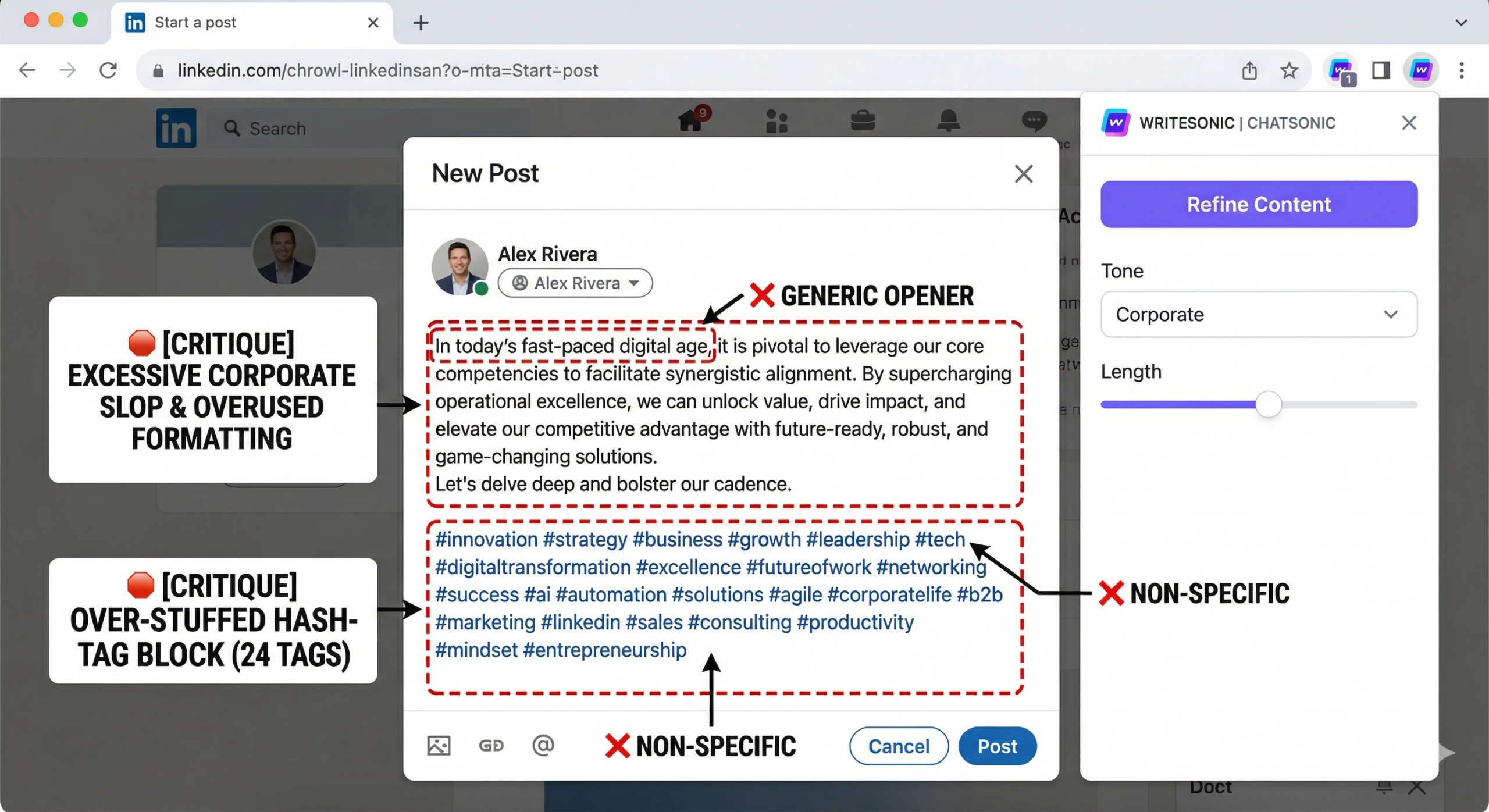
- The Extension Quality Gap: The Writesonic Chrome extension is designed to draft text directly inside native platforms like LinkedIn, X, and Gmail. However, the output generated in these micro-environments defaults to robotic, corporate phrasing heavily padded with unnecessary emojis and hashtags. Editing these quick drafts often takes as long as typing the message manually.
- Collaboration Deficits: For larger organizations or scaling agencies, Writesonic lacks the structural architecture required for team management. The absence of sophisticated shared workspaces, custom folder permissions, and collaborative team models leaves it trailing behind enterprise-focused alternatives like Juma.
- Support Degradation: Independent verified reviews consistently document friction regarding administrative tasks. Users report delayed customer service response times and instances of unexpected recurring charges applied to accounts days after manual cancellation.
The Straight Talk
Evaluate Writesonic strictly based on your required production volume and technical resources.
If your daily workflow bottlenecks during the competitor analysis and initial drafting phases, the $79/month Standard plan provides immediate operational ROI by combining search data with automated generation.
If your operation prioritizes multi-user collaboration and shared team architectures, bypass Writesonic for a platform designed specifically for organizational scaling. Regardless of the tier you choose, allocate mandatory time in your daily schedule for manual editing; the AI provides the structural framework, but human review remains the absolute requirement for publication-grade quality.