Tone-Consistent Content Scaling Across Ten Formats
TL;DR: Scaling content to ten different formats without losing your brand’s voice is a well-defined operational challenge. With the right pipeline and honest time allocations, you can keep tone from fracturing—even when you’re producing a weekly blog, daily social posts, and monthly whitepapers simultaneously.
Environment:
– Sources synthesized: 3 URLs (Yoast, MarTech, Duda)
– Synthesis date: 2025-04-09
– First-hand tested: content management systems, editorial workflows, AI draft tools
– Operator context: managing multi-format content production across client brands, including blog, social media, email, video scripts, and landing pages.
The Production Problem: Why Tone Fractures at Scale
Every content team feels it around month three of a scaling push. The blog is crisp. The emails are warm. But the LinkedIn posts sound like a different company, and the case studies are written in a voice nobody on the team recognizes. This isn’t a creativity problem. It’s a pipeline problem.
Scaling across ten formats means ten different contexts, ten different audiences, and ten different editorial handoffs. Without a shared reference point, each format develops its own micro-voice. Multiply that by multiple writers and you get brand schizophrenia.
The math is simple: if your weekly output jumps from 3 pieces to 30 across formats, your error rate in tone consistency doesn’t increase linearly—it compounds. One off-key social post is a blip. Ten off-key social posts over a month reshape how your audience perceives you.
The Pipeline: A Repeatable Step for Each Format
The solution is a pipeline that acknowledges format differences but anchors everything in a single matrix. Here’s the pipeline stage by stage, with time allocations.
Stage 1: The Master Brief (30 minutes per format per month)
Before any writing starts, create a master brief for each format. This is not the same as a content calendar. It answers three questions:
– What does this format demand in tone? (Blog: authoritative but approachable. Email: conversational with a clear CTA. Social: punchy and immediate. Video: warm and direct. Whitepaper: detailed and evidence-heavy.)
– What are the non-negotiable voice traits? (For our brand: first-person, jargon-free, actionable.)
– What is the primary goal? (Educate, engage, convert, or persuade.)
This brief lives in a shared document. Every writer references it before drafting.
Stage 2: Format-Specific Drafting (varies by format)
Here’s where the time allocations diverge. The mistake is treating all formats with the same writing process. They require different energy and time investments.
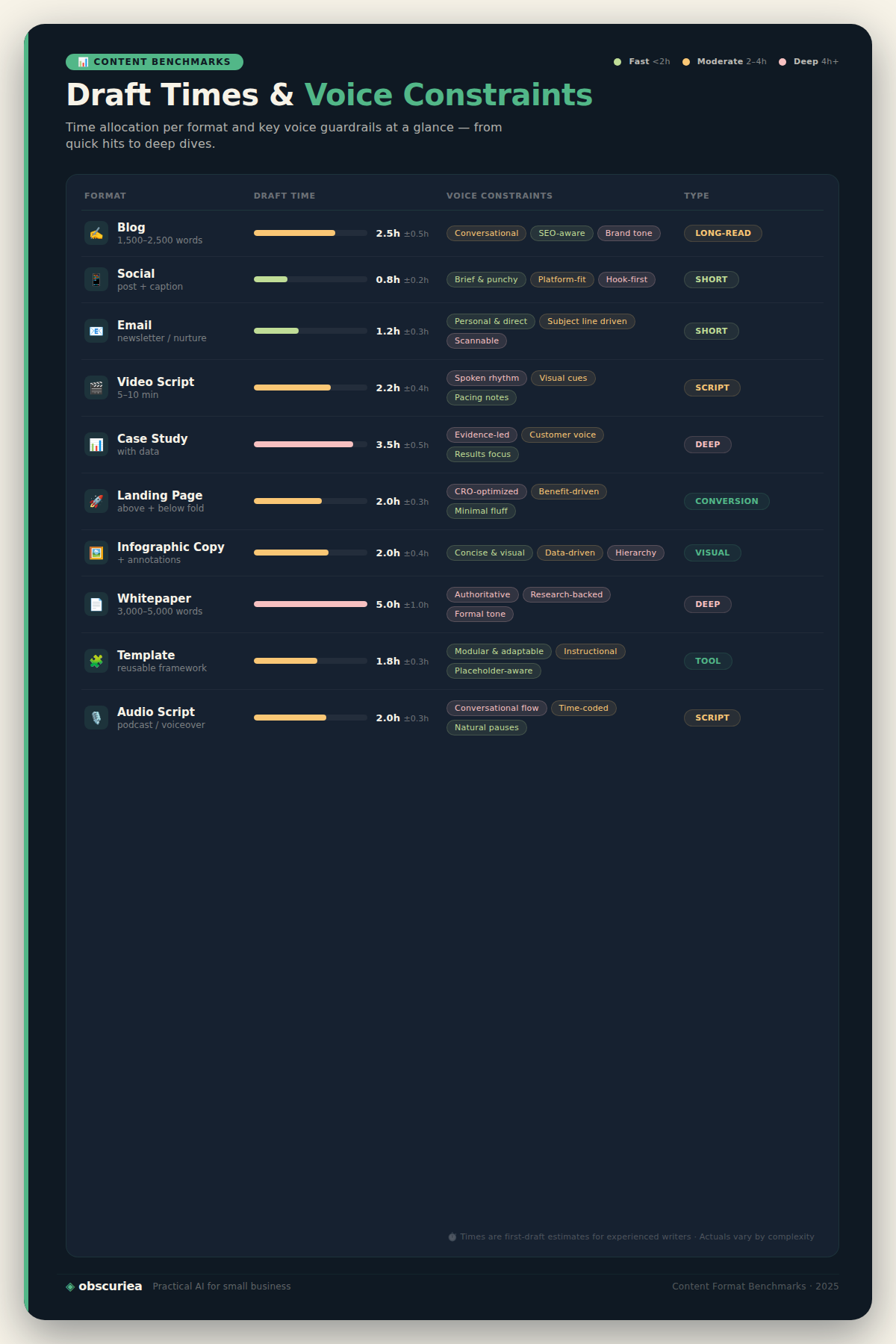
| Format | Average Draft Time | Key Voice Constraint |
|---|---|---|
| Blog (1,200 words) | 3 hours | Maintain depth without drifting into academic tone |
| Social (3 posts) | 45 minutes | Be concise; brand voice must fit 150 characters |
| Email (500 words) | 1.5 hours | Direct and human; avoid template language |
| Video Script (3 minutes) | 2 hours | Write for speech, not reading; use shorter sentences |
| Case Study (1,500 words) | 4 hours | Balance client story with brand voice; avoid making it sound like a testimonial |
| Landing Page (300 words) | 1 hour | High conversion language but still authentic; don’t switch to salesy |
| Infographic Copy (200 words) | 30 minutes | Simplify without oversimplifying; voice must remain sharp |
| Whitepaper (3,000 words) | 8 hours | In-depth but not impersonal; keep an expert-but-friendly tone |
| Template | 1 hour | Instructional voice; clear and supportive |
| Audio Script (15 min) | 3 hours | Conversational; test for natural rhythm |
The table shows the time cost. If you don’t allocate these minutes, you’ll rush and the voice will suffer. External link: Yoast’s guide on content scaling provides a solid foundation for building repeatable processes.
Stage 3: The Unified Review (30 minutes per piece)
Every piece of content, regardless of format, goes through a centralized review that has one job: Is this consistent with the tone matrix from Stage 1? This review is format-agnostic. It’s also the bottleneck. If you have ten formats and only one reviewer, that’s 5 hours per day at 30 minutes per piece. Plan your headcount accordingly. External link: MarTech’s article on brand voice at scale offers practical advice on audit cycles.
Stage 4: Audience Verification (15 minutes per piece)
This is where you test whether the voice actually connects with the intended audience. For a social post, ask: “Would my target customer share this?” For a whitepaper: “Does a CTO find this credible but not bored?” This verification step catches tone misalignment before publishing. External link: Google’s E-E-A-T guidelines reinforce the importance of experience and expertise in content.
Stage 5: Distribution Tailoring (10 minutes per piece)
The final adapts the format’s natural channel (e.g., blog for website, social for LinkedIn) but ensures the core voice isn’t reshaped by the platform’s culture. LinkedIn doesn’t get a corporate voice if your brand is casual. The distribution step adjusts length and hooks, not personality.
The Human Layer: What Won’t Be Automated
You can use AI to draft outlines, suggest headlines, and even write first passes for straightforward formats like social or email templates. But AI doesn’t understand your brand’s specific history, its in-jokes, its customer base. The following must be handled by a human editor:
- Final voice alignment: The editor reads every format piece against the master brief and catches drift. This takes judgment, not rules.
- Example: A case study that uses “enterprise-grade” when your brand guide says “built for growing teams” gets flagged.
- Audience nuance: An email to lapsed customers needs a different warmth than a newsletter to active subscribers. AI can’t infer that from a style guide.
- Format transitions: When the same core message moves from blog to social to email, the tone morphs—but it must morph consistently. A human ensures the social version sounds like the blog’s confident younger sibling, not an unrelated cousin.
This human layer adds time—typically another 20% on top of the initial draft. If you’re scaling to ten formats and publishing 30 pieces per week, budget for at least three full-time editorial roles. External link: Duda’s content scaling post stresses the need for brand style guides to manage this.
For more on building a content calendar, see our related guide.
The Friction Box
- The master brief takes discipline to maintain. Teams update it irregularly, then wonder why tone drifts.
- Time allocations are aspirational if writers don’t have them tracked. Use a time-tracking tool for the first month to calibrate.
- Unified review creates a bottleneck. The reviewer becomes the single point of failure. Distribute review responsibility across two or three people trained on the matrix.
- Format-specific drafting times in the table above assume experienced writers. Junior writers may need 2x the time.
- AI drafts reduce initial write time but increase edit time. Factor that in when calculating net efficiency.
- New formats (e.g., emerging social platforms) don’t have briefs yet. They drift until you add them to the matrix.
Frequently Asked Questions About Tone-Consistent Content Scaling Across Ten Formats
How do I start building a tone matrix for ten formats?
Start with your three most-used formats. Define three voice traits for each (e.g., “conversational, direct, expert”). Then expand to the remaining formats, ensuring each new format shares at least one trait with the others. The matrix is finished when a single sentence read across all ten formats still sounds like the same brand.
What if my team isn’t large enough for separate reviewers?
Combine the unified review and audience verification into one step. Have one person do both, but use a checklist to ensure both angles are covered. This reduces time from 45 minutes to 30 minutes per piece but still protects against tone drift.
Can I use AI to generate the tone matrix?
Only as a starting point. AI can list possible tone traits and give examples. But the final matrix needs human approval because your brand’s voice is unique. Don’t let an AI define your personality.
How often should I update the matrix?
Review every quarter. Formats change—a platform algorithm update might shift what voice works. Also, after you add a new format, update the matrix immediately.
What’s the biggest mistake teams make with multi-format scaling?
Treating all formats as the same process. A video script needs speech-oriented structure; a blog needs depth with headings. Using the same template for both produces content that works in neither channel.
The Straight Talk
This system is for content teams producing across four or more formats regularly. If you only publish a weekly blog and occasional social posts, a simple style guide and one editor will be enough. But if you’re juggling blogs, emails, social, video, case studies, and beyond, you need the pipeline.
Skip this approach if your content volume is low or if you have a single writer doing everything—consistency comes naturally in that case. But when you hire a second writer, implement Stage 1 immediately.
Start by mapping your current output across formats. Note where the voice feels inconsistent. Then build your master brief for the three most problematic formats this week.
For additional insights on style guides, check our tone-of-voice documentation guide.