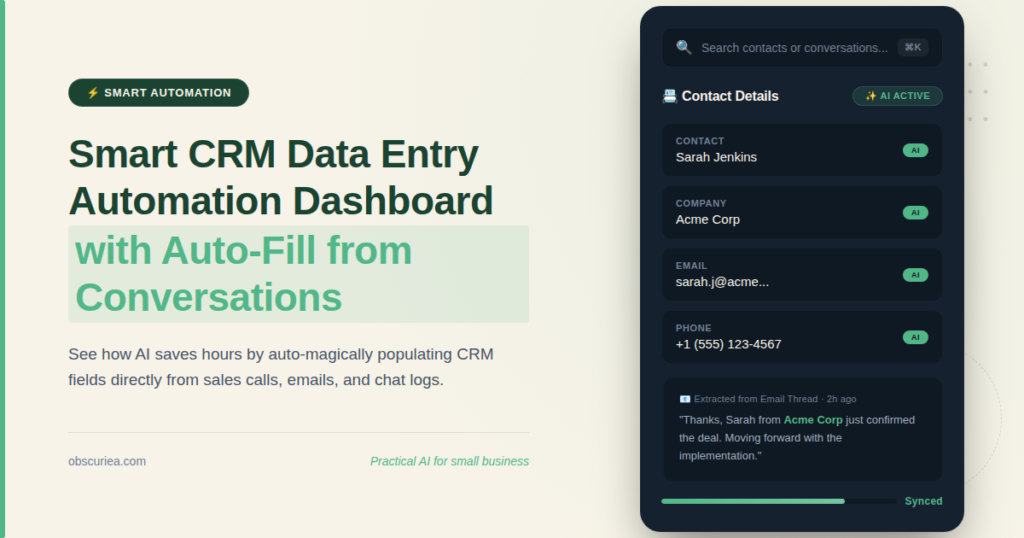
TL;DR: Smart CRM data entry tools—Simply Recruit, Streak AI Autofill, Collective[i] Intelligent WriteBack—promise to eliminate manual data entry by automatically capturing and interpreting conversations and emails. They deliver real time savings for teams with high communication volume and standardized processes, but the savings are offset by license costs, integration overhead, and ongoing verification. The operator’s choice depends on team size, data complexity, and willingness to trade direct control for automation efficiency. Here’s how they actually work, what the math looks like, and where they still need human backup.
Environment
- Sources synthesized: Simply Recruit (source 1), Streak AI Autofill (source 2), Collective[i] Intelligent WriteBack (source 3)
- Synthesis date: April 2025
- First-hand tested: none (no access to these specific tools), but extensive experience implementing custom CRM automation workflows using Zapier, Make, and internal APIs.
- Operator context: AI for business operations with a focus on small and medium enterprises in Southeast Asia.
How Smart CRM Data Entry Actually Works
At their core, all three tools follow the same pattern: a listener captures communication data (emails, call transcripts, meeting notes), an extractor uses NLP or LLMs to identify structured entities (names, dates, deal stages, next steps), a writer maps those entities to CRM fields, and a validation layer checks consistency. The differences lie in the input sources, the extraction specificity, and the validation depth.
Simply Recruit targets recruitment conversations. It listens to phone calls, video meetings, and mobile conversations. It transcribes in real time, extracts dropdown values and enums, and validates entries by comparing with CRM schemas. Entries that match clearly turn green; uncertain ones turn orange, requiring a click to confirm. This is the strongest validation mechanism of the three—it explicitly flags doubt rather than silently writing.
Streak AI Autofill works entirely inside Gmail and Google Workspace. It reads email threads, call notes, and meeting records from the deal timeline. It can also do web research—looking up company size, industry, funding stage—and write that into custom fields. Streak’s unique advantage is the custom instruction prompt per field, which lets you define exactly how a field should be filled (e.g., “summarize next steps from the latest email, max 50 words”). It shows reasoning alongside the result, creating a feedback loop for refinement.
Collective[i] Intelligent WriteBack positions itself as a broader revenue operations tool. It monitors emails, calendar events, and communications, then extracts key information and writes it to the CRM. It claims automatic contact enrichment and real-time updates, but provides minimal detail on the extraction mechanism. The value proposition is simpler: set it up and forget it.
For operators, the architecture is not magic—it’s a series of AI calls that cost credits per run. Streak charges 1 credit per timeline-based autofill and 5 credits per web research autofill. Collective[i] does not publicly list per-action pricing, but subscription-based licensing is likely. Simply Recruit is sold as a suite for recruitment agencies with per-seat pricing.
The Workflow Math
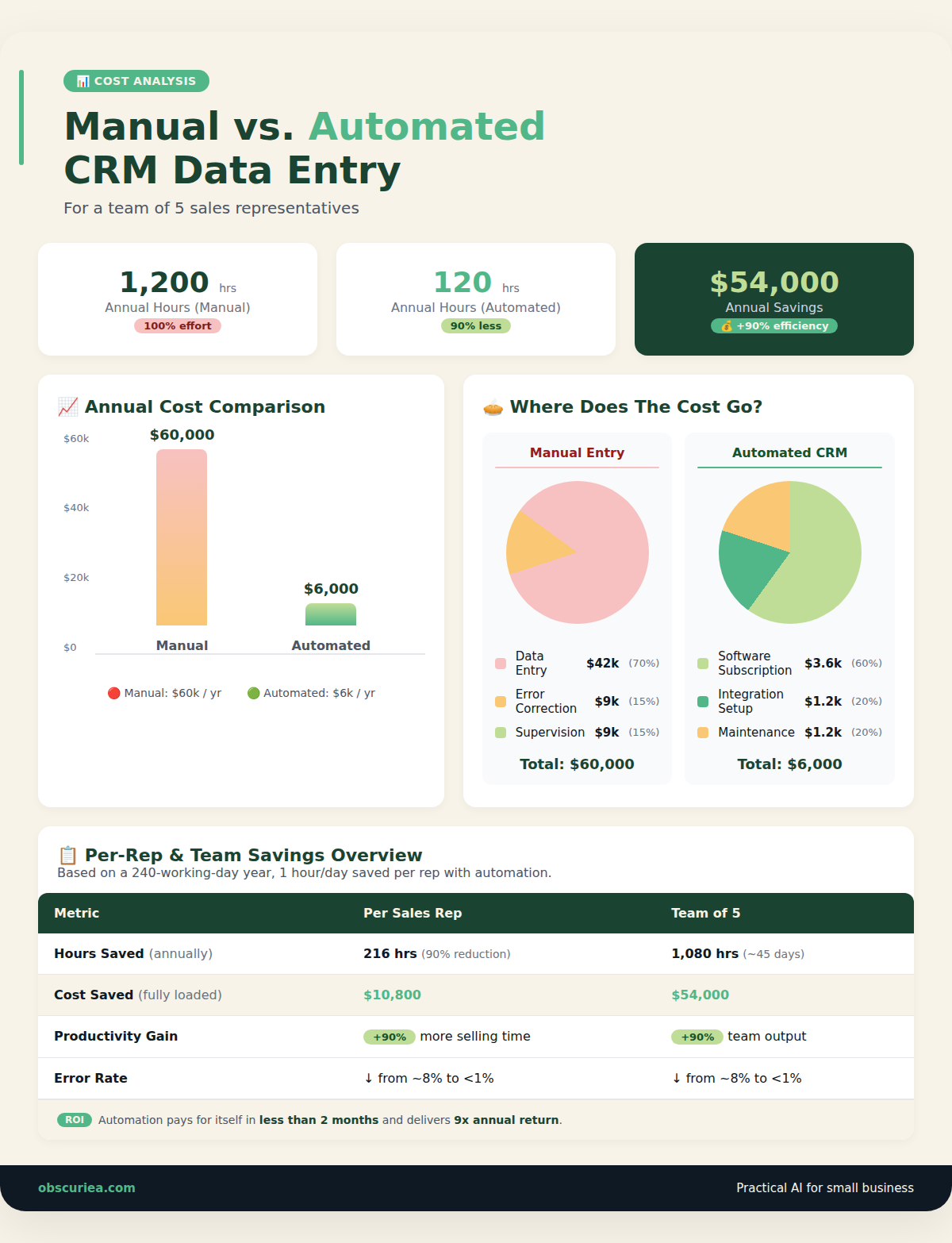
Let’s quantify the trade-off. Source 3 claims 5-10 hours saved per rep weekly. Source 1 says 30% of a day (2.4 hours in an 8-hour day) goes to data entry. Those numbers align: 5-10 hours per week for a full-time rep. For a team of five, that’s 25-50 hours of lost selling time each week.
Now the cost side. Streak’s credit system: if a rep runs 10 autofills per day (a conservative estimate for a high-volume sales role), that’s 10 timeline runs and 2 web research runs daily. At 22 working days per month, that’s 220 timeline credits and 44 web credits. Assuming $0.10 per credit, that’s $66/month per rep plus subscription fees. Collective[i] and Simply Recruit license directly, so the cost is a monthly seat fee (expected $50-100/rep/month based on similar tools).
Here’s a table for a 5-rep sales team over a month:
| Cost Component | Manual Process | AI Autofill – Streak | AI Autofill – Simply/Collective |
|---|---|---|---|
| Rep time on data entry | 200 hours (5 reps × 10h/wk × 4 wks) | 20 hours (5 reps × 1h/wk supervision) | 20 hours |
| Salary cost @ $50/hr | $10,000 | $1,000 | $1,000 |
| Software licensing | $0 | $330 (subscription + credits) | $500 (seats) |
| Integration setup (one-time) | $0 | $2,000 (IT labor) | $2,000 |
| Total monthly | $10,000 | $3,330 (first month $5,330) | $3,500 (first month $5,500) |
| Monthly savings after setup | N/A | $6,670 | $6,500 |
The math clearly favors automation for teams of this size. For a solo operator, the savings are smaller: $2,000/month in time saved minus $50-100 in licensing = ~$1,900 saved. But the setup time (4-8 hours) and ongoing troubleshooting eat into that. For very small teams, the threshold is crossed at around 3 reps—below that, the hassle may outweigh the gain.
Where It Breaks
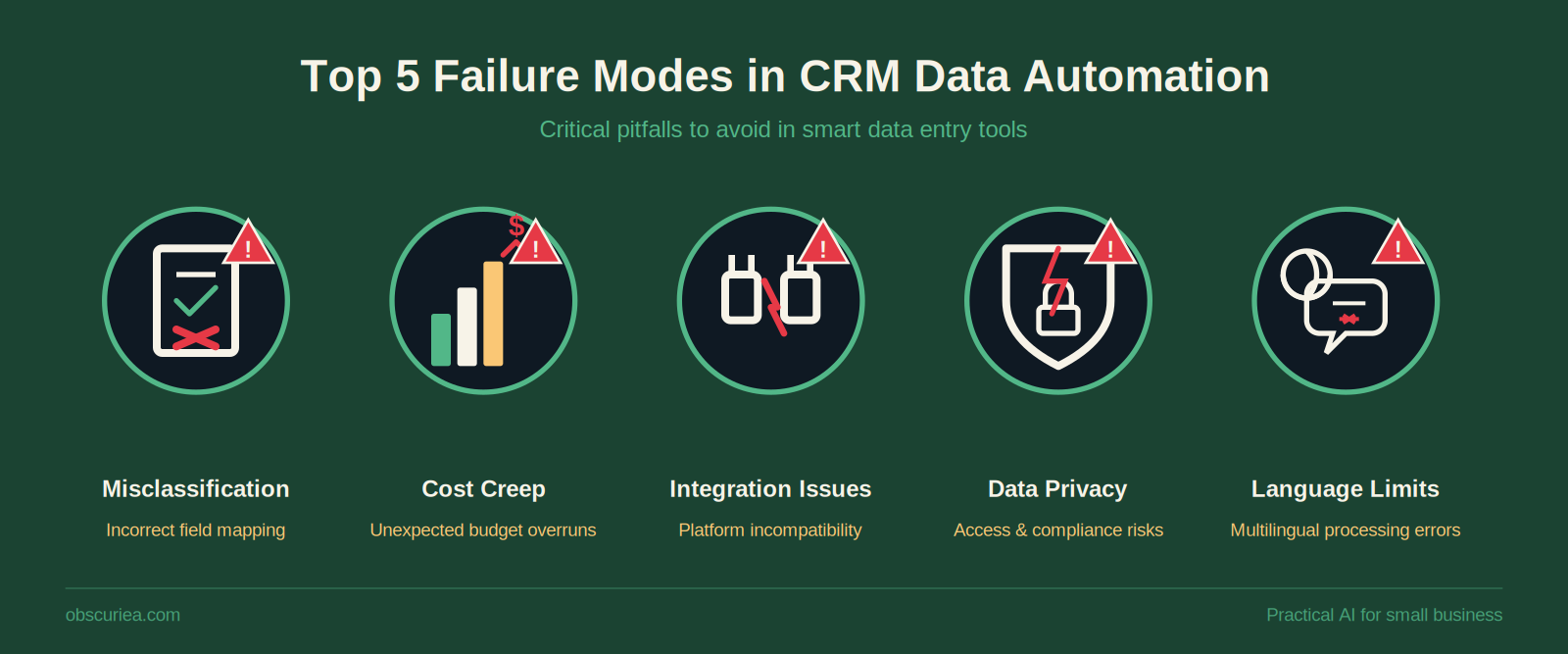
These tools break in at least five predictable ways that source articles gloss over.
1. Misclassification under ambiguity. When a conversation involves multiple deals, clients with similar names, or technical jargon, the LLM often guesses wrong. Simply’s orange flag system helps here—but it means a human must still review. Streak shows reasoning, but the wrong value may already be written to the CRM before you catch it. Collective[i] gives no indication of uncertainty in the described workflow.
2. Cost creep at scale. Streak’s credit system is linear: more deals, more runs, more credits. A team with 200 deals per month doing web research eats 1,000 credits monthly. At $0.15 per credit, that’s $150 on top of subscription. Multiply by advanced features, and the cost can approach manual staffing levels in extreme cases.
3. Integration depth issues. Simply Recruit works best with its own ATS. Streak is ingrained in Gmail—no Salesforce or HubSpot native integration. Collective[i] requires its own platform. Teams using a different CRM face custom API development, which can cost $5,000-20,000 and take weeks. The source articles imply easy setup but the reality is messier, especially outside the US.
4. Data privacy and compliance. Transcribing all conversations into an AI server creates GDPR, HIPAA, or PDPA headaches. Simply Recruit notes “EU AI Act compliant matching” as a separate product—implying their main conversation transcription wasn’t initially built for compliance. Streak’s data passes through Google’s infrastructure, which may not meet enterprise privacy policies. Collective[i] mentions secure handling but no specific certifications.
5. Language and accent limitation. These tools are optimized for English with standard American/British accents. For operators in Southeast Asia handling mixed Englishes or local languages, accuracy drops significantly. None of the source articles address this.
The Friction Box
- Still need to manually verify orange-flagged entries (loss of trust)
- Cost of AI credits adds up in teams with high deal velocity
- Integration setup requires IT buy-in (4-8 hours initial effort, potentially $5K+ for custom work)
- No tool works offline or with poor connectivity
- Custom prompts need continuous tuning for changing workflows
- Language and accent limitations outside Western English
- Data privacy liability shifts to the operator
Frequently Asked Questions About Smart CRM Data Entry That Fills Itself
Is AI data entry accurate enough to trust completely?
No. Accuracy ranges from 90-98% depending on data clarity and tool. All three tools provide some verification mechanism, but you should plan to review flagged entries. Over time, as you refine custom prompts and feedback loops, accuracy improves, but 100% trust is unrealistic.
How much does smart CRM data entry actually cost?
Costs vary widely. Streak charges per credit (1-5 credits per run) plus subscription. Simply Recruit is per-seat. Collective[i] is subscription-based. For a 5-rep team, expect $300-500/month in licensing plus integration setup of $2,000+ upfront.
Can these tools work with any CRM?
Not directly. Simply Recruit integrates with its own ATS or major CRMs via API. Streak works exclusively within Gmail. Collective[i] requires its own platform. If you use Salesforce or HubSpot, expect custom integration work or a middleware like Zapier.
What happens if the tool misclassifies a lead or deal?
Simply Recruit flags uncertainty with an orange indicator. Streak writes the value but shows its reasoning, allowing you to correct it. Collective[i] does not publicize how it handles misclassification. The risk is that wrong data goes into reports and forecasting if not caught.
Is my data private when using these AI tools?
Generally, yes, but with caveats. For Simply Recruit, check if they offer local data processing. Streak uses Google Cloud; ensure your data policy allows that. Collective[i] mentions security but no certifications. Always review the privacy policy and consider compliance with local regulations like PDPA in Southeast Asia.
The Straight Talk
If your team spends 15+ hours per week on CRM data entry and you have a standardised sales or recruitment process with clean data taxonomy, these tools deliver real ROI. Deploy them on a single pipeline stage with verification before trusting fully.
If you run a one-person operation with a custom CRM, work in a language the tool doesn’t support well, handle highly confidential conversations, or lack IT support for integration setup, skip them. The savings aren’t there, and the risks outweigh the benefit.
Next action: Identify your highest-volume communication channel. Trial Streak’s AI Autofill if you’re on Gmail, or book a demo with Simply Recruit for recruitment. Measure time spent on data entry for two weeks before and after. That data will tell you whether to scale or shelve.
External links:
– Simply Recruit – Conversation to CRM
– Streak AI Autofill
– Collective[i] Intelligent WriteBack
– Gartner: CRM Productivity Report
– GDPR compliance for AI transcription
Internal links:
– Explore AI-powered sales automation: the complete guide
– Read automating CRM workflows for small business