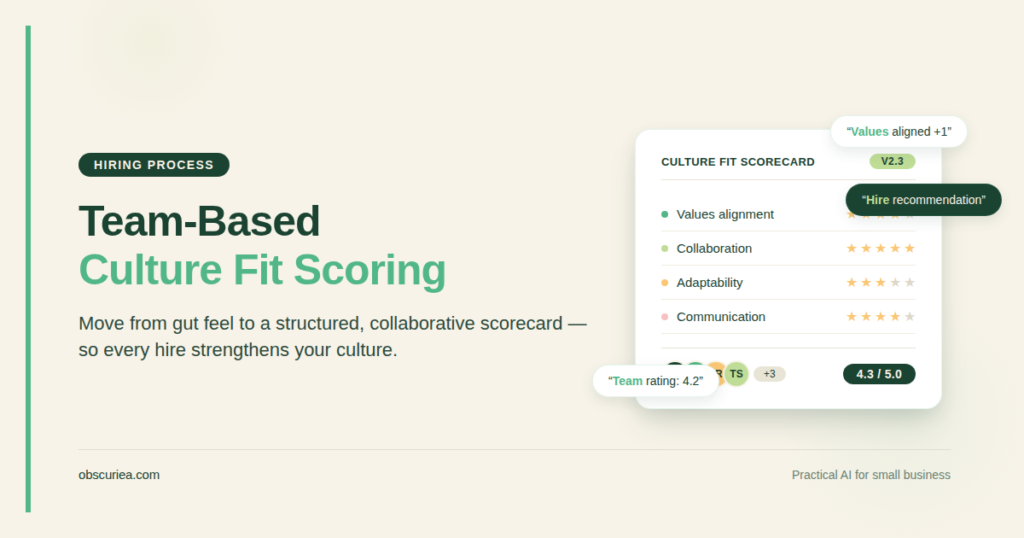
TL;DR: Structured culture fit assessments can reduce bad hires and their costs, but only if you build them around your actual values—and accept that no tool eliminates human judgment. Most hiring teams still rely on gut feeling because they don’t know where to start. This article breaks down the architecture, the math, and the failure points.
Environment:
– Sources synthesized: 3 URLs (happily.ai, kassen.ca, employmentmetrix.com)
– Synthesis date: 2025-04-10
– First-hand tested: none
– Operator context: synthesizing from sources for AI for Business audience; typical small-to-medium business hiring context in Southeast Asia
The Architecture of Culture Fit Assessment
You walk out of an interview with a candidate who aced every technical question. Resumé clean. Portfolio sharp. References glowing. But something feels off—and you can’t name it.
That feeling is the reason 89% of hiring failures come from attitude, not skill (Leadership IQ). But feeling isn’t data. And data is the only thing that scales.
Culture fit assessment isn’t a single tool. It’s a system with four layers:
Layer 1 – Definition. You can’t assess what you haven’t named. Most companies claim they value “collaboration” or “innovation” without defining what that looks like in daily work. Does collaboration mean Slack threads or weekly stand-ups? Does innovation mean quarterly hackathons or permission to break production? Write down 3–5 specific behaviours, not buzzwords.
Layer 2 – Collection. Structured interviews, scorecards, personality assessments, simulations—each collects evidence differently. The mistake is using one in isolation. A DISC profile tells you work style. A behavioral interview tells you past decisions. A job simulation tells you how they react under pressure. Use all three, but know what each measures.
Layer 3 – Integration. Multiple interviewers, each scoring the same dimensions independently. This is where bias dies—or gets reinforced if your panel lacks diversity. Use a shared rubric with anchor examples. Score before group discussion.
Layer 4 – Verification. References, but targeted. Not “was she a good employee?” but “give me a specific example of how she handled a disagreement with a teammate.”
Skipping any layer introduces noise. Gut feeling is the default when layers are missing.
The Workflow Math: Time vs. Cost
Let’s run the numbers on a typical hire at a 50-person company in Indonesia, annual salary Rp 180 million (~$11,500 USD).
| Gut Feeling Approach | Structured Assessment | |
|---|---|---|
| Time to define culture | 0 hours (undefined) | 6 hours (workshop + documentation) |
| Interview prep per role | 15 min | 45 min (build questions, calibrate panel) |
| Interview time | 1 hour | 2.5 hours (panel, behavioral + simulation) |
| Scoring & debrief | 10 min (vibes) | 30 min (rubric, group review) |
| Total per hire | ~1.5 hours | ~4 hours |
| Cost of bad hire (60% salary) | Rp 108 million | Rp 108 million (same, but fewer occurrences) |
That extra 2.5 hours per hire looks expensive until you consider the 89% failure rate on culture. If structured assessment cuts bad hires by half (conservative), you save Rp 54 million per mis-hire avoided.
For a company hiring 10 people a year, that’s Rp 540 million in prevented losses. The time investment—about 25 extra hours annually—pays for itself the first time you dodge a bad fit.
Where It Breaks
Every culture fit system has failure points. Here are the ones most operators miss:
1. The Rubric Drift. You write three culture markers in January. By June, the hiring team has forgotten them, and interviewers are back to scoring by charisma. Solution: quarterly calibration sessions where everyone scores the same candidate (mock or past) and compares results.
2. The Homogeneity Trap. Structured assessments reduce bias from gut feeling but can introduce new bias if the rubric itself is narrow. If all your values reward assertiveness and speed, you’ll filter out thoughtful introverts who produce better long-term work. Define values with counterexamples: “We value speed, but also encourage pausing to ask the right question.”
3. Candidate Gaming. Behavioral questions are easy to fake. Anyone who has watched two YouTube interview prep videos knows to answer “Tell me about a conflict” with the STAR method. Job simulations are harder to game, but if your simulation is a five-minute hypothetical, it’s surface-level. Use realistic, time-pressured scenarios.
4. Tool Limitations. Platforms like [MyCulture](https://happily.ai) or [CultureAmp](https://www.cultureamp.com) give you a score—but they don’t tell you how to act on it. A candidate who scores 85% alignment might still leave in six months because their manager is toxic. Assessment tools measure values, not management reality.
5. The Reference Riddle. Former bosses hate to give bad references. They’ll say “she’s a great worker” even if she was a team cancer. Counteract this by asking sequence questions: “Walk me through a project where things went wrong. What was her role? How did the team recover?”
The Friction Box
- You need 4–6 hours upfront to define culture properly—most teams skip this.
- Structured interviews require training; untrained interviewers destroy consistency.
- Small companies (under 20 people) can’t afford a dedicated HR tool; spreadsheet scorecards work but require discipline.
- In remote-first teams, cultural signals are weaker—you can’t read body language across Zoom.
- Cultural alignment doesn’t predict performance if the role requires adapting to changing norms.
Frequently Asked Questions About Culture Fit Assessment
What is the difference between culture fit and culture add?
Culture fit checks alignment with existing values; culture add evaluates what fresh perspective the candidate brings. For innovation-driven companies, culture add prevents stagnation. For highly operational teams, culture fit may be more critical to maintain efficiency.
How do I define culture markers for a startup with no history?
Look at the founder’s stated principles, look at why people stay (or leave), and look at what behaviors get rewarded informally. Write a short list like: “We ship fast and fix bugs later” or “We debate openly then commit fully.”
Are personality tests like DISC or MBTI reliable for culture fit?
They measure preferred styles, not alignment with organizational values. Use them as conversation starters, not pass/fail filters. A high-DISC D person can thrive in a collaborative culture if they respect the process.
Can you assess culture fit during remote interviews?
Yes, but rely more on behavioral questions and work samples. Structure the interview around specific values. Give a realistic job preview: show them how the team communicates on Slack and ask their reaction.
What should I do if a candidate scores low on culture fit but high on skill?
Go deeper. The low score may reflect a misunderstanding of your culture, not a true mismatch. Backchannel with them about specific values. Sometimes skill can expand culture, but if the values are truly misaligned, walk away—two months of productivity isn’t worth twelve months of friction.
The Straight Talk
This is for founders and ops managers who have made at least one bad hire and want a repeatable system—not for enterprise HR teams with dedicated TA software. If you’re hiring fewer than 5 people per year, skip the tool and focus on the interview rubric.
Start this week: write down your top three culture markers in one sentence each. Use those as the header row of a scorecard for your next two hires.
If you want a structured conversation, call a recruiter who builds scorecards—not one who “trusts their gut.”