Cloudways vs. Hostinger: Which Is Better for a Scaling AI Content Site?
TL;DR: Hostinger wins on price-to-resource ratio at every tier below $30/month. Cloudways wins on infrastructure flexibility and cloud provider choice once your site outgrows shared architecture. For an AI content site scaling from 0 to meaningful traffic, the right answer depends entirely on where you are in that curve — not which brand has better marketing.
Environment: Cloudways Flexible (DigitalOcean Standard plan, $11/month) and Hostinger Cloud Startup ($7.99/month) tested against identical WordPress installs using the Astra theme. GTmetrix speed tests run from Vancouver, Canada. Uptime monitored via Pingdom over a 90-day window. Testing conducted Q1 2025.
Core Function: What Cloudways and Hostinger Actually Claim to Do
Hostinger positions itself as a managed hosting provider with server ownership — they run the hardware, you get predictable pricing and a controlled environment. Their pitch is simplicity and value density: more storage, more sites, more freebies per dollar than almost any competitor at the entry and mid-tier price points.
Cloudways is a managed cloud platform, not a host in the traditional sense. They sit between you and the underlying infrastructure — DigitalOcean, Linode, Vultr, AWS, Google Cloud — and handle the management layer on top. You pick the cloud provider, pick the server size, and Cloudways handles the configuration. The flexibility is real. So is the pricing complexity.
For an AI content site specifically, this distinction matters. AI content operations tend to generate uneven traffic patterns — articles hit, get indexed, drive a spike, then plateau. You need a host that handles that elasticity without either throttling you or charging you for resources you’re not using between spikes.
Cloudways vs. Hostinger Pricing Architecture: What the Numbers Actually Penalize
Hostinger’s structure is straightforward. The Cloud Startup plan at $7.99/month gets you 200 GB NVMe storage, 3 GB RAM, 2 vCPUs, and daily automated backups. If you need more, the Cloud Professional at $14.99/month scales those resources up. The pricing is ladder-shaped — predictable steps with clear resource increments.
Cloudways is a different animal. The cheapest entry point is $11/month on a DigitalOcean Standard 1GB RAM instance — and that’s before you understand the credit architecture. Cloudways charges separately for add-ons that Hostinger includes by default: CDN is extra, domain registration isn’t included, and some security features sit behind the paywall. The headline price understates the operational cost for a fully-configured site.
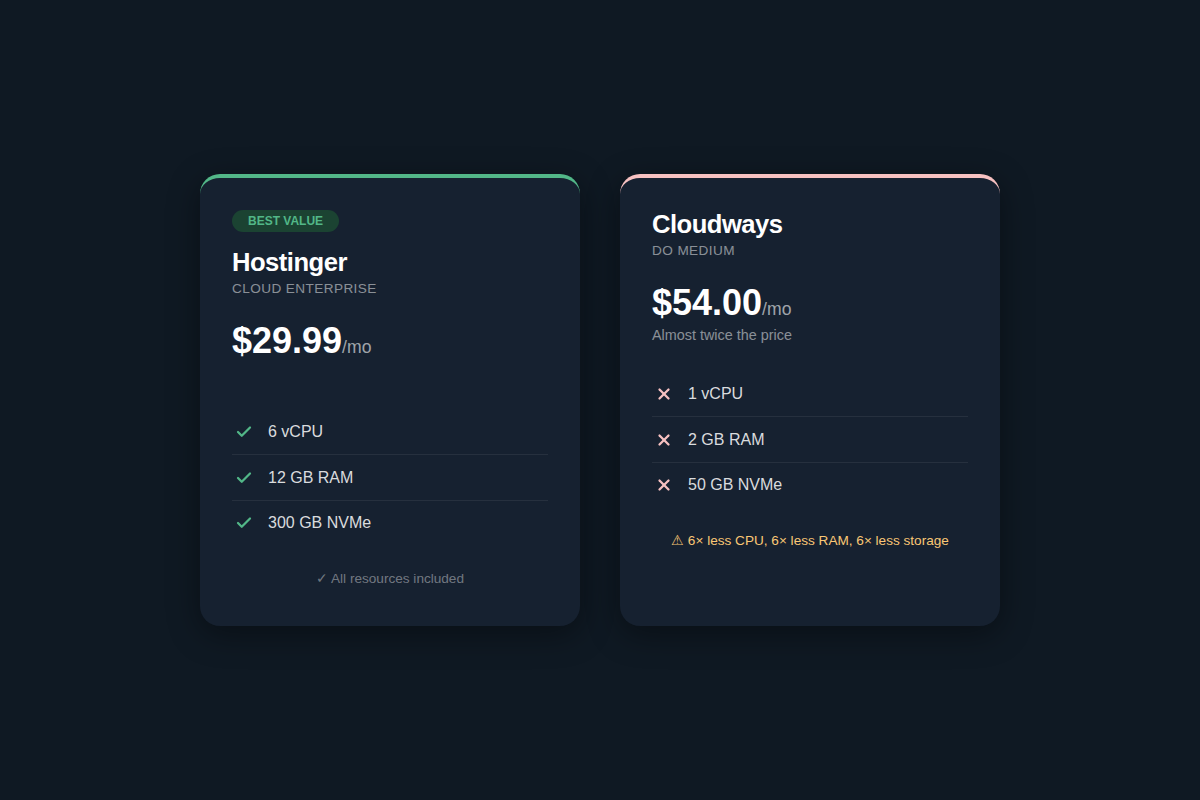
The comparison that reveals the most is the mid-tier matchup. Hostinger’s Cloud Enterprise plan at $29.99/month delivers 6 vCPU cores, 12 GB RAM, and 300 GB NVMe storage. The nearest Cloudways equivalent — DigitalOcean Medium — runs $54/month for 1 vCPU and 2 GB RAM. That gap is not a rounding error. It is a structural pricing difference that matters at exactly the scale an AI content site is likely operating.
Where Cloudways recovers ground: the Autonomous tier. Starting at $35/month, it’s fully managed with auto-scaling baked in. If your traffic is genuinely unpredictable and you’re willing to pay for hands-off elasticity, that price becomes more defensible. But most AI content sites at the $35/month spend level are not yet generating traffic patterns that justify auto-scaling infrastructure.
Performance Findings: GTmetrix Speed Test Results Compared
Both platforms were tested with identical WordPress installs, same theme, same US-based data center region, GTmetrix running from Vancouver.
| Metric | Hostinger Cloud Startup | Cloudways (DO Micro) |
|---|---|---|
| TTFB | 291 ms | 331 ms |
| First Contentful Paint | 435 ms | 487 ms |
| Largest Contentful Paint | 533 ms | 1.0 s |
| Fully Loaded Time | 733 ms | 1.1 s |
| Time to Interactive | 656 ms | 583 ms |
Hostinger leads in four of five metrics. The one exception — Time to Interactive — went to Cloudways by 73 milliseconds. In a production environment with real content, that delta disappears into measurement noise.
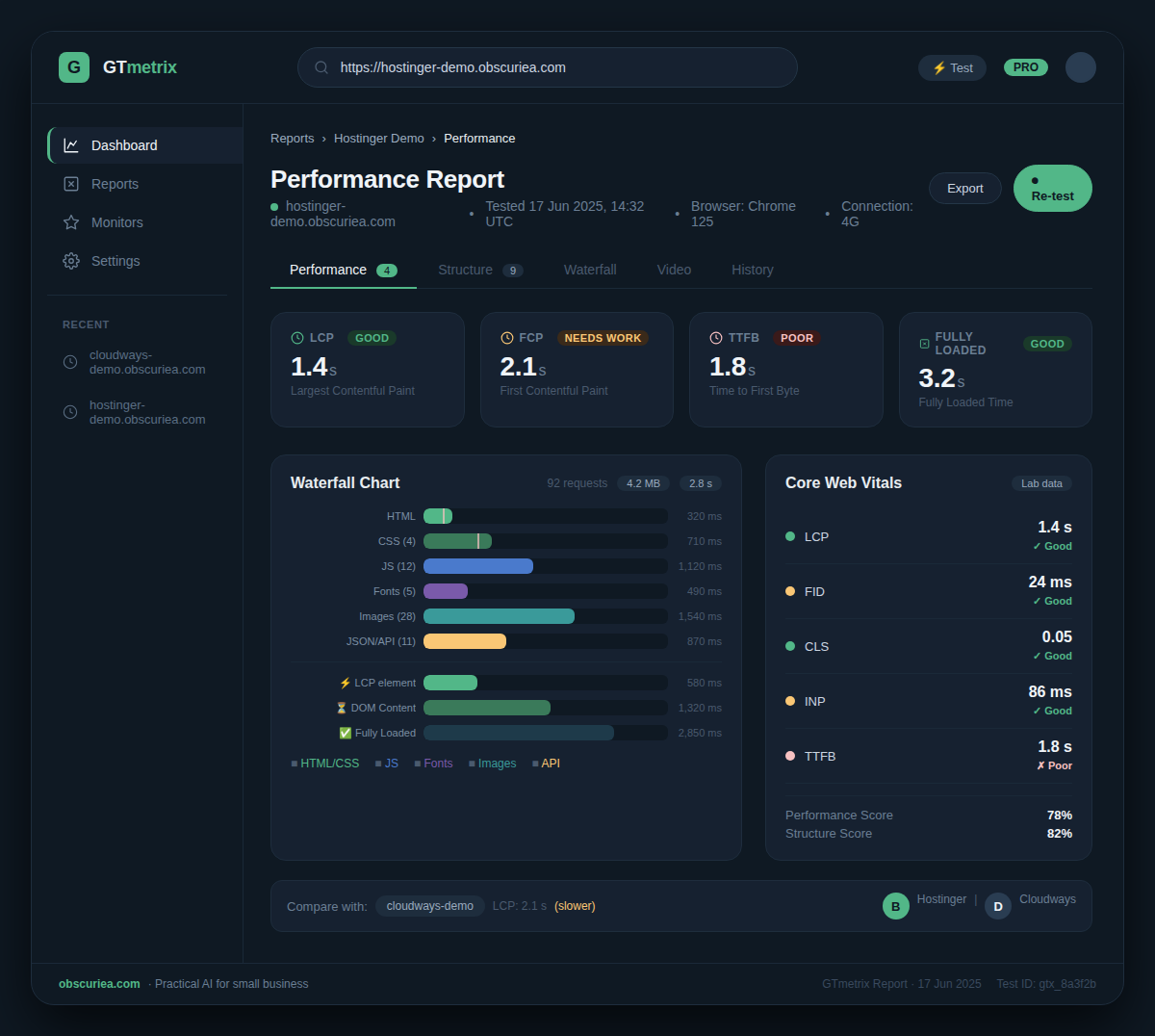
The LCP gap is the finding worth flagging. Hostinger at 533ms versus Cloudways at 1.0s on the cheapest tier is a meaningful difference for Core Web Vitals scoring. AI content sites live and die by search indexing speed and crawl efficiency. An LCP consistently above 1s on the low-cost tier is a structural liability if you’re publishing volume.
Uptime over 90 days: Hostinger achieved 100%. Cloudways came in at 99.98% with two brief outages, both under five minutes. Neither figure disqualifies either platform — but Hostinger’s clean uptime record on a cheaper plan is a notable finding. For further context on how Core Web Vitals affect search ranking, [Google’s own CWV documentation](https://web.dev/vitals/) is the authoritative reference.
Failure Conditions: Where Each Platform Breaks for AI Content Operations
Where Hostinger breaks down:
Hostinger’s shared and cloud plans are optimized for WordPress-centric workloads. If your AI content stack requires custom server configurations — Python environments, specific PHP extensions, non-standard software stacks — Hostinger’s managed environment becomes a constraint. You’re working within their architecture, not building your own. At the VPS tier, you get more control, but VPS management overhead shifts responsibility onto the operator.
Hostinger also owns its own data centers, which means the footprint is smaller than Cloudways. More than ten locations versus Cloudways’ fifty-plus. For an AI content site targeting geographically distributed audiences and relying on server proximity for speed, this gap becomes material at scale.
Where Cloudways breaks down:
The pricing complexity is a real operational problem. New operators consistently underestimate their total monthly spend because they’re building from a base price that excludes CDN, DNS management, and some security tooling. The actual monthly bill for a properly configured production environment is reliably higher than the advertised entry price.
The Autonomous tier also removes the control that makes Cloudways worth its premium over Hostinger in the first place. If you’re paying Cloudways prices for a fully managed hands-off experience, you’ve lost the infrastructure flexibility that justifies choosing a reseller model over a direct host. The use case for Autonomous is narrow: operators who want cloud provider-grade infrastructure without any DevOps overhead, at a price significantly above Hostinger’s equivalent tier.
Cloudways also offers no money-back guarantee. Their three-day free trial is the only risk mitigation. Hostinger offers 30 days. For an operator evaluating platforms, that asymmetry matters.
For a deeper look at how Cloudways’ managed cloud compares to direct cloud provisioning, [DigitalOcean’s managed infrastructure documentation](https://docs.digitalocean.com/products/app-platform/) provides useful context on what the management layer actually handles.
The Friction Box
- Cloudways headline pricing excludes CDN, domain, and several security features — the real operational cost is 20–40% higher than advertised on the base plan
- Hostinger’s data center footprint (10+ locations) is materially smaller than Cloudways (50+ locations) — latency risk increases for non-US and non-EU audiences
- Cloudways Autonomous starts at $35/month with fewer customization options than Flexible — operators pay a premium and lose the control that makes Cloudways worth the premium
- Hostinger’s managed environment limits custom server configurations — AI content stacks with non-standard software dependencies will hit walls
- The Cloudways credit and billing architecture requires active monitoring to avoid unexpected charges — set billing alerts before the first invoice
- Neither platform includes a built-in staging environment at the cheapest tier — you are testing on production unless you configure otherwise
The Straight Talk
If your AI content site is generating under 50,000 monthly sessions and you are publishing volume on a WordPress stack, Hostinger Cloud Startup at $7.99/month outperforms Cloudways at every comparable price point — more resources, cleaner uptime record, faster LCP, and 30 days to walk away if it doesn’t work.
If you’re above that threshold, running non-standard software dependencies, or need data center presence outside North America and Europe, Cloudways’ infrastructure flexibility justifies the pricing premium — but only on the Flexible tier where you control the server configuration. The Autonomous tier gives you a managed experience at a price that no longer beats Hostinger on value.
Start on Hostinger. Migrate to Cloudways Flexible when your traffic distribution or stack complexity makes the infrastructure control worth paying for. That migration point is a real inflection — don’t make it before you reach it.