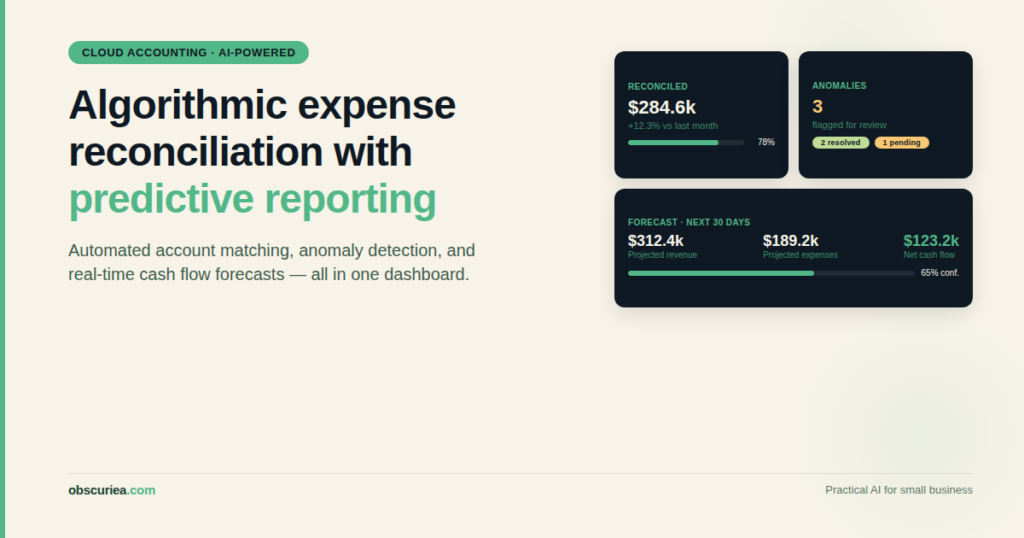
Cloud Accounting with Algorithmic Expense Reconciliation and Automated Predictive Reporting
Most finance teams are not losing money to fraud. They are losing it to lag — the 11-day gap between a transaction hitting a card and someone in accounting actually seeing it, understanding it, and reconciling it against the right GL code. That lag is where errors compound, where audits get expensive, and where the CFO’s monthly numbers arrive late enough to be mostly useless for real decisions.
TL;DR: Cloud accounting platforms with algorithmic expense reconciliation compress the transaction-to-close cycle from weeks to hours. The math favors operators running more than 500 monthly transactions who are currently absorbing 15+ analyst hours per close cycle. Predictive reporting adds a second ROI layer — forward-looking cash flow visibility instead of backward-looking ledger summaries.
Environment: Analysis based on HighRadius reconciliation architecture, Navan Expense AI agents, and Optimus Fintech cloud reconciliation infrastructure. Research period: Q1–Q2 2025. Applicable to SMB operators with 10–200 employees and mid-market finance teams running multi-entity environments.
How Cloud Accounting with Algorithmic Expense Reconciliation Actually Works
The standard reconciliation stack at most small-to-mid-size businesses looks like this: someone exports a bank statement, someone else opens a spreadsheet, and a third person spends two days matching rows while a fourth person chases receipts over Slack. At 200 transactions a month, this is annoying. At 2,000 transactions, it is a structural bottleneck that directly delays your financial close — and your ability to make any capital decision that depends on current numbers.
Cloud accounting with algorithmic expense reconciliation replaces that stack with a three-layer system.
Layer 1: Unified data ingestion. Pre-built API and SFTP connectors pull bank statements, ERP balances, payment processor data, and subledger entries into a single reconciliation engine in real time. No manual exports. No spreadsheet uploads. The data is already in one place before an analyst opens their laptop.
Layer 2: ML-driven matching. The engine applies configurable rules — matching on amount, date, reference IDs — and simultaneously uses machine learning to identify patterns from historical reconciliation behavior. New matching rules emerge from the model itself, not from a finance analyst writing logic by hand. This matters because transaction behavior evolves. A new payment processor, a new vendor, a new cost center — manual rule libraries go stale. ML models retrain on the new patterns automatically.
Layer 3: Exception routing with context. Transactions that do not auto-match get flagged, categorized by exception type — missing entry, duplicate, timing gap, unmatched transaction — and routed for human review with supporting documentation already attached. The analyst sees the exception and the evidence simultaneously. No digging through systems to understand what went wrong.
The result is that the human workload concentrates on the 3–8% of transactions that genuinely need judgment, not the 92–97% that follow established patterns.
The Workflow Math: Time and Cost Comparison
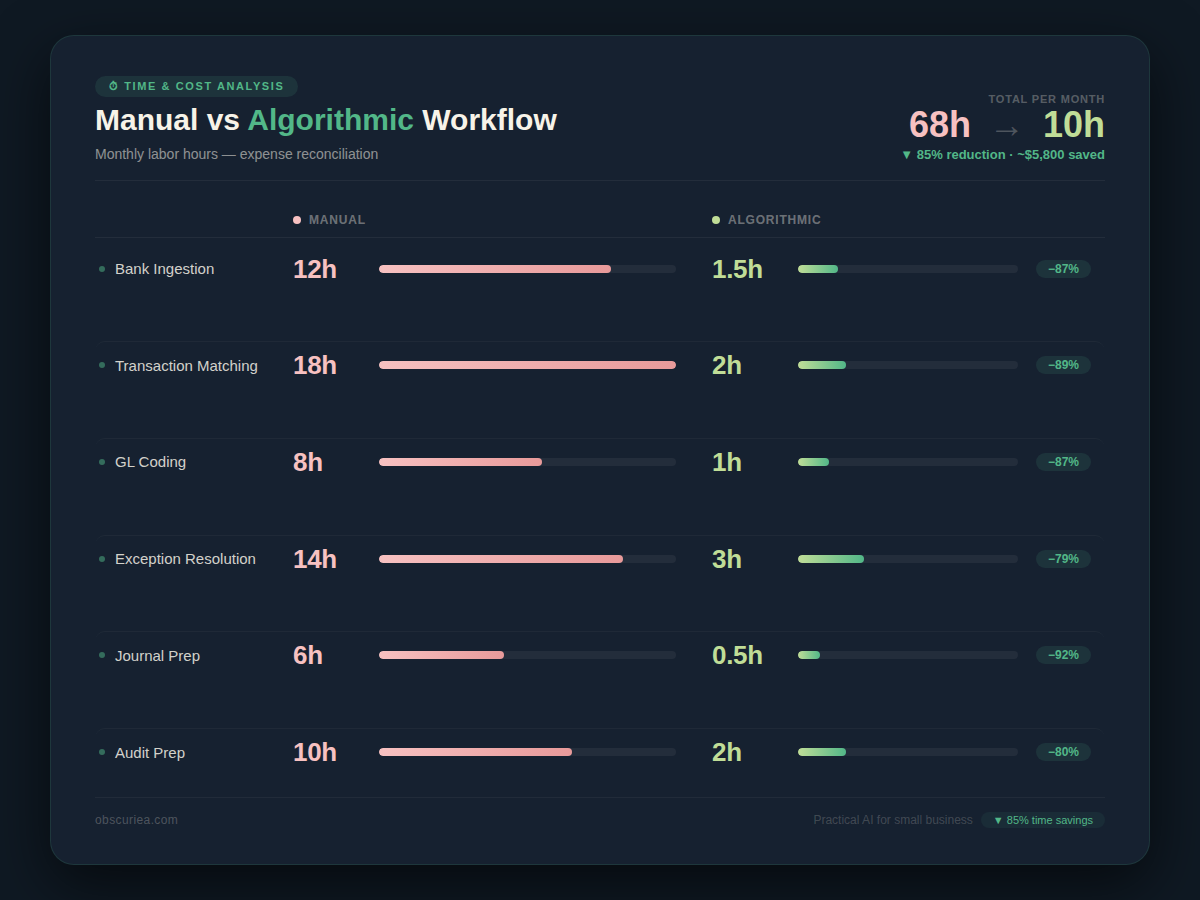
Here is where operators need to run their own numbers before committing to a platform. The math is straightforward, but it only works if you measure your current state honestly.
| Process | Manual Workflow | Algorithmic Workflow |
|---|---|---|
| Bank statement ingestion | 45–90 min/cycle | 0 min (automated pull) |
| Transaction matching | 8–20 hrs/month | 15–45 min (exception review only) |
| GL coding | 3–6 hrs/month | Near-zero (ML prediction) |
| Exception resolution | 2–4 hrs/month | 1–2 hrs (pre-contextualized) |
| Journal entry preparation | 2–3 hrs/month | Automated for standard variances |
| Audit prep | 4–8 hrs/quarter | 30–60 min (auto-generated documentation) |
The Forrester TEI study on Navan’s platform documented 80% reduction in time-per-expense-report for employees and 40% reduction in audit time for finance teams. Those numbers come from a composite enterprise profile, but the directional math holds at smaller scale. A 3-person finance team absorbing 20 hours per close cycle is looking at recovering 12–16 of those hours. At a fully-loaded labor cost of $35–$55/hour, that is $420–$880 per close cycle, or $5,000–$10,500 annually — before counting the cost of errors caught late.
The break-even calculation for most operators: if your current reconciliation labor cost per month exceeds the platform subscription, the decision is already made. According to [Navan’s research](https://navan.com/blog/ai-tools-financial-reconciliation-expense-reporting), 71% of employees still spend more than 30 minutes per expense report — a figure that compounds fast across a 50-person organization.
Automated Predictive Reporting: The Second ROI Layer
Reconciliation fixes the past. Predictive reporting is where cloud accounting starts generating forward-looking value — and where most operators have not even started extracting the ROI.
The reconciliation engine is sitting on a complete, clean, time-stamped transaction history. That dataset is exactly what a predictive model needs to project cash flow, flag anomalies before they become problems, and surface spending pattern deviations before month-end.
Specific outputs that automated predictive reporting layers generate:
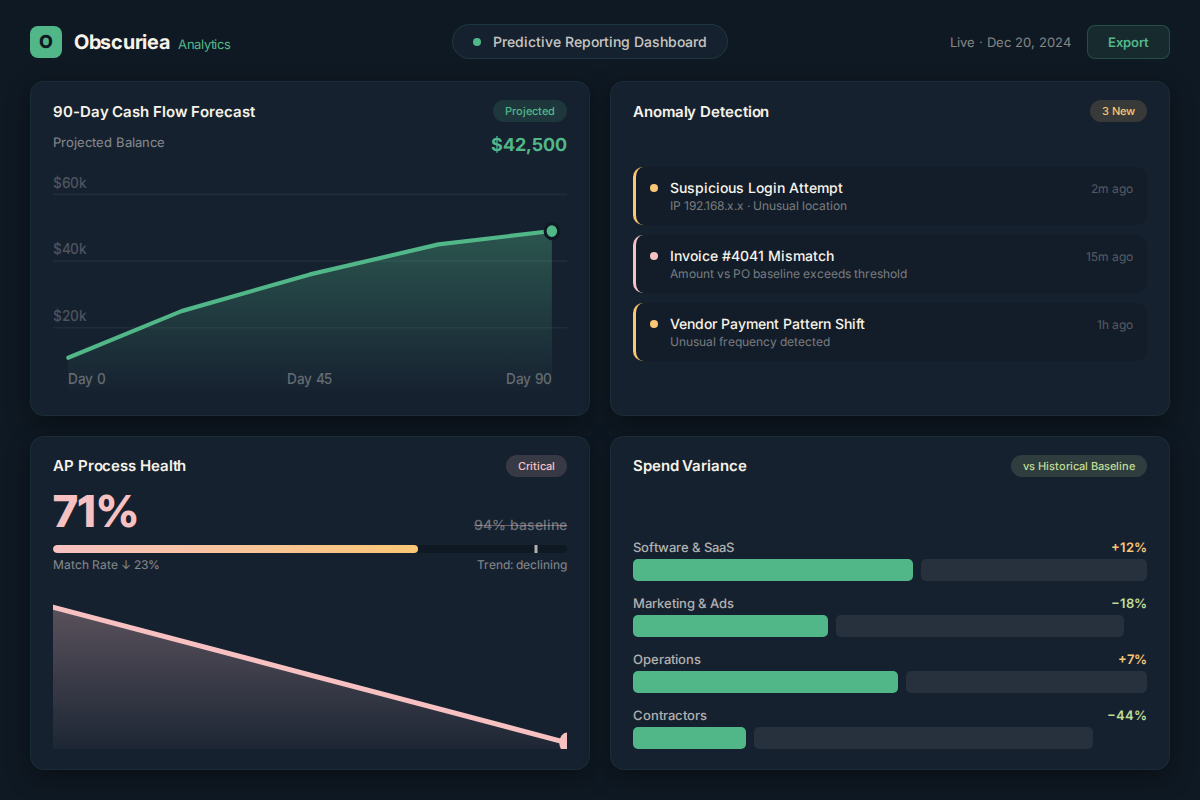
Cash flow forecasting. The model knows your vendor payment cycles, your receivables timing, and your recurring expense structure. It can project 30-, 60-, and 90-day cash positions with reasonable accuracy — not based on someone’s estimate in a spreadsheet, but based on actual transaction behavior from the previous 12–24 months. For operators managing working capital against a credit line, this is not a nice-to-have. It is the difference between a proactive call to your lender and a reactive one.
Anomaly detection before close. Instead of discovering in month-end review that a vendor was double-paid in week two, the system surfaces the anomaly when it happens. [HighRadius’s architecture](https://www.highradius.com/product/account-reconciliation-software/) specifically flags unauthorized transactions, duplicate postings, and cash leakage patterns as part of the reconciliation loop — not as a separate audit function. The detection window moves from 30 days post-fact to same-day.
Process break identification. When the auto-match rate on a specific account drops from 94% to 71% over three weeks, that is a signal — new transaction format from a payment processor, a GL mapping that got changed, a new expense category being miscoded. Automated predictive reporting surfaces these process breaks as leading indicators, not lagging ones.
Spend pattern variance reporting. The system compares current-period spend by category, vendor, and cost center against historical baselines. Variances above defined thresholds surface automatically. For operators managing against a budget, this replaces the manual variance analysis that typically happens two weeks after the period closes — when acting on it is already expensive.
Where Algorithmic Reconciliation Breaks
Three failure conditions that operators consistently underestimate:
Data quality at ingestion. The ML matching engine is only as good as the data it ingests. If your ERP has inconsistent vendor naming conventions — “Amazon” in one system, “Amazon Web Services” in another, “AWS” in a third — the matching logic fragments. Before deploying cloud accounting with algorithmic expense reconciliation, audit your data sources for consistency. This cleanup phase takes 2–4 weeks at most organizations and is the actual bottleneck, not the platform implementation.
Rule library cold start. The ML model improves over time, but it starts with limited pattern history in a new environment. The first 60–90 days of deployment will show lower auto-match rates than the platform’s marketing claims. Plan for elevated exception volume during this period. Staff the review queue accordingly instead of assuming the system performs at full capacity on day one.
Human oversight gaps on high-risk exceptions. The architecture correctly routes complex exceptions for human review. The failure mode occurs when the review queue gets backlogged and exceptions age without resolution. At that point, the system’s accuracy advantage disappears — you still have unreconciled transactions, they just sit in a digital queue instead of a spreadsheet. The workflow discipline required to clear exceptions within 24–48 hours is an operational commitment, not a software feature.
The Friction Box
- ERP integration depth varies significantly by platform — bidirectional sync with NetSuite and Sage Intacct is table-stakes for mid-market, but not all platforms deliver it cleanly. Verify before committing.
- Multi-entity environments require additional configuration time — plan for 4–6 weeks per entity during initial setup, not 4–6 weeks total.
- Predictive reporting accuracy degrades on volatile transaction environments — seasonal businesses or those in rapid growth phases will see wider forecast variance ranges.
- Pricing architectures on most platforms are credit- or transaction-volume-based — high-volume months can push costs above projections if transaction tiers are not mapped to your actual volume patterns.
- VAT reclamation automation requires specific documentation standards — international operators need to verify compliance with destination-country requirements before assuming automation handles everything.
The Straight Talk
This architecture is built for operators running at least 500 monthly transactions who currently employ a human to manage reconciliation cycles. If your transaction volume is lower and your current process takes under 5 hours per month, the setup investment does not pencil out yet.
If you are managing multi-entity environments, significant travel and expense volume, or a finance team that spends more time on close mechanics than on analysis, the ROI case for cloud accounting with algorithmic expense reconciliation and automated predictive reporting is straightforward — deploy algorithmic reconciliation first, let predictive reporting run for 90 days on clean data, then evaluate the forecast accuracy against your actual cash positions.
Start with the data audit. Before you demo a platform, export 90 days of transactions from every source you plan to connect and check vendor naming consistency, GL code standardization, and duplicate transaction frequency. That audit will tell you your actual implementation timeline and whether you need a data cleanup sprint before go-live.