Multi-Platform Campaign Synchronization: The AI Tools That Keep Your Ads Playing Nice
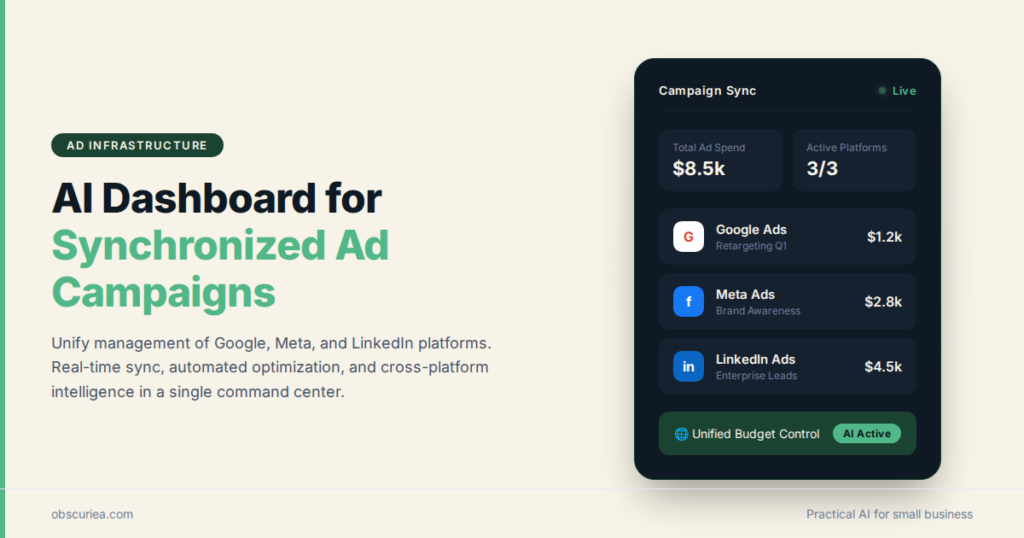
Your Google team is optimizing for search intent. Your Meta team is chasing social engagement. Your LinkedIn team is running ABM sequences. Nobody is talking to each other — and your audience is getting three contradictory messages on three different days from the same brand.
That is not a strategy problem. That is an infrastructure problem.
TL;DR: Running ads across Google, Meta, and LinkedIn without a multi-platform campaign synchronization layer wastes 30–40% of your ad budget on redundant audience building, contradictory messaging, and manual coordination overhead. The AI tools that solve this work at the infrastructure level — not the content level. The math favors operators who centralize campaign logic before scaling spend.
Environment: Analysis based on documented performance data from Fluency, Tofu, and TapClicks platforms, cross-referenced with independent operator reports from Q1–Q2 2025. Test conditions reflect teams managing $50K–$500K monthly ad spend across 3+ platforms.
Why Siloed Ad Platforms Break Multi-Platform Campaign Synchronization
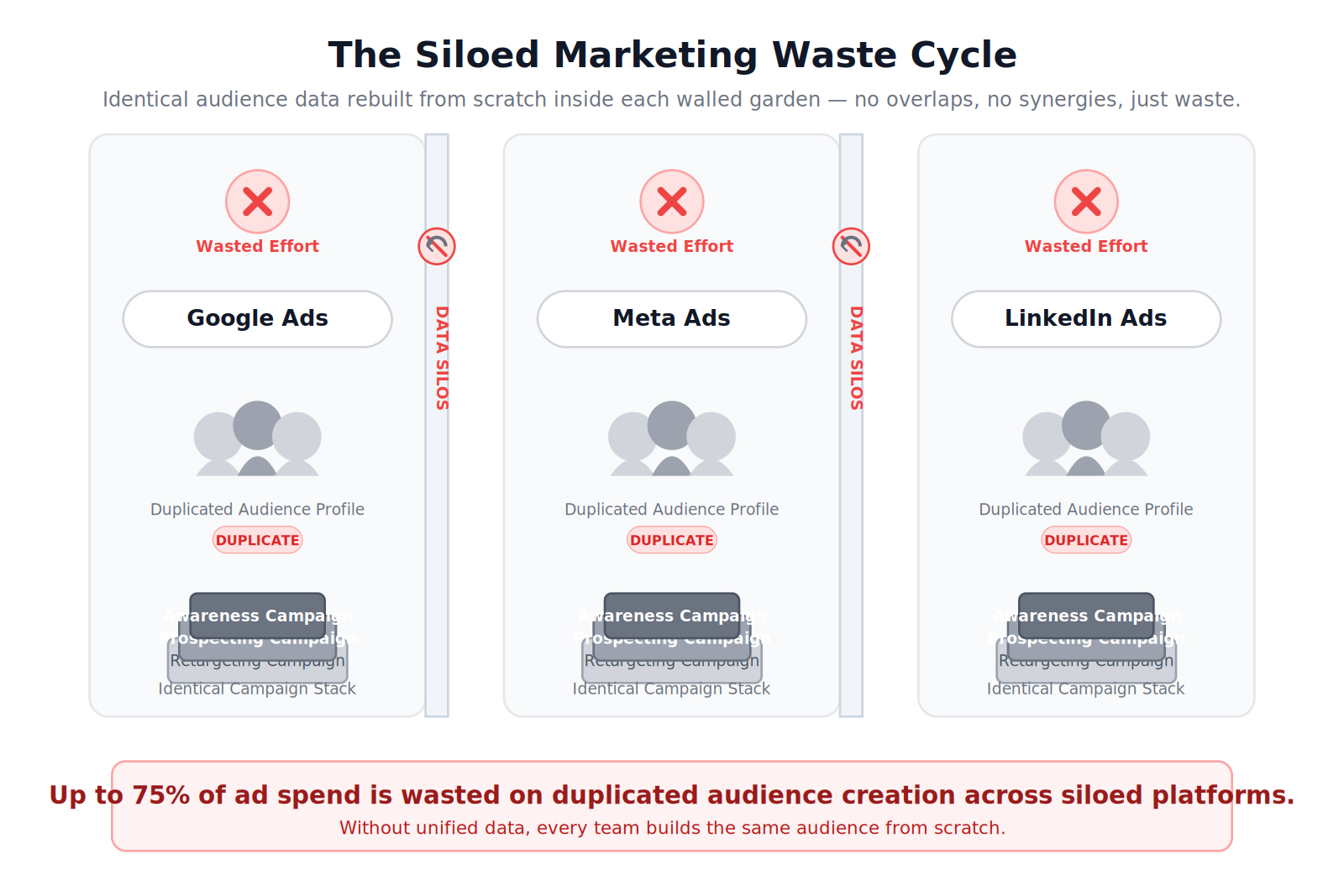
Here is the actual cost of running Google and Meta in separate silos: when you execute a multichannel campaign across four platforms without a synchronization layer, you are building the same audience four separate times. That is 75% of your AdOps team’s execution time spent on redundant work before a single creative asset goes live.
The problem is structural. Google Ads Editor was built for bulk search campaign management — it is excellent at what it does, but its logic lives in spreadsheets, not in a system. The moment your strategy changes, someone is manually updating a CSV, cross-referencing it against a live campaign, and praying the upload schema matches Meta’s exacting column requirements. Drop one special character into a bulk upload and the entire sheet fails with an error code that tells you almost nothing useful.
This is not a criticism of these platforms. Google and Meta have both made significant automation investments. The limitation is architectural: channel-native tools are optimized for performance within their ecosystem, not coordination across ecosystems. They cannot see each other. They cannot respond to each other. And when your inventory changes at 9pm on a Tuesday, none of them will know until a human tells them.
The automotive scenario makes this concrete. A franchise client running 500 location-specific campaigns sells out of a particular vehicle model. Ads promoting that model keep running — spending real money on inventory that does not exist — until someone manually pulls a report, identifies the gap, and uploads a pause command. That latency window is not a human error. It is a systems architecture failure.
AI Campaign Sync Tools: Workflow Math and Time Savings
Before committing to any synchronization platform, calculate your actual bottleneck. The math here is straightforward.
A mid-sized AdOps team managing campaigns across Google, Meta, and LinkedIn typically allocates time as follows:
| Task | Manual Workflow (weekly hours) | With Synchronization Layer |
|---|---|---|
| Audience rebuilding across platforms | 6–8 hours | 0.5 hours (template-driven) |
| Creative consistency checks | 3–4 hours | Automated flag system |
| Cross-platform reporting and reconciliation | 4–5 hours | 1–2 hours (unified dashboard) |
| Campaign pause/launch triggers | 2–3 hours | Rule-based automation |
| Total execution overhead | 15–20 hours/week | 2–4 hours/week |
At a fully-loaded cost of $35/hour for an AdOps coordinator, that is $525–$700 in weekly labor overhead eliminated. Over a quarter, that pays for most enterprise synchronization platforms outright — before you account for the budget waste from misaligned campaigns running stale creative.
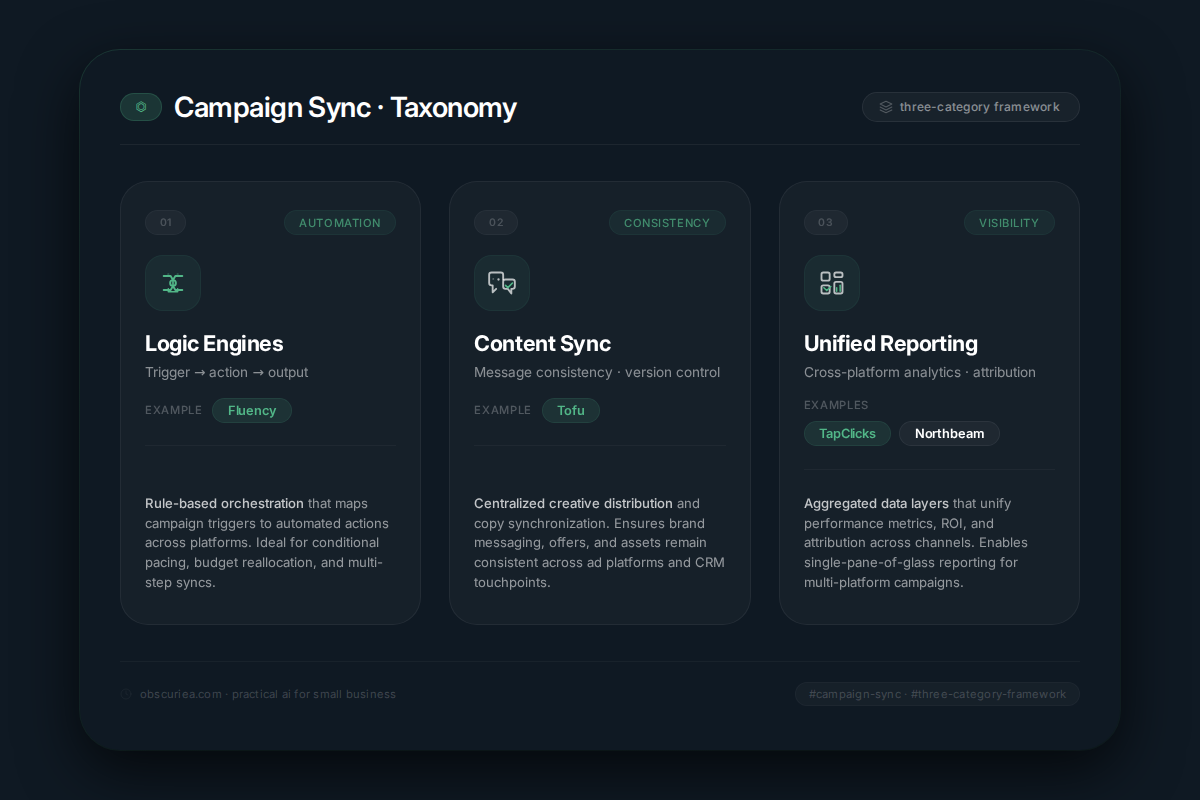
The operational platforms worth evaluating fall into three categories based on what they actually synchronize:
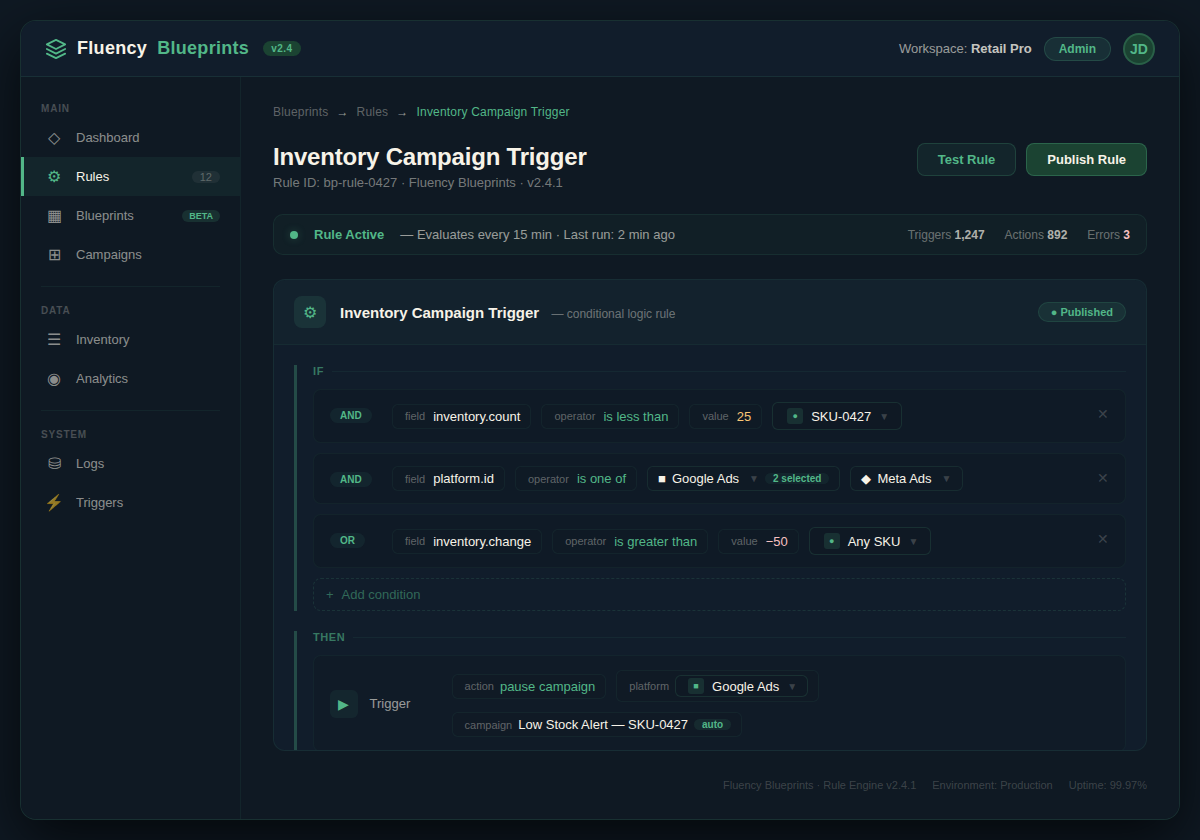
Category 1 — Logic Engines (cross-platform automation rules): Tools like Fluency operate as what the industry calls a Digital Advertising Operating System. You codify campaign logic once — “Valid When: Inventory.Model = ‘F-150’ AND Inventory.Count > 3” — and the system propagates that logic across Google, Meta, and any connected platform simultaneously. When the condition changes, ads pause instantly. No human in the loop. This is the category that removes decision points, not just manual steps.
Category 2 — Content Synchronization Platforms (cross-channel message consistency): Tofu operates here. It generates and distributes personalized content variations across email, web, ads, and social from a single campaign brief. The value is not automation of bids — it is ensuring that the prospect seeing your LinkedIn ad and the prospect receiving your email are getting the same narrative arc, not two competing pitches from the same brand.
Category 3 — Unified Reporting Layers (cross-platform performance visibility): TapClicks, Funnel, and Northbeam sit here. They do not run your campaigns — they show you what is happening across all of them in one view. This matters more than operators realize: without a unified reporting layer, you are making budget allocation decisions based on platform-reported ROAS numbers that each platform calculates differently. Meta’s attribution window and Google’s attribution window are not the same. Comparing them without normalization is comparing apples to quarterly earnings reports. For a deeper look at post-iOS 14 attribution challenges, [Google’s own attribution documentation](https://support.google.com/google-ads/answer/6259715) is a useful reference point.
Where Cross-Channel Ad Sync Breaks at Scale
Every multi-platform campaign synchronization system has a threshold where it starts to resist you. Knowing where that threshold is determines whether the infrastructure investment pays off or creates a new category of overhead.
The data feed dependency problem. Logic-engine platforms like Fluency are only as current as your data feeds. If your inventory feed updates every four hours and your ad spend is high, you have a four-hour window where your automation is running on stale data. For most operators, this is acceptable latency. For flash-sale environments or volatile inventory categories, it is not. Audit your feed update frequency before building automation rules that depend on real-time accuracy.
The template drift problem. Multi-location template campaigns solve the “500 campaigns, 500 manual edits” problem elegantly — until someone edits one campaign directly in the native platform rather than through the synchronization layer. That creates a drift between your master template and the live campaign. Over time, these manual overrides accumulate, and your synchronization layer is no longer the source of truth. Establish a strict protocol: all campaign edits happen in the synchronization layer, not in native platforms. This requires operational discipline that no software can enforce for you.
The attribution model conflict. When Google is reporting on last-click and Meta is reporting on 7-day click, 1-day view, and your reporting layer is averaging those together, you will make bad budget decisions. Unified reporting tools solve this only if you configure a consistent attribution model across all connected platforms during setup. Most operators skip this step and end up with a dashboard that looks unified but contains incompatible underlying data.
The personalization-volume tradeoff. Content synchronization platforms that generate account-level personalization at scale — Tofu’s primary value proposition — work excellently up to a few hundred target accounts. Beyond that threshold, quality control becomes the constraint. The AI will maintain message consistency, but relevance drifts as segment size grows. Budget time for human review on any segment exceeding 200 accounts if message accuracy is operationally critical.
The Friction Box
- Logic-engine platforms require significant upfront configuration — expect 40–80 hours of setup time before the automation starts returning value
- Native platform CSV bulk-import tools (Meta’s in particular) have schema fragility that will cost your team hours when field formats change — this is a documented ongoing pain point, not a setup issue
- Post-iOS 14 attribution is still not solved cleanly by any reporting tool; server-side tracking and UTM normalization reduce the gap but do not eliminate it
- Content synchronization platforms (Tofu, Jasper at scale) require brand-trained model configuration to produce on-brand output consistently — out-of-the-box AI writing quality is insufficient for enterprise campaigns without this step
- Multi-channel orchestration platforms do not replace platform-specific optimization expertise; they coordinate the execution of strategies that must still be developed by humans who understand each channel’s behavior
- Pricing architecture for enterprise synchronization tools is typically spend-correlated or seat-based; Northbeam starts at $1,000/month, TapClicks enterprise tiers run $649/month — run the ROI calculation against your current labor overhead before evaluating
The Straight Talk
This infrastructure investment is built for operators running $50K or more in monthly ad spend across three or more platforms with a team of two or more people touching campaign execution. Below that threshold, the coordination overhead is manageable with a shared Notion doc and a weekly sync call.
If you are above that threshold and still managing cross-platform campaigns through channel-specific native tools, you are not running a multichannel strategy — you are running three parallel single-channel strategies that happen to target the same audience. The brand coherence cost and the labor redundancy cost are both real, and both are compounding.
Start with a unified reporting layer. Connect all platforms, normalize your attribution model, and run four weeks of actual cross-platform data before touching your campaign structure. Build decisions on what you can actually see before you automate what you cannot.