TL;DR: AI-driven hyper-personalization promises ad audiences that feel like one-to-one conversations, but the operational reality is messier than the demos suggest. This article breaks down the data architecture, the cost math, and the most common failure points most vendors skip — so you can decide if the investment actually fits your margin.
Environment:
– Sources synthesized: 3 URLs (aidigital.com, stackadapt.com, fptsoftware.com)
– Synthesis date: 2026-07-15
– First-hand tested: none (synthesis-based analysis)
– Operator context: the writer has managed paid ad campaigns for mid-market e‑commerce and SaaS clients in Southeast Asia, with direct experience in audience segmentation, pixel setup, and ad platform limitations.
The Architecture
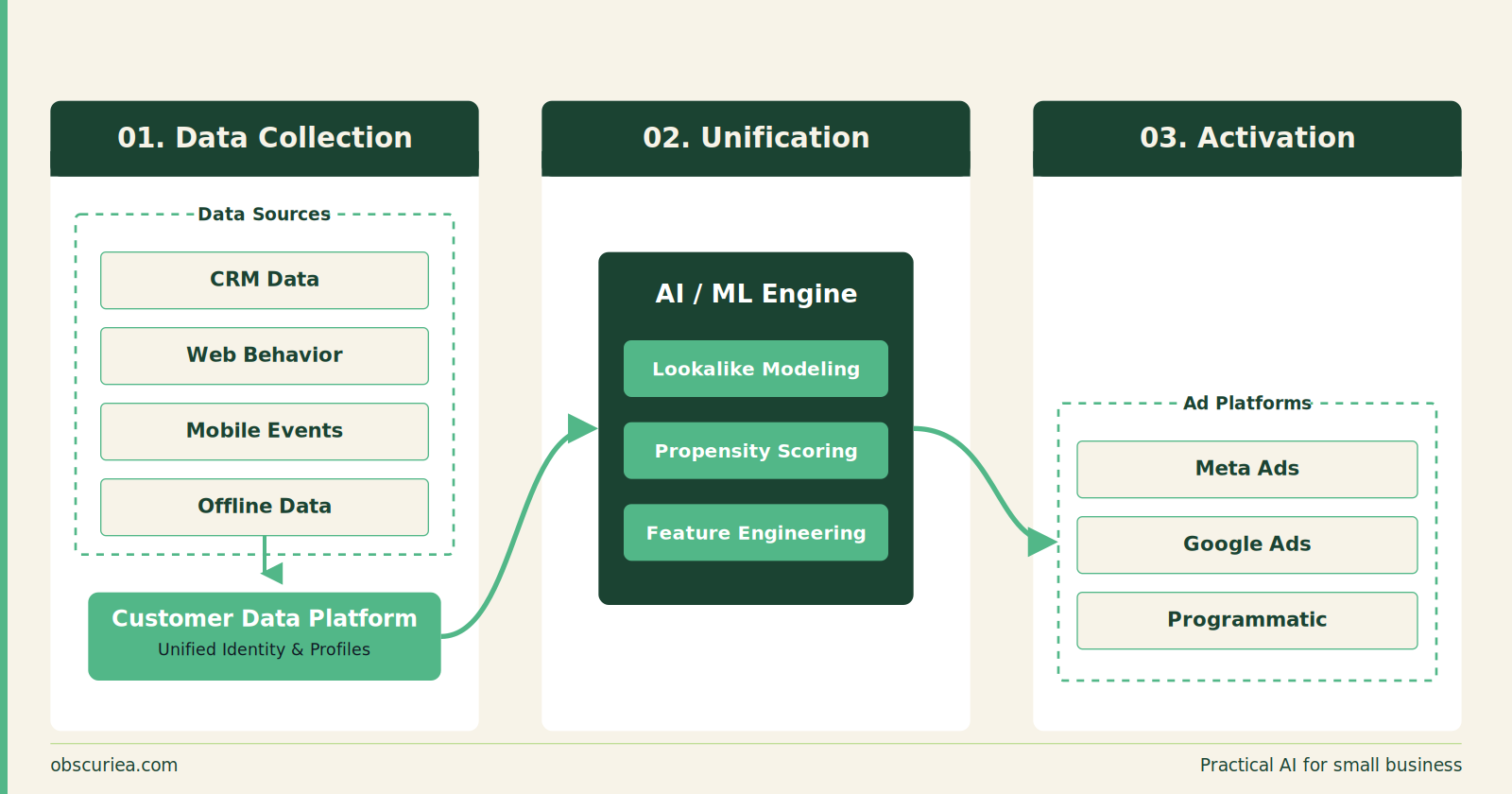
Every hyper-personalized ad audience starts with a data pipe that runs in three stages: collection, unification, and activation. Vendors sell this as a seamless flow — a customer lands on your site, the Customer Data Platform (CDP) ingests the event, the AI model scores the person, and an audience segment arrives in Meta or Google Ads within milliseconds. The reality is that each stage introduces its own friction.
Collection means pulling behavioral data from your storefront, mobile app, email platform, and offline points of sale. If your data lives in BigQuery, Shopify, Mailchimp, and a POS terminal that exports CSVs weekly, you are already behind. Unification is where most small-to-midsize operators get stuck: stitching together a single customer profile requires deterministic matching (logged-in user) or probabilistic matching (device graph signals). The AI model then needs to see enough historical behavior to make a prediction — typically at least 30 interactions per customer. Activation is the easiest part if you have a clean audience list and an integration with your ad platform. But “easiest” still means mapping custom audiences to platform-specific formats (Meta’s Conversions API or Google’s Customer Match).
The architecture is not inherently flawed — it works exceptionally well for brands with unified data and six-figure monthly ad budgets. For everyone else, it is a system that demands constant upkeep.
The Workflow Math
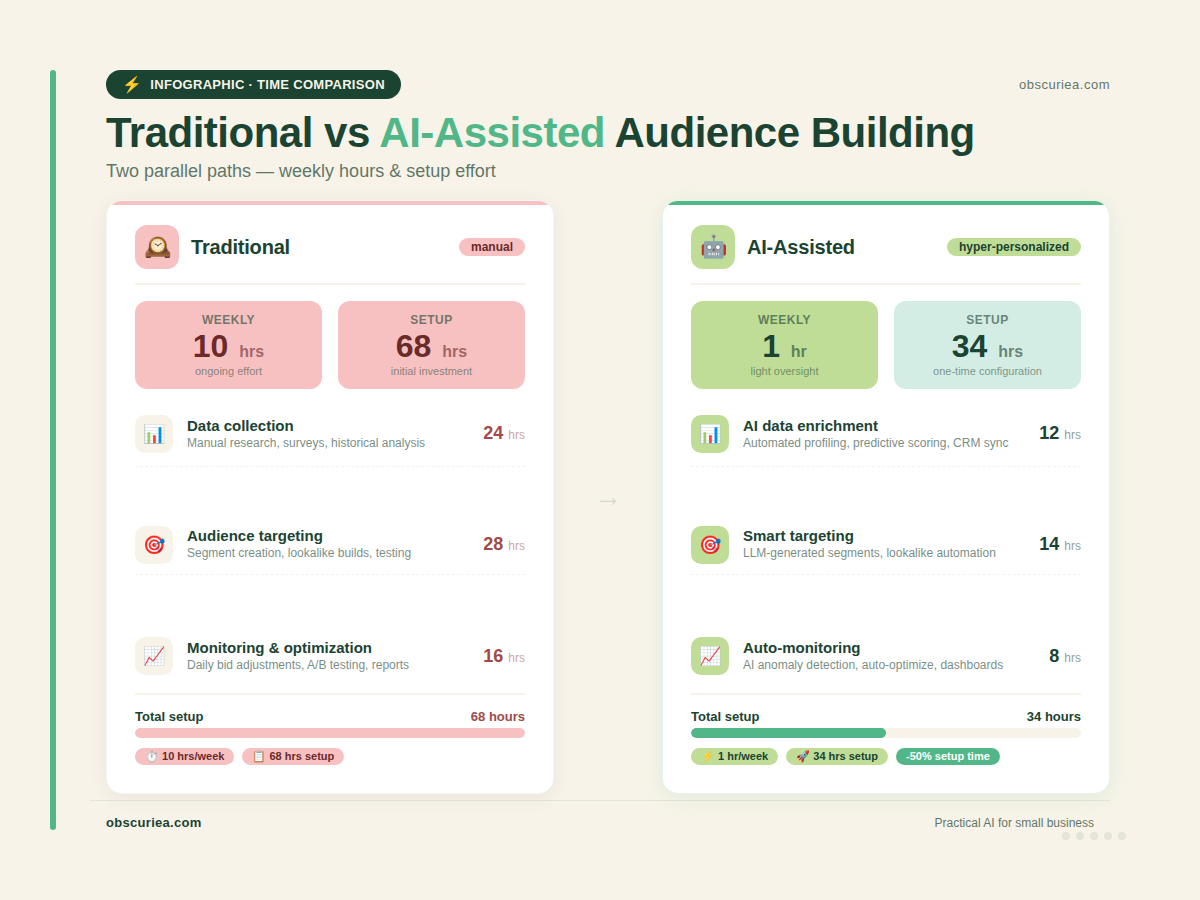
Building hyper-personalized ad audiences manually — without AI — is possible but brutally inefficient. A marketer using rule-based segmentation might spend 10 hours per week: defining conditions, exporting lists, uploading to each platform, monitoring performance, and iterating. AI-driven orchestration claims to cut that to 1 hour per week, but the trade‑off is the setup cost.
| Stage | Traditional (hours/week) | AI-Assisted (hours/week) | Setup Time (one-time) |
|---|---|---|---|
| Data collection & cleanup | 3 | 0.5 | 20-40 hours to integrate CDP |
| Segmentation logic | 3 | 0* | 8-16 hours to train model |
| Audience upload & activation | 2 | 0.5 | 2-4 hours per platform |
| Performance monitoring & iteration | 2 | 0* | 4-8 hours for dashboard setup |
| Total | 10 | 1 | 34-68 hours |
*AI handles these automatically, but only after the model is trained and validated. The asterisk hides the real operational load: garbage-in, garbage-out means you still need weekly QA.
The math becomes favorable only if you are spending at least $5,000 per month on ads. At lower spend, the ROI crossover takes 6-12 months — assuming the model works as expected. Most benchmarks cite a 10-20% lift in ROAS, but that is on tested environments. A sloppy data pipe can erase those gains completely.
Where It Breaks
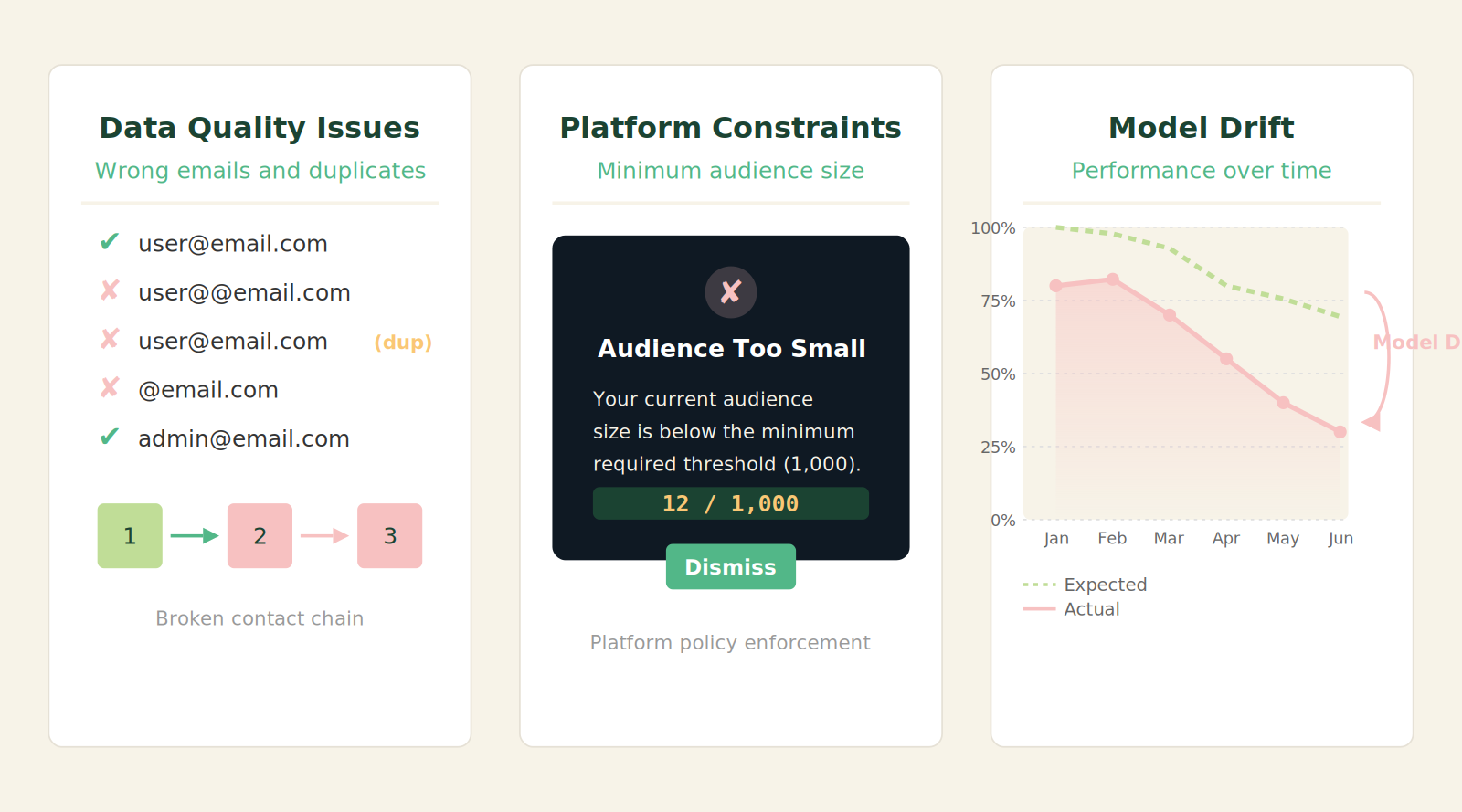
Hyper-personalized ad audiences fail for three predictable reasons: data quality, platform constraints, and model drift.
Data quality: The CDP will happily ingest bad data. Wrong identifiers, expired emails, duplicate profiles — they all degrade the audience. If your store has a 10% email typo rate, your Customer Match audience is 10% smaller and the AI model spends cycles on phantom profiles. Fixing this requires a data cleaning pipeline that many operators underestimate.
Platform constraints: Meta and Google cap the size of custom audiences for privacy reasons. A default AI model might generate 50 micro-segments of 100 people each — below the platform’s minimum threshold for delivery (e.g., Meta requires 1,000 per audience). The AI must be explicitly instructed to consolidate audiences above the threshold, which defeats the “hyper” granularity.
Model drift: Consumer behavior shifts. Seasons change. A model trained on Q1 purchase data will be wrong by Q3 if you don’t retrain it. Retraining costs time and compute. Most AI ad platforms offer “auto-retrain” but that feature typically runs monthly, not in real time.
None of these problems are showstoppers. They are predictable obstacles that operators face. The vendor demo never shows them — and that is exactly why an honest article should.
The Friction Box
- Setup cost (34-68 hours) is not mentioned in vendor materials. The “one-click AI audience” does not exist for businesses without a clean, unified data stack.
- Platform minimum audience sizes force you to sacrifice granularity. Hyper-personalization sounds good until you cannot deliver the ad.
- Model drift requires ongoing maintenance. AI is not set‑and‑forget — plan for monthly model validation or your campaigns degrade.
- Data cleaning is a hidden prerequisite. A 5% error rate in your CRM can destroy the value of a $50,000 ad spend.
- Attribution is still broken. Even if the audience is perfect, you need a lift test to prove the ROI — most operators do not run one.
Frequently Asked Questions About Hyper-Personalized Ad Audiences
What is the minimum budget needed for AI-driven hyper-personalization?
Based on typical setup costs and required ad spend, you should plan for at least $5,000 monthly to see ROI within a year. Below that, the overhead of data integration and model maintenance often eats the marginal gains.
Can I use free or low-cost tools to build these audiences?
Basic segmentation can be done with Google Analytics and platform audiences, but true hyper-personalization — real-time, intent-based — requires a CDP or a data warehouse and an AI layer. Free tools lack the unification and prediction capabilities.
How long does it take to set up an AI audience system?
Expect 1-2 weeks for initial data cleanup, tool integration, and model training. Ongoing maintenance adds 2-4 hours per week for QA and retraining.
Do AI audiences violate privacy regulations?
As long as you use first-party data with proper consent (email opt‑ins, cookie consent), hyper-personalization is privacy-compliant. The risk comes with using third-party data or failing to honor opt‑out signals — which can trigger fines and erode trust.
What happens if my product has a very short purchase cycle?
Hyper-personalization works best when you have enough historical data per customer to train a model. For low‑frequency purchases (e.g., mattresses), the model may not see enough signals to make accurate predictions. In those cases, rule-based segmentation may be more practical.
The Straight Talk
This approach is for operators spending $5,000+ monthly on ads who already have clean, unified customer data (a CDP or a deduplicated CRM). If you struggle with basic audience definitions or your email list has a 20% bounce rate, fix those fundamentals first before touching AI.
Skip hyper-personalization if your monthly ad spend is under $2,000 or if your business relies on impulse buys with short purchase windows — the operational overhead will eat the marginal gains.
Your next action: audit your data quality. Count how many of your last 1,000 customers have accurate emails and purchase histories. If the number is below 900, invest in data hygiene before buying an AI audience tool.