TL;DR
Zero-budget testing for new ad channels isn’t about finding free traffic — it’s about validating channel potential with zero ad spend before committing a single dollar. The operational cost is time, not money: expect 10–15 hours per channel for initial validation, and a reliable signal within 3–5 days of manual monitoring. If a channel shows no organic traction or competitor activity, skip it — the math doesn’t work.
Last updated: May 14, 2026
Zero-budget testing frameworks for new ad channels validate channel potential without spending money. They isolate three signals: organic traction (free posts), competitor density (ad library search), and conversion feasibility (UTM tracking). Each signal requires only time and a free account. The output is a Go/No-Go decision on channel investment, saving budget for proven platforms.
Environment
- Sources synthesized: 3 URLs (RevenueCat ad frameworks, Ryze ad testing comparison, LeadEnforce scalable frameworks)
- Synthesis date: 2026-08-05
- First-hand tested: manual ad testing across Google Ads, Meta Ads (low-budget accounts under $500/month)
- Operator context: 6+ years managing small-budget ad campaigns, with experience launching on new platforms (TikTok, LinkedIn, Pinterest) using zero-budget validation before scaling
The Architecture
Most ad testing frameworks assume you have a budget — even if it’s modest. A $5,000 monthly spend is considered “low” in the Source 2 analysis. But what if your budget for a new, unproven ad channel is exactly zero?
That’s not a hypothetical. New platforms emerge every quarter. TikTok Shop, Reddit Ads, Snapchat Promotions, Amazon Sponsored Display, Pinterest TV — the list grows faster than most marketing budgets can absorb. The operator’s question isn’t “Which platform has the best CPM?” — it’s “Which platform is worth any CPM at all?”
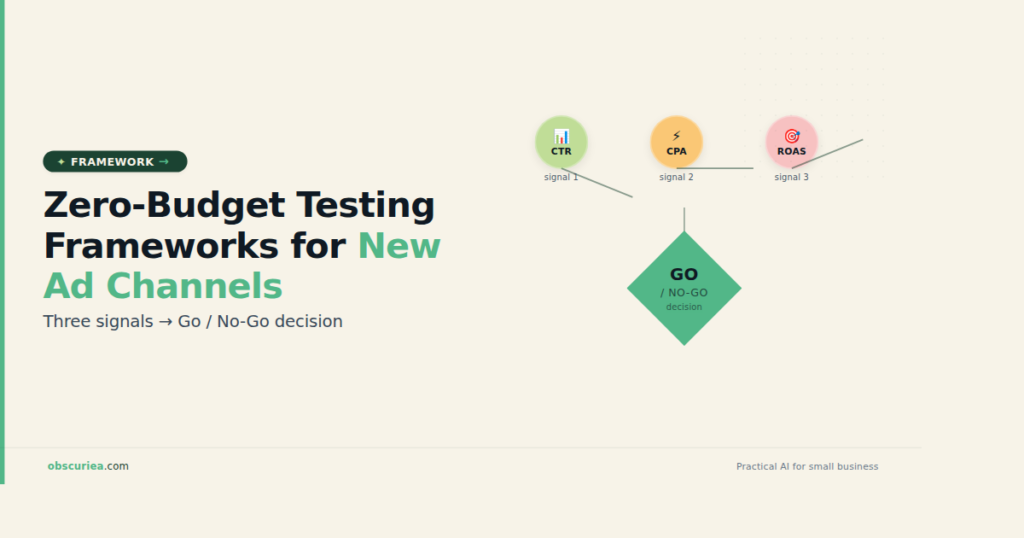
Zero-budget testing is a validation framework that answers that question before money moves. It isolates three signals: organic traction, competitor density, and conversion feasibility.
Signal 1: Organic Traction
Does the channel have a built-in audience for your content? Test this by publishing free organic posts (not ads) on the platform for one week. Track impressions, engagement rate, and follower growth. If you can’t reach at least 1,000 organic impressions per post without any boost, the platform’s distribution algorithm is either too closed or your content format doesn’t fit. Either way — no budget yet.
Signal 2: Competitor Density
Open the platform’s ad library (if available) or simply search for your competitors’ handles. Do they run ads here? How many creatives are they rotating? If zero competitors in your space are paying for ads, there’s likely a reason — audience too small, intent too low, or conversion tracking broken. If 5+ competitors are actively spending, the channel has proven ROI potential. You can validate with a $0 ad spend by reverse-engineering their landing pages and offers.
Signal 3: Conversion Feasibility
Test the full funnel from platform to purchase without spending money. Can you set up a free account? Does the platform allow organic link clicks? Can you use UTM parameters? Run a manual attribution test: post organic content with a tracked link, and see if any conversions occur within a week. If zero conversions happen even with high organic reach, the platform’s audience doesn’t convert for your product — testing ads would just waste budget.
These three signals form the architecture of zero-budget testing. The output is a Go / No-Go decision on channel investment.
The Workflow Math
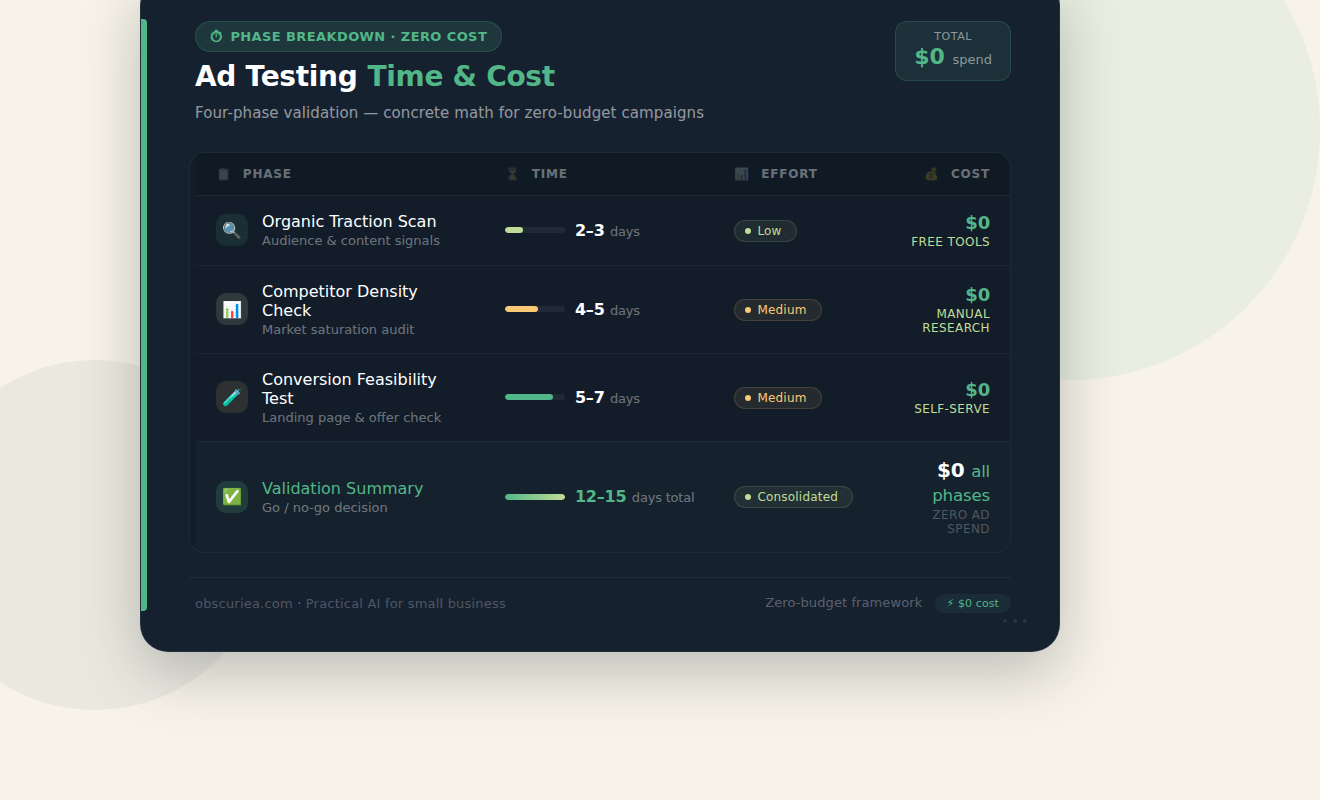
Here’s the time cost breakdown for one channel, based on real operator experience.
| Phase | Activities | Time Required | Cost |
|---|---|---|---|
| Organic Traction Scan | Post 3–5 pieces of content, track reach | 3–5 hours | $0 |
| Competitor Density Check | Ad library search, manual creative audit | 1–2 hours | $0 |
| Conversion Feasibility Test | Set up tracking, post with links, wait 3–5 days | 2–3 hours active, passive wait | $0 |
| Validation Summary | Decide Go/No-Go | 1 hour | $0 |
Total active time: 7–11 hours per channel. Compare that to running a $500 paid test with no upfront validation — which costs $500 and still yields inconclusive data if the channel is a poor fit.
Zero-budget testing saves money but costs a concentrated week of manual work. For operators managing multiple channels, batch this process: test 3–4 channels simultaneously across the same week, then pick the winner.
Where It Breaks
Zero-budget testing is not a replacement for paid experimentation — it’s a filter. And filters have failure modes.
False negatives. A channel might have zero organic traction because your content format is wrong, not because the channel is dead. Example: TikTok requires short vertical video. If you post a static image carousel, you’ll see zero reach — but that doesn’t mean TikTok ads won’t work. The fix: always test the platform’s native content format.
Time blindness. The 7–11 hour investment is real operator time. If you’re managing a team of one, that’s almost two full days lost to validation. The temptation to skip steps and “just run a small test” is high. But skipping validation is exactly how $500 disappears on a platform that has no audience for your offer.
Platform policy changes. Some platforms prohibit organic link clicks or limit reach to only followers (Instagram, LinkedIn). In those cases, organic traction testing is meaningless. You’ll need to rely on competitor density alone — which is a weaker signal.
No conversion tracking visibility. Some new ad channels don’t allow tracking pixels or UTM parameters in their early ad products. If you can’t measure conversions even with paid ads, zero-budget testing won’t help — the channel is not ready for your business.
The Friction Box
- Time investment is real and can derail other marketing tasks — allocate a dedicated validation week, not spare hours
- Organic traction tests are platform-dependent — always verify the content format before starting
- Competitor density can be misleading — a channel with heavy ad spend from big brands might be too expensive for small operators
- Conversion feasibility requires a working funnel setup — if you don’t have a tracking infrastructure, this phase adds extra overhead
- The false-negative risk is highest for content-heavy platforms (TikTok, YouTube Shorts) — budget for a $50–100 test if organic traction is zero but competitor activity is high
Frequently Asked Questions About Zero-Budget Testing Frameworks for New Ad Channels
How do I validate a new ad channel without spending any money?
Use the three-signal framework: organic traction (free posts), competitor density (ad library search), and conversion feasibility (UTM tracking). Each requires only time and a free account.
What free tools can I use for zero-budget ad channel testing?
Google Trends shows platform search interest, Meta Ad Library reveals competitor spending, and UTM builder in Google Analytics tracks organic conversions. No paid tool needed.
How much time does zero-budget testing take per channel?
Expect 7–11 hours of active work over a week. That includes content creation, monitoring, and analysis.
Can I trust organic traction as a signal for paid ad success?
Not always — some platforms (like LinkedIn) restrict organic reach. But if a platform has strong organic traction for your niche, paid ads generally amplify it. If organic is dead, paid often follows.
What if my competitor analysis shows no one in my niche is advertising?
That could mean the audience is too small or conversion tracking is broken. Run a small $50 test to be sure, but consider it a red flag.
Should I test multiple new channels at once?
Yes. Batch the validation process across 3–4 channels in the same week. It maximizes your time and gives a side-by-side comparison.
The Straight Talk
This framework is for operators who manage multiple ad channels with limited budgets — solopreneurs, small agency owners, and marketing managers who need to decide where to deploy their first $500. If you have a $10K+/month testing budget, skip the zero-battery approach and run small paid experiments directly — the time saved is worth more than the money.
Start with one unproven channel this week. Post three pieces of native-content organic posts. Check the competitor ad library. If both signals are positive, spend one hour setting up conversion tracking. That’s your zero-budget validation. Act on the data before the week ends.
External links:
– Meta Ad Library — competitor density research
– Google Trends — platform popularity check
– [GA4 UTM Builder](https://ga-dev-tools.web.app/campaign-url-builder/) — track organic clicks
– [TikTok Creator Marketplace](https://www.tiktok.com/business/en/creator-marketplace) — identify brand creators (organic signal)
– [RevenueCat article on ad testing](https://www.revenuecat.com/blog/growth/7-meta-ad-testing-frameworks-for-subscription-apps/) — source reference for budget-based frameworks
Internal links:
– Learn more about building a tracking infrastructure
– See how to scale ad channels after validation