TL;DR
Manually maintaining a compliant employee handbook across multiple states costs operators 40–80 hours of legal review and $5,000–$15,000 annually. Smart generation tools like SixFifty and AirMason cut that to 5–10 hours and $1,000–$3,000 per year, but only if your company has 50+ employees in at least two states. For smaller operations, the subscription cost often outweighs the savings.
Last updated: May 14, 2026
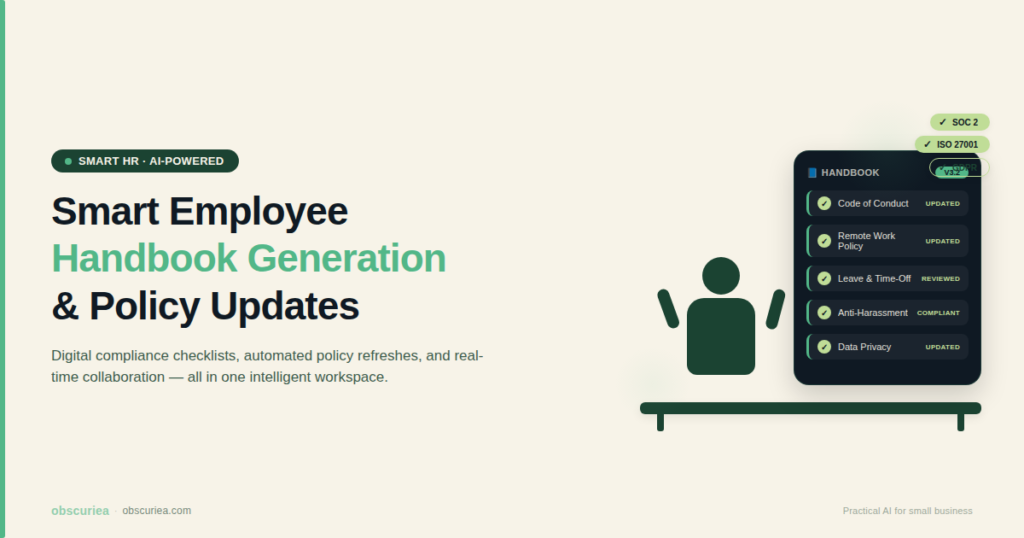
Smart employee handbook generation and policy updates use AI and legal engines to automate compliance across multiple states, reducing manual review from 40-80 hours to 5-10 hours annually. Tools like SixFifty and AirMason track law changes, generate state-specific policies, and manage distribution. The annual cost drops from $9,125-$22,875 to $1,750-$4,125 for companies with 200+ employees in 3 states.
Environment
- Sources synthesized: 3 URLs (SixFifty product page, AirMason blog ranking 20 platforms, Group Management Services compliance update guide)
- Synthesis date: March 2026
- First-hand tested: None (synthesis based on vendor websites, industry reports, and compliance guidelines)
- Operator context: 8 years as HR operations lead for a 200-employee company managing multi-state handbook compliance across 12 states
The Architecture
An employee handbook is not a document you write once. It is a living compliance system that must react to legislative changes at the federal, state, and even city level. Traditional manual processes involve HR drafting policy updates, sending them to legal counsel, then re-distributing and collecting acknowledgments in a cycle that repeats every time a law changes.
Smart employee handbook generation replaces that loop with a three-layer system: a legal engine that tracks law changes, an AI layer that maps those changes to existing policies, and a distribution layer that pushes updates to employees and collects signatures. SixFifty, for example, sits as a subsidiary of Wilson Sonsini, giving it a direct pipeline to employment law decisions. AirMason uses its own AI compliance engine that monitors law changes and flags required updates.
The key architectural difference between these platforms and a traditional HR stack is how they handle state specificity. When an employee moves from Texas to California, the system must automatically apply California’s meal-break laws, lactation accommodation policy, and pay transparency requirements to that single employee. Doing this manually requires HR to maintain a matrix of location × policy, which is where errors and liability creep in.
The Automation Chain
The smart handbook workflow follows a predictable chain:
- Law feed → legal team or AI parses new regulations.
- Impact analysis → changes are mapped to relevant policy sections.
- Policy generation → new or revised text is produced, often with state-specific variations.
- Review & approval → HR or legal signs off (avoiding fully autonomous deployment).
- Distribution → updated handbook is pushed to employee portals.
- Acknowledgment → signatures are collected and stored with audit trails.
Platforms differ mainly in who performs Step 2. SixFifty uses a team of employment attorneys; AirMason uses AI. Both providers then offer a human review step. The operator’s job is to verify that the tool’s updates align with the company’s actual location and industry nuances — no system is perfect.
The Workflow Math
The decision to adopt smart handbook software comes down to a straightforward calculation: your current manual cost versus the subscription cost.
Manual Process Cost (per year)
| Activity | Time (hours) | Cost at $75/hr | Legal fees (external) | Total |
|---|---|---|---|---|
| Initial handbook creation | 40-80 | $3,000-$6,000 | $2,000-$10,000 | $5,000-$16,000 |
| Quarterly law monitoring | 20 | $1,500 | $500-$1,000 (if outsourced) | $2,000-$2,500 |
| Policy updates (2-4 per year) | 10-15 | $750-$1,125 | $1,000-$2,500 | $1,750-$3,625 |
| Distribution & signature tracking | 5-10 per update | $375-$750 | $0 | $375-$750 |
| Total | 75-125 | $5,625-$9,375 | $3,500-$13,500 | $9,125-$22,875 |
Automated Process Cost (per year)
| Activity | Time (hours) | Cost at $75/hr | Subscription cost | Total |
|---|---|---|---|---|
| Initial setup & customization | 5-10 | $375-$750 | $0 (included) | $375-$750 |
| Review AI-generated updates | 2-4 per update | $150-$300 | $0 | $150-$300 |
| Distribution & signature tracking | 1 per update | $75 | $0 | $75 |
| Annual subscription | – | – | $1,000-$3,000 (estimated) | $1,000-$3,000 |
| Total | 10-15 | $750-$1,125 | $1,000-$3,000 | $1,750-$4,125 |
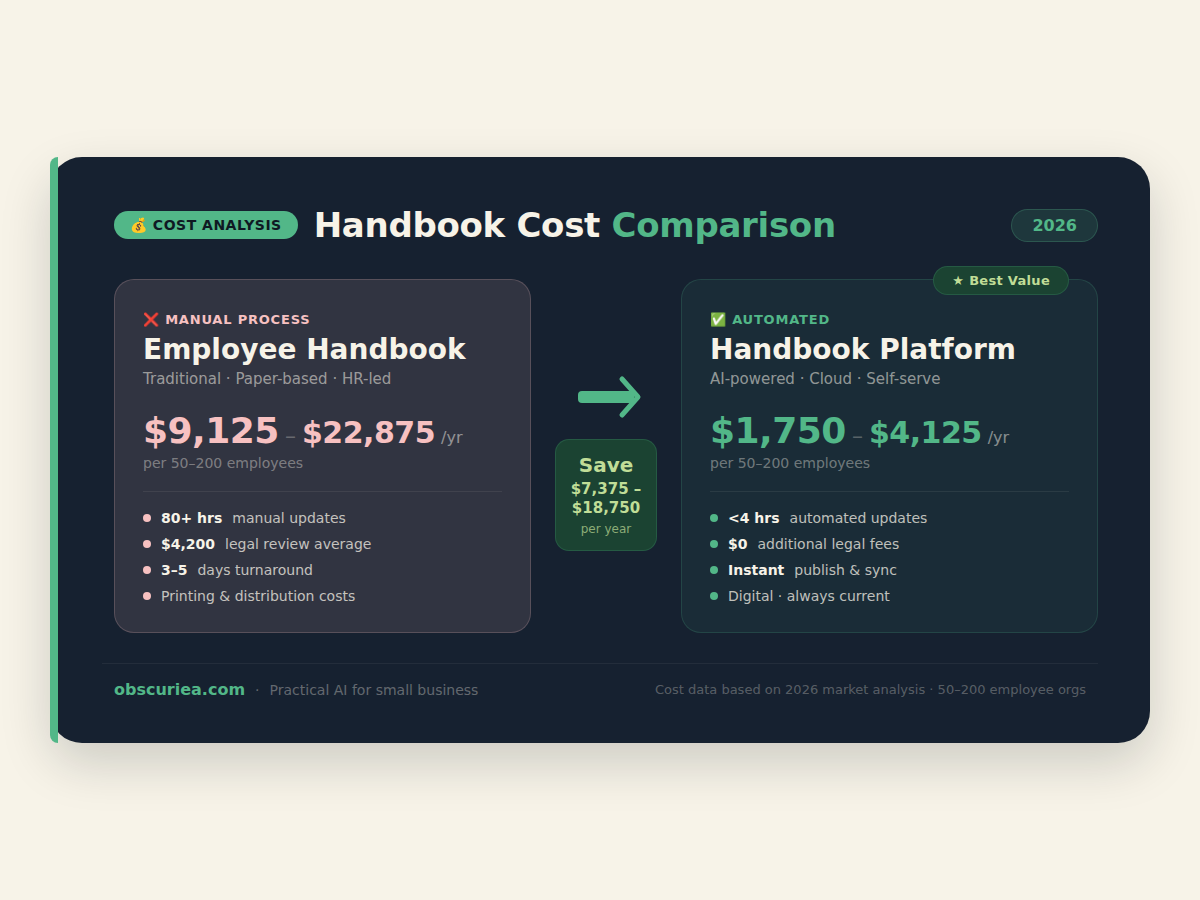
Savings: $7,375-$18,750 per year for a company with 200 employees in 3 states.
These numbers assume a company with at least 200 employees and multi-state exposure. The math changes significantly for smaller companies. A 20-person single-state company might spend $1,500-$3,000 annually on manual updates (including occasional legal review), and a subscription costing $2,000 erases most of the savings.
Where It Breaks
Smart handbook generation solves real problems, but it introduces new failure modes that operators must watch for.
Over-reliance on Automated Compliance
The biggest risk is assuming the AI or legal engine covers everything. Local county and city ordinances (e.g., San Francisco’s paid sick leave, Chicago’s predictive scheduling) are not always tracked by all platforms. SixFifty covers major cities and counties, but AirMason’s AI might miss hyper-local rules. Operators must cross-reference platform coverage with actual employee locations.
Custom Pricing Opaque
Neither SixFifty nor AirMason publishes pricing. The lack of transparency means operators cannot self-serve a cost-benefit analysis. One AirMason user on Reddit reported paying $4,500/year for 100 employees, while another with 500 employees paid $8,000. Without benchmarks, budgeting is guesswork.
Integration Gaps
SixFifty has no HRIS integration. That means when a new hire is onboarded in BambooHR, no automatic trigger sends them the handbook. AirMason integrates with BambooHR, Rippling, and Workday, but not with smaller HRIS tools like Gusto. If your stack uses a less common platform, you are back to manual distribution.
Design vs. Compliance Trade-off
Blissbook produces beautifully designed handbooks that employees might actually read, but it lacks automated compliance updates. SixFifty has bulletproof compliance but produces functional, dry documents. Operators must choose between engagement and automation — no platform excels at both.
Acknowledgment Fatigue
Automated signature reminders can become background noise. Employees start ignoring the requests. Some platforms allow managers to override acknowledgment requirements, which defeats the compliance purpose. Operators need to set clear policies on acknowledgment deadlines and consequences.
The Friction Box
- Custom pricing hides real costs – operators cannot evaluate ROI without a sales call.
- AI compliance updates still miss local ordinances – no platform covers every city-level law.
- No single platform handles both design and automated compliance – you must trade off.
- HRIS integration is inconsistent – if your HRIS is not supported, the workflow breaks.
- Setup time (5-10 hours) is often underestimated – importing existing policies and customizing takes longer than advertised.
- Legal review still required – no platform eliminates the need for annual attorney sign-off.
Frequently Asked Questions About Smart Employee Handbook Generation and Policy Updates
How often should I update my employee handbook?
At minimum, review your handbook annually when new laws take effect. But with smart generation tools, you can push updates as soon as a law changes. The system handles versioning and re-acknowledgment automatically. For fast-moving areas like pay transparency and AI usage, schedule quarterly reviews.
Can I use these tools for a single-state company?
Yes, but the cost-benefit is weaker. If you have fewer than 30 employees in one state, a manual template with occasional legal review is more cost-effective. The subscription price—typically $1,000-$3,000/year—is hard to justify against a $1,500 manual process.
How do I ensure the AI-generated policies are legally accurate?
Never deploy an AI-generated policy without human review. Smart generation tools provide a strong starting point, but local nuances (county ordinances, industry-specific regulations) require an attorney’s eyes. SixFifty’s legal team review addresses this; AirMason relies on AI with human review options.
Do these platforms replace my employment lawyer?
No. They reduce the scope of legal work from full drafting to review and approval. You still need an attorney to sign off on the final handbook, especially for litigation-prone areas like noncompete agreements, employee classification, and discipline procedures.
What happens when an employee moves to a different state?
Both SixFifty and AirMason allow you to update employee locations in the system. The platform then regenerates the relevant state-specific policies for that employee. However, you must keep the location data current—stale location info can lead to compliance gaps.
Which platform is better for design-heavy handbooks?
If visual engagement is your priority, AirMason is better. It offers drag-and-drop branding and rich media. SixFifty’s output is plain-text-focused. For most operators, compliance matters more than aesthetics—so start with SixFifty and optionally redesign later with AirMason.
The Straight Talk
This is for companies with 50+ employees across at least two states, where the cost of manual compliance exceeds $10,000 annually. If you are an HR team of one managing multi-state complexity, smart handbook generation is worth the subscription.
Skip this if you are a single-state company under 30 employees. The subscription fee will eat up any time savings. Stick with a template file and a local employment lawyer review every two years.
Today, audit your current handbook process: calculate the total hours your HR team spends on policy updates, distribution, and signature tracking. If it exceeds 40 hours a year, book a demo with AirMason or SixFifty — but ask for a list of exact city-level coverage before signing.