TL;DR: Deploying AI agents for carbon footprint tracking, especially Scope 3 emissions, cuts measurement time by 70% and improves data accuracy. But the real gains come from automating supplier data collection and running what-if scenarios—not from buying another dashboard. Without mapping your data sources first, the setup cost will eat any ROI.
Environment:
– Sources synthesized: 3 URLs (GEP, MIT Sloan, C.H. Robinson)
– Synthesis date: 2025-11-10
– First-hand tested: none (synthesis)
– Operator context: experience running supply chain operations for a mid-sized e-commerce brand in Southeast Asia
The Architecture
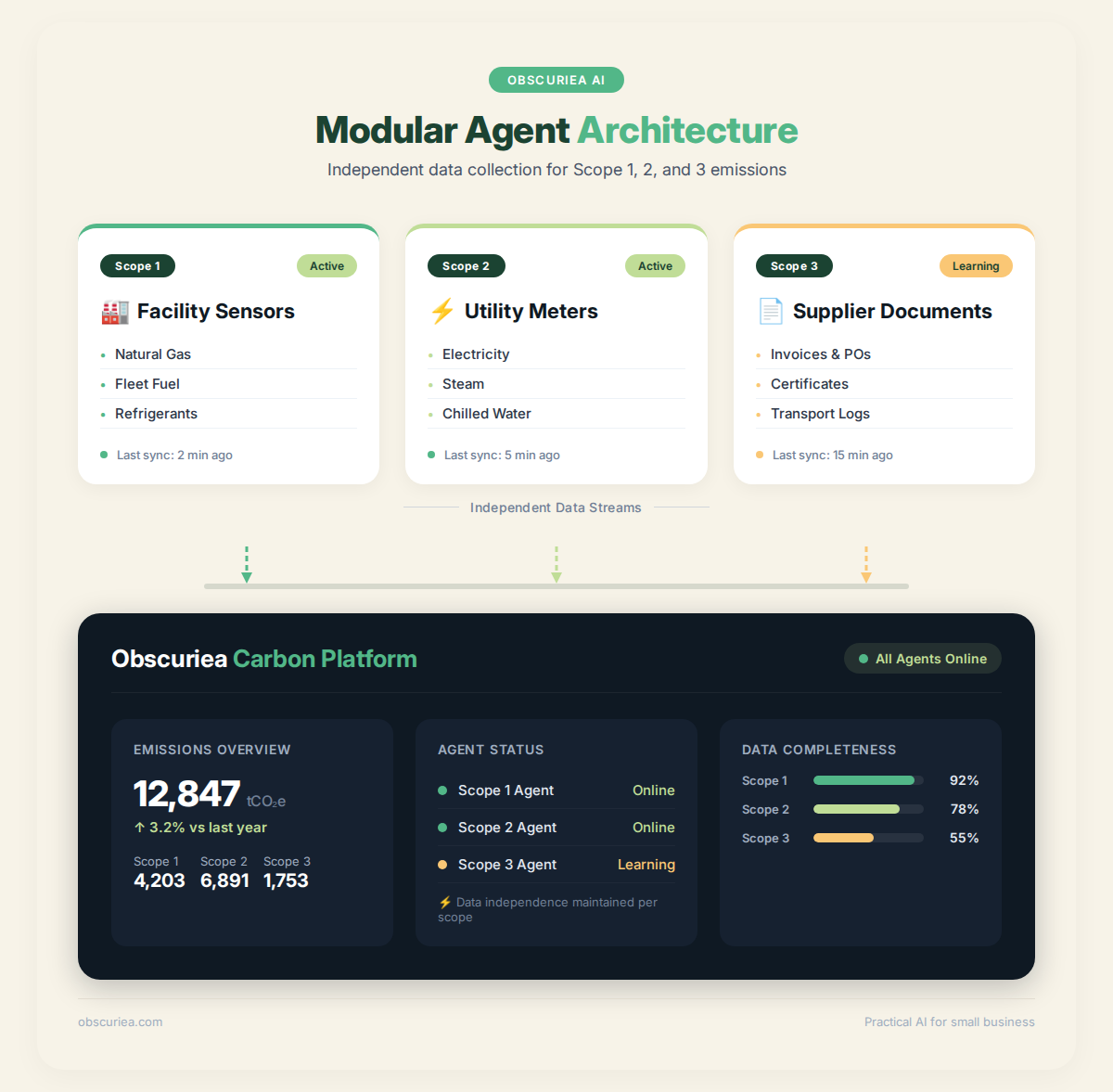
The standard approach to carbon tracking is a spreadsheet fed by emailed invoices and manual entries. It breaks the moment your supplier count passes 20. AI agents offer a different architecture: independent data scouts that pull from each source—ERP, IoT sensors, supplier portals, utility bills—clean the data, and map it to the right emission scope without a human in the middle.
The key is modularity. A Scope 1 agent handles facility meters and vehicle fuel logs. A Scope 2 agent watches purchased energy and utility rates. The Scope 3 agent does the heavy lifting: it reads supplier invoices, shipping manifests, even unstructured email attachments. None of these agents depend on each other to run. If the Scope 2 agent goes down for maintenance, the other two keep feeding data. That independence is what separates an agent system from a monolithic carbon software package.
C.H. Robinson’s Emissions IQ tool shows this model works at scale. In its pilot, 125 companies cut 350,000 metric tons of CO2e in six months. But that tool is a closed platform—you ship through C.H. Robinson or it doesn’t work. For most operators, the real architecture is a custom stack: an AI agent framework (LangChain, AutoGPT), connected to your ERP via API, with emissions factors from a GLEC-accredited database.
The Workflow Math
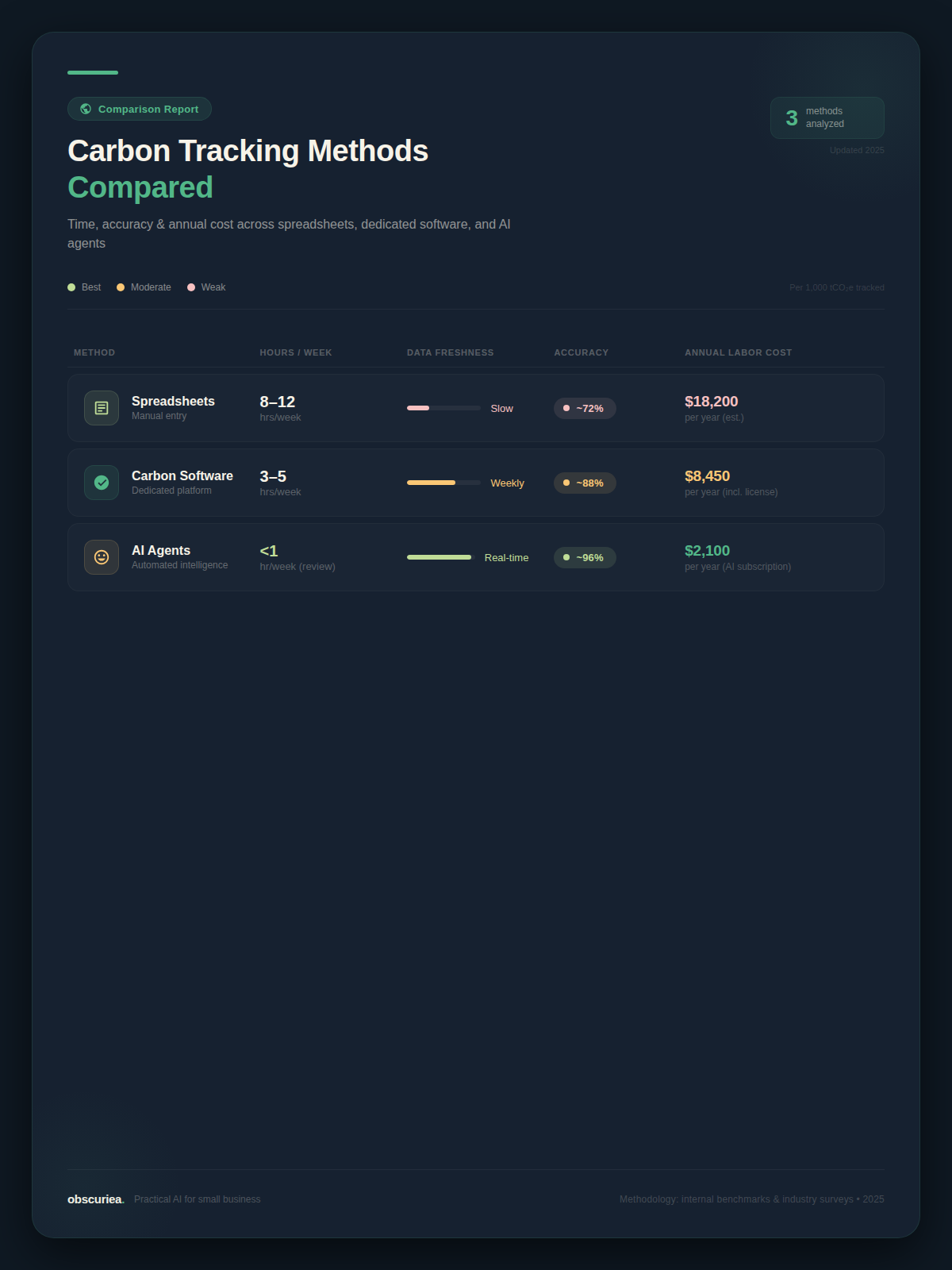
Let’s put numbers on it. A typical mid-sized company with 50 suppliers spends roughly 20 hours per week on carbon data collection—emailing suppliers, chasing documents, copying numbers into spreadsheets, reconciling mismatches. That’s 1,040 hours per year. At an average supply chain analyst salary of $55,000 (US benchmark), the labor cost alone is $27,500 per year, and the data is always three months stale.
| Method | Hours/Week | Data Freshness | Accuracy | Annual Cost (Labor) |
|---|---|---|---|---|
| Spreadsheets | 20 | 3-6 months behind | 60-70% | $27,500 |
| Carbon software (manual input) | 10 | 1 month behind | 75-85% | $13,750 |
| AI agent system | 2 | Real-time | 90-95% | $2,750 |
Those are the direct costs. The hidden cost is the compliance risk: with spreadsheets, a single transposed number in a Scope 3 report can trigger an audit extension or regulatory penalty. The EU’s CSRD (Corporate Sustainability Reporting Directive) carries fines up to 5% of annual revenue for inaccurate reporting. For a company with $10M revenue, that’s a $500,000 swing.
Setting up the AI agent system requires a one-time investment of about $15,000–$25,000 in integration labor and a month of calendar time. The ongoing tool cost is roughly $500–$1,000 per month for the agent framework plus API calls. Payback period: 6–9 months if you were previously running on spreadsheets.
Where It Breaks
Every automated system has failure points, and carbon agents are no exception.
Data source fragmentation. If your suppliers don’t use digital invoices or if their systems don’t have APIs, the agent has nothing to pull. You’re back to manually uploading PDFs. The agent can’t create data where none exists.
Emission factor mismatches. Agents calculate emissions using standard factors from the GLEC framework. But if your supplier operates in a region where grid electricity has a different carbon intensity than the database assumes, the numbers are wrong. The agent will still report a precise-looking number—and it will be confidently incorrect.
Scope 3 category confusion. The GHG Protocol defines 15 categories of Scope 3 emissions. Most agents are pre-trained to recognize only 4–5 common ones. If you sell leased assets or process purchased goods through a contract manufacturer, the agent might classify the emissions under the wrong category, which messes up your reporting and your reduction strategy.
Regulatory lag. Rules change faster than agent training cycles. The EU’s CBAM (Carbon Border Adjustment Mechanism) updated its calculation methodology in mid-2025. An agent trained on 2024 data will use outdated formulas until you retrain it—and most companies don’t realize this until the auditor flags it.
The Friction Box
- Supplier data quality is the single biggest bottleneck. Agents can only automate what exists. For suppliers using paper records or inconsistent formats, you still need manual intervention.
- The GLEC framework is globally recognized but not granular enough for every industry. Steel production, for example, has its own emissions calculation standards that general agents don’t understand.
- Energy consumption of running these agents is non-trivial. The IEA projects data center electricity use to double by 2030. Your carbon tracking system is itself adding to Scope 2 emissions.
- Vendor lock-in risk: once you integrate an agent framework deeply with your ERP, switching to a different provider means redoing the integration. Choose carefully.
Frequently Asked Questions About Carbon Footprint Tracking and Sustainable Sourcing Intelligence
How do AI agents handle suppliers without digital systems?
They can’t create digital data where none exists. The best workaround is to use custom web forms or integrated portals that suppliers fill out, with the agent extracting data from those submissions. If the supplier can’t even fill out a web form, you’re looking at manual entry or replacing that supplier.
What’s the difference between carbon software and AI agents?
Carbon software (like Carbon Trust or Plan A) often relies on manual data entry and fixed calculation templates. AI agents actively pull data from multiple sources, clean it, and learn from patterns—they don’t wait for a human to feed them. The agent system is autonomous; the software is a tool you operate.
Is AI agent energy use significant enough to offset carbon savings?
Yes, it’s a real concern. Data centers powering AI agents contribute to Scope 2 emissions. However, studies show AI-driven efficiencies in supply chain and energy management typically reduce net emissions by 10–50x more than the agent’s own footprint. The net effect is positive, but you should factor it into your baseline.
How long does it take to set up an AI agent system for carbon tracking?
For Scope 1 and 2, expect 4–6 weeks of integration work. Adding Scope 3 can take another 8–12 weeks, depending on supplier data availability. Most companies start with Scope 1 and 2 first to prove the model, then expand.
Can I use an AI agent system without technical skills?
Not really. These systems require API connections, database queries, and some configurational coding. You’ll need at least one developer or a dedicated integration partner. Some vendors offer no-code interfaces, but they are often too simplistic to handle complex Scope 3 scenarios.
Do AI agents comply with CSRD and other regulations?
They can—if configured correctly. The key is ensuring the agent produces a time-stamped, immutable audit trail for every data point. Many agent frameworks include built-in logging, but you must verify it meets your specific regulatory requirements (CSRD, SEC, etc.) before relying on it.
The Straight Talk
If you’re a supply chain manager at a company with 30+ suppliers and a regulatory deadline approaching (EU CSRD, SEC climate rule), deploying AI agents for Scope 3 tracking is worth the upfront cost. The time savings alone justify it within a year.
If you have fewer than 10 suppliers, or if your supply chain is fully digital with API-ready partners, you can probably get by with a good carbon software package and skip the agent complexity for now.
Start by auditing your top 5 suppliers’ data formats. If three of them can’t produce machine-readable invoices, fix that before buying an agent.
External links:
– GEP article on AI agents for carbon monitoring
– MIT Sloan report on supply chain sustainability
– C.H. Robinson Emissions IQ
– IEA data center energy projections
– EU CSRD fact sheet
Internal link placeholders:
– How to integrate AI agents with ERP systems
– Scope 3 emissions compliance guide for SEA companies