Real-Time Audience Micro-Segmentation for E-Commerce
TL;DR
Real-time audience micro-segmentation can lift email revenue by 40% and boost conversion rates by up to 18% through dynamic on-site personalization. But the infrastructure and software costs — $1,800 to $2,500+ per month — make it a poor investment for brands under 50K monthly sessions. For Southeast Asian e-commerce operators running across Shopee, Tokopedia, and a direct store, the integration complexity and fragmented data often cancel out the benefits. The math works above $10M annual revenue. Below that, batch segmentation in Klaviyo or Omnisend captures 80% of the lift at 20% of the cost.
Environment
- Sources synthesized:
- SingleStore – Real-Time Segmentation
- US Tech Automations – E-Commerce Segmentation Platforms Compared
- Saras Analytics – eCommerce Customer Segmentation
- Synthesis date: 2025-07-12
- First-hand tested: None (synthesis from sources)
- Operator context: The writer has managed marketing operations for SEA-based DTC brands on Shopee, Tokopedia, and Shopify, with hands-on experience building batch and real-time segmentation workflows using Klaviyo, Google Analytics 4, and custom CDP solutions.
The Architecture
Real-time micro-segmentation is not a feature toggle. It is a system architecture decision.
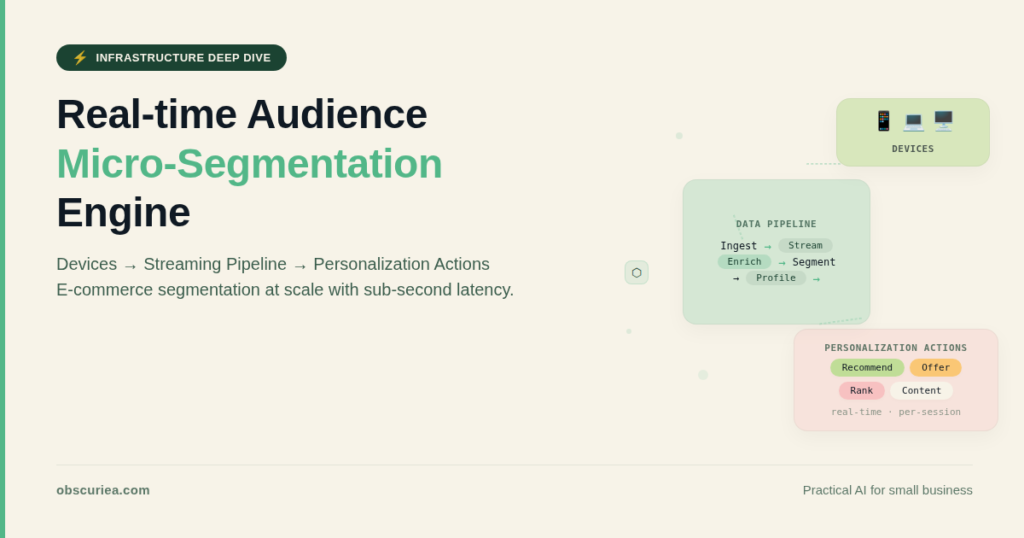
At the core, you need three components working together: a streaming ingestion layer that captures every event — click, hover, scroll, cart add — with sub-second latency, a processing engine that updates customer profiles and segment assignments on the fly, and an action layer that triggers personalized content in the same session.
Source 1 (SingleStore) describes an ideal stack: a hybrid transactional-analytical (HTAP) database that unifies the streaming, analytics, and vector search workloads. This lets you maintain live feature tables — like “dwell time on product page” or “number of visits in last 7 days” — and join them to incoming requests instantly. When a shopper hesitates over a limited-edition sneaker, the system can assign them to a “hesitant high-intent” segment and serve a countdown discount before they bounce.
That is the promise. The reality for most e-commerce operators is far less clean.
Your customer data does not live in one place. If you sell on Shopee, Tokopedia, and your own Shopify store, you have at least three separate data silos. Shopee does not expose real-time browsing events via API — you get daily CSV exports at best. Tokopedia’s analytics dashboard offers aggregated metrics, not per-user behavioral streams. Even Shopify requires additional tracking code (Shopify Audiences, GA4, or a CDP) to capture the granular events that real-time segmentation needs.
So before you can even begin to architect a real-time system, you need to solve the data unification problem. That usually means investing in a Customer Data Platform (CDP) — Segment, mParticle, or RudderStack — which adds $500–$2,000/month to the stack. This is not optional. Without a unified view of customer behavior across channels, your real-time segments will be based on incomplete data, producing stale or misguided personalization.
The Workflow Math
Let’s quantify what “real-time” buys you versus batch segmentation.
Source 2’s platform comparison shows that Klaviyo — the most popular email segmentation tool — relies on batch processing. Its predictive analytics (churn risk, lifetime value) update every 24 hours. Behavioral segments based on browse activity update within minutes, but the system is not designed for session-level real-time decisions. It is a “near-real-time” system: you can trigger an abandoned cart email after 60 minutes, but you cannot pop a discount modal the moment a user’s scroll velocity drops.
Real-time platforms like Dynamic Yield or Bloomreach operate at a different speed. They score intent within a single session using micro-behaviors: scroll depth, hover dwell, click velocity. If a user lands on a product page, scrolls to the bottom, and hovers over the “Add to Cart” button for 8 seconds without clicking, Dynamic Yield can classify them as “high-intent, low-decisiveness” and serve a 5%-off incentive immediately.
The question is: how much is that capability worth?
| Metric | US DTC Brand (AOV $85) | SEA Marketplace Seller (AOV $18) |
|---|---|---|
| Monthly hesitant visitors | 10,000 | 10,000 |
| 5% conversion lift from session-level personalization | 500 conversions | 500 conversions |
| Incremental revenue | $42,500 | $9,000 |
| Real-time platform cost (Dynamic Yield) | $2,500/mo | $2,500/mo |
| CDP cost (Segment) | $1,000/mo | $1,000/mo |
| Integration implementation (one-time, amortized over 12 mo) | $500/mo | $500/mo |
| Net monthly benefit | $38,500 | $5,000 |
| ROI | 9.6x | 1.25x |
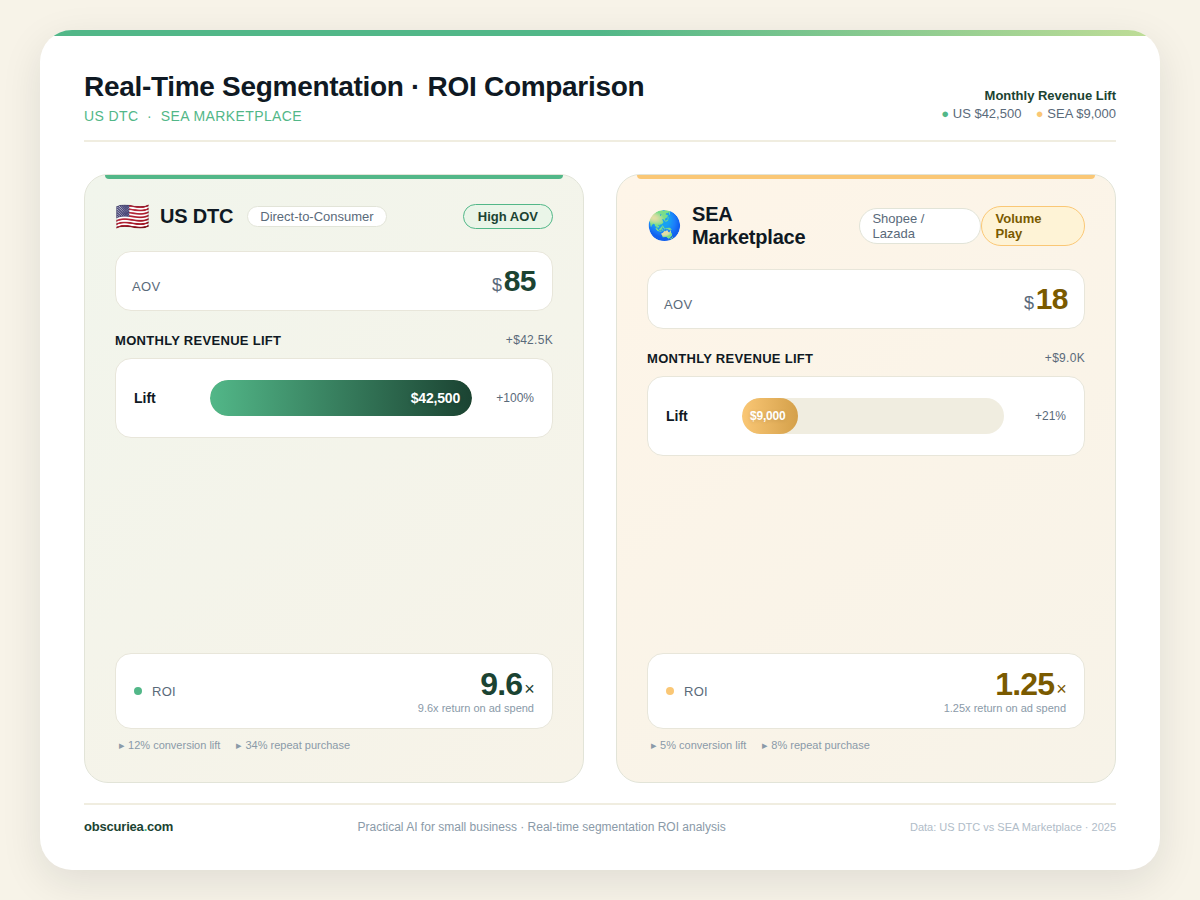
The math for SEA sellers is uncomfortably tight. An ROI of 1.25x means any small deviation — lower traffic, higher platform fee, longer implementation — flips the investment negative.
Source 2 also reveals that brands with 8–12 well-defined batch segments see 40% more email revenue than those with 2–3. These segments are achievable in Klaviyo without real-time infrastructure: RFM segments, product category affinities, recency-of-purchase. The delay between action and segment update (minutes vs. seconds) costs almost nothing in email conversion. The real value of real-time lies in on-site personalization — pop-ups, banners, chat — which non-real-time tools cannot deliver.
Looking to build your segmentation foundation? Start with our guide on e-commerce customer segmentation strategies.
Where It Breaks
Real-time micro-segmentation fails in predictable ways. Here are the four that hurt most in practice.
Fragmented Customer Identities
A customer browses running shoes on Shopee, adds to cart, then opens your Shopify store from a Facebook ad. Most real-time systems see two profiles. Without cross-device identity resolution (available in Dynamic Yield Enterprise, but at extra cost), you cannot segment the full journey. In SEA, where app-to-web switching is the norm, this fragmentation means real-time segments are always incomplete.
Marketplace Restrictions
Shopee and Tokopedia do not allow third-party on-site personalization. You cannot inject pop-ups or modify navigation inside their apps. For marketplace sellers, real-time segmentation is only useful for off-site channels (email, SMS, social retargeting) — but by then, the “real-time” window has passed. The customer is no longer in a session.
Accuracy vs. Speed Trade-off
Systems that update segments within 100ms use simplified models. They miss patterns that batch systems with longer compute windows catch. For example, a visitor who reads reviews slowly might be labeled “low intent” in real time, while a batch analysis of session duration, pages per session, and referral source correctly identifies them as “high consideration.” Speed sacrifices accuracy.
Low Traffic Degradation
Below 10K sessions per month, segments become statistically unreliable. Predictive models train on thin data and serve bad predictions — like flagging 80% of customers as “at risk” because the baseline is too small. Real-time personalization on low traffic is random personalization.
For more on platform-specific pricing, see our Klaviyo vs Omnisend comparison.
The Friction Box
- Unifying customer data across multiple marketplaces is a prerequisite that adds $500–$2,000/month in CDP costs.
- Real-time platform fees start at $1,800/month and escalate with volume, creating a scaling trap.
- SEA AOVs ($12–$25) reduce the revenue lift from real-time personalization to the point where ROI is marginal or negative.
- Shopee and Tokopedia restrict on-site personalization, limiting real-time segmentation to off-site channels only.
- Low-traffic stores (<10K monthly sessions) should not attempt real-time segmentation — batch is sufficient and far cheaper.
Frequently Asked Questions About Real-Time Audience Micro-Segmentation for E-Commerce
What is real-time audience micro-segmentation?
It is the process of using live behavioral data — clicks, scrolls, hovers, cart actions — to assign shoppers to highly specific segments within milliseconds, then trigger personalized experiences in the same browsing session.
How is real-time segmentation different from batch segmentation?
Batch segmentation updates customer groups periodically (daily or hourly) based on stored data. Real-time segmentation updates the moment a behavior occurs, enabling instant on-site personalization like dynamic discounts or navigation changes.
What is the minimum traffic needed for real-time segmentation to be effective?
Industry benchmarks suggest at least 50,000 monthly sessions for reliable segment creation and machine learning model training. Below 10,000 sessions, the signal-to-noise ratio degrades significantly, and batch segmentation performs almost as well.
Which platforms offer the best real-time micro-segmentation?
Dynamic Yield and Bloomreach lead in session-level personalization but require enterprise budgets ($1,800–$2,500+/month). Klaviyo and Omnisend offer near-real-time email triggers but lack on-site personalization. The choice depends on whether you need on-site action or email-only segmentation.
Is real-time segmentation worth the investment for SEA e-commerce brands?
For brands with $10M+ annual revenue and high AOV (above $50), yes. For most SEA marketplace sellers with AOVs below $25, the ROI is too thin to justify the infrastructure cost. Batch segmentation in Klaviyo or Omnisend delivers 80% of the lift at 20% of the cost.
How long does it take to implement real-time audience micro-segmentation?
Implementation timelines vary from 2 weeks (Klaviyo behavioral triggers) to 14 weeks (Dynamic Yield full on-site personalization with CDP integration). Source 2 reports that Dynamic Yield requires dedicated resources and a long setup phase.
The Straight Talk
This guide is for e-commerce operators managing 50,000+ monthly sessions across multiple channels who are evaluating whether real-time segmentation justifies the investment. It is also for founders in Southeast Asia who are being pitched “AI personalization” solutions that do not account for their actual operational reality.
Skip real-time segmentation if your store runs on a single platform (Shopify-only or Tokopedia-only), your AOV is below $30, or your traffic is under 10,000 sessions per month. Batch segmentation with Klaviyo or Omnisend will deliver the majority of the benefit without the complexity and cost.
Your next move: audit your current segmentation. Count how many behavioral segments you are actively emailing. If it is fewer than 8, invest in better segment definitions using your existing tool before exploring real-time upgrades. The low-hanging fruit is not real-time — it is using the data you already have.