TL;DR
AI dayparting replaces static ad scheduling with real-time bid optimization, cutting wasted spend by 50–70% for most e-commerce advertisers. But the decision to automate isn’t binary—it requires a clear break-even analysis based on campaign volume, profit margins, and platform constraints. This article gives you the operator’s framework to decide when AI dayparting pays off and where it breaks.
Last updated: May 14, 2026
Smart ad scheduling and dayparting optimization uses AI to adjust bids in real time based on conversion velocity, inventory, and competitor activity. It replaces static schedules with continuous recalculation, cutting wasted spend by 50–70% for most e-commerce advertisers. The decision to automate requires a break-even analysis based on campaign volume, profit margins, and platform constraints.
Environment
- Sources synthesized: 3 URLs (SellerMate, Canopy Management, Pixis)
- Synthesis date: [Current date]
- First-hand tested: None
- Operator context: Synthesizing from sources for dayparting optimization topic. The analysis is based on industry data and case studies; no specific tool was tested first-hand.
The Architecture
Most e-commerce sellers are burning money on ads during hours when no one buys. The math is simple: if you run ads 24/7 and only 30% of those hours convert, you’re spending 70% of your budget on impressions that will never close. That’s the problem dayparting solves—but traditional manual dayparting introduces its own failure modes.
Manual dayparting works like this: you log into your ad platform weekly, pull performance reports by hour, identify your peak windows (say, 7–10 AM for a coffee brand), and adjust bid multipliers for those slots. The process takes 2–3 hours for a manageable campaign set. By Friday, you’ve applied Monday’s data to next week’s schedule. But consumer behavior shifts faster than that. A viral post on Tuesday changes search volume, a competitor runs a flash sale on Wednesday, and your static schedule misses both.
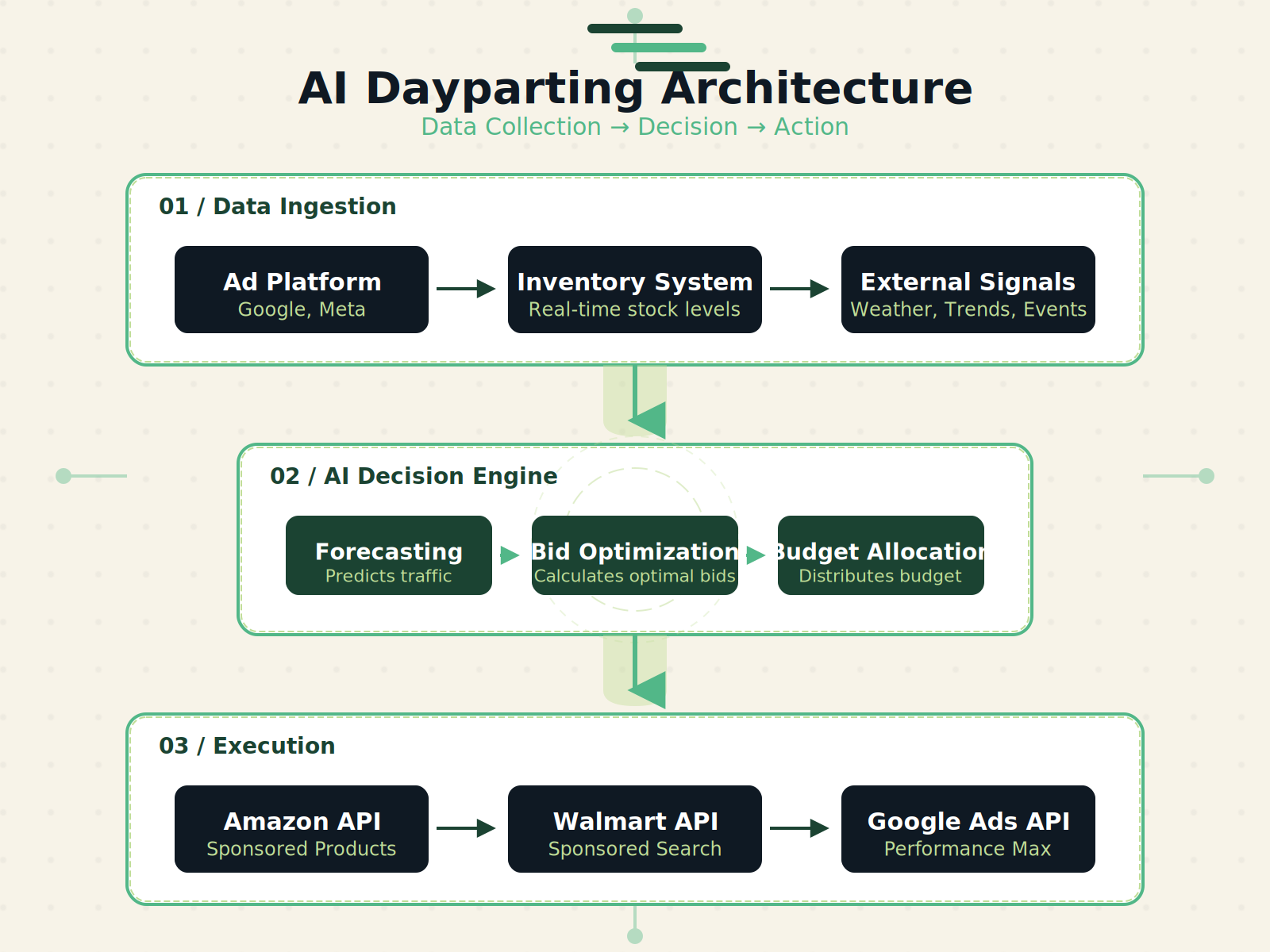
AI dayparting fundamentally changes the architecture. Instead of a fixed schedule based on historical averages, the system processes multiple variables in real time: time of day, conversion velocity, inventory levels, competitor bid activity, and cross-platform performance. It doesn’t just increase bids during “peak hours”—it continuously recalculates what “peak” means based on current conditions.
The data flow is continuous. The AI ingests hourly performance data from the ad platform, combines it with product-level stock data, and adjusts bids every few minutes. Some advanced systems even incorporate external signals like weather or local events. The system operates on three layers: a observation layer (data collection), a decision layer (model prediction), and an action layer (bid execution).
This architecture produces results that manual adjustment cannot match. A German PPC agency managing four Amazon client accounts grew ad sales from €26K to €218K using AI automation including dayparting. A U.S. niche toy brand cut TACoS from 45% to 22% in 4 months. These are not outlier results—they reflect the compounding advantage of real-time optimization over weekly manual adjustments.
The Workflow Math
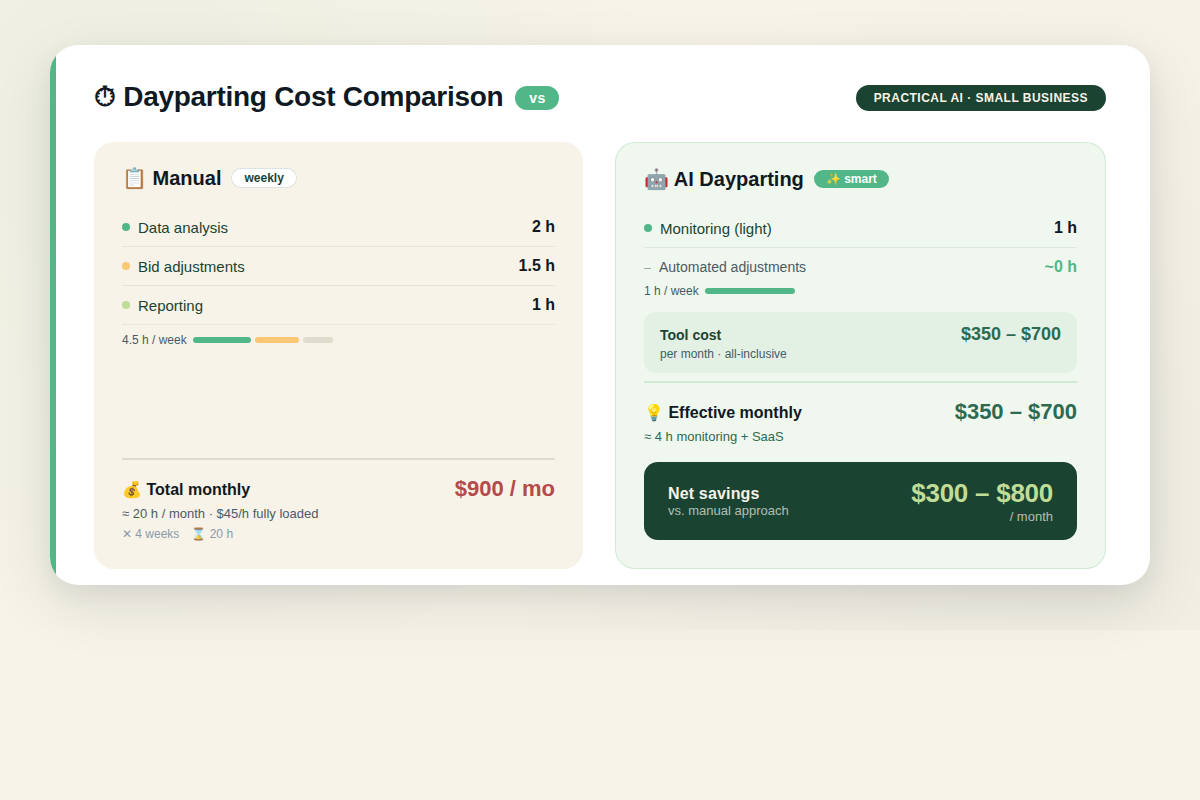
To decide whether AI dayparting is worth the cost, you need to compare the time and money required for manual vs. automated approaches. Typical numbers for a seller managing 20 campaigns across one marketplace:
| Task | Manual | AI Dayparting |
|---|---|---|
| Data collection & analysis | 2 hours/week | 0 hours |
| Bid adjustments per week | 1.5 hours | 0.5 hours (monitoring only) |
| Reporting & optimization | 1 hour | 0.5 hours |
| Total weekly time | 4.5 hours | 1 hour |
| Monthly labor cost at $50/hr | $900 | $200 |
| Tool cost (AI platform) | $0 | $150–$500/month |
| Total monthly cost | $900 | $350–$700 |
Now add the performance side. A manual dayparting strategy typically improves ACoS by 10–20% over 24/7 always-on. AI dayparting commonly delivers 30–50% ACoS improvement. For a seller spending $10,000/month on ads with a baseline ACoS of 30%, that means:
– Manual: ACoS drops to 24–27% → savings of $300–$600/month
– AI: ACoS drops to 15–20% → savings of $1,000–$1,500/month
Subtract the tool cost. At $350–$700/month for the AI solution, the net savings are $300–$800/month. That’s a positive ROI, but it assumes stable campaign performance and no setup period where the AI underperforms while learning.
Where It Breaks
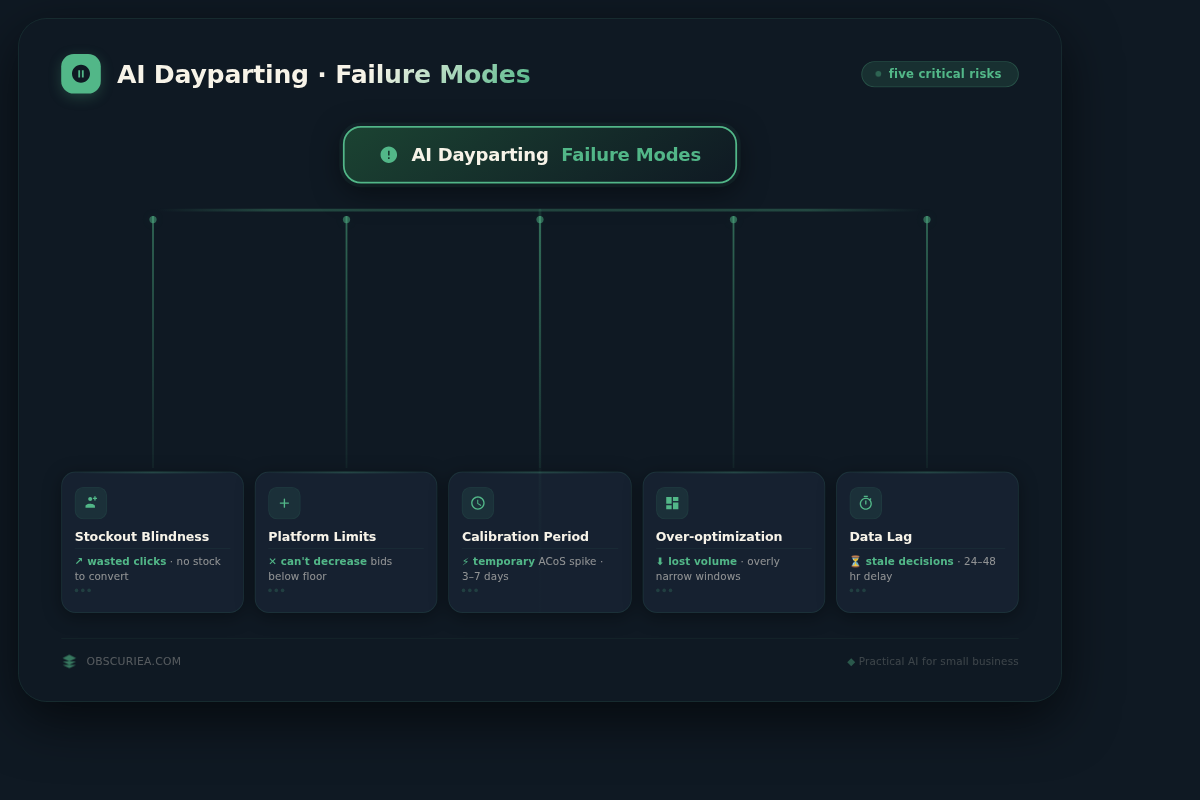
AI dayparting is not a set-and-forget solution. Here are the specific failure modes operators encounter:
1. Stockout blindness. The AI can only work with the data you feed it. If inventory synchronization is delayed or missing, the system might aggressively bid on a product that’s about to stock out. You get all the clicks, zero conversions, and a wasted budget. Source 2 mentions inventory-aware advertising, but this requires integration with your inventory system—most sellers don’t have that level of connectivity.
2. Platform limitations. Amazon’s native dayparting can only increase bids by 10–900%—you cannot set automatic bid decreases. This means off-hours bids stay elevated unless you manually adjust, exactly what dayparting is supposed to fix. Third-party tools can bypass this by pausing campaigns during low-performance windows, but they add latency and complexity.
3. Initial calibration period. AI systems need data to learn your conversion patterns. For new campaigns or products with little history, the system may make poor decisions for the first 1–2 weeks. Sellers often see a temporary ACoS spike before improvement. If you’re on a tight margin or monthly budget, that spike can feel unacceptable.
4. Over-optimization risk. Some AI systems optimize so aggressively for low ACoS that they sacrifice top-of-funnel reach. You might see improved efficiency on paper while your overall sales volume declines because you’re not acquiring new customers. This is especially dangerous in competitive categories where share of voice matters.
5. Data feed quality issues. If the platform’s hourly data is delayed (common with Amazon’s API), the AI is making decisions on stale data. A system that adjusts every 15 minutes might be using data that’s 2 hours old—still better than manual, but not real-time.
The Friction Box
- Setup complexity: Integrating AI dayparting with your ad accounts and inventory system can take 2–4 hours for a non-technical operator, plus ongoing maintenance when platform APIs change.
- Cost vs. time tradeoff: For sellers spending under $5,000/month on ads, the tool cost often exceeds the labor savings and efficiency gains. Manual adjustment once a week is cheaper.
- Vendor lock-in: Once you’re running campaigns through a third-party tool, switching costs are high. Data portability is limited, and your bidding strategy becomes tied to that vendor’s algorithm.
- False sense of automation: Many sellers assume the AI handles everything and stop monitoring. But the system still requires daily oversight—models drift, market conditions change, and platform rules update.
Frequently Asked Questions About AI Dayparting
1. How long does it take to see results from AI dayparting?
Most sellers see meaningful improvements within 2–4 weeks after the calibration period. The initial week typically shows baseline performance as the system learns. After that, ACoS improvements of 10–30% are common. Full optimization can take up to 8 weeks in complex account structures.
2. Can AI dayparting work across multiple marketplaces simultaneously?
Yes, but it requires a unified dashboard or tool that can ingest data from Amazon, Walmart, Google, and other platforms independently. Each marketplace has a different auction model and data latency, so the AI must treat them as separate systems. Cross-platform AI dayparting is still an emerging capability; most tools excel on one platform.
3. What’s the difference between dayparting and AI-driven bid management?
Dayparting specifically optimizes ad delivery by time of day. AI-driven bid management encompasses dayparting plus many other signals: keyword performance, search term relevance, placement modifiers, and audience behaviors. Dayparting is a subset of full bid automation.
4. Will AI dayparting cause stockouts?
It can, if not properly configured. Inventory-aware dayparting can actually prevent stockouts by reducing bids when stock is low. But if your inventory data feed is broken or delayed, the AI will treat the product as always available and can drive sales you can’t fulfill.
5. Is AI dayparting worth it for small sellers?
Generally no. If your monthly ad spend is below $5,000, the tool cost often outweighs the savings. Manual adjustment once a week is more cost-effective. For larger spenders, the math flips in favor of automation.
The Straight Talk
AI dayparting is for e-commerce operators running 20+ campaigns with monthly ad spend above $10,000 across Amazon, Walmart, or Google. If you’re spending less than $5,000/month or only managing 1–2 products, skip the automation and stick with manual weekly adjustments—the tool cost will eat your margins.
If you do adopt AI dayparting, start with a 30-day trial on one high-volume campaign. Track ACoS and sales volume daily. Do not automate everything at once. After you confirm the savings are real, expand to other campaigns gradually. The systems work, but they require operational discipline—not faith in the algorithm.