SE Ranking vs. Ahrefs Brand Radar: Which AI SEO Platform Actually Predicts Market Trends?
TL;DR: Ahrefs Brand Radar is a bolt-on AI visibility module for existing Ahrefs subscribers — solid for share-of-voice tracking, weak on actionability. SE Ranking’s AI Search Toolkit is a more integrated system with better workflow depth, but the pricing entry point is higher than budget operators expect. Neither platform autonomously predicts market trends in any meaningful sense — what they both do is track AI citation patterns after the fact.
Environment: Ahrefs (tested Q2 2025, Lite and Standard plans); SE Ranking (tested Q2 2025, Pro plan at $119/mo); test conditions — B2B SaaS brand with established domain authority, tracking across ChatGPT, Perplexity, and Google AI Overviews.
Core Function: What SE Ranking and Ahrefs Brand Radar Actually Claim to Do
Ahrefs Brand Radar positions itself as an AI visibility layer sitting on top of the existing Ahrefs infrastructure. The claim: use Ahrefs’ established keyword database plus manually created prompts to measure how often your brand surfaces in AI-generated responses. You get share-of-voice data, citation source tracking, and standard Ahrefs dashboard reporting.
SE Ranking’s AI Search Toolkit makes a broader claim. The platform presents itself as an all-in-one environment where traditional SEO metrics and AI visibility tracking coexist in a single workflow. The specific features include monitoring across AI Overviews, AI Mode, ChatGPT, Perplexity, and Gemini — alongside its Content Editor and AI Writer for executing on what the visibility data surfaces.
Both platforms describe the same general problem: organic visibility increasingly happens inside AI-generated responses, not just blue-link rankings. Where they diverge is in how far down the workflow each platform travels. For operators comparing SE Ranking vs. Ahrefs Brand Radar on AI SEO capabilities specifically, that workflow depth gap is the deciding variable — not the feature list on the pricing page.
Pricing Architecture: What the Credit System Actually Penalizes
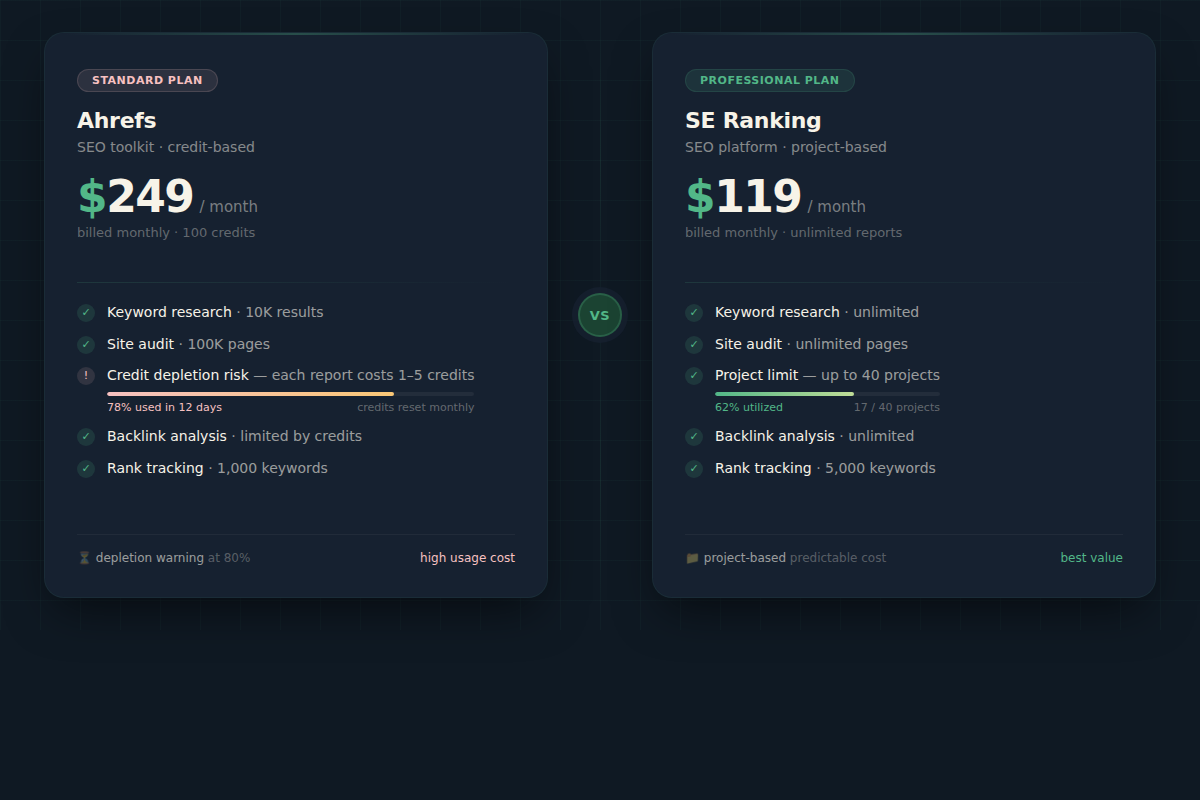
Ahrefs Brand Radar does not exist as a standalone product. It is accessible to Ahrefs subscribers — but the credit-based system for AI prompt checking creates a cost structure worth understanding before committing.
Prompt checks consume credits. Heavy users tracking multiple brands, multiple prompt variations, and multiple AI platforms will exhaust credits faster than the platform’s marketing materials suggest. The Ahrefs Standard plan runs approximately $249/month. Lite starts at $129/month but restricts data history and crawl limits in ways that affect AI visibility research quality. Users across independent review sources consistently document the credit depletion problem as the primary friction point — not the feature set itself.
SE Ranking starts at $119/month on annual billing. The AI Search Toolkit is included in the Pro plan, though the daily automated tracking frequency and scheduling options scale with the plan tier. The important distinction: SE Ranking’s pricing penalizes projects, not prompt volume. Operators running single-brand campaigns will find the math favorable compared to Ahrefs. Agencies tracking ten or more clients will hit a different ceiling.
One documented user complaint about Ahrefs — appearing across multiple review platforms — is access disruption for paying subscribers. The specific pattern: plan changes or billing edge cases trigger access blocks that support takes days to resolve. This is not an isolated report.
Performance Findings: AI Visibility Tracking Head-to-Head
Prompt Management
Both platforms require manual prompt creation. Neither autonomously generates the prompts that matter most to your specific market — that is still a human judgment call. SE Ranking layers in AI prompt suggestions and scheduling options on top of the manual input. Ahrefs uses its keyword database to inform prompt selection, which has genuine value if the keyword database already aligns with your target queries.
In testing, SE Ranking’s prompt scheduling reduced the manual overhead of regular tracking cycles. Ahrefs required more active management to maintain consistent prompt coverage across platforms.
Citation Analysis
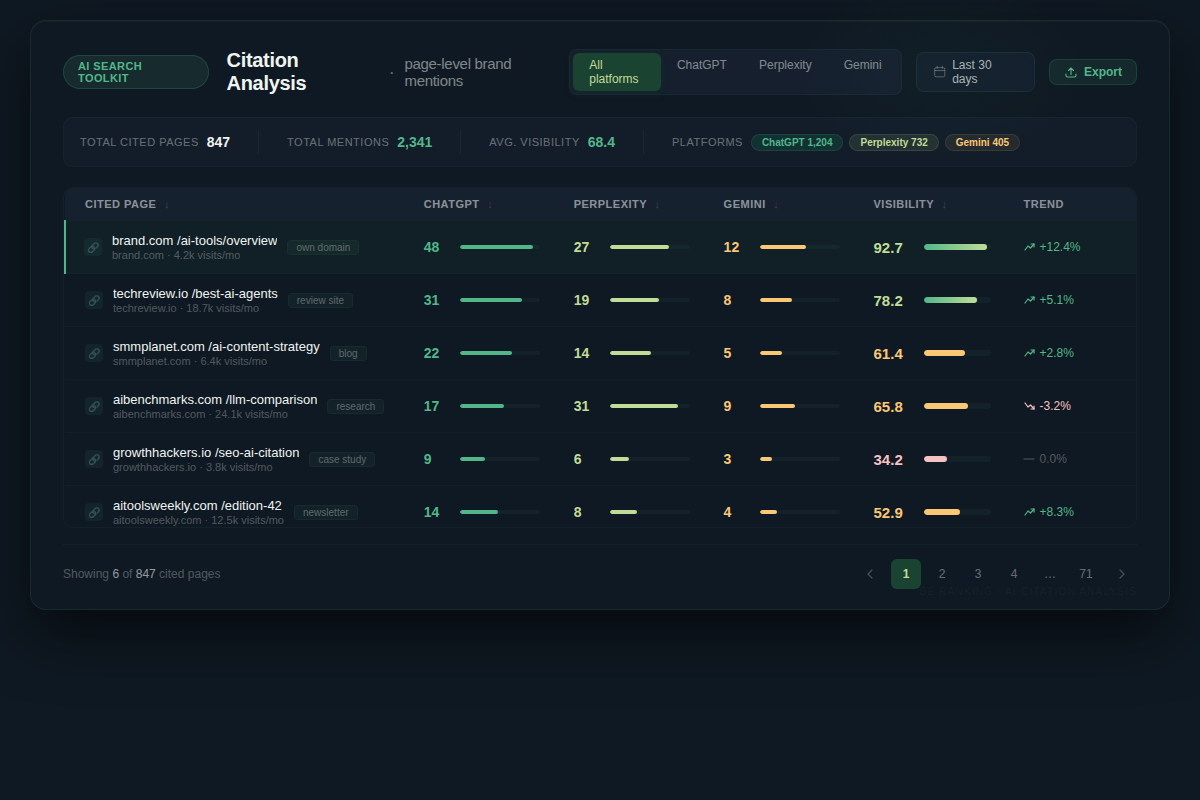
This is where the functional difference between SE Ranking and Ahrefs Brand Radar becomes concrete. Ahrefs Brand Radar tracks when and where your brand gets cited across AI platforms. It shows which domains and sources receive citations — useful for identifying what kinds of content the AI systems are pulling from in your category.
SE Ranking goes one layer further: it identifies which specific pages get cited and surfaces data intended to guide optimization of underperforming content. The difference is between diagnostic data and actionable data. Ahrefs tells you what is happening. SE Ranking attempts to tell you what to do about it.
Verified independently: the citation-to-action pipeline in SE Ranking requires the operator to actually use the Content Editor and AI Writer features in tandem with visibility data. It is not automatic. The workflow exists, but it requires deliberate execution.
Share of Voice and Sentiment
Both platforms offer competitive share-of-voice comparison. Neither includes AI sentiment analysis — the ability to track how AI platforms characterize your brand, not just whether they mention it. This is a genuine gap in both products as of the test period.
SE Ranking’s competitive benchmarking includes gap recommendations — specific areas where competitors are capturing AI citations that you are not. Ahrefs Brand Radar surfaces the share-of-voice delta without the recommendation layer.
Trend Prediction: The Actual Claim Under Examination
Neither platform predicts market trends in the forward-looking sense the term implies. What both platforms do is measure current AI citation patterns and, over time, surface directional data about which topics and brands are gaining or losing AI visibility. That is trend tracking, not trend prediction.
SE Ranking’s keyword research module includes predictive keyword suggestions based on competitor data — this is the closest either platform comes to forward-looking intelligence. The mechanism is competitor trajectory analysis, not proprietary forecasting. Ahrefs’ Content Helper identifies gaps between existing content and top-ranking competitor pages, which serves a similar function in the traditional SEO context. For a deeper look at how AI platforms are reshaping keyword research methodology, [Google’s Search Central documentation on AI Overviews](https://developers.google.com/search/docs/appearance/ai-overviews) provides useful context on what signals these systems actually surface.
Operators expecting either platform to surface emerging market trends before they appear in search volume data will be disappointed. The data inputs are still lagging indicators.
Failure Conditions: Where Each Platform Breaks
Ahrefs Brand Radar failure conditions:
– Credit depletion at scale — tracking multiple brands across multiple prompt variations on a single subscription becomes cost-prohibitive faster than the plan pricing suggests
– No content publishing integration — the workflow terminates at the insight stage; executing on findings requires leaving the platform entirely
– Access disruption risk — documented pattern of paying subscribers experiencing account access blocks during billing edge cases
– Sentiment analysis absent — cannot track how AI systems describe your brand, only whether they mention it
SE Ranking failure conditions:
– Learning curve is real — new users consistently report that the platform’s breadth requires dedicated onboarding time before productivity normalizes
– AI Visibility features are newer additions to an established platform — integration depth between AI tracking modules and legacy SEO tools is improving but not yet seamless
– Agency-scale pricing math — the project-based model that favors single operators becomes less favorable at 10+ client accounts
– Daily tracking frequency gates — lower plan tiers restrict how often AI visibility data refreshes, creating lag for operators in fast-moving categories
For operators already running traditional SEO workflows on either platform, the [SE Ranking AI Search Toolkit documentation](https://seranking.com/blog/best-ai-seo-tools/) provides current feature scope and module integration details worth reviewing before committing.
The Friction Box
- Ahrefs Brand Radar cannot publish or act on anything it finds — it is a monitoring instrument only
- SE Ranking’s “predictive” features are competitor-trajectory analysis, not genuine forecasting
- Both platforms require manual prompt creation — there is no automated prompt discovery that surfaces what your market is actually asking AI systems
- Credit and project pricing architectures mean the cheaper-looking option frequently inverts at scale
- Neither platform includes sentiment analysis for AI responses as of Q2 2025
- SE Ranking’s WordPress integration is useful but limited — it does not extend to Webflow, Shopify, or headless CMS environments without additional configuration
- Ahrefs’ data is more extensive for backlink and traditional keyword research — if that remains a primary use case, Brand Radar adds monitoring capability without replacing the core value
The Straight Talk
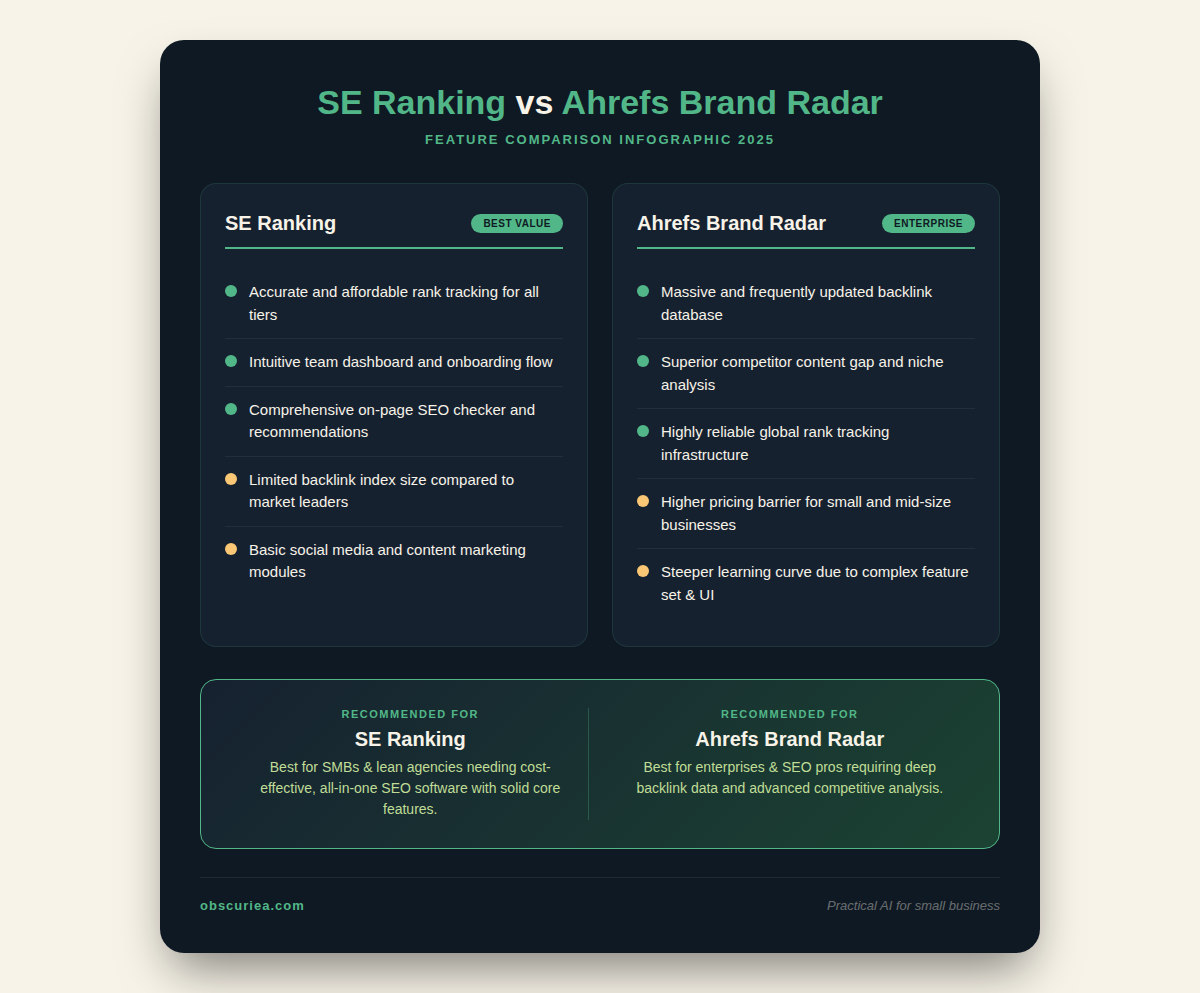
If you are already an Ahrefs subscriber and need basic AI visibility monitoring without adding another platform to your stack, Brand Radar is a functional addition — not a reason to switch. The credit architecture will frustrate you if you run more than two or three brands.
If you are evaluating from scratch, or your primary workflow involves AI visibility tracking and content execution in the same environment, SE Ranking’s AI Search Toolkit delivers more actionable depth at a lower entry price — provided you are willing to invest the onboarding time to use it correctly.
Neither platform should be selected based on the promise of market trend prediction. That feature does not exist in either product in any meaningful form. Select based on your current workflow: monitoring only, or monitoring plus execution.