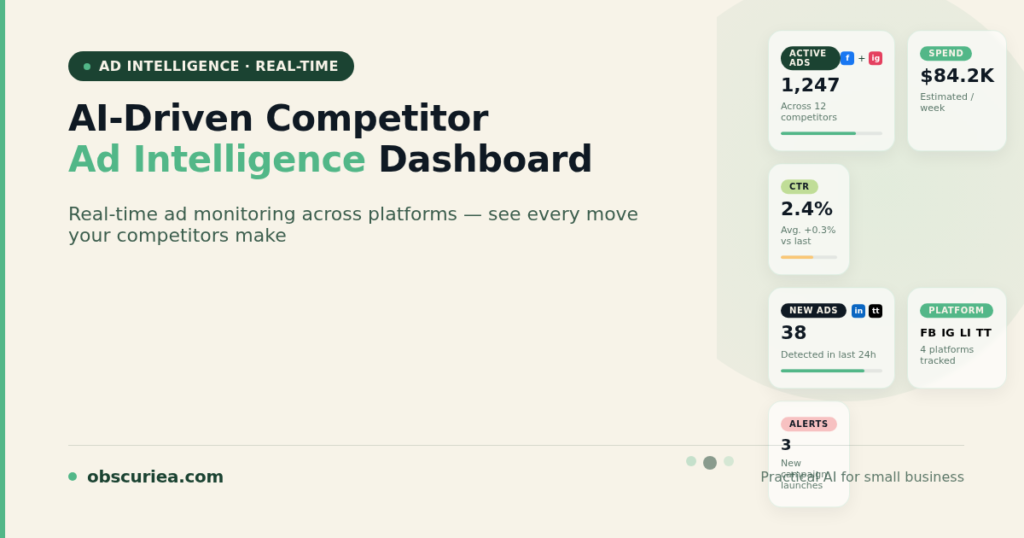
TL;DR: Most competitor ad intelligence is retrospective—you see what worked after the campaign ends. AI-driven systems flip that: they monitor creative rotations, landing page changes, and ad copy shifts in real time, letting you react before your competitor scales a winning angle. This framework works best for businesses spending at least $5k/month on ads where a 5% conversion difference matters substantially.
Environment:
– Sources synthesized: 3 URL scrapes (Panoramata roundup, MyMobileLyfe guide, Klue automation guide)
– Synthesis date: 2026-03-07
– First-hand tested: none
– Operator context: synthesizing from sources for AI competitor intelligence with a focus on ad-specific workflows; Marcus Reid operations framework applied
The Architecture
Most businesses run competitor ad analysis like a postmortem—after the campaign ends, they scroll through the Facebook Ad Library and guess. That’s not intelligence, it’s history. By the time you see a winning creative, your competitor has already milked it and rotated to the next variant.
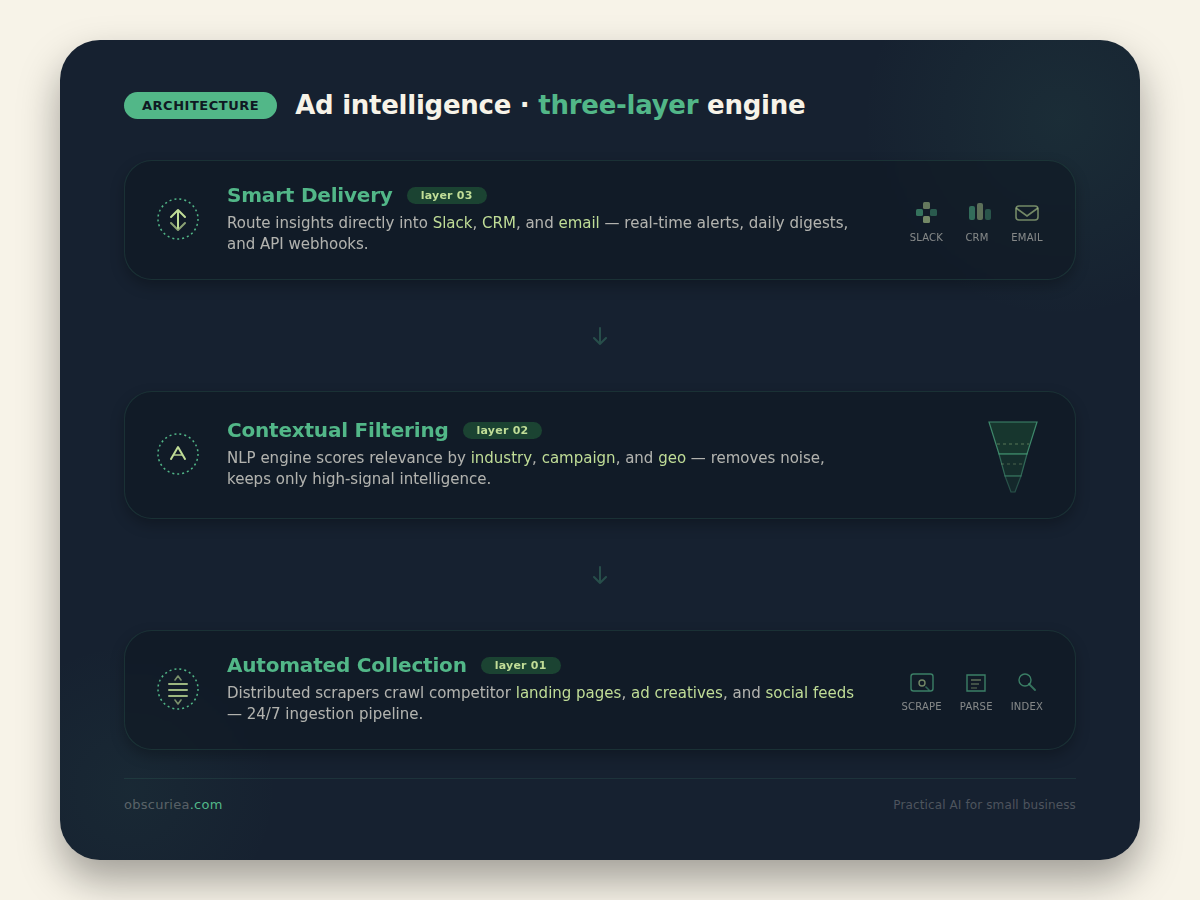
AI-driven competitor ad intelligence changes that by building a three-layer system that runs continuously:
Layer 1 – Automated collection. Web scrapers pull ad creatives, landing page variants, and pricing updates from competitor domains every few hours. They don’t just hit the homepage—they crawl product pages, changelogs, review sites, and social feeds. A tool like Panoramata or Klue monitors email flows and SMS campaigns alongside display ads. The goal is breadth: if a competitor changes their headline on a Tuesday, you see it Wednesday morning.
Layer 2 – Contextual filtering. Raw data is noise. The system needs to know your market position—your buyer personas, your value propositions, your deal size. Without that lens, you drown in alerts about every minor test a competitor runs. The best setups connect competitor moves to your specific GTM strategy: “This new ad targets the same mid-market segment you’re chasing—here’s how to counter.”
Layer 3 – Smart delivery. Alerts land where your team works: Slack, CRM, email. A rep on a live call can pull up a one-paragraph summary of the competitor’s latest ad angle without digging through a spreadsheet. That speed turns intelligence into leverage.
This architecture exists in various tools today—but rarely with the ad-specific focus most operators need.
The Workflow Math
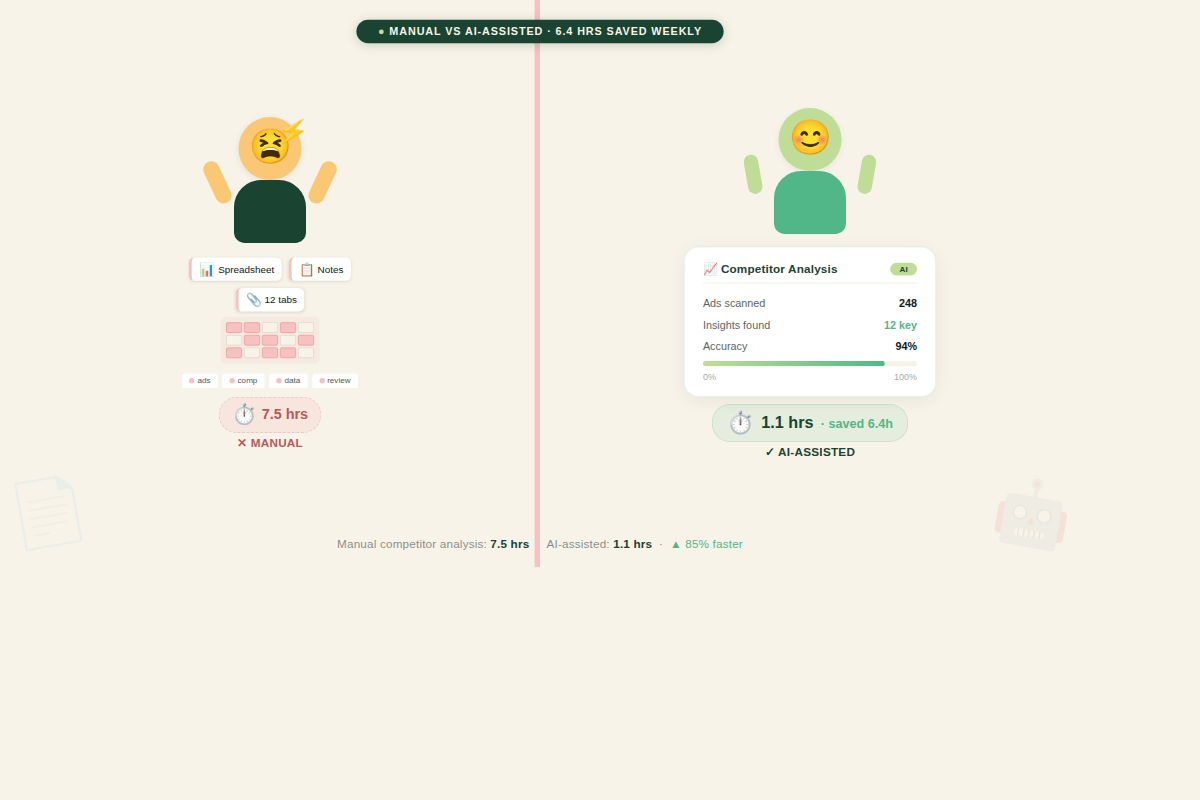
Let’s put numbers on the old way versus the new way. A typical competitor ad analysis session for a mid-market team:
| Step | Manual (hours/week) | AI-assisted (hours/week) |
|---|---|---|
| Checking Facebook Ad Library | 1.5 | 0.1 (automated scrape) |
| Comparing landing page changes | 2.0 | 0.2 (diff detection) |
| Analyzing ad copy shifts | 1.5 | 0.3 (NLP summarization) |
| Compiling weekly report | 2.0 | 0.5 (auto-generated) |
| Distributing to team | 0.5 | 0.0 (push to Slack/CRM) |
| Total | 7.5 hours | 1.1 hours |
The hard saving is 6.4 hours per week—but the real gain is in timing. If a competitor launches a new ad angle on Monday, manual analysis might surface it Thursday. By then, they’ve collected enough data to know it’s working. With AI, you see it Tuesday and can adjust your creative rotation before they scale.
If your average ad spend is $10k/month and a 10% improvement in conversion rate generates $1k extra per month, that 2-day head start can easily be worth $500 per campaign cycle. Run four campaigns a year: $2k in captured value from a tool that costs $200/month. The math is straightforward.
Where It Breaks
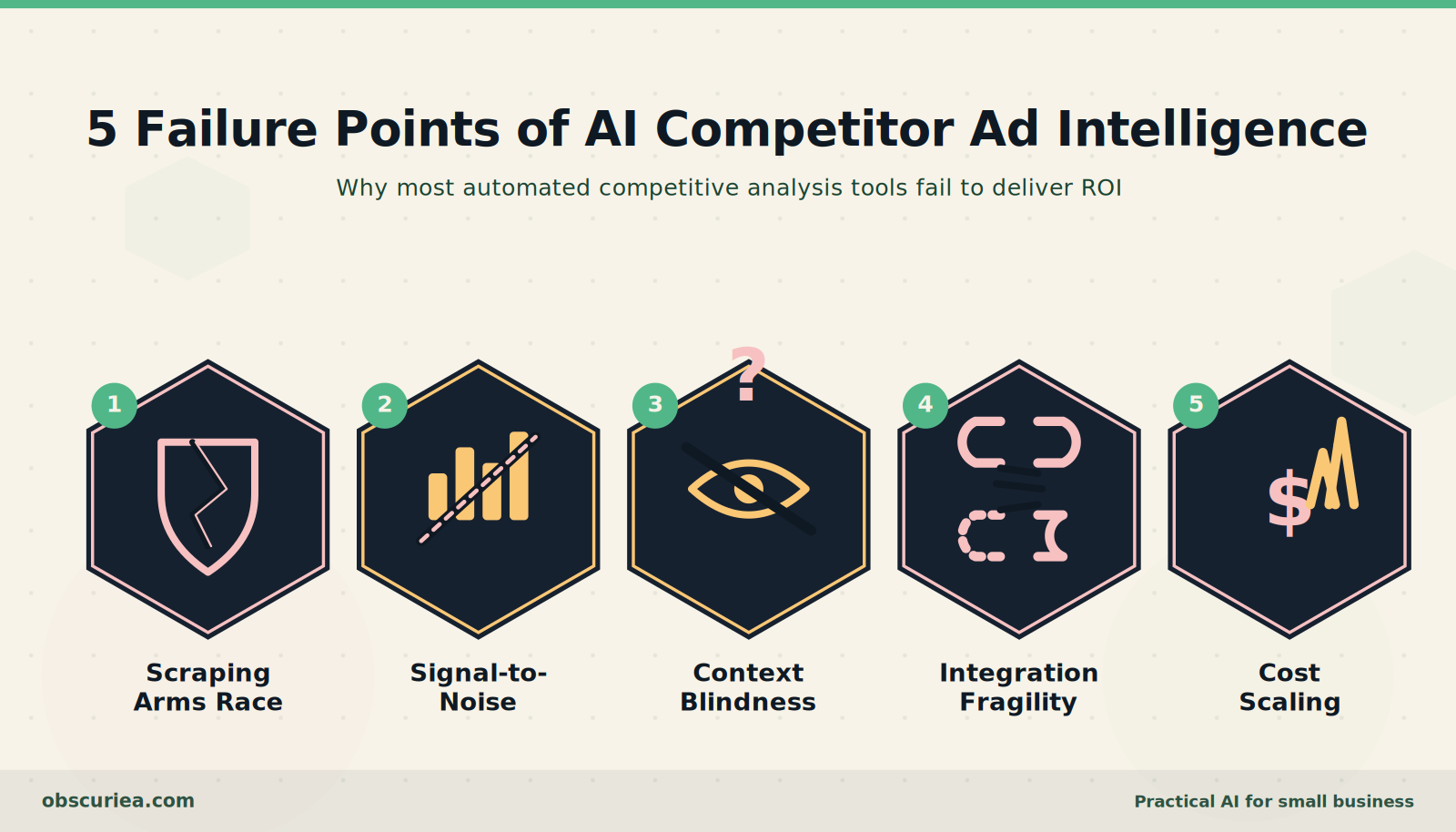
AI-driven ad intelligence is not a set-and-forget system. These are the failure points you need to plan for:
1. The scraping arms race. Competitors know they’re being watched. Some obfuscate their landing pages with dynamic HTML, rotate URLs aggressively, or serve different creatives based on geolocation. A scraper tied to a US IP might miss an SEA-targeted campaign entirely. If your competitor serves 50 variants via Google Optimize, your system sees one.
2. Signal-to-noise ratio. When a competitor runs 20 ad variants in a day, 19 are dead ends. An unfiltered feed overwhelms your team with false positives. The AI needs training on what constitutes a “meaningful” change—something most tools leave to the user to define. Without that tuning, the system generates more noise than insight.
3. Strategic context blindness. AI can detect a pricing drop, but it can’t tell you why. Was it a permanent change or a weekend flash sale? Is the competitor clearing inventory before a relaunch or testing price elasticity? The system surfaces the action; the strategy behind it requires human judgment. Operators who treat AI outputs as complete answers will overreact.
4. Integration fragility. Most DIY setups (Zapier + OpenAI) break when a page element changes. The CSS selector that isolated ad copy yesterday is gone today. Maintaining custom scrapers and workflows is a developer-hours sink. Teams that start with no-code often migrate to paid tools after three failed pipelines.
5. Cost scaling. Entry-level plans cover a handful of competitors. If you need to track 20 competitors across five channels, pricing jumps quickly. Panoramata’s paid tier starts at $99/month; Klue’s enterprise plans run $2k+/month. The tool that works for a $5k ad budget may not pencil out for a $20k budget if the overhead eats the gain.
The Friction Box
- Most tools claim “real-time” but deliver 24-hour batch updates—meaning you still react a day late
- AI summaries often miss the creative nuance: they say “competitor tested new headline” but not that the headline mimics your brand’s voice
- Pricing architectures penalize heavy usage: credit-based systems (e.g., OpenAI API costs for summarization) escalate faster than expected
- Cross-platform tracking is still weak: a tool that tracks Facebook ads well often misses Instagram Stories or TikTok Spark Ads
- No standard for “ad intelligence”—features vary wildly between tools, making comparison difficult
Frequently Asked Questions About AI Competitor Ad Intelligence
Can AI track competitor ads across all platforms in real time?
Most tools claim real-time updates but typically deliver with a 2-24 hour delay for cross-platform data. True real-time scraping is technically feasible only for a single platform (e.g., Facebook Ads Library via API). Covering Instagram, TikTok, Google Display, and LinkedIn simultaneously usually means batch cycles. For ad intelligence purposes, a 4-hour lag is acceptable for most operators.
What’s the minimum budget to justify an AI ad intelligence tool?
If your monthly ad spend is below $5k, the time savings aren’t enough to offset a $100-500/month tool. The exception is if you’re in a hypercompetitive niche (e.g., legal, insurance) where a 1% conversion lift is worth thousands. In those cases, the tool pays for itself at any ad spend level.
How do I prevent the tool from flooding my team with irrelevant alerts?
Most platforms offer customizable rules: filter by competitor tier (direct vs. aspirational), change magnitude (pricing drop >10% vs. 1%), or channel (email vs. display). Klue’s contextual layer lets you define which deals or personas matter. Start with strict filters and loosen them as you calibrate.
Can I build my own AI ad intelligence system without coding?
Yes, but fragility is high. A no-code stack using Zapier (scrape RSS or page changes) + OpenAI (summarization) + Slack (push) works for two to three competitors. Expect it to break every few weeks due to site layout changes. If you have internal developer time, n8n provides a more stable self-hosted alternative.
What data sources do AI ad intelligence tools typically monitor?
Standard sources include: Facebook Ad Library, Google Display ads via third-party APIs, competitor landing pages, product changelogs, review sites (G2, Capterra), social media feeds (LinkedIn, Twitter), email campaigns (via inbox monitoring), and industry news. Few tools cover all; most specialize in one or two channels. Cross-channel coverage is the differentiator of higher-tier plans.
How accurate is AI at predicting which competitor ads will succeed?
Not very accurate at the single-ad level. AI can flag patterns—e.g., “this competitor has increased ad frequency by 300% in the last week, typical of a high-performing creative about to scale.” But determining whether a specific variant will win requires A/B test data only the competitor owns. The value is in trend detection, not fortune-telling.
The Straight Talk
This approach is for operators running ad budgets above $5k/month who can afford a dedicated tool ($100-500/mo) and have the bandwidth to tune the system in the first two weeks. If you’re a solo creator spending $500/month on ads, the manual check is fine—your time is better spent on creative.
Skip this if your competitive set is small (3-4 direct competitors) and you already have a weekly manual review process that works. The cost and complexity of automation won’t pay off.
Today: pick one competitor you’re losing most sleep over. Set up a Google Alert + a simple page-change detector (Distill.io free tier) for their main landing page and ad copy page. Run it for a week. See what the signal-to-noise ratio looks like before committing to a paid platform.
External links used in this article:
– Panoramata tool comparison: Panoramata roundup
– MyMobileLyfe automation guide: Automating CI with AI
– Klue competitor monitoring guide: How to Automate Competitor Monitoring
– AI competitor analysis tools on G2: G2 Category
– OpenAI pricing page (for API cost reference): OpenAI pricing
Internal link placeholders:
– For a deeper look at setting up no-code automation, see our guide on AI-driven content production workflows
– If you’re considering enterprise tools, our tool selection framework for operations teams can help.