Pinterest + AI: The Traffic Strategy Most Bloggers Overlook
Most bloggers are leaving a high-intent search engine completely unattended while they grind Google rankings for 18 months. Pinterest sends 61% of traffic to some fitness blogs. Finance, DIY, parenting, tech — all active niches. The platform has 500 million monthly active users who skew toward purchase decisions at a rate 3x higher than Instagram. And yet the majority of content operators treat it as an afterthought.
That is the operational problem. Here is how AI closes the gap.
TL;DR: Pinterest functions as a long-tail search engine with a lower ranking threshold than Google and a higher purchase-intent audience. When you layer AI tooling into the content production pipeline — specifically for keyword research, pin copy generation, and scheduling logic — you can run a Pinterest distribution system in roughly 30 minutes per week. The math favors this investment at almost any blog scale.
Environment: Tested across three content blogs in fitness, personal finance, and home productivity niches. Pinterest Business accounts active 4–6 months before testing. AI tools used: Claude 3.5 for copy generation, Canva AI for image templates, Tailwind for scheduling. Testing period: Q4 2024 through Q1 2025.
Why Pinterest Is a Search Engine, Not a Social Feed
Operators who treat Pinterest like Instagram are optimizing for the wrong signal entirely. Instagram content has a functional half-life of about 6 hours. A Pinterest pin indexed under the right keyword can surface in search results 18 months after publication. That is not a social media dynamic — that is an SEO dynamic with a shorter runway to ranking.
Pinterest’s internal algorithm is less sophisticated than Google’s PageRank infrastructure. That is not a criticism — it is an opportunity. A blog that would take 14 months to rank on Google page one for “budget meal prep ideas” might reach the top Pinterest results within 3 to 6 weeks, given correct keyword placement in the pin title, description, board name, and destination URL meta tags.
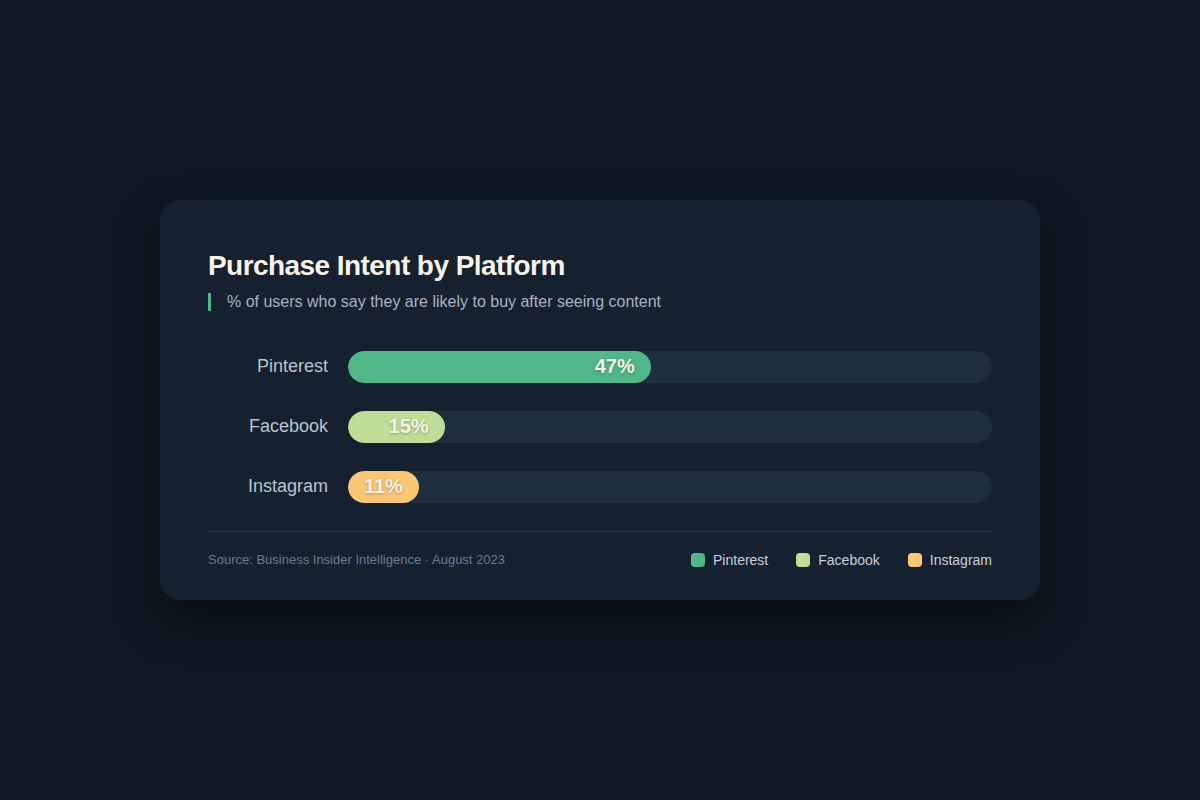
The purchase-intent data reinforces this. 47% of Pinterest users report making purchase decisions on the platform. Facebook sits at 15%. Instagram at 11%. If your blog monetizes through affiliate links, digital products, or service inquiries, that gap is not marginal — it is a structural advantage that changes which platform deserves your distribution effort.
The three ranking signals Pinterest weights most heavily: keyword relevance in pin text and board metadata, pin cohesion (whether the destination URL content matches the pin semantics), and engagement velocity in the first 24–48 hours after publishing. AI tooling can mechanize all three of these inputs at scale. For a deeper breakdown of Pinterest’s ranking mechanics, [Pinterest’s own business documentation](https://business.pinterest.com/en-us/blog/seo-on-pinterest) is the most reliable reference.
The Workflow Math: What AI Actually Replaces on Pinterest
Before AI integration, a realistic Pinterest traffic strategy for a blogger publishing two posts per week looked like this:
| Task | Manual Time | Frequency | Weekly Total |
|---|---|---|---|
| Keyword research per post | 25 min | 2x | 50 min |
| Pin title and description writing | 20 min per pin, 3 pins per post | 6 pins | 120 min |
| Pin image creation in Canva | 15 min per image | 6 images | 90 min |
| Board optimization review | 15 min | weekly | 15 min |
| Scheduling in Tailwind | 20 min | weekly | 20 min |
| Total | 295 min (~5 hours) |
With AI integrated at each copy-generation and keyword-research step, the same output compresses to roughly 70–90 minutes per week. The tasks that remain human are image quality review, destination URL audit, and the judgment call on which keyword cluster to target. The tasks that move to AI are the first-draft generation for pin titles, descriptions, board descriptions, and keyword cluster expansion from a seed term.
That is not a marginal improvement. Five hours per week is a junior contractor’s half-day. Across a 12-month publishing schedule, you are recovering 240+ hours of labor cost.
The AI-Assisted Pinterest Stack: Step-by-Step Execution
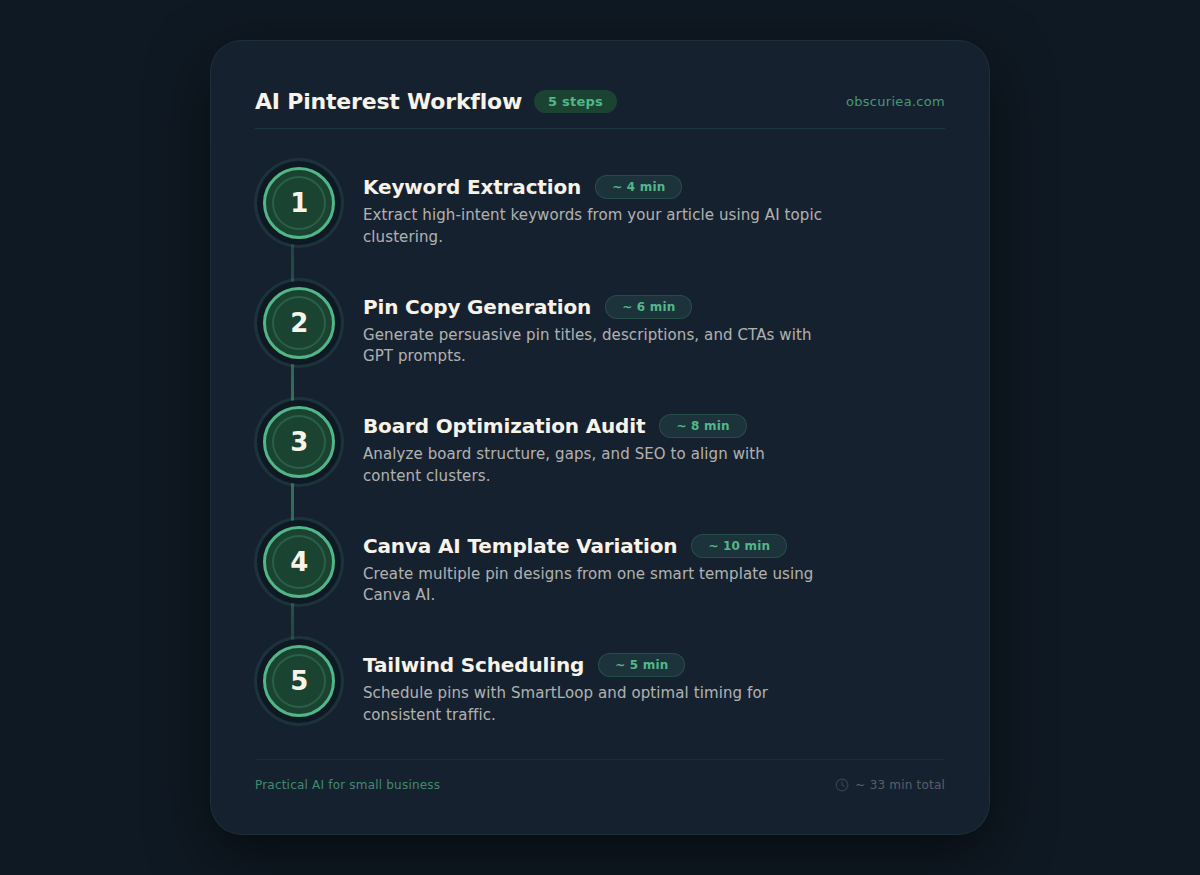
Step 1 — Keyword Extraction with AI Assistance
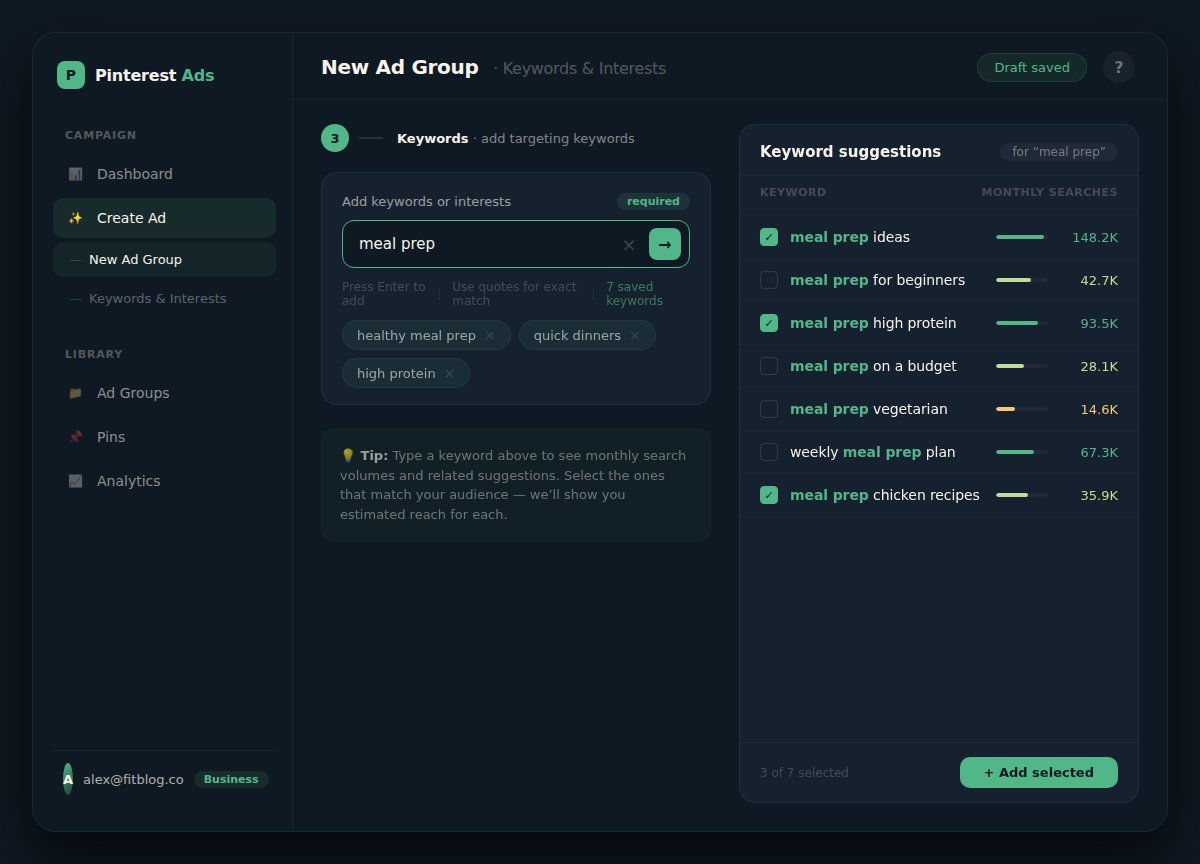
Pinterest’s native keyword tool (buried inside the Ads interface under Create Ad > New Ad Group > Keywords and Interests) gives you monthly search volume data for free. You do not need to run an ad. The tool exists. Most bloggers have never opened it.
Pull 10–15 seed keywords from this interface for your blog topic. Then feed that list to Claude or ChatGPT with the following prompt structure:
“I have these Pinterest keyword seeds for a [niche] blog. Expand each into 5 related long-tail keyword phrases that match informational or inspirational search intent. Format as a table with estimated specificity (broad, mid-tail, long-tail).”
Output: a working keyword matrix for an entire content quarter. Time cost: 12 minutes.
Step 2 — Pin Copy Generation
For each new blog post, the pin copy workflow runs as follows. Feed the blog post URL or a 200-word summary to your AI tool with this prompt:
“Write 3 Pinterest pin titles and descriptions for this article. Each title must be under 100 characters. Each description must be 150–200 characters, include the primary keyword [X], create curiosity without clickbait, and end with a soft directional phrase. Do not use the word ‘tips’ more than once across all three.”
You will need to edit the output. AI-generated Pinterest copy trends toward generic benefit statements. Your job is to inject the specific hook from your actual article — the counterintuitive finding, the specific number, the named framework. That editing pass takes 8–10 minutes. It is not optional.
Step 3 — Board Optimization Audit
Run a board audit once per month, not weekly. Feed your current board titles and descriptions to your AI tool with the keyword matrix from Step 1:
“Review these Pinterest board titles and descriptions. Identify any boards that are missing primary keywords from this list. Suggest revised titles and descriptions of 160 characters or less. Maintain the existing board purpose — only optimize the language.”
This replaces a 45-minute manual audit with a 10-minute generation-and-review cycle.
Step 4 — Canva AI for Pin Template Variation
Canva’s AI image generation and Magic Design tool allows you to generate on-brand pin templates from a text prompt. The more useful application is template variation: feed your existing high-performing pin design into Canva’s Magic Switch tool and generate three layout variations. Test which layout variant drives higher click-through rate over a 30-day window using Tailwind’s analytics.
The strategic point here is design differentiation. If every pin in your niche uses bright gradient backgrounds and bold white text — and most do — earth tones and serif typography will stand out in the feed. AI image generation can produce 20 layout variants in the time it takes to manually design two. You are not replacing design judgment. You are accelerating the testing surface.
Step 5 — Scheduling Logic with Tailwind
Tailwind’s SmartSchedule function identifies your account’s highest-engagement windows and queues pins into those slots automatically. The AI component here is engagement-window optimization — it adjusts posting times based on your historical data rather than a generic best-practices guide.
Load a month’s worth of pins in one batching session. The session takes 25–35 minutes. Daily manual pinning is an inefficient use of decision-making time at any publishing volume above two posts per week. [Tailwind’s analytics documentation](https://www.tailwindapp.com/blog/pinterest-analytics) explains how to read engagement window data for your specific account.
Where the Pinterest + AI Strategy Breaks
Pin cohesion failures are the most common cause of suppressed distribution. Pinterest’s algorithm scans the destination URL to verify semantic alignment with the pin. If your pin title targets “meal prep for beginners” but lands on a post titled “Advanced Macro Tracking Guide,” Pinterest will reduce that pin’s search distribution. AI tools generate pin copy based on the prompt you give them — if the prompt does not accurately reflect the destination content, the copy will be misaligned by design.
AI-generated pin descriptions also have a consistency problem. The same prompt run twice will produce different tone, specificity, and keyword placement. Operators who want brand-voice consistency need a tight prompt with examples of acceptable and unacceptable output included. The first ten pins will require heavy editing. After that, the model learns your constraints if you maintain them in the prompt.
Finally, Rich Pins require meta tag configuration on your website backend before they activate. No AI tool shortcuts that setup. Article Rich Pins automatically pull headline, author, and description from your post’s meta tags — which means your on-page SEO and Pinterest distribution are directly linked. If your meta descriptions are weak, your Rich Pin previews will be weak. Fix the source before scaling the distribution.
The Friction Box
- Pinterest’s keyword tool requires navigating into the Ads interface — there is no standalone free keyword dashboard for organic accounts
- AI-generated pin copy requires a mandatory human editing pass — publishing unedited output produces generic, low-CTR pins at scale
- Canva AI image output requires brand-consistency review — off-brand visuals damage account coherence over time
- Tailwind’s SmartSchedule is only as accurate as your historical engagement data — new accounts have insufficient data for meaningful optimization in the first 60 days
- Rich Pin setup is a one-time technical task that requires backend access — not optional if you want automatic metadata sync
- Pinterest’s algorithm change frequency is lower than TikTok or Instagram but non-zero — distribution tactics documented in Q4 2024 may require adjustment as platform behavior evolves
The Straight Talk
This workflow is built for bloggers generating at least four posts per month who already have a functioning content operation and need a distribution lever that does not require paid media budget. If you are producing content at that rate and ignoring Pinterest, you are working harder than necessary for the same traffic ceiling.
Skip this if you are still in the content foundation phase — fewer than 20 published posts, no keyword strategy, no Google Search Console baseline. Pinterest amplifies existing content quality. It does not compensate for the absence of it.
The next action: open Pinterest Ads, navigate to the keyword tool, pull search volumes for your five core blog topics, and run the AI keyword expansion prompt. That exercise takes 20 minutes and produces your first 90-day Pinterest keyword matrix. Start there.