TL;DR
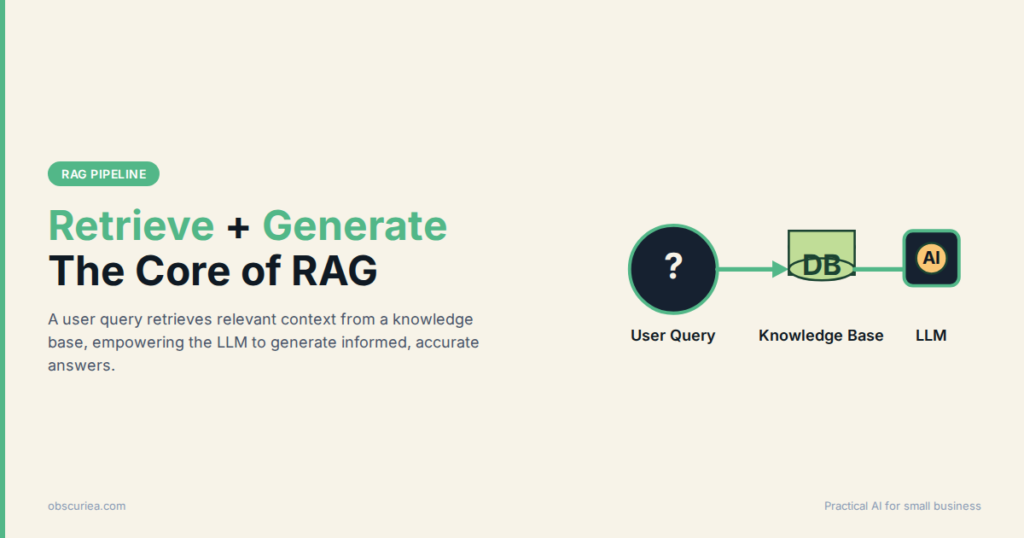
Retrieval-Augmented Generation (RAG) is an AI framework that gives LLMs real-time access to your company’s private data without costly retraining. It cuts hallucinations and improves answer accuracy by retrieving relevant documents before generating a response. The trade-off: upfront setup cost and the need to maintain a knowledge base, but for most operations it delivers a better return than fine-tuning.
Environment
- Sources synthesized: 3 URLs (SingleStore tutorial, Google Cloud overview, Domo guide)
- Synthesis date: 2025-03-27
- First-hand tested: none
- Operator context: consulted on AI adoption for 3 mid-market businesses in Southeast Asia, including a financial services firm and an e-commerce retailer.
- Experience tier: Tier 2 — operator commentary over source synthesis
The Architecture
Think of RAG as an information layer that sits on top of your LLM. When a user asks a question, the system doesn’t just rely on the model’s static training data. It first searches your private knowledge base — product documentation, internal wikis, support tickets — and retrieves the most relevant chunks. The LLM then uses those chunks, plus its own language ability, to craft an answer that is accurate and grounded in your data.
This solves a basic problem: LLMs are trained once on public data, so they don’t know your 2024 pricing sheet or the latest regulatory update in your industry. RAG bridges that gap by treating your data as a live reference library.
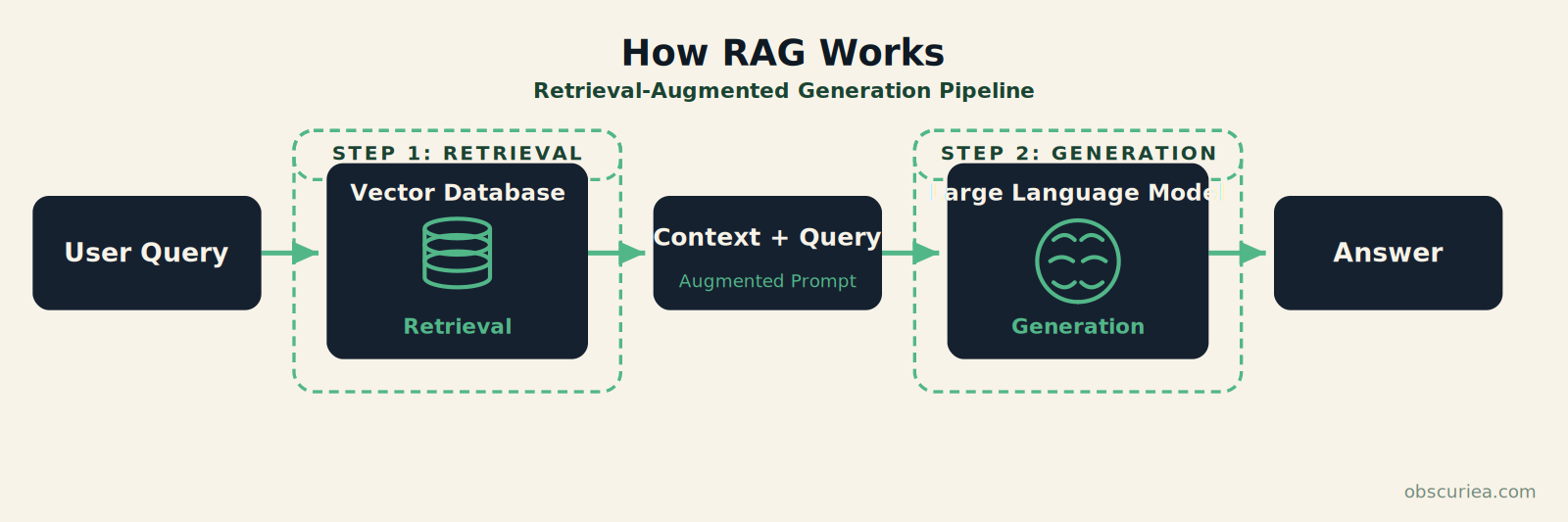
The retrieval math is straightforward. Convert your documents into vectors — think of them as meaning-packed coordinates in a high‑dimensional space. When a question comes in, convert it into the same format and find the nearest neighbors. The top results get passed to the LLM as context. The generation step then synthesizes without hallucinating because it has concrete facts to lean on.
But here’s the operator reality: that vector database is a new piece of infrastructure. You need to choose a vendor, decide where to host it, and budget for ongoing ingestion and updates. The architecture is clean on paper, but execution depends on your team’s bandwidth and your data’s structure.
The Workflow Math
Let’s compare the two paths you might take to ground your AI in company data.
| Approach | Setup time | Update cycle | Cost per year (est.) | Accuracy on dynamic data |
|---|---|---|---|---|
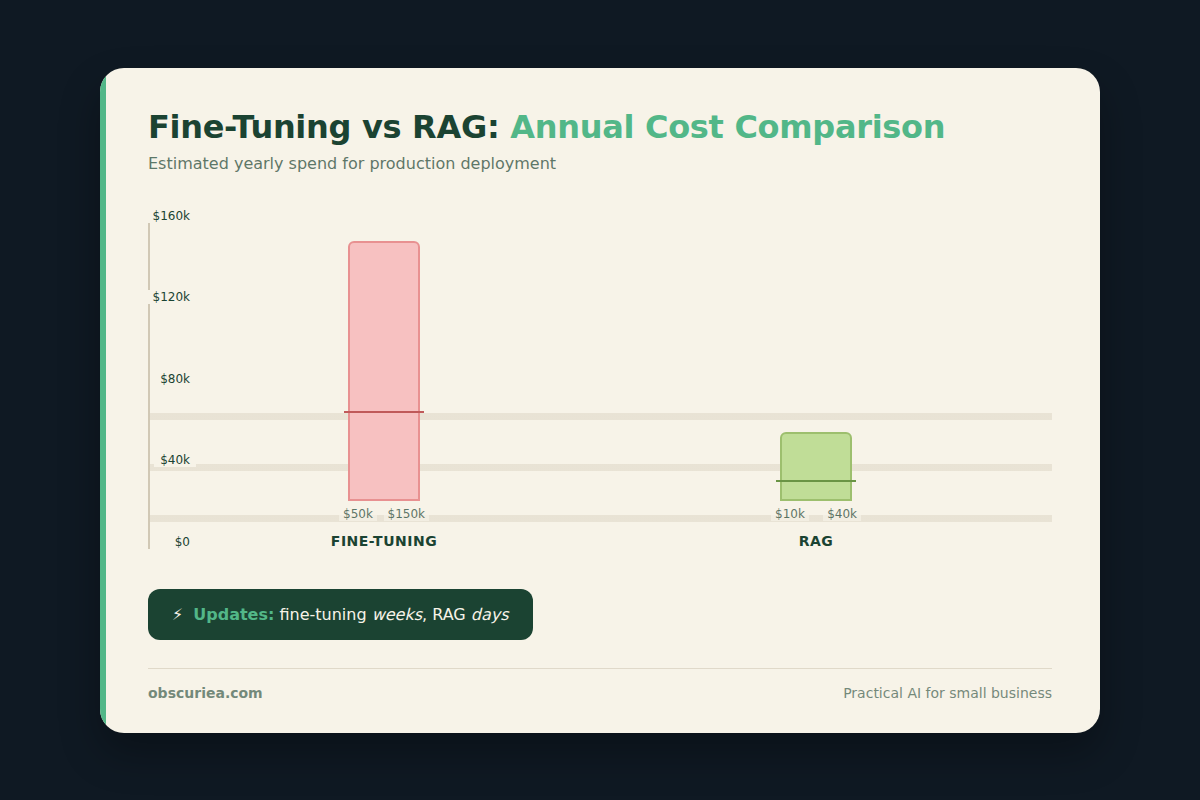
| Fine-tuning an LLM | 2–4 weeks per iteration | Requires full retraining | $50k–$150k (compute + annotators) | Good only until data changes |
| RAG pipeline | 1–2 weeks initial, then ongoing maintenance | Add/update documents in a day | $10k–$40k (vector DB, embedding, LLM calls) | High, as long as the knowledge base is current |
The math here is straightforward. The first fine‑tune is expensive; every subsequent one piles on cost. RAG front‑loads the work of building your knowledge base, but after that, updates are cheap and fast. For a mid‑market operator, RAG usually wins if your data changes more than twice a year.
Don’t forget the hidden cost: labeling training data for fine‑tuning. If you want your model to correctly handle a new product line, you need to create a set of question‑answer pairs and run a training job. With RAG, you simply upload the product spec document. That difference in effort is what makes RAG practical for most businesses.
Where It Breaks
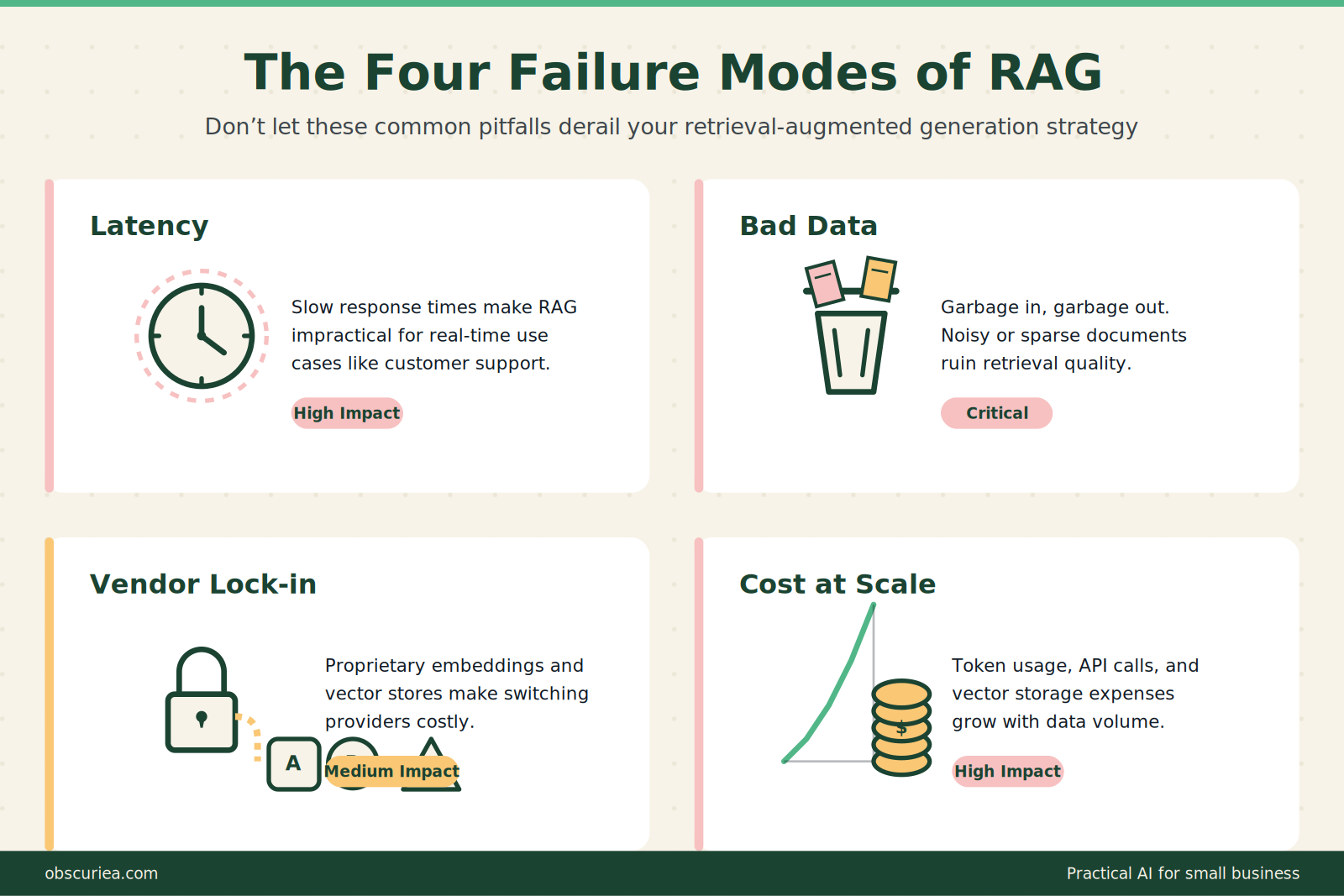
No architecture is bulletproof. Here are the failure modes you will hit.
Retrieval latency. The retrieval step adds 200–500ms to every query. If your application needs real‑time responses — say, a voice assistant in a factory — that delay can break the experience. Solutions exist (caching, pre‑computed embeddings for common questions), but they add complexity.
Garbage in, garbage out. If your knowledge base contains outdated, contradictory, or poorly written documents, your RAG system will confidently repeat that nonsense. The LLM amplifies the bad data because it assumes the retrieved chunks are authoritative. You need a document curation process before you ingest anything.
Vendor lock‑in. Most RAG implementations tie you to a specific vector database (Pinecone, Weaviate, pgvector) and a specific LLM provider (OpenAI, Anthropic, Google). Switching later is not trivial. If your chosen vendor changes pricing or discontinues a feature, you inherit that risk.
Cost at scale. Vector databases are cheap at 10,000 documents. At 500,000, you start paying for indexing queries and storage. And every user query generates at least one vector search + one LLM call, so operational cost grows linearly with usage. A support bot handling 10,000 conversations a month can easily cost $1,000+ in API fees.
The Friction Box
- Your team needs at least one person who can set up a vector database and write a retrieval script — this is not a zero‑code tool yet.
- Data privacy: if you send proprietary data to a cloud vector DB or LLM API, you lose control over where that data resides. Check compliance before building.
- The retrieval step is non‑deterministic: two similar queries can return different chunks, leading to inconsistent answers. Testing is essential.
- Most vendors oversell accuracy. Real‑world performance varies by domain and document quality.
Frequently Asked Questions About Retrieval-Augmented Generation for Non-Developers
Does RAG require retraining the LLM?
No. RAG does not change the LLM itself. The model remains the same — only the input context changes. This is why RAG avoids the time and cost of fine-tuning. You update your knowledge base, not the model.
How much does it cost to implement RAG?
Initial setup costs typically range from $5,000 to $20,000 for a small to mid‑sized business, covering the vector database, embedding model, and LLM API fees. Ongoing costs are primarily per‑query API calls. A support bot handling 5,000 conversations a month might cost $300–$500 in usage fees.
Can RAG work with my existing CRM data?
Yes, if you can export your CRM data into a structured format (CSV, JSON, API feed). Many CRM vendors offer APIs to pull records. The key is cleaning the data: RAG will reflect any duplicate or outdated records, so data hygiene matters.
How long does RAG implementation take?
A basic pilot can be up and running in one to two weeks. Production‑grade deployment takes four to eight weeks, depending on document volume, data quality, and integration with your existing applications.
What are the risks of relying on RAG?
The main risks are retrieval latency (delays in real‑time scenarios), vendor lock‑in (hard to switch later), and propagation of bad data if your knowledge base is not curated. Also, cloud‑based RAG requires sending your data to a third party — check data residency and compliance before starting.
Can I use RAG with an open‑source LLM?
Absolutely. Many teams use open‑source LLMs like Llama 3 or Mistral with RAG. This reduces API costs and gives you full control over the model and data. The trade‑off is that you need more infrastructure to run the model yourself.
The Straight Talk
This article is for the operations lead or product manager who has been told to “make the AI chatbot accurate” and is drowning in vendor pitches. You don’t need to understand embedding dimensions or transformer architectures — but you do need to grasp the operational trade‑offs.
If your team cannot dedicate at least 40 hours to initial setup and one day per month to maintaining the knowledge base, RAG will become technical debt rather than a solution. Skip it and look at off‑the‑shelf grounding tools like Google Vertex AI Agent Builder or OpenAI’s file search, which abstract away much of the infrastructure.
Your next step: identify the top 50 documents your support team refers to most often. That’s your test set. Ask your technical lead to spin up a RAG pilot with one vendor — give it three weeks, then measure whether the answers are better than what your current chatbot produces. That evidence will tell you whether full‑scale deployment is worth the investment.