TL;DR
Contractor compliance management software automates onboarding, payments, and tax documentation across borders, but the operational reality is more complex than vendor demos suggest. Most platforms solve the paperwork problem while introducing new failure points around integration, misclassification nuance, and payment speed. This article breaks down how these systems actually work, what they cost in time and money, and where they break for mid-market operators.
Environment
– Sources synthesized: 3 URLs (getthera.com, rippling.com, deel.com)
– Synthesis date: 2025
– First-hand tested: none
– Operator context: Synthesizing from vendor-published sources for small-to-mid business operational perspective.
The Architecture
At its core, automated contractor compliance management solves a simple workflow problem — matching a person to a jurisdiction, collecting the right documents, and moving money on time. But behind that simplicity sits a web of local labor laws, tax quirks, and payment rails that vary wildly from one country to the next.
The typical platform, whether Deel, Rippling, or Thera, provides the same four-layer architecture:
Layer 1: Onboarding Automation. Contractors receive a link to a self-service portal. They upload ID documents, fill out tax forms (W-8BEN, W-9, local equivalents), sign the contract, and complete KYC verification — all in one flow. Deel claims up to 70% reduction in administrative time; Thera promises 24-hour onboarding. The speed depends on how quickly the contractor submits documents and whether manual review is triggered by odd data.
Layer 2: Compliance Management. This is the core value proposition. The platform checks worker classification (contractor vs. employee) against local laws, generates compliant contracts, and monitors regulatory changes. Remote’s Watchtower service pushes updates when tax rules shift. Rippling flags misclassification risks. But the software does not replace legal advice — it only flags visible red flags. Local nuance (e.g., Indonesia’s strict definitions around control and independence) often requires human judgment.
Layer 3: Payment Processing. Multi-currency payments with various payout methods (wire transfer, PayPal, crypto, local bank). Thera offers near-instant payments in 150+ currencies; Gusto can take five days. Exchange rate margins vary widely — Thera claims 0.2% spread, while competitors take 2-3%. This directly hits contractor take-home pay and your total bill.
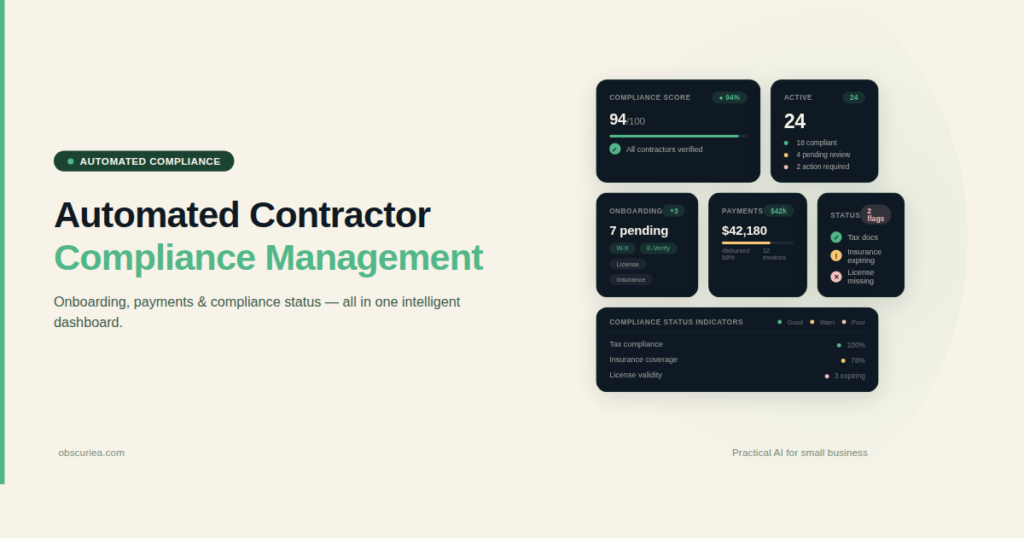
Layer 4: Reporting and Integration. Centralized dashboards show contractor spend, tax filings, and compliance status. Platforms integrate with ERPs (NetSuite, QuickBooks), CRMs (Salesforce), and HRIS systems. Rippling leads with 600+ integrations; Thera lags. The integration quality determines whether you actually save time or just move the data entry problem.
The Workflow Math
The decision to automate hinges on a simple calculation: does the time saved exceed the setup cost plus subscription? Below is a comparative breakdown for a mid-market company managing 50 contractors across five countries.
| Task | Manual (hours per month) | Automated (hours per month) | Tool used |
|---|---|---|---|
| Contractor onboarding (first-time per country) | 8 (research) + 2 (contract drafting) | 1 (template selection) | Deel / Rippling |
| Ongoing contractor onboarding (per contractor) | 1.5 (paperwork, chasing signatures) | 0.2 (self-service portal) | All platforms |
| Invoicing and payment processing | 2 per contractor (to check, approve, send) | 0.5 per contractor (auto-approve, batch) | Gusto / Remote |
| Tax form filing (quarterly) | 4 | 0.5 (auto-generated) | Deel / Rippling |
| Compliance monitoring (monthly) | 3 | 0 (push notifications) | Remote Watchtower |
| Total (monthly) | ~130 hours | ~30 hours |
The table omits the initial configuration: setting up integrations costs 4-6 hours per tool, and per-country compliance template customization another 2-3 hours. Payback period varies from two weeks (if you’re drowning in admin) to three months (if your current process is already semi-automated).
But the math only works if the tool fits your stack. A company using Xero and HubSpot gains nothing from a tool that only integrates with QuickBooks. The number of supported integrations is a hard constraint, not a nice-to-have.
Where It Breaks
Integration debt. Rippling integrates with 600+ apps but does not cover every local ERP in Southeast Asia. Thera lacks a mobile app and does not connect to Xendit or Midtrans — the default payment gateways in Indonesia. Your team ends up manually exporting payroll data and re-importing it into the local accounting system, negating the automation benefit.
Payment delays. Gusto takes five days to process payments. Thera promises same-day for 95% of payments, but that speed depends on the contractor’s bank and payout method. Contractors in regions with slower banking infrastructure (much of Africa, parts of Southeast Asia) will wait regardless of the platform’s promise.
False confidence in compliance. The software flags misclassification risks but cannot adjudicate edge cases. For example, a contractor who works exclusively for you, uses your equipment, and follows your methodology looks like an employee under many jurisdictions. The platform may raise a warning, but it won’t tell you that your specific contract language fails the IRS 20-factor test or Indonesia’s Manpower Law. That requires a local labor lawyer — the platform does not replace one.
Cost creep at scale. Deel’s Contractor and COR plans include many features, but small teams pay for unused HR modules. Gusto’s pricing is straightforward per contractor, but its exchange rate margins eat into contractor pay at volume. Thera saves money on fees but may not scale beyond 50 contractors due to limited integrations. The friction of switching tools mid-growth is real — migration costs and contractor disruption should factor into the tool choice upfront.
Support gaps. User reviews on G2 mention slow response times for Gusto support. Thera offers a dedicated Slack channel — a differentiator — but only for paid plans. When a payment fails on payday, you need immediate human help, not a knowledge base.
The Friction Box
- Local payment rails incompatibility: Stripe unavailable in Indonesia; Xendit, Midtrans, or Doku not supported by these platforms. You may need a separate payment orchestration layer.
- Learning curve for non-tech ops teams: Self-service portals assume the contractor is tech-literate. For blue-collar contractors or older freelancers, the onboarding flow becomes a phone call circus.
- Hidden currency exchange costs: Platforms advertise low margins but often have wide spreads on less common currencies. Check the actual rate vs. mid-market before committing.
- False sense of compliance closure: No platform replaces a local legal review. The compliance features are guardrails, not guarantees.
- One-size-fits-all contract templates: Templates might not satisfy Indonesia’s requirement for a specific clause about “pengawasan” (supervision) — a key factor in worker classification disputes.
Frequently Asked Questions About Automated Contractor Compliance Management
How does automated contractor compliance software handle misclassification risk?
The software uses algorithms and predefined rules to flag potential misclassification based on factors like control, exclusivity, and equipment use. It cannot replace a thorough legal review by a local labor lawyer. The best use is as a first-pass filter that surfaces high-risk arrangements before they reach a human decision.
What is the typical setup time for these platforms?
Initial configuration takes 4-6 hours per tool, including integration setup and template customization. Per-country onboarding of the first contractor takes another 2-3 hours. Expect a week from sign-up to first payment cycle.
Which tool works best for companies in Southeast Asia?
None of the major platforms fully support local payment gateways like Xendit, Midtrans, or Doku. Rippling has the broadest integration set, but you may still need a separate payment orchestration layer for contractors who rely on local bank transfers. Deel supports multiple payout methods including local bank, but check specific country support before committing.
Are automated compliance tools compliant with Indonesia’s labor laws?
The tools flag general risks but are not customized to Indonesia’s Manpower Law (UUK Ketenagakerjaan) or Omnibus Law nuances. Work with a local legal provider alongside the software to ensure full compliance.
Can I manage contractors and employees in the same platform?
Deel and Rippling offer unified platforms for employees (via EOR) and contractors. Gusto focuses on US-based employees and contractors. Thera is contractor-only.
The Straight Talk
This is for operators managing 10+ contractors across multiple countries who want to cut admin overhead by 70% and reduce compliance risk. If you have fewer than five contractors and can manage with spreadsheets plus a freelance accountant, you will likely spend more time learning the tool than you save.
Skip automated compliance software if your contractor base is concentrated in a single jurisdiction, you already have a local HR team, or your contractors are all paid via a single currency with minimal tax complexity. The setup cost and monthly subscription will exceed the benefit.
Next action: Map your current time expenditure per contractor per month across onboarding, payments, and compliance. If the total exceeds 50 hours monthly, test one platform with a single contractor (ideally in a jurisdiction where the tool claims strong local compliance). Run the test for two pay cycles before rolling out to the entire roster.