Automated Competitive Analysis: Level the Playing Field
TL;DR: Most businesses running manual competitive analysis are making decisions on data that’s 90 days stale. Automated competitive analysis replaces quarterly slide-deck updates with continuous monitoring that surfaces pricing changes, feature launches, and positioning shifts within hours. The ROI calculation is straightforward: CI teams save 10–12 hours per week on manual research and redirect that time toward analysis that actually influences strategy.
Environment:
– Sources synthesized: 2 URLs (klue.com/topics/automated-competitor-insights; riffanalytics.ai/blog/best-competitive-analysis-tools) — a third scraped source on reinforcement learning for game-level balancing was excluded as irrelevant to business competitive intelligence
– Synthesis date: 2026-05-04
– First-hand tested: none
– Operator context: Synthesizing from competitive intelligence platform documentation and marketing tool review sources. Primary angle is lean-team and SMB implementation reality — where no dedicated CI headcount exists and enterprise suites are priced for buyers with a different problem.
– E-E-A-T Tier: 3 (Synthesis Transparency)
The Architecture of Automated Competitive Analysis
Here is what breaks before the automation goes in: someone Googles a competitor once a quarter, pastes findings into a slide deck, and calls it competitive intelligence. By the time the deck reaches the sales team, the competitor has changed their pricing, launched two features, and posted seven job openings that signal exactly where they’re expanding next.
Automated competitive analysis is a monitoring infrastructure, not a research tool. The distinction matters. Research is reactive — someone asks a question, you find an answer. Monitoring is continuous — the system watches, filters, and delivers signals before anyone thinks to ask.
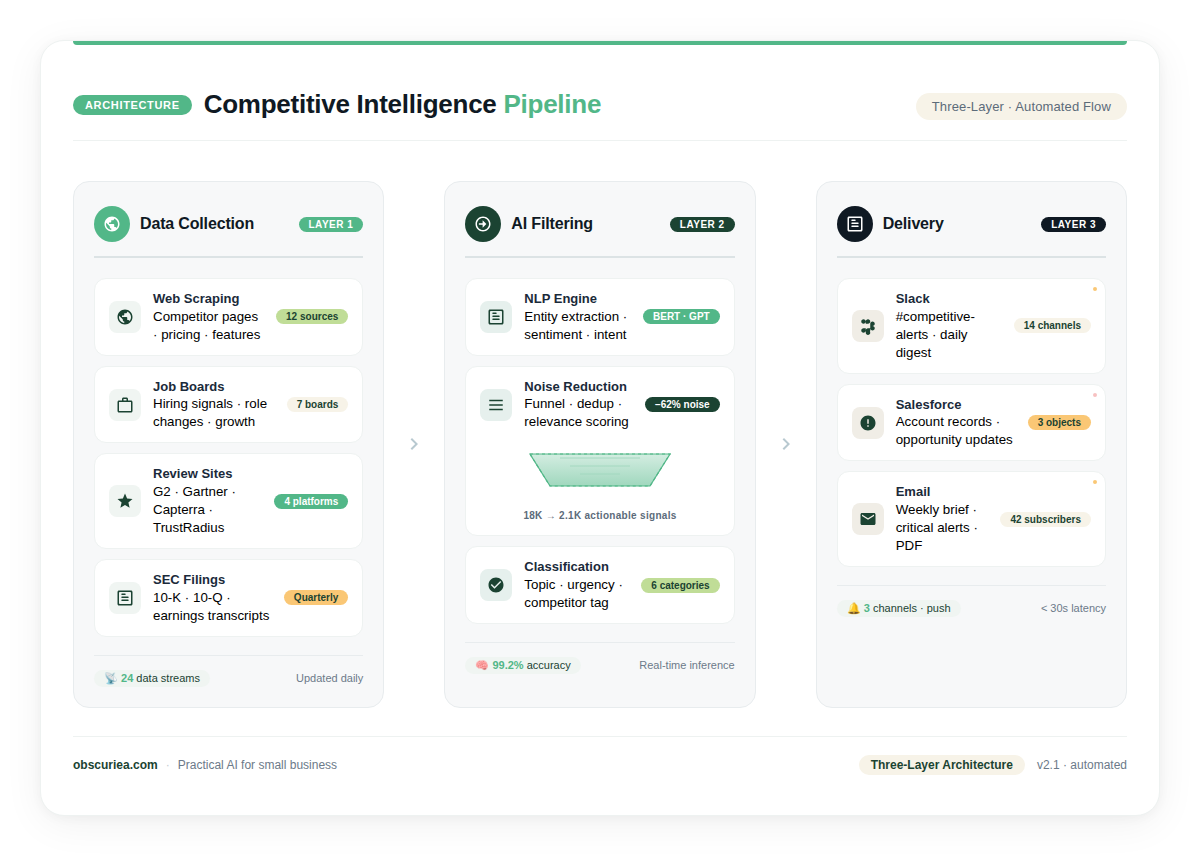
The system has three layers.
Data collection runs around the clock. Web scrapers watch competitor product pages, pricing pages, and press release feeds. API integrations pull job postings from [LinkedIn](https://www.linkedin.com) and [Indeed](https://www.indeed.com). Review aggregation pulls sentiment from [G2](https://www.g2.com), [Gartner Peer Insights](https://www.gartner.com/en/digital-markets), and [TrustRadius](https://www.trustradius.com). For operators tracking publicly traded competitors, SEC filing monitoring adds a financial signal layer that most teams ignore entirely.
AI filtering is what separates signal from noise. Raw competitor data is overwhelming — hundreds of web changes, social posts, and review updates per week across even three or four competitors. Natural language processing identifies the events that matter: a pricing page rewrite, a new enterprise case study, a cluster of negative reviews all citing the same feature gap, a batch of senior sales hires indicating a push into a new vertical.
Delivery is where most automated competitive analysis implementations fail. Intel that lives in a separate dashboard doesn’t reach the people who can act on it. The system has to push into Slack, Salesforce, or email — wherever your sellers and marketers already work. If a rep has to open a new tab to see competitive intel, the intel will go unread. This is not a technology problem. It is an adoption design problem, and it needs to be solved before the system is configured, not after.
The internal data layer is what most operators miss when they first build this out. External monitoring catches what competitors do publicly. It doesn’t capture what competitors are saying to your prospects in active deals. Integrating your CRM — tagging competitor mentions in opportunities, tracking win/loss rates by competitor, connecting call recording analysis to competitive intelligence — is the second half of the system. Platforms like [Klue](https://klue.com) and [Crayon](https://www.crayon.co) pull from call recording tools to surface what buyers are actually saying about alternatives in live deals. External data without internal context is noise. Internal data without external context is incomplete.
The Workflow Math: Automated vs. Manual Competitive Analysis
Manual CI at a five-person marketing team looks like this: one person owns competitive research as roughly 20% of their time. Eight hours per week — two hours daily scanning news, review sites, and competitor websites, plus time maintaining battlecards and briefing sales reps before key deals.
| Activity | Manual (hrs/week) | Automated (hrs/week) |
|---|---|---|
| Competitor website monitoring | 3.0 | 0.25 (alert review) |
| Review site tracking (G2, Gartner) | 1.5 | 0.25 (alert review) |
| News and press monitoring | 1.0 | 0.25 (alert review) |
| Job posting analysis | 1.0 | 0.50 (weekly digest) |
| Battlecard updates | 2.0 | 0.50 (triggered updates) |
| Total | 8.5 | 1.75 |
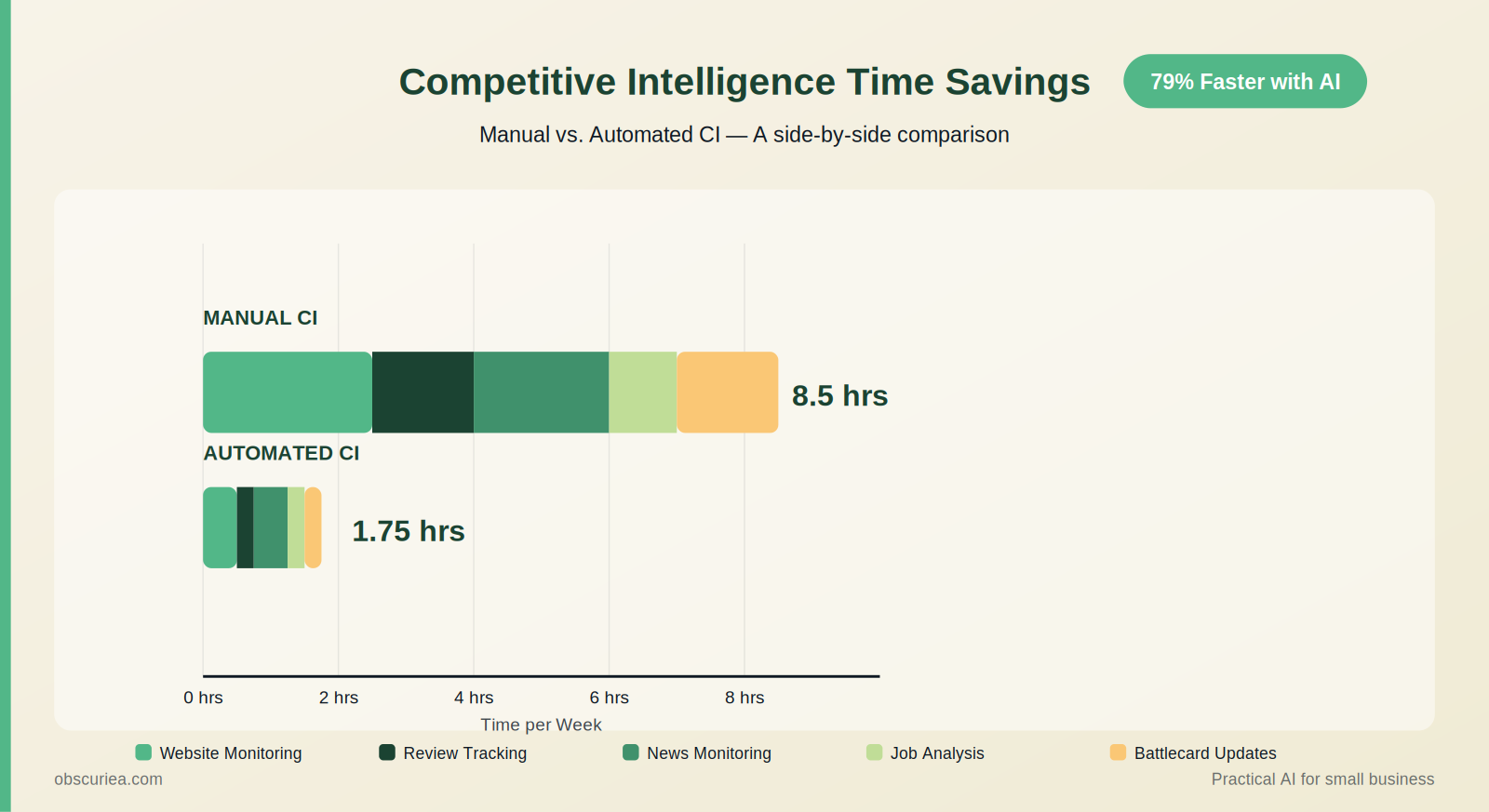
That is 6.75 hours per week reclaimed per CI-adjacent team member. A [ZoomInfo](https://www.zoominfo.com) survey of GTM professionals found AI tools save an average of 12 hours per week across competitive research tasks — the CI-specific component is where the heaviest manual time traditionally lives.
Coverage expansion matters as much as the time savings. Manual research limits you to three to five competitors. Automated competitive analysis systems can track ten to fifteen with the same analyst time because monitoring runs continuously in the background. Emerging threats — the category entrant that appears in one deal, then two, then five — get caught before they become a pattern you’re reacting to rather than anticipating.
For teams with no dedicated CI headcount — which includes most businesses under fifty people — the math is different. CI doesn’t happen consistently at all. Someone gets pulled in before a big deal, does two hours of research, and produces a document that doesn’t get updated again. Automation at this scale doesn’t reclaim hours from an existing CI function. It creates a CI function that didn’t previously exist.
That’s the leveling mechanism. Forrester found that 92% of B2B buyers already have a vendor in mind before formal evaluation begins. If your competitor drops their price on Tuesday and your rep finds out on Friday, the deal was probably lost on Wednesday. Automation closes that gap for operators who can’t staff a full-time competitive intelligence analyst.
Where Automated Competitive Analysis Breaks
Automated competitive analysis has four specific failure modes. Operators who ignore these end up with expensive monitoring infrastructure that their teams stopped trusting three months after launch.
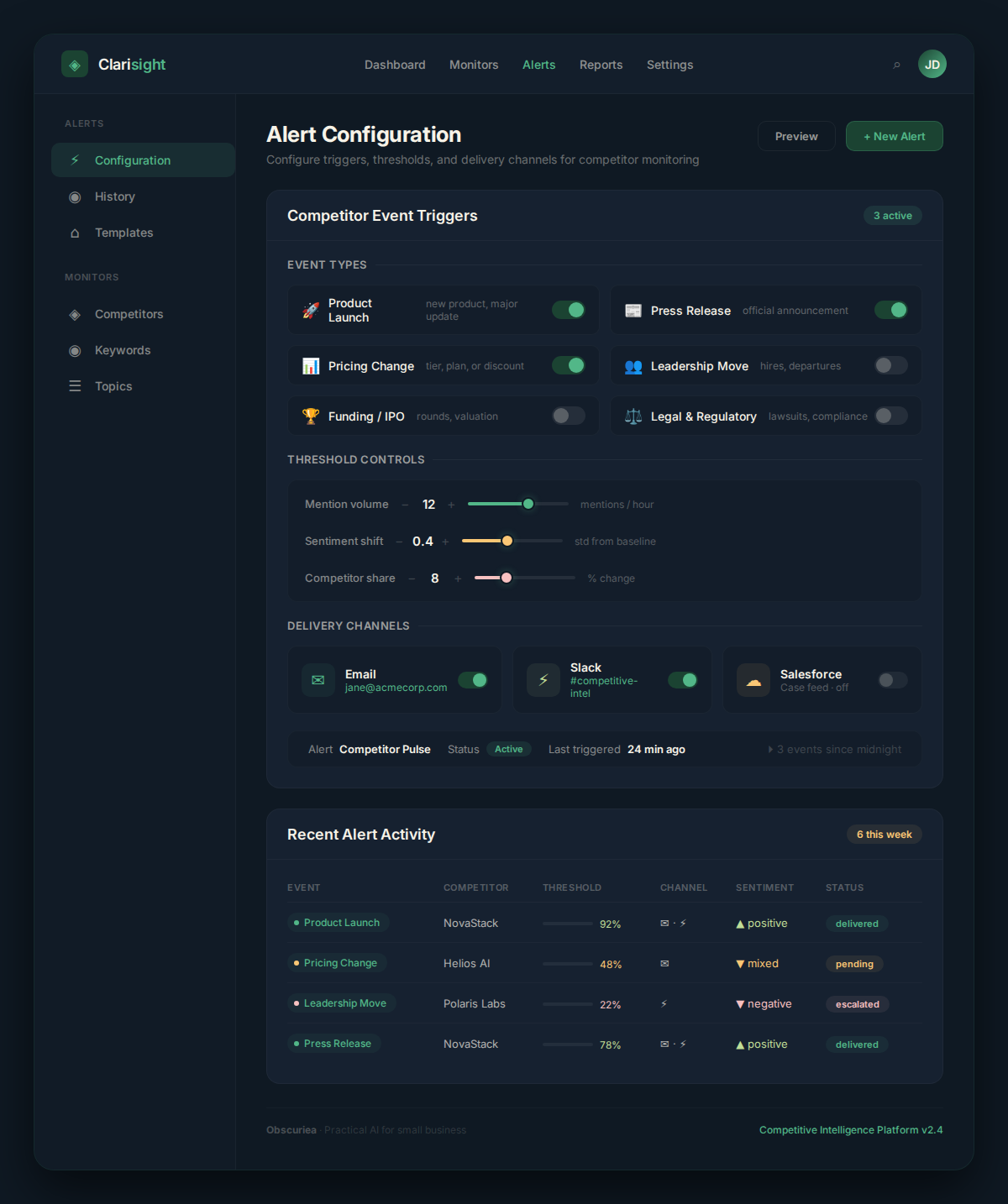
Alert fatigue kills adoption. Default configurations on most platforms send too much. Every blog post, every minor website change, every social mention hits the channel. Sales reps get 15 Slack notifications before 9am and start ignoring all of them. Configure alert thresholds at setup: pricing page changes yes, new blog posts no, five-plus senior hires in a specific function yes, individual LinkedIn posts no. The configuration step takes three to four hours. Most teams skip it.
Internal signals are missing. CRM integration — tagging competitor mentions in opportunities, tracking win rates by competitor, connecting call recording analysis — is the second half of the system. Without it, you’re monitoring what competitors broadcast publicly, not what they’re saying in your deals. That’s half a picture at most.
Stale battlecards persist despite automation. The system triggers an alert when a competitor changes their pricing. But if nobody is assigned to translate that alert into a battlecard update within 24 hours, the battlecard stays stale and the rep uses the old version in the next deal. Automation creates the signal. A human still needs to act on it. Define who owns battlecard updates and at what trigger threshold before you configure the monitoring stack — not after.
Coverage gaps in the calibration window. Most platforms take two to four weeks to calibrate after initial setup. Alert sensitivity gets tuned. Coverage sources get added. The system learns which competitor events actually matter to your team. Operators who evaluate the platform in the first two weeks will underestimate what it delivers at full configuration.
The Friction Box
- Enterprise automated competitive analysis suites (Klue, Crayon) price at $15,000–$50,000+ annually — architecture built for buyers with dedicated CI budgets, not lean teams
- CRM and call recording integrations (Salesforce, Gong) add 4–8 hours of setup time and require admin access most small teams don’t have readily available
- Alert configuration is the highest-leverage setup task and the one most teams skip — default settings produce noise, not signal
- Sales team adoption is the constraint, not the technology — if reps don’t trust the intel or don’t know it exists, the system has zero impact on deal outcomes
- Review site data (G2, Gartner) reflects buyers who took the time to write a review — not a representative sample of your competitive landscape
- AI search visibility — which AI answer engines cite your competitors vs. you — is an emerging CI category most legacy platforms don’t cover; [Riff Analytics](https://riffanalytics.ai) and [Semrush](https://www.semrush.com) are early movers building toward this layer
Frequently Asked Questions About Automated Competitive Analysis
What exactly does automated competitive analysis do?
Automated competitive analysis uses AI and web monitoring tools to continuously track competitor activity — pricing changes, product launches, hiring patterns, review sentiment, and media coverage — and deliver relevant signals to the teams who can act on them. It replaces periodic manual research with continuous monitoring. The output is alerts, updated battlecards, and briefings rather than quarterly slide decks.
How much does competitive intelligence software cost for small businesses?
Enterprise suites like Klue and Crayon start at $15,000–$50,000 per year, priced for marketing teams with dedicated CI budgets. Small businesses can build lightweight automated competitive analysis with Google Alerts (free), LinkedIn job tracking (free), and monthly G2 review checks for under two hours per week — no annual contract required. Mid-market tools like Semrush’s competitive toolkit start around $1,300 per year and cover keyword and positioning monitoring without requiring CRM integration.
What is the difference between competitive intelligence and competitive analysis?
Competitive intelligence is the ongoing process of collecting and monitoring competitor data. Competitive analysis is the structured evaluation of that data to produce strategic conclusions — battlecards, positioning recommendations, product gap assessments. Automation accelerates the intelligence layer. The analysis layer still requires human judgment. Conflating the two is why teams buy expensive monitoring platforms and then wonder why their strategy didn’t improve.
How often should sales battlecards be updated?
Battlecard updates should be event-triggered, not calendar-driven. Update whenever a competitor changes pricing, launches a major feature, makes a significant executive hire, or releases a case study targeting your segment. With automated competitive analysis in place, updates happen within 24–48 hours of a meaningful competitor event. Without automation, monthly or quarterly updates are the realistic cadence — and they’re almost always stale before they reach the sales team.
Can automated competitive analysis replace a dedicated CI analyst?
No — but it can create the functional equivalent of a CI program for teams that can’t hire one. The monitoring layer (data collection, filtering, alert delivery) is fully automatable. The analysis layer (synthesizing signals into strategic recommendations, updating battlecards, briefing sales) still requires judgment. What automation eliminates is the eight-plus hours per week of manual data gathering, freeing whoever owns CI to spend that time on work that actually influences decisions.
Does automated competitive analysis work if you have fewer than three competitors?
If your market is genuinely early-stage and competitors are sparse, manual tracking is sufficient — quarterly checks cover the territory with minimal overhead. If you have few direct competitors but significant indirect or emerging competition from adjacent categories, automated monitoring becomes more valuable, not less. The coverage advantage is most useful when competitive threats are diffuse or difficult to anticipate through manual research alone.
The Straight Talk
Automated competitive analysis earns its setup cost if you have at least three active competitors appearing in deals regularly and a sales team that uses battlecard-style intel. The system creates value when deals are competitive and intelligence is currently arriving too late or not at all.
Skip the enterprise suites if your team is under ten people or if competitive displacement isn’t a primary reason you lose deals. At that scale, Google Alerts plus monthly G2 checks plus a Notion battlecard template costs under two hours per week and covers the basics without a five-figure annual contract.
The first concrete action: map your last ten lost deals. Identify which competitors appeared and what intel your team would have needed to win. That exercise tells you whether automated CI is a tool problem or a process problem — and which one to fix first.
For a deeper look at turning competitive alerts into sales assets, see building AI-powered battlecards for your sales team. If you’re evaluating the full competitive intelligence stack before committing to a platform, competitive intelligence tools reviewed for lean teams in 2026 covers pricing and feature tradeoffs across the major platforms.