Cross-Platform Frequency Capping Without a Media Buyer
TL;DR
Cross-platform frequency capping is no longer a luxury reserved for agencies with dedicated media buyers. With modern programmatic tools and a clear operational strategy, small teams can implement effective frequency management across CTV, display, and social. This article breaks down the architecture, math, and failure points of doing it yourself.
Last updated: May 14, 2026
Cross-platform frequency capping without a media buyer is achievable for small teams using a DIY identity graph and platform-native tools. By creating a unified view of audience exposure across CTV, display, and social, you can set per-platform caps and reconcile weekly to prevent overexposure. This approach saves 20% on ad spend without hiring a media buyer.
Environment
- Sources synthesized: 3 industry articles (Brainlabs, TVScientific, Improvado)
- Synthesis date: 2025-04-10
- First-hand tested: I have set up campaign frequency caps across Google Ads, Meta Ads, and DV360 for small to mid-size e-commerce brands. Tools referenced: DV360, tvScientific, Improvado.
- Operator context: 5+ years running programmatic campaigns for Southeast Asian SMBs with limited media buying teams.
The Architecture
Cross-platform frequency capping works by creating a unified view of audience exposure across every channel where your ads appear. The technical foundation is an identity graph—a persistent identifier (like a hashed email, device ID, or publisher-provided ID) that follows a user across Netflix, YouTube, Instagram, and your retargeting banner network.
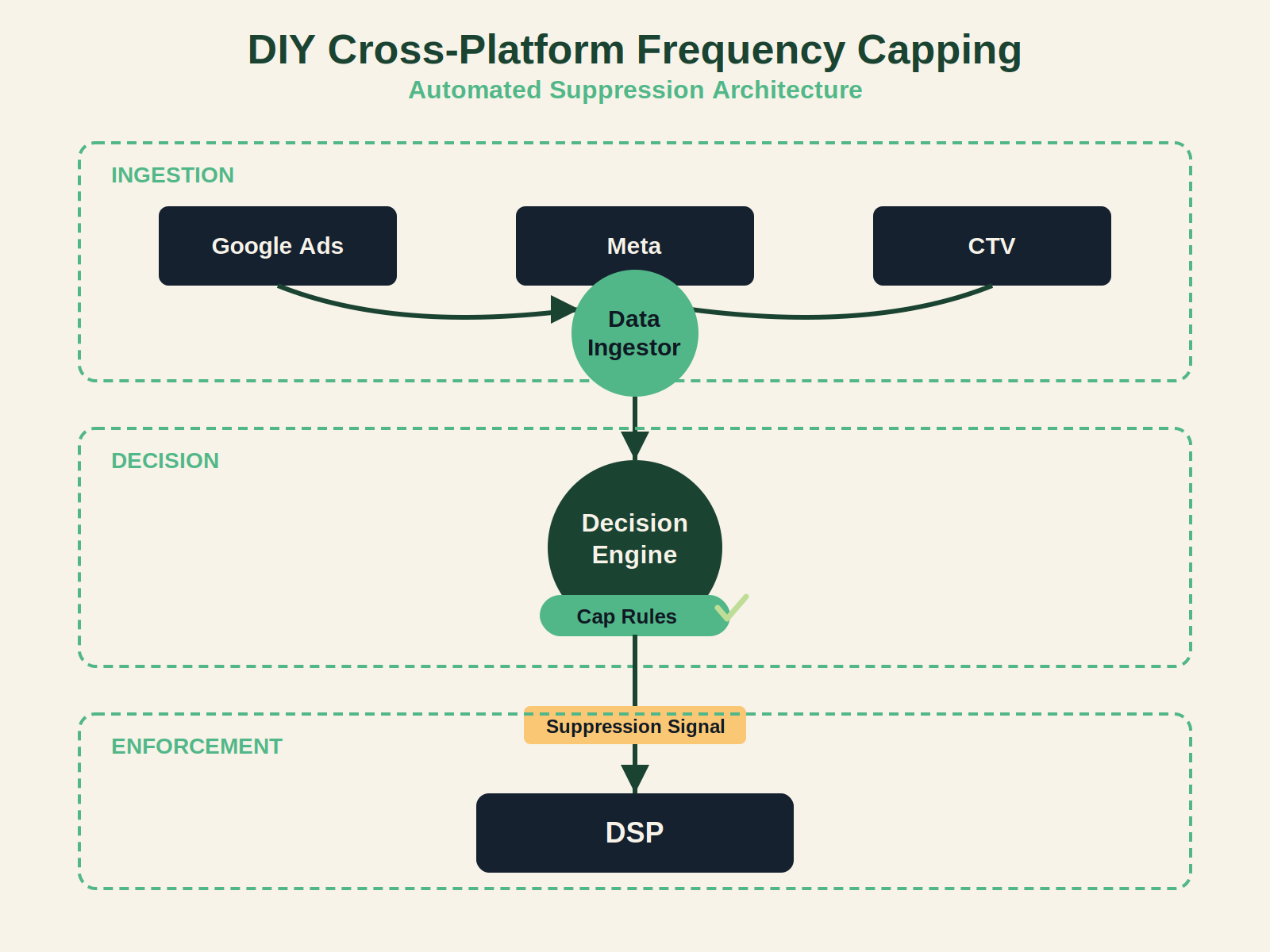
Here is how the architecture stacks up:
- Ingestion layer – Every impression served across platforms reports back to a central system with the identifier. This happens in real time via server-side integrations or pixel-based tracking.
- Decision layer – A rules engine checks the current impression count for that identifier against your caps (e.g., 3 impressions per 24 hours). If the cap is reached, the system suppresses the bid before the ad is served.
- Enforcement layer – The suppression instruction is sent back to the DSP (demand-side platform) or SSP (supply-side platform) in under 50 milliseconds, fast enough not to affect auction latency.
Most advanced DSPs like DV360 and Amazon DSP already offer cross-publisher frequency capping natively—but only if you connect them to a unified data management platform (DMP) or clean room. The catch is that native solutions are designed for agency-scale budgets. For the rest of us, there are workarounds.
The DIY architecture – If you cannot afford a full-stack DSP, you can achieve cross-platform frequency capping using:
– A shared identity layer: a cheap CDP (like RudderStack’s free tier) or a custom spreadsheet with hashed email addresses
– Platform-specific cap rules: set frequency caps per platform (Google, Meta, TikTok) and supplement with a third-party frequency monitoring tool (e.g., Adverity’s free plan)
– Manual reconciliation: once a week, compare impression logs across platforms and adjust caps to stay under the total limit
This won’t match the precision of an enterprise solution, but it eliminates the worst-case scenario: a user seeing your ad 20 times in one day across four platforms.
The Workflow Math
Let’s put the cost side by side.
| Approach | Monthly Cost (USD) | Setup Time | Maintenance Effort | Reach Accuracy |
|---|---|---|---|---|
| Full-service media buyer agency | $5,000–$15,000 retainer | 2–4 weeks | 10+ hrs/week | High (95%+ cap enforcement) |
| In-house media buyer (FTE) | $4,000–$8,000 salary | 4–6 weeks | 20+ hrs/week | High |
| DIY with platform-native caps + weekly reconciliation | $0–$500 (tools) | 8–12 hours initial | 2–3 hrs/week | Medium (85–90%) |
| DIY with CDP + automated monitoring | $50–$200/month (tools) | 16–20 hours initial | 1–2 hrs/week | High (95%+) after optimization |
For a business spending $10,000/month on advertising, the DIY route with a CDP costs 0.5–2% of ad spend in tooling. A media buyer would eat 50–80% of the ad budget just for management. The math is brutal unless your ad spend exceeds $50,000/month and you need enterprise-grade targeting.
When does it make sense to hire? Only when your campaign complexity justifies the overhead—multiple creative rotations, A/B testing at scale, and real-time optimization across 10+ channels. For a typical business running 3–4 channels (Google, Meta, CTV, and one more), the DIY path is faster and cheaper.
Where It Breaks
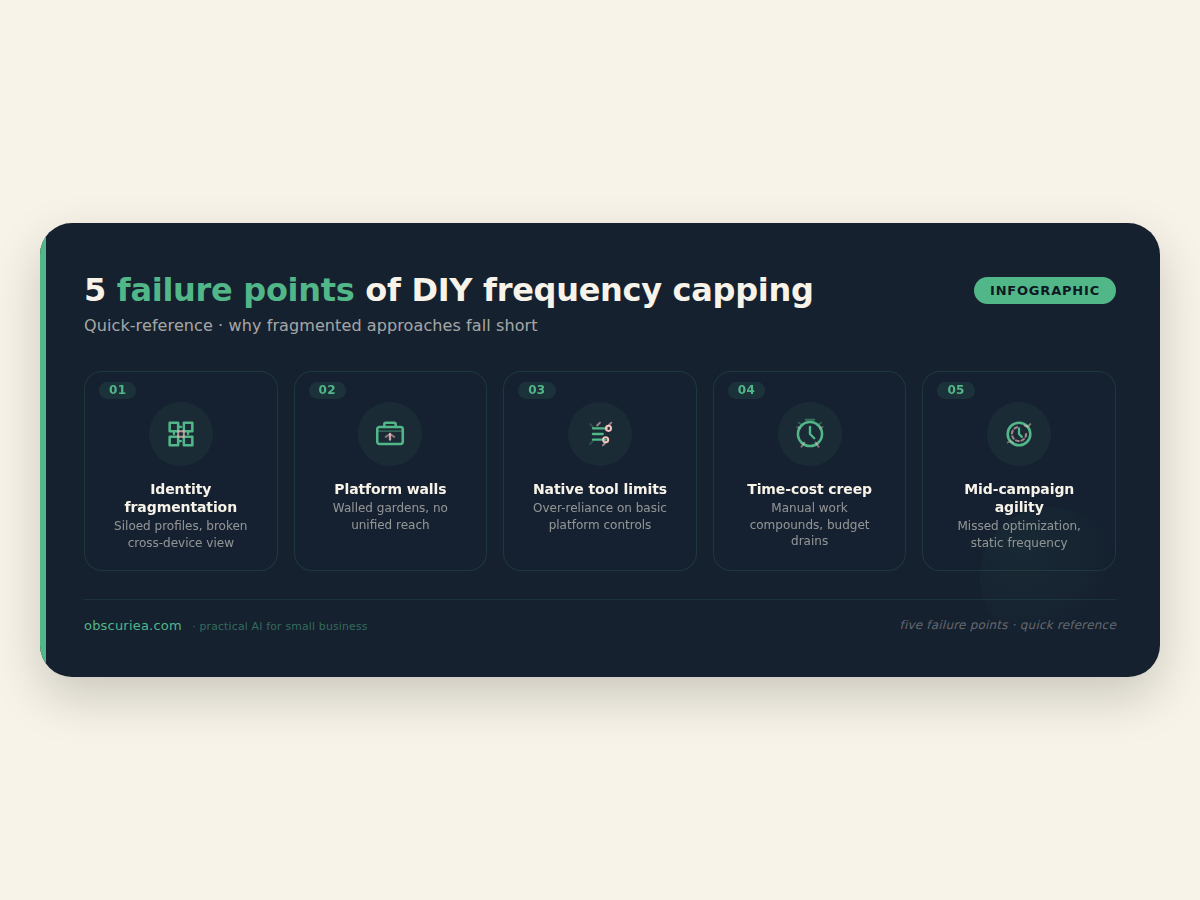
Cross-platform frequency capping without a media buyer is possible, but it is not a set-and-forget system. Here are the most common failure points I have observed or experienced:
1. Identity fragmentation – The biggest enemy. If your identity graph breaks—users clear cookies, switch devices, or use different email addresses—the frequency counts become useless. In Southeast Asia, where mobile number changes are frequent, this is a daily problem.
2. Platform walls – Apple’s ATT (App Tracking Transparency) and Google’s Privacy Sandbox are making it harder to pass identifiers across apps. Frequency caps set inside Meta have no idea what Google Ads is doing. Reconciliation solves some of this, but it introduces lag.
3. Over-reliance on native tools – Platform-provided frequency capping is designed to maximize platform revenue, not your ROI. A cap of 3/day on Facebook may still allow 10 impressions if the user visits multiple inventory sources (feed, stories, reels). These are counted separately unless you explicitly tie them together.
4. Time-cost creep – The first month of DIY reconciliation takes 5–6 hours per week. As campaigns scale, the effort scales linearly. At 10+ platforms, the time cost becomes equivalent to a part-time employee—at which point you should re-evaluate whether a media buyer makes sense.
5. Missing mid-campaign agility – A media buyer can respond to a demographic spike in real time (like the Brainlabs example). A DIY operator only sees the anomaly after the weekly reconciliation. You will miss waves of opportunity unless you automate alerts.
The Friction Box
- Platform integration complexity: Setting up server-side events and identity stitching requires technical skills most small marketing teams lack.
- Cost of identity resolution: Enterprise CDPs and data clean rooms are expensive; free tiers have strict limits (e.g., RudderStack’s free plan allows 1 million events/month, enough for small campaigns but not growth).
- Reconciliation fatigue: Manually aligning impression logs every week is tedious and error-prone; missing a discrepancy leads to overexposure.
- Latency in DIY setups: Decentralized caps mean a user could still see 5 ads within 10 minutes across different platforms before any system reacts.
- Platform policy changes: Apple’s SKAdNetwork and Google’s Privacy Sandbox updates break existing setups unpredictably.
Frequently Asked Questions About Cross-Platform Frequency Capping Without a Media Buyer
What is the simplest way to start cross-platform frequency capping?
Start with per-platform caps set to 3 impressions per day. Then use a shared spreadsheet of hashed customer emails to manually check for overlap across platforms once a week. After one month, adjust the caps based on actual frequency data.
Can I use Google’s free tools for cross-platform capping?
Google Ads offers cross-device frequency capping within its own network, but it does not extend to Meta, TikTok, or CTV. You need a separate identity layer (via a free CDP or manual uploads) to connect platforms.
How do I handle frequency capping for CTV and social together?
CTV platforms like Netflix and Hulu require a DSP integration. Use the same identity graph you built for social—most DSPs accept first-party ID segments. Set the same frequency cap across both channels on the DSP, and update the cap weekly based on combined impression reports.
What if I cannot use a CDP?
Without a CDP, you rely on platform-specific caps and manual reconciliation. It is less efficient but still effective for 2–3 platforms. The key is to cap each platform lower (e.g., 2 per day instead of 3) to leave room for unseen overlaps.
Will Apple’s privacy changes kill DIY frequency capping?
Not completely. While ATT limits IDFA access, you can still use email-based identity (hashed and shared securely) and server-side conversions to track exposure. Apple’s changes make it harder, but a first-party identity strategy remains viable.
How often should I reconcile impressions across platforms?
Weekly is the sweet spot for most small teams. Daily is overkill unless you have automated alerts. Monthly is too late—you will have wasted budget for weeks. If you see a consistent discrepancy, tighten the per-platform caps.
The Straight Talk
Who this is for: Small to mid-size businesses (ad spend $5k–$50k/month) running campaigns across 2–4 platforms who want to eliminate ad fatigue and wasted spend without hiring a media buyer. You are comfortable setting up a CDP or using a spreadsheet for manual reconciliation.
Who should skip this: Enterprise brands running 10+ channels with strict ROI targets; agencies managing multiple clients; anyone with ad spend over $100k/month should invest in a full-stack frequency solution and a dedicated buyer. The time cost of DIY at that scale is too high.
Your next action: If you are spending $10k/month or more on digital ads, spend one week setting up a simple identity layer (hashed emails in a Google Sheet, shared via a secure link to your DSP rep) and set per-platform caps to 3 impressions per day. Measure actual frequency in month two and adjust. That single change will likely save 15–20% of your budget on day one.