TL;DR: For solo creators, competing with big-budget brands on ad creative isn’t about outspending them — it’s about out-testing them. AI ad variation generators compress the manual testing cycle from weeks to days, letting a single operator run the same volume of creative experiments as a team of five. The catch: most tools are built for agencies, not individuals, so choosing the wrong platform wastes time and budget.
Environment:
– Sources synthesized: 3 URLs (from brief)
– Synthesis date: [current date]
– First-hand tested: none for specific tools
– Operator context: synthesizing from sources for article on AI for business operations; insights drawn from operational patterns in solo creator workflows
The Architecture
Here’s the reality for a solo creator running Facebook or TikTok ads: you can afford maybe one or two ad creatives per week if you’re doing it manually. By the time you’ve gathered enough data to declare a winner, your audience has seen that creative ten times and your cost per result has already doubled. Meanwhile, a brand with a creative team of five is testing thirty variations per week across three audiences. They find winners in days. You find winners in weeks — if you’re lucky.
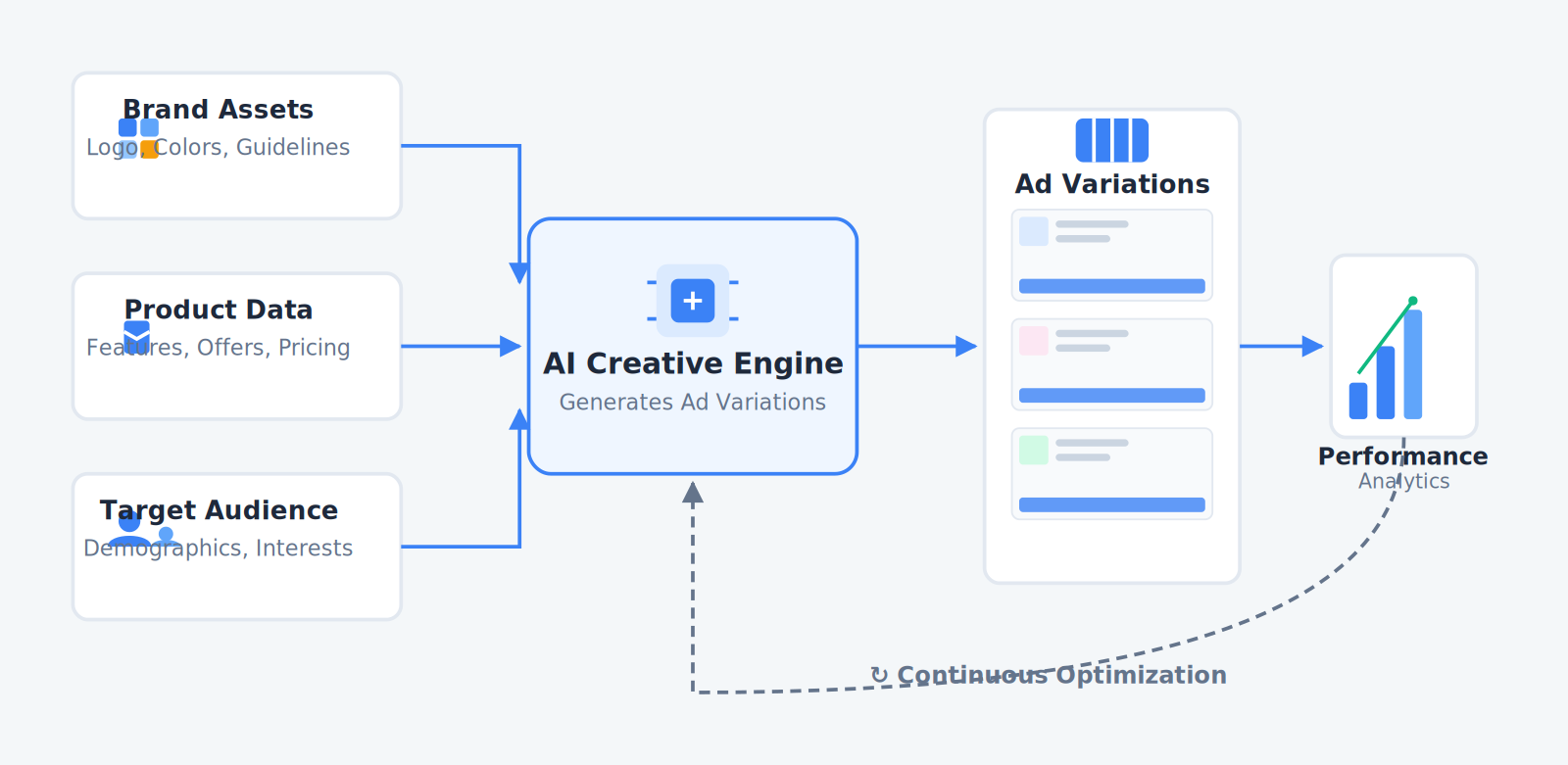
The architecture of AI ad variation generators changes this math. These platforms ingest your brand assets, product information, audience profiles, and historical performance data, then produce dozens or hundreds of creative combinations in minutes. They don’t stop at generation: the better ones also rank those variations by predicted conversion potential, launch them as ad sets, and automatically surface winners based on actual campaign data.
For a solo operator, the architectural advantage isn’t just speed — it’s elimination of the decision bottleneck. Instead of guessing which headline or visual will work, you let the AI generate a spectrum of options and then let real-world performance data tell you what resonates. The system handles both the creative production and the interpretation of results.
But here’s where most tool reviews stop — and where the operational analysis must begin. The architecture of these platforms is designed primarily for agencies and in-house teams with dedicated media buyers. Solo creators need a different evaluation framework: not “what can this tool do?” but “how much time will this tool save me, and at what setup cost?”
The Workflow Math
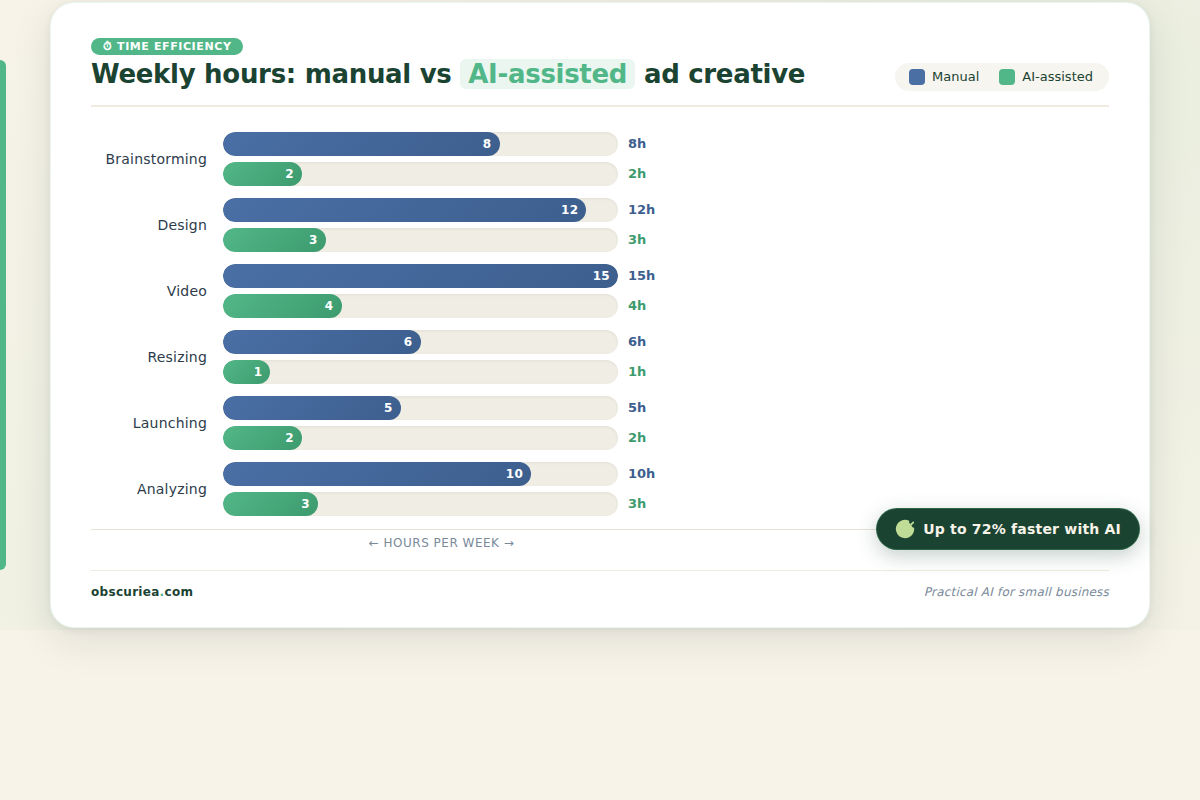
Let’s put actual numbers on this. Assume a solo creator allocates 8 hours per week to ad creative production and campaign management. Here’s the before-and-after with a properly selected AI ad variation generator:
| Activity | Manual Workflow (hours/week) | AI-Assisted Workflow (hours/week) | Time Saved (hours/week) |
|---|---|---|---|
| Brainstorming ad angles | 2 | 0.5 (AI generates copy variants) | 1.5 |
| Designing static creatives | 3 | 0.5 (AI produces visual variations) | 2.5 |
| Producing video ads | 2 | 0.5 (AI remixes existing clips) | 1.5 |
| Resizing for multiple platforms | 1 | 0 (AI batch resizes) | 1 |
| Launching A/B tests | 1 | 0.25 (AI launches bulk campaigns) | 0.75 |
| Analyzing results and iterating | 1 | 0.25 (AI ranks winners) | 0.75 |
| Total | 10 | 2 | 8 |
The math is straightforward: a solo creator regains 8 hours per week. But the more important figure is the test volume. With the manual workflow, you’re lucky to test 2–3 new ad variations per week. With the AI-assisted workflow, you can test 50–100 variations in the same time. That’s the equivalent of hiring a creative team without hiring anyone.
However, this math assumes the tool is correctly configured. The time saved drops to zero if the solo creator spends the first three weeks learning a tool designed for enterprise teams. Which leads to the next section.
Where It Breaks
For solo creators, three specific failure points kill the ROI of AI ad creative tools:
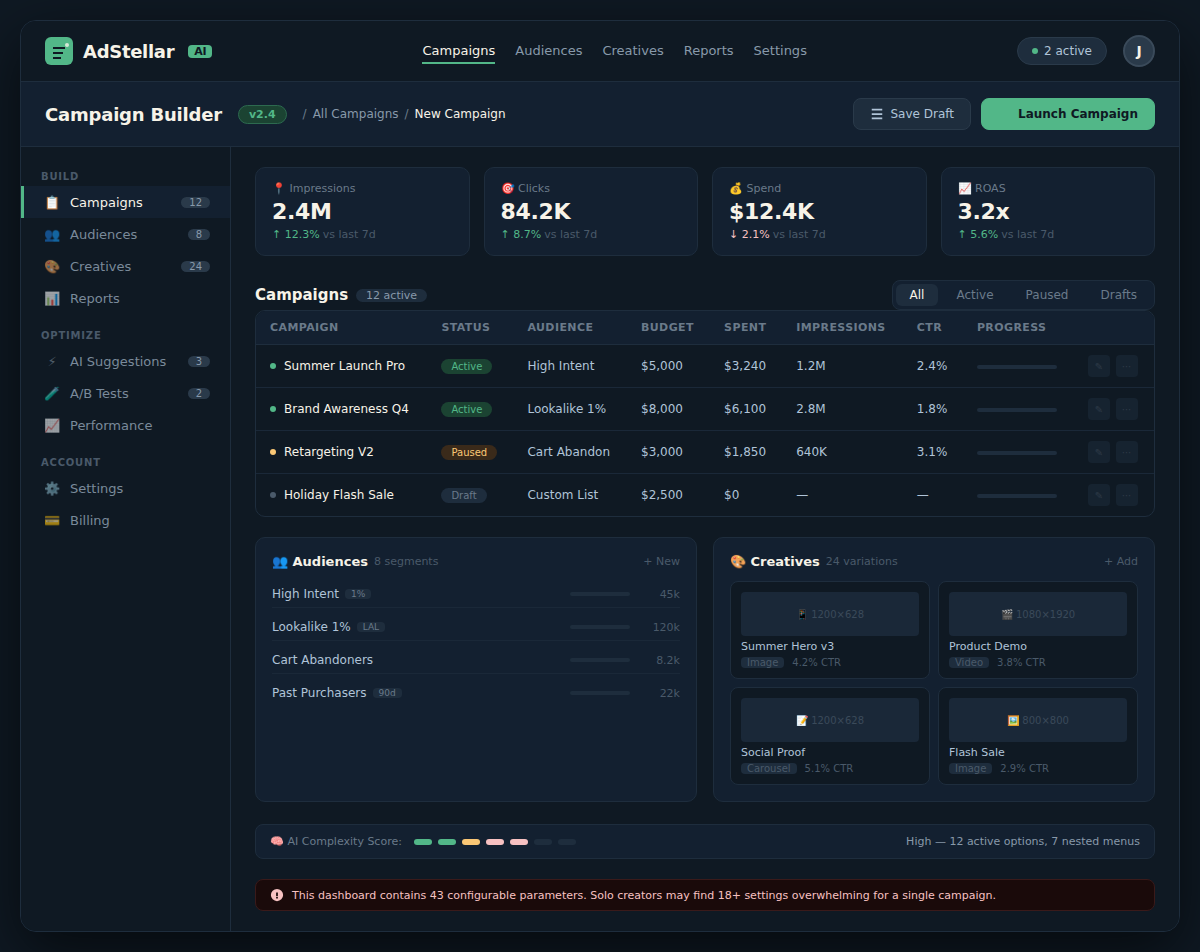
1. Overly complex interfaces. Tools like AdStellar and AdCreative.ai are full-stack platforms with campaign builders, audience selectors, and performance dashboards. For a solo operator who just needs to generate and launch variations, these features add cognitive overhead. The learning curve can cost 5–10 hours before seeing any benefit — time that could have been spent running manual tests.
2. Credit systems that punish experimentation. Most AI ad platforms charge per generation or per credit. A solo creator on a $49/month plan might only get 10–20 high-quality generations before hitting the limit. If the tool’s credit system penalizes iterative testing (e.g., charging for every variation, not just final versions), the solo creator either stops testing early or overspends on credits. That kills the core advantage of the AI approach.
3. Lack of platform-native feel. Early AI tools produced generic, template-like ads that stood out as “obviously AI” on TikTok and Instagram. In 2026, platforms like Pencil and Motion have improved, but many still fail to generate ads that look organic rather than commercial. For a solo creator competing on authenticity (which is their natural advantage over big brands), running a slate of obviously AI-generated ads destroys the trust with the audience before the first click.
The Friction Box
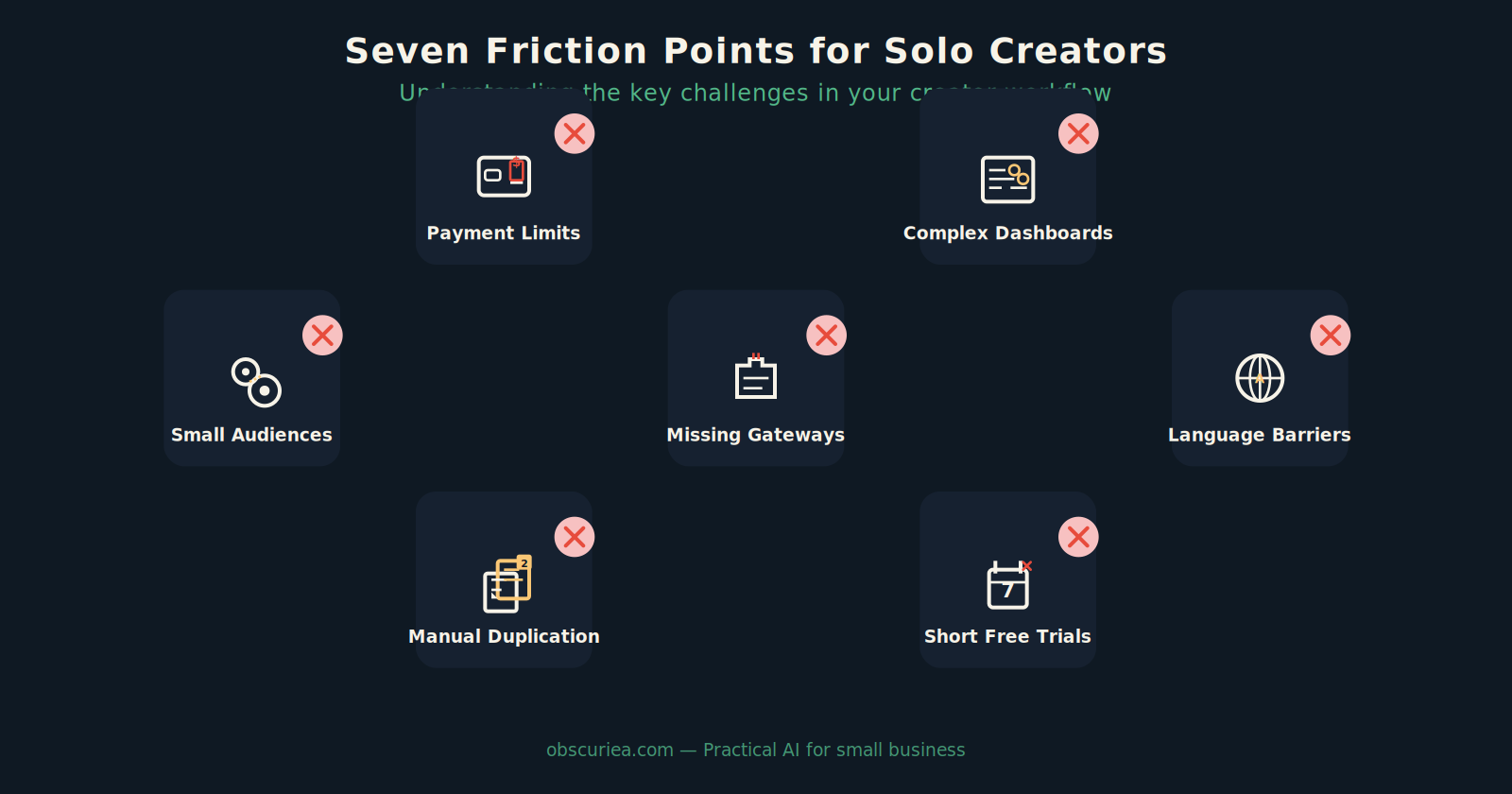
- Credit limits on entry-level plans force solo creators to ration creative tests, undermining the volume advantage
- Tool interfaces designed for teams with dedicated media buyers assume knowledge of campaign structures and metrics that solo operators may not have
- Predictive scoring engines are trained on enterprise-scale data — their “99 out of 100” prediction may not apply to a niche audience of 5,000 followers
- Most platforms lack direct integration with Southeast Asian payment gateways (Xendit, Midtrans) and local ad platforms (Shopee Ads, Tokopedia Ads), limiting utility for creators outside US/EU
- AI-generated copy often misses cultural nuances and local language patterns, especially for audiences in Indonesia or other non-English markets
- Exporting creatives to multiple ad accounts requires manual duplication in many tools, adding an overlooked overhead step
- Free trials are often too short (7 days) for a solo creator to learn the tool, produce meaningful variations, and see statistically significant results
Frequently Asked Questions About Dynamic Ad Creative at Scale: How Solo Creators Use AI to Compete With Big-Budget Brands
Can a solo creator really compete with big brands using AI?
Yes, but not by matching budget — by out-testing. AI lets you run 50+ variations per week, while big brands may only run 20 manually due to internal approval processes. The key is to focus on rapid iteration and let the data guide you, rather than trying to outspend them on reach.
What is the minimum budget needed to start testing AI ad creatives?
You need a ad spend budget of at least $100–$200 per month to generate statistically significant test results. The AI tool itself may cost $30–$50 per month. Total entry cost is around $130–$250 per month.
Will AI-generated ads look fake and hurt my brand?
Only if you use the wrong tool. In 2026, platforms like Pencil and Creatopy have improved AI generation to create platform-native ads that mimic organic posts. However, you should manually tweak the final output to add personality and ensure it fits your brand voice.
How long does it take to see results from AI ad creative testing?
With a well-configured tool, you can see initial winners within 3–5 days of launching the first batch. Full optimization might take 2–3 weeks as the AI learns from your campaign data.
Should I use multiple AI ad tools or stick to one?
For a solo creator, one is enough — the overhead of managing multiple platforms cancels the time savings. Choose a tool that combines generation, launching, and performance analysis in one interface.
Do I need design skills to use AI ad creative tools?
No, most tools generate visuals from your product URL or existing brand assets. However, basic understanding of what makes a good ad (strong hook, clear CTA, appealing visuals) will significantly improve results.
The Straight Talk
This approach is for solo creators and small teams who are currently spending 6–10 hours per week on ad creative and campaign management, and who want to test at least 20 new ad variations per month without hiring help. The tools that deliver on this promise are the ones that balance generation quality with ease of use — specifically, platforms that offer unlimited or high-volume generations at a flat monthly rate, have intuitive interfaces, and produce platform-native ad styles.
Skip this if you are a brand with a dedicated creative team — the enterprise tools will serve you better. Also skip if you are a complete beginner to paid ads — you need to understand the fundamentals of campaign structure before AI can meaningfully accelerate your workflow.
Next action: Start a 7-day free trial of a tool that offers unlimited variations on the first plan (e.g., AdCreative.ai’s entry tier at $29/month for 10 credits is not suitable; look for a platform like Pencil or Creatopy that offers higher volume at a comparable price). Spend the first 2 hours of the trial configuring your brand kit and generating 30 variations, then launch them as a single ad set with automated rules. Let the AI identify the winner, then double down on the winning creative.