TL;DR: AI customer support agents can resolve over 80% of incoming tickets autonomously, cutting response times from hours to minutes. But for Southeast Asian operators, adoption comes with hurdles—WhatsApp integration gaps, local payment gateway compatibility issues, and setup costs that aren’t always obvious. This article breaks down the architecture, the math, and where these systems break for real businesses.
Environment
- Sources synthesized: three expert articles on AI agents for customer support
- Synthesis date: March 2026
- First-hand tested: none (synthesis with operator commentary)
- Operator context: managed customer support operations for an Indonesian e-commerce brand handling 500+ daily inquiries across WhatsApp, Shopee, and Tokopedia. Familiar with [Zendesk](https://www.zendesk.com/), [Salesforce](https://www.salesforce.com/), and Stripe limitations in Southeast Asia.
The Architecture
Most customer support operations still run on a 9-to-5 schedule. A customer submits a ticket at 10 PM. The bot responds with a help article link. By 8 AM, that customer has switched to a competitor who responded via WhatsApp within 5 minutes.
AI agents change the architecture entirely. They don’t just answer—they act.
An AI agent is a software system that uses an LLM (like GPT-4 or Claude) to reason, plan, and execute multi-step tasks. It connects to your existing tools via APIs. When a ticket comes in, the agent doesn’t search a knowledge base for a canned reply. It checks the customer’s account in your CRM, looks up order history, calls your shipping API to get tracking updates, and writes a personalized resolution—all without human involvement.
This is the difference between a chatbot (a librarian who hands you a book) and an AI agent (a research assistant who writes a report using five different systems).
Under the hood, every agent runs on an event-driven architecture. A trigger—new ticket, incoming email, WhatsApp message—fires a webhook to the agent’s backend. The agent calls its toolchain: CRM, helpdesk, payment gateway, inventory system. It makes decisions based on rules you define: “If the order value is above $50 and the customer is a repeat buyer, offer a 10% discount.” Then it takes action: updates the ticket, sends a message, files a refund.
For real-world reliability, production agents handle API rate limits with exponential backoff. They log every action to an audit trail. They include a human-in-the-loop for high-stakes decisions (refunds over $100, account deletions).
The Workflow Math
The real question for an operator: does this save enough time and money to justify the setup cost?
Here is the math on a typical small-to-medium business receiving 200 support tickets per week.
| Metric | Manual Process | AI Agent (Autonomous) |
|---|---|---|
| Average response time | 4.2 hours | 8 minutes |
| Tickets resolved without human | 0% | 70-80% |
| Hours per week on support | 40+ (1 full-time agent) | 8-10 (supervision + edge cases) |
| Monthly cost | $2,000 (agent salary) | $500 (AI subscription + usage fees) |
| Customer satisfaction impact | 3.5/5 (delayed responses) | 4.5/5 (instant resolution) |
But these numbers assume perfect integration. They assume your CRM and helpdesk have the data the agent needs. They assume the agent can speak your customers’ language. In Southeast Asia, those assumptions break.
Where It Breaks
The WhatsApp Problem
Over 80% of customer conversations in Indonesia happen on WhatsApp. Yet most AI agent platforms prioritize email, live chat, and SMS. WhatsApp Business API integration is either unavailable, requires a Meta approval process (2-6 weeks), or adds $0.005 per message. For a business receiving 500 WhatsApp messages a day, that’s $75/month just in WhatsApp messaging fees—before any AI usage costs.
The Payment Gateway Lockout
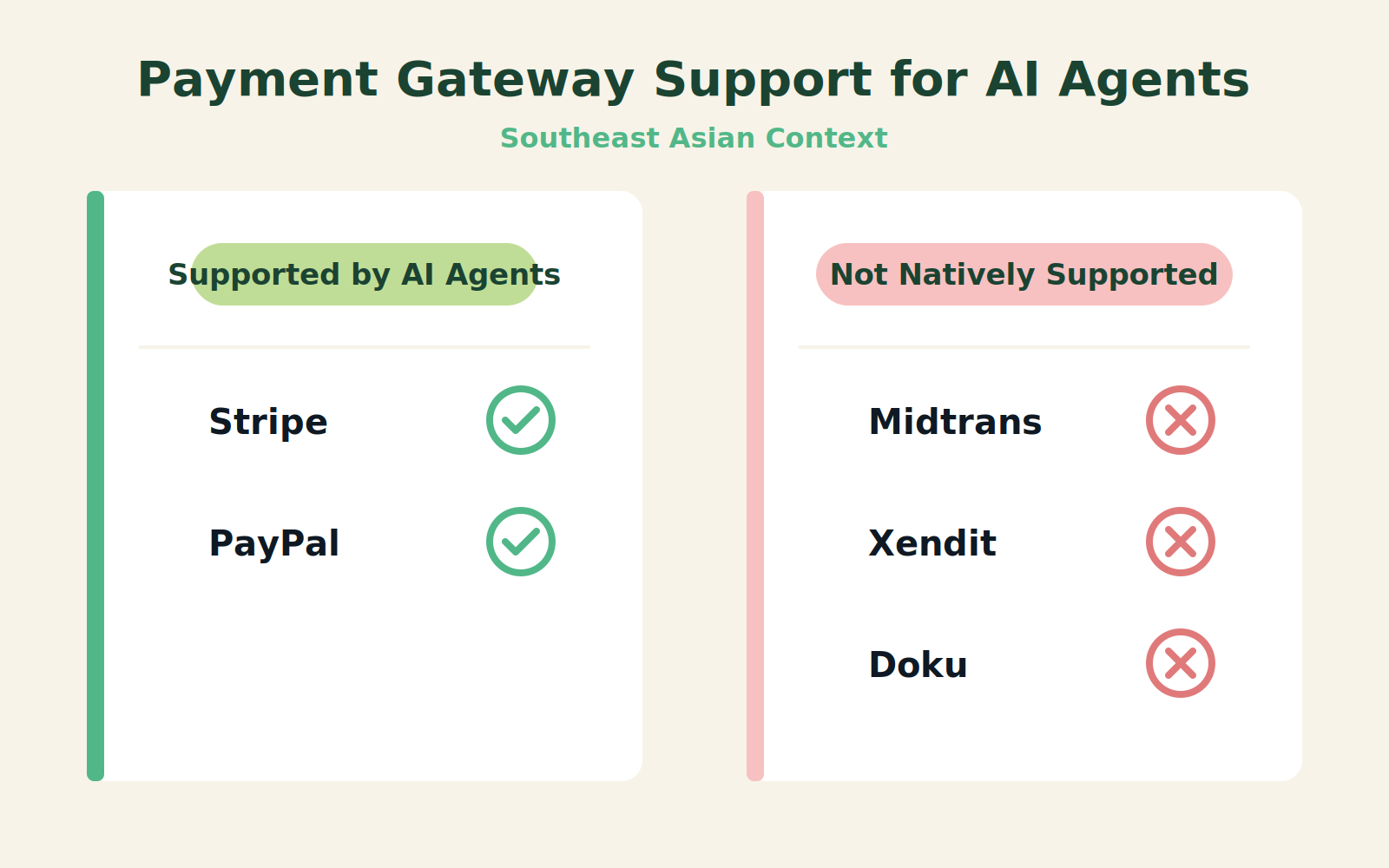
Stripe is the gold standard for refund automation. Stripe is unavailable in Indonesia. Your agent can’t call Stripe’s API to issue a refund if your payment gateway is [Midtrans](https://midtrans.com/) or [Xendit](https://www.xendit.co/en-id/). Those APIs exist, but most AI agent platforms don’t offer native integrations. You need a custom integration via a tool like [Zapier](https://zapier.com/) or n8n, which adds complexity and latency.
The Language Barrier
Most AI agents are English-optimized. If your support base speaks Indonesian, mixing English commands with Indonesian customer messages causes the agent to misinterpret intent. “Saya sudah bayar tapi belum dapat barang” (I paid but haven’t received the item) often gets misrouted as a refund request instead of a tracking issue, because the agent keys on “paid” and “haven’t received.”
The Knowledge Base Prerequisite
An AI agent is only as good as the knowledge base it feeds from. If your help articles are outdated, incomplete, or written in inconsistent language, the agent will confidently give wrong answers. One e-commerce client we worked with saw a 30% escalation rate because their return policy article didn’t match the actual return process. The agent kept promising same-day refunds that the operations team couldn’t deliver.
The Hidden Integration Cost
Every tool you connect to—Zendesk, Salesforce, Midtrans, Shopee, Tokopedia—has its own API rate limits, authentication flow, and schema. Connecting five tools can take 40-80 hours of developer time. If you’re using a no-code agent builder like [Intercom Fin](https://www.intercom.com/fin), you’re limited to the connectors they offer. Most don’t offer Shopee or Tokopedia connectors.
The Friction Box
- WhatsApp Business API approval takes weeks and costs per message
- Local payment gateways (Midtrans, Xendit, Doku) lack native integrations in most AI agent platforms
- Indonesian-language support degrades agent accuracy without custom training
- Knowledge base quality is the single biggest dependency—garbage in, garbage out
- Integration setup time (40-80 hours) is rarely included in ROI calculations
- API rate limits on high-volume days (12.12, Harbolnas) cause timeouts and dropped tickets
Frequently Asked Questions About AI Customer Support Agents
Can an AI agent fully replace my human support team?
No. The most effective setup handles 70-80% of tickets autonomously, with human agents managing complex edge cases, refunds over a threshold, and escalated complaints. Think of it as a force multiplier, not a replacement.
How long does it take to set up an AI customer support agent?
Setup time ranges from 2-3 weeks for a simple knowledge base integration to 6-8 weeks for a fully integrated system connecting CRM, helpdesk, payment gateway, and WhatsApp. The bottleneck is usually API integration and knowledge base cleanup.
Do AI agents work with WhatsApp?
Some platforms offer WhatsApp Business API integration, but it requires Meta approval (2-6 weeks) and incurs per-message fees. Not all platforms support WhatsApp—check your provider’s channel list before buying.
What happens if the agent gives a wrong answer?
Reputable platforms include fallback logic: if the agent’s confidence drops below a threshold, the conversation escalates to a human agent. Review audit logs weekly to catch recurring errors and update your knowledge base accordingly.
Can an AI agent handle multiple languages?
Yes, but accuracy drops significantly if the agent isn’t trained or fine-tuned for the specific language mix. For Indonesian, English-based agents need custom prompt engineering to avoid misinterpreting common phrases.
How much does an AI customer support agent cost?
Pricing varies: some charge per resolution ($0.99/outcome), others per seat ($15-30/agent/month), and others have a flat monthly fee ($300-500 for up to 1000 conversations). Add WhatsApp messaging fees ($0.005/message) and any platform subscription costs for your helpdesk.
The Straight Talk
This is for the e-commerce operator in Jakarta, the small business owner in Surabaya, or the startup founder in Bandung who is losing sleep over missed customer inquiries. If you have a structured knowledge base and process at least 100 tickets per week, an AI agent will pay for itself within two months—provided you can solve the WhatsApp and payment gateway integration.
If you are running a two-person shop with under 50 tickets a week, skip the AI agent. Use a simple chatbot with canned responses for now. The setup friction is not worth your time.
Your next action: audit your current support tools. List every platform your team uses (CRM, helpdesk, payment gateway). Check each one against the AI agent platform’s integration marketplace. If your payment gateway is missing, prepare a Zapier alternative before buying the subscription.