TL;DR: Hyper-targeting looks like a smart way to cut waste, but going too narrow creates a new problem: you starve your brand’s mental availability. The operational math reveals that the optimal targeting width is wider than most operators use, and ignoring that costs long-term revenue.
Environment:
– Sources synthesized: [Marketing Architects blog](https://www.marketingarchitects.com/blog/if-your-next-big-move-in-your-marketing-strategy-is-hyper-targeting-you-need-a-bigger-move), [Ideas Collide](https://www.ideascollide.com/news/the-paradox-of-hypertargeting/), [ASAE](https://www.asaecenter.org/en/resources/articles/an_plus/2022/04-april/understand-risks-before-employing-hyper-targeted-digital-marketing-efforts)
– Synthesis date: 2025-09-23
– First-hand tested: none
– Operator context: business operations and marketing strategy for SMBs, including experience with e-commerce and SaaS growth campaigns.
The Architecture
The hyper-targeting paradox is a structural trade-off in how customers make decisions. Most purchase decisions are driven by memory structures built through repeated exposure. If your brand only reaches a narrow set of people who are in-market, you fail to build the mental availability that triggers future purchases. Byron Sharp’s research is clear: brand growth comes from attracting as many buyers as possible, not just the most likely ones.
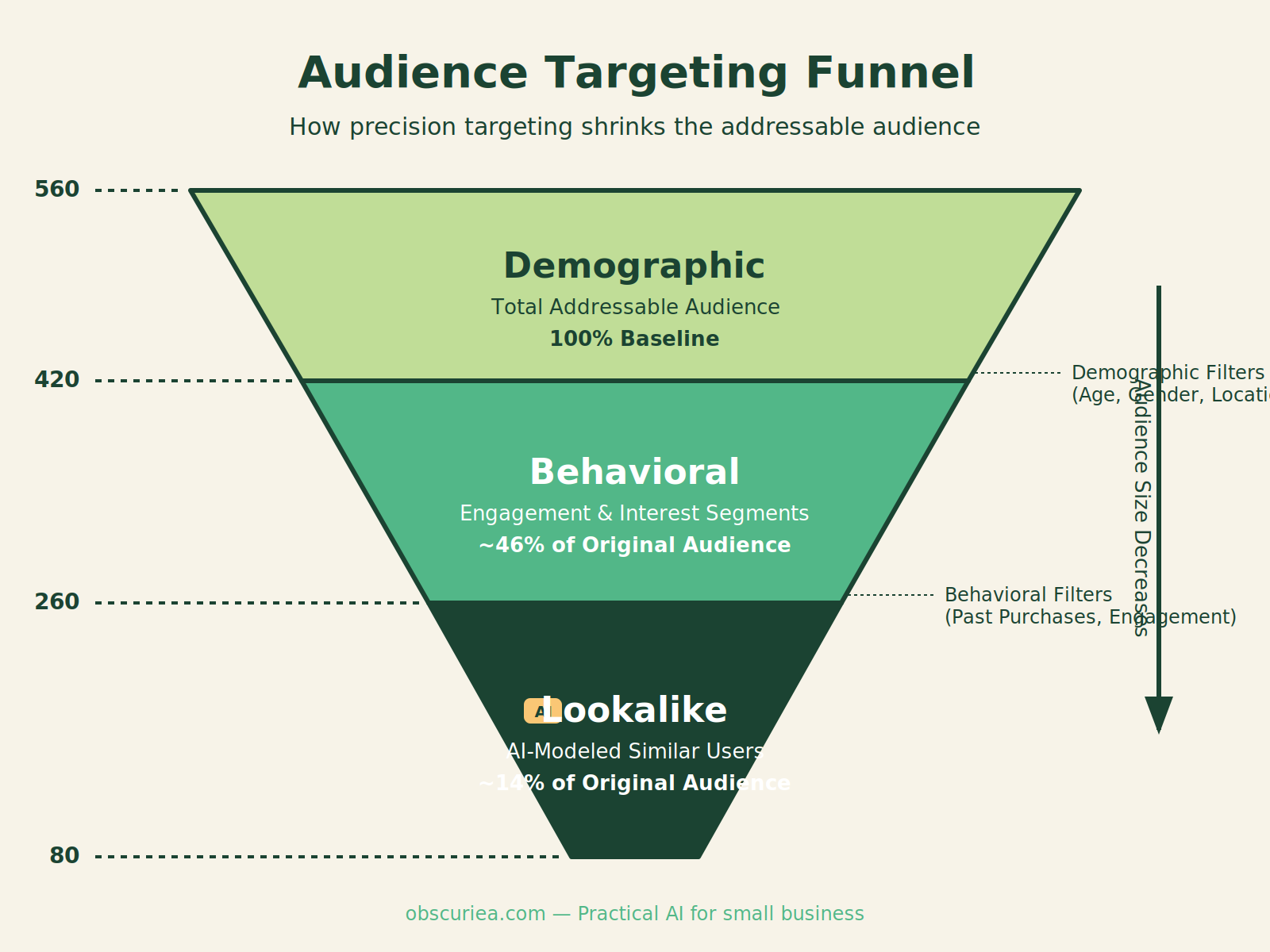
The architecture of modern ad platforms reinforces this problem. Facebook, Google, and LinkedIn all encourage extreme segmentation because it drives higher CPMs and more campaign iterations. The platform’s incentive is not aligned with the operator’s long-term health. Each additional targeting layer—demographic, behavioral, lookalike—shrinks the addressable pool. The operator must ask: “At what point does the conversion lift from narrower targeting fail to compensate for the lost reach?”
Consider a local service business like a dentist. Hyper-targeting to “people who have searched for toothache in the last week” might get high intent but tiny volume. A broader campaign to everyone in a 5-mile radius builds the brand so that when they do get a toothache, they think of you. The hyper-targeting campaign may show better ROAS, but it misses the systemic effect of brand building.
For further reading on audience segmentation, see our guide on audience segmentation best practices.
The Workflow Math
Let’s make this concrete with two scenarios: a mid-price product ($50) and a high-price product ($500). We’ll compare three targeting strategies: broad (all relevant audience), targeted (demographic + interest), and hyper-targeted (behavioral + past visitors). We’ll use typical platform costs.
For the $50 product:
– Broad: CPM $5, reach 1M, conversion rate 0.5% → 500 sales, $25k revenue, ad spend $5k, ROAS 5.0
– Targeted: CPM $8, reach 200k, conversion rate 1.5% → 300 sales, $15k revenue, ad spend $1.6k, ROAS 9.4
– Hyper: CPM $15, reach 20k, conversion rate 3% → 60 sales, $3k revenue, ad spend $300, ROAS 10.0
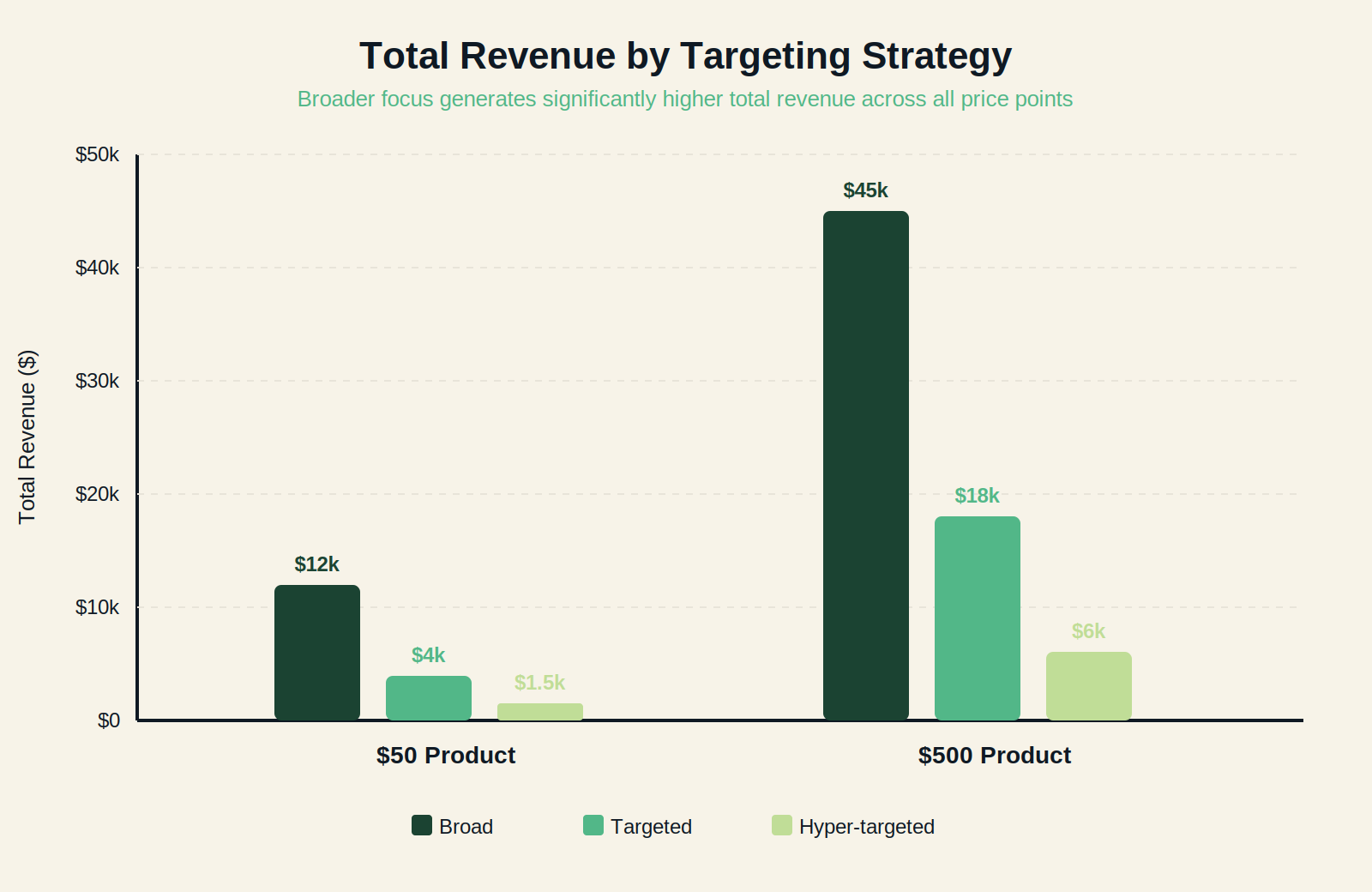
Short-term ROAS favors hyper-targeted, but total revenue is only $3k vs $25k. More importantly, the broad campaign built brand awareness with 1M people; the hyper-targeted reached only 20k. The long-term value of that awareness—repeat purchases, word-of-mouth, future conversions—is not captured in the campaign ROAS.
Now for the $500 product:
– Broad: CPM $5, reach 1M, conversion 0.1% → 1,000 sales, $500k revenue, spend $5k, ROAS 100
– Targeted: CPM $8, reach 200k, conversion 0.5% → 100 sales, $50k revenue, spend $1.6k, ROAS 31
– Hyper: CPM $15, reach 20k, conversion 2% → 40 sales, $20k revenue, spend $300, ROAS 66
Here, broad campaign dominates because high-value purchases benefit from broad awareness. Hyper-targeting underperforms because the audience is too small.
The table illustrates a key insight: the value of broad reach increases with product price and purchase cycle length. For low-cost impulse buys, hyper-targeting can work if the product has low brand sensitivity. For any significant purchase, broad reach is critical.
| Product Price | Strategy | Revenue | ROAS | Mental Availability |
|---|---|---|---|---|
| $50 | Broad | $25k | 5.0 | High |
| $50 | Targeted | $15k | 9.4 | Medium |
| $50 | Hyper | $3k | 10.0 | Low |
| $500 | Broad | $500k | 100 | High |
| $500 | Targeted | $50k | 31 | Medium |
| $500 | Hyper | $20k | 66 | Low |
The math is straightforward: unless your product has zero repeat purchase potential and zero word-of-mouth effect, hyper-targeting sacrifices long-term growth for short-term efficiency.
Where It Breaks
Hyper-targeting fails in five predictable ways:
-
Audience exhaustion: Small segments deplete quickly. After a few weeks, you’re showing the same ad to the same people, driving fatigue and ad blindness. The law of diminishing returns hits hard when the audience is 10,000 instead of 1 million.
-
Algorithmic tribalization: As noted in the ASAE article, feeding narrow segments only content that reinforces their existing beliefs narrows their view of your brand. They miss out on other products or services you offer. An association targeting only “HR professionals in healthcare” will miss the opportunity to reach those same people for other events.
-
Cost scaling: Creating 10 different ad creatives, landing pages, and email sequences for 10 segments multiplies production costs. For a small team, this overhead can consume the efficiency gains from targeting.
-
Data dependence: Hyper-targeting relies on rich customer data. Privacy regulations ([CCPA](https://oag.ca.gov/privacy/ccpa), [GDPR](https://gdpr.eu/)) are cutting off access to third-party data. Apple’s [App Tracking Transparency](https://developer.apple.com/app-store/user-privacy-and-data-use/) has disrupted Facebook’s targeting capabilities. Building campaigns on shaky data is building on sand.
-
The creep factor: When a user receives an ad that references a private conversation or a Google search they did days ago, it feels invasive. Multiple studies show that perceived creepiness reduces trust in the brand. The short-term gain from the targeted ad can be offset by long-term brand damage.
Explore our deep dive on managing algorithmic tribalization in digital marketing.
The Friction Box
- Small teams often find that managing 8+ segments is operationally unsustainable
- Inaccurate segmentation leads to wasted ad spend and negative ROI
- Lookalike models amplify bias from your existing customer base
- Hyper-targeting ignores the majority of future customers who don’t fit today’s profile
- Platform algorithms reward narrow targeting with higher CPMs, creating an incentive to go narrower than optimal
- Clients frequently report that their broadest campaigns generate the highest total profit, even with lower ROAS
- Measuring the brand impact of broad campaigns is harder than measuring direct response, leading to underinvestment
Frequently Asked Questions About Hyper-Targeting
How do I know if I’ve gone too narrow in my targeting?
A good rule of thumb: if your audience size is smaller than 50,000 people and you’re not in a niche B2B industry, you are likely over-segmenting. Look at your frequency metrics—if the same users see your ad more than 5 times in a week without converting, your audience is exhausted.
What is the ideal number of audience segments for a small business?
Most small businesses should start with 3–4 segments based on broad purchase triggers (e.g., new visitors, returning customers, high-intent searches, and a general warm audience). More than 5 segments often reduces overall efficiency because management overhead grows faster than conversion gains.
Can hyper-targeting work for B2B marketing?
Yes, but with caution. B2B buying cycles are long and involve multiple stakeholders. Hyper-targeting to a very narrow job title or company size may miss key decision-makers. A broader campaign targeting the wider industry, combined with retargeting to engaged accounts, is often more effective.
How does privacy regulation affect hyper-targeting strategies?
CCPA and GDPR have limited the availability of third-party data, making it harder to build detailed behavioral profiles. First-party data (email lists, CRM data) is now the safest source for segmentation. Operators must also ensure consent management is in place, or risk fines up to 4% of global revenue under GDPR.
What tools can help measure the brand impact of broader campaigns?
Brand lift studies on Facebook and Google can measure awareness and consideration increases. Also consider surveys among target audiences before and after campaigns. For smaller budgets, simple attribution modeling that tracks assisted conversions can reveal the broad campaign’s role in the buyer’s journey.
Should I ever use hyper-targeting for a new product launch?
No—new products need maximum exposure to build initial awareness. Hyper-targeting a small group may give early metrics but will starve the product of the broad mental availability needed for success. Use broad targeting for the first 90 days, then refine based on who actually converts.
The Straight Talk
This article is for operators at small to mid-sized businesses who are in the trap of constantly refining audience segments in the belief that narrower is better. If you are spending more time in the ad manager creating segments than you are thinking about the overall market, you have already gone too narrow.
If you run a large brand with separate brand and DR budgets, keep doing what you’re doing—but ensure the brand budget is larger than the DR budget. If you sell high-priced items with long consideration cycles, your first priority is reach, not targeting.
Your next action: for your next campaign, run a single broad audience (city-wide with basic demographics) alongside your hyper-targeted campaign. Compare not just ROAS, but total revenue and new customer rate. The broad campaign will likely generate more total revenue and more new-to-brand customers.