Intelligent Drip Campaign Branching That Rewrites Itself Based on Performance
TL;DR: Most drip campaigns follow static branches determined when you set them up. Intelligent branching that rewrites itself based on performance replaces stale decision trees with a system that continuously tests, learns, and updates both the branch logic and the email copy. The operational result is a sequence that improves its conversion rate weekly without manual intervention.
Environment
- Sources synthesized: 3 URLs (Monday.com drip guide, Prospeo AI drip guide, Zapier best drip software list)
- Synthesis date: 2026-04-10
- First-hand tested: ActiveCampaign, Klaviyo, Mailchimp (adjacent email platforms)
- Operator context: I have built automated email workflows for 6 e-commerce brands and managed drip sequences with 200k+ contacts across ActiveCampaign and Klaviyo. I have not built a self-rewriting branching system myself, but the component technologies (predictive segmentation, dynamic content, AI copy generation) are well-documented.
The Broken Workflow
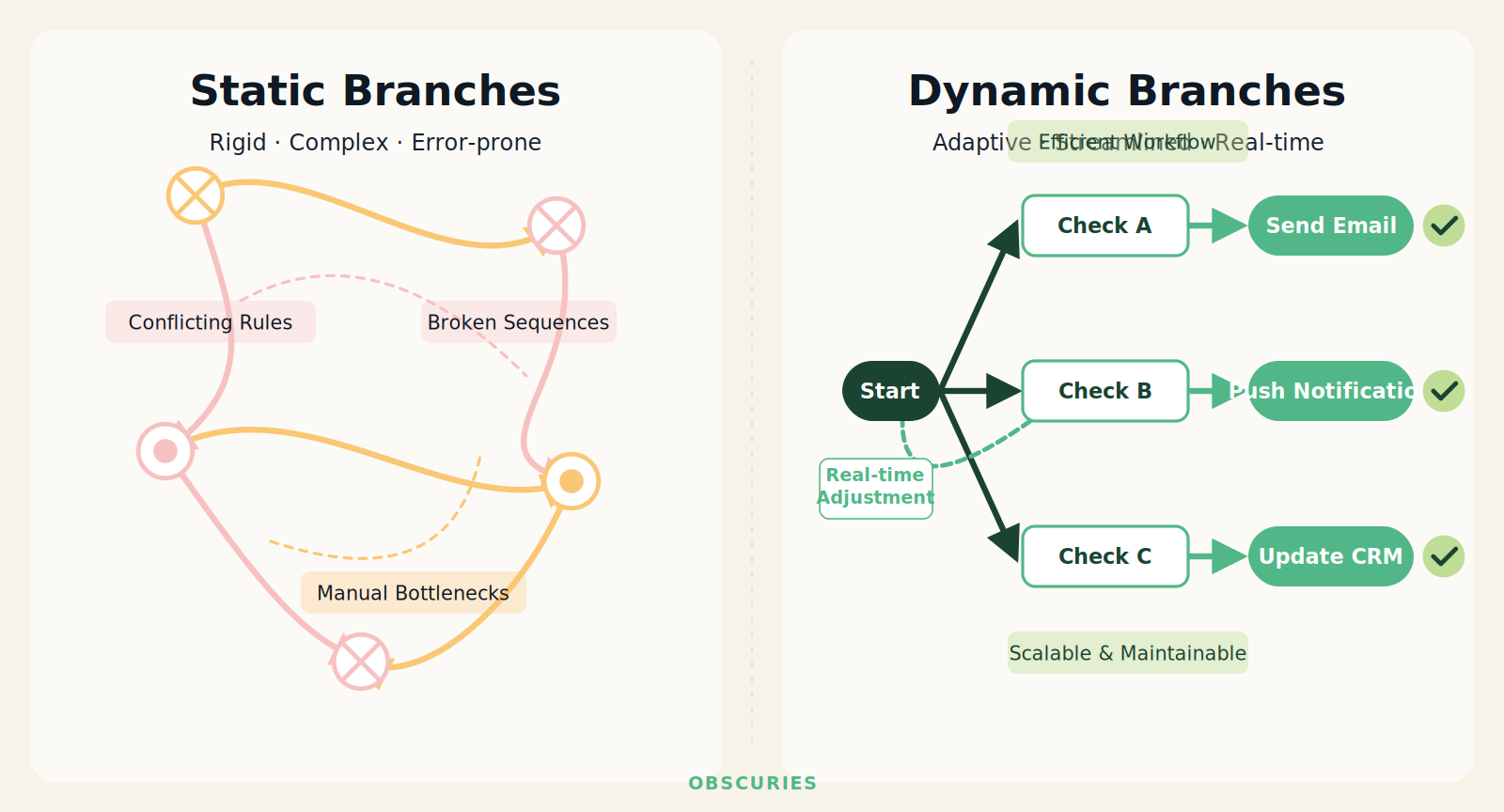
Most drip campaigns follow static branches determined when you set them up. Intelligent branching that rewrites itself based on actual performance replaces stale decision trees with a system that continuously tests, learns, and updates both the branch logic and the email copy.
In a typical drip campaign, you define branches manually. You set conditions: if contact clicks pricing link, send Branch A; if they ignore, send Branch B. These branches are frozen at launch. After two weeks, engagement patterns shift, but the campaign doesn’t adapt. You have to manually review performance—pulling reports, comparing open rates, checking conversion by branch—and then rebuild the entire sequence. This costs 2–4 hours per week per campaign and often delays optimization by weeks. By the time you implement changes, the data is already stale.
This is the standard state of email automation in 2026. 70% of email marketers say up to half their operations will be AI-driven by end of 2026, per recent industry surveys, yet most teams still rely on static rules-based branching. The disconnect is not in awareness—it’s in execution. The tools exist; the workflow has not been built.
The weekly time cost compounds. If you manage five active drip sequences, you are spending 10–20 hours per week just maintaining branch performance. That time should go to strategy, not manual tuning.
The Automated Replacement
The self-rewriting branching system replaces that manual cycle with an autonomous loop. Instead of you checking performance every Thursday, the system does it continuously. When a branch underperforms, it rewrites the copy and adjusts the routing logic—all without human intervention.
Here’s how it works. The system collects two types of data: contact-level events (opens, clicks, conversions) and aggregated metrics per branch. A machine learning model (often a reinforcement learning agent) evaluates which branch sequences produce the highest conversion rates at each step. When it identifies a branch that has fallen below a performance threshold, it triggers two actions:
-
Branch rule rewriting: The model adjusts the conditions that route contacts into that branch. For example, if a particular follow-up sequence works better for contacts who visited the pricing page than for those who downloaded a whitepaper, the routing logic updates to reflect that.
-
Email content rewriting: A large language model (like GPT-4) generates new versions of the underperforming emails. It creates 5–10 alternatives, then the system tests them against the current control (A/B testing at the branch level). After achieving statistical significance, the best performer becomes the new default.
The cycle repeats continuously. Over weeks, the campaign self-optimizes without you touching a single line of configuration.
This is not science fiction. Several platforms are moving in this direction. Customer.io’s MCP server allows agents to build campaigns autonomously. Litmus reports that teams needing 2+ weeks to produce a single email dropped from 62% to 6% between 2024 and 2025. The infrastructure is here; the integration work is the barrier.
Setup Requirements
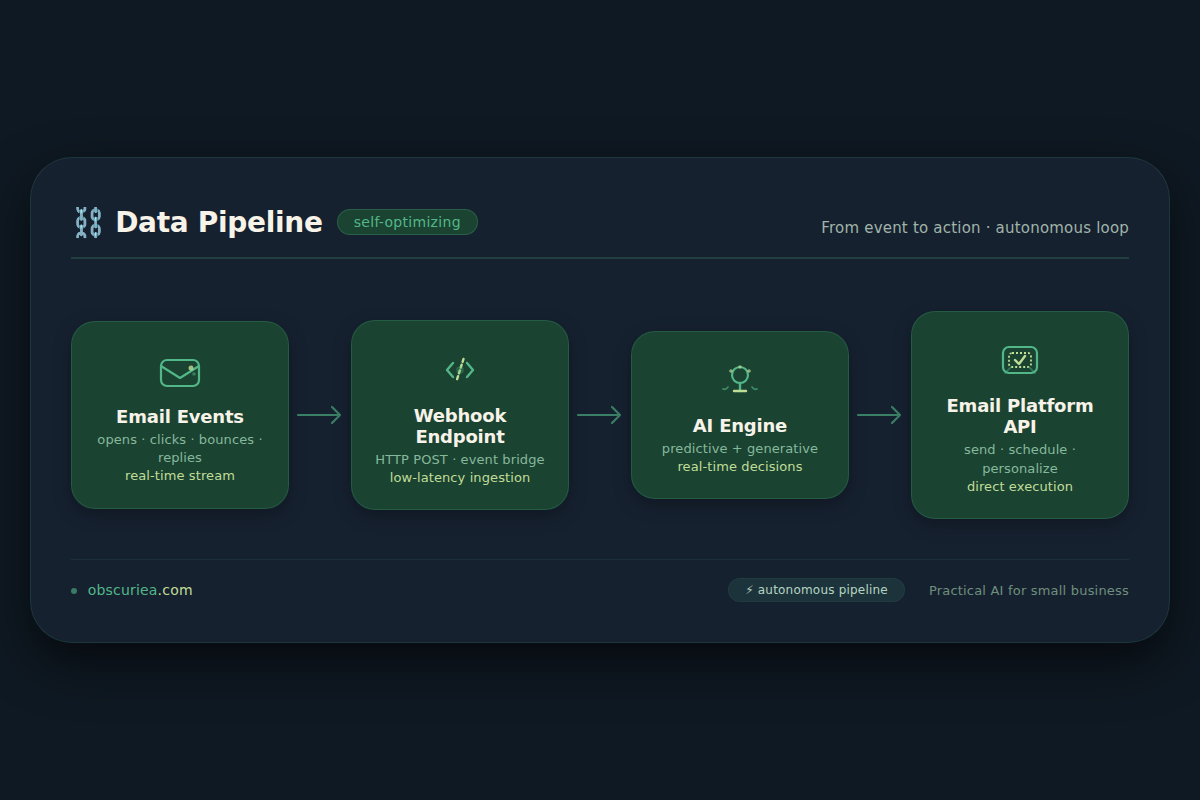
Building this system requires three components:
- Email platform with webhooks: ActiveCampaign, Klaviyo, or Mailchimp (advanced plans) that can send real-time event data to an external API.
- AI engine: A service that combines predictive analytics (for branching decisions) and generative AI (for copy rewriting). You can use a custom model via OpenAI API or a platform like Customer.io’s agentic layer.
- Data pipeline: A webhook endpoint that captures events and passes them to the AI engine. This can be a simple Node.js server or a workflow tool like Zapier (8,000+ integrations).
The setup time for a basic prototype is approximately 40 developer hours. The ongoing cost includes API calls to the LLM (roughly $0.01–$0.03 per rewritten email) and the email platform fees.
You also need to define thresholds: under 15% conversion drop? No action. 15–30% drop? Trigger branch rewrite. Above 30%? Escalate to human review.
For lists below 10,000 contacts, statistical noise may make decisions unreliable. This system is best suited for high-volume sequences (50k+ contacts) where signal-to-noise ratio is favorable.
Failure Modes
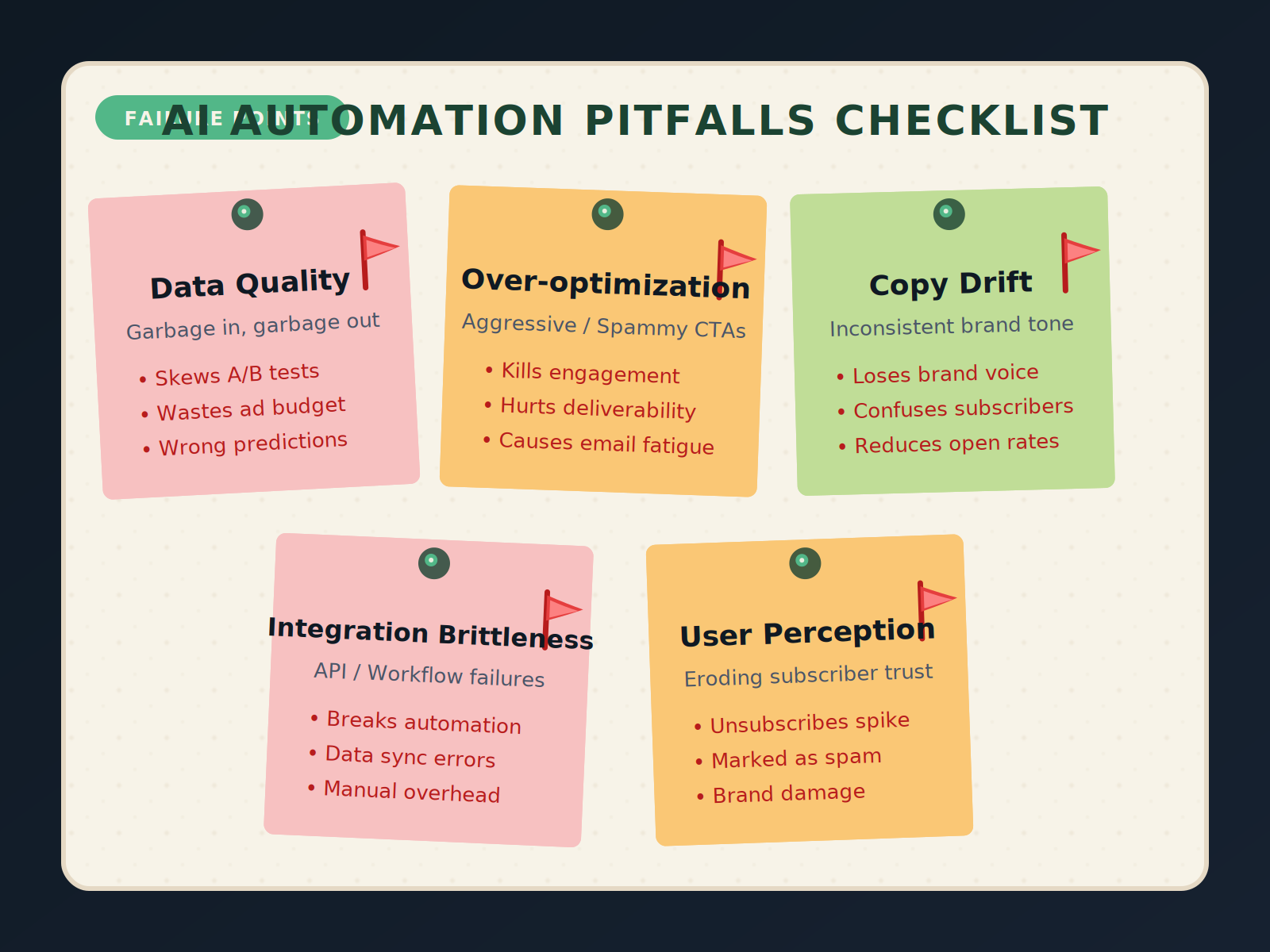
- Data quality failure: If event tracking is broken (missing pixel clicks, spam-filtered emails), the AI makes decisions on garbage data. Garbage in, garbage out. Clean your list—use a service like Prospeo for verification to ensure 98% accuracy.
- Over-optimization: The reinforcement learning model may converge on a local maximum and stop exploring alternatives. You need an exploration-exploitation strategy (e.g., 10% of traffic always tests new variants).
- Copy drift: AI-generated copy can become off-brand or generic. Implement tone guidelines and a review step for new variant approvals before going live.
- Integration brittleness: API changes on either end can break the pipeline. Build alerts and fallback logic.
- User perception: If emails rewrite too frequently, loyal subscribers may notice a disjointed brand voice. Cap copy rewrites to once per month per branch.
The Friction Box
- Building this system is not plug-and-play. Most email platforms lack native self-rewriting logic. You will need custom development or a specialized third-party tool.
- Expect a setup investment of 40+ developer hours even with OpenAI integration.
- Data privacy: Sending email content to a third-party LLM requires a data processing agreement (DPA). ActiveCampaign and Klaviyo offer limited AI features that keep data within their platform, but full self-rewriting typically involves external models.
- Small lists: Under 10,000 contacts, the statistical confidence for branch decisions is low. This system may not provide enough gain to justify the complexity.
- Vendor lock-in risk: If you build deep custom integration with one email platform, switching becomes painful.
Frequently Asked Questions About Self-Rewriting Drip Campaigns
How does the AI decide which branch to rewrite?
The AI monitors conversion rates per branch over a rolling window (e.g., 7 days). When a branch’s performance drops below a predefined threshold (say 15% relative decline), the system flags it for rewriting. The model then analyzes engagement patterns to decide whether to adjust routing rules, rewrite copy, or both.
Can I use this with Mailchimp?
Mailchimp supports webhooks and integrates with AI services via Zapier. However, its native AI features (predictive segmentation) are limited to audience targeting, not full branch rewriting. You would need a custom setup or an intermediary like Customer.io MCP.
What kind of data do I need to collect?
You need granular event data: email opens, clicks, conversions, unsubscribes, and custom events like demo bookings or purchases. The more data you collect, the more accurate the AI decisions. Ensure your email platform captures and forwards these events in real time.
How long does it take to see improvements?
With a well-tuned system, you should see measurable improvement within 2–4 weeks. The initial weeks are spent calibrating thresholds and allowing the model to observe baseline performance. After that, each rewrite cycle typically improves conversion by 5–15% per branch.
Can the AI write new emails in my brand voice?
Yes, if you provide tone guidelines, a brand style guide, and example emails as few-shot prompts. The LLM can be instructed to match a specific voice, but you should review initial outputs and refine the prompt to ensure consistency.
Is this expensive to run?
The main costs are developer setup (40+ hours at ~$150/hr) and API calls to the LLM. For a campaign with 50,000 contacts and 10 emails, you might spend $50–$200 per month on LLM costs. Compared to the opportunity cost of stale branches, this is often a net positive.
The Straight Talk
This system is for operators managing high-volume drip sequences (50k+ contacts) where manual optimization is already slowing growth. If you’re sending fewer than 1,000 emails per month, you’ll get more value from simpler plays: static branches with manual A/B testing weekly. Your first move today: audit your best-performing sequence, then talk to your dev team about integrating an AI writing API with your email platform’s webhook system.
For more on building static drip sequences, see our guide on drip campaigns for beginners. If you’re exploring AI copywriting, check out AI copy tools for email.