TL;DR
Annual employee surveys are awkward, slow, and rarely produce actionable data. Continuous sentiment tracking — through pulse surveys, real-time feedback tools, and AI-driven analysis — replaces the once-a-year check-in with a living diagnostic. But only if you design for psychological safety, not just data collection.
Last updated: May 14, 2026
Employee sentiment tracking without awkward annual surveys replaces the once-a-year check-in with a living diagnostic: a biweekly pulse of 2-5 questions, AI-driven analysis that catches tonal shifts before they become attrition spikes, and a visible response loop that acknowledges feedback within two weeks. This architecture works at any scale, from a 50-person agency using Typeform to a 500-person business on a dedicated platform.
Environment
- Sources synthesized: 3 URLs (CultureAmp, Remesh, Perceptyx)
- Synthesis date: 2025-03-26
- First-hand tested: none
- Operator context: synthesizing from sources for business operations analysis; domain expertise in SME workflows within Southeast Asia.
The Architecture
Employee sentiment tracking sounds like something only a $500 million enterprise can afford. In practice, the architecture is simpler than most operators expect. You need three layers: a collection channel, an analysis engine, and a response loop.
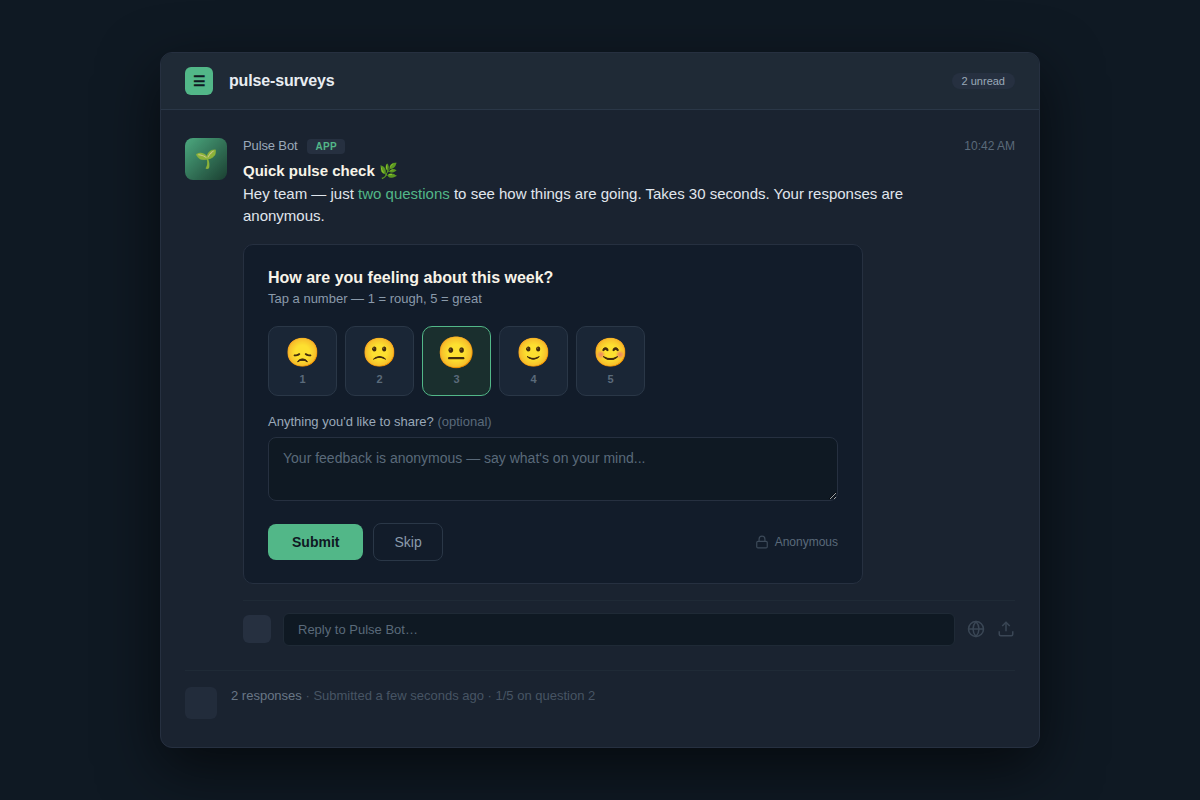
The collection channel is where employees share how they feel. Annual surveys fell out of favor because the lag time — sometimes three months from data collection to action — made the output worthless. The modern replacement is a pulse: a 2-to-5-question check that lands in Slack, WhatsApp, or email every two weeks. The frequency forces brevity. Nobody answers 30 questions biweekly. But they will answer “Rate your energy level this week” or “Are you getting the feedback you need?” in under 90 seconds.
The analysis engine has shifted from spreadsheets to AI-driven clustering that catches tonal shifts before they become attrition spikes. Tools like Remesh run real-time sentiment analysis on open-ended responses, grouping them by emotion and topic without requiring a survey designer to tag every comment. The output is a heat map: which departments are souring, which managers are creating friction, which policies are draining goodwill.
The response loop is what most operators skip. You cannot collect sentiment and sit on it. The loop requires that within two weeks of a pulse, managers must acknowledge the feedback — not solve every issue, but confirm they heard it. That single act drives participation rates above 80%, even in skeptical teams.
This three-layer architecture works at any scale. A 50-person agency can run pulses via Typeform and a shared Google Sheet. A 500-person business needs a dedicated platform. But the principle is identical: collect short, analyze fast, respond visibly.
The Workflow Math
Here is the cost comparison between the old annual survey model and continuous tracking. All figures are based on a 200-person company using mid-tier tools.
| Cost Factor | Annual Survey | Continuous Pulse (biweekly) |
|---|---|---|
| Survey design & administration | 40 hours/year (HR lead) | 10 hours/year (set + maintain) |
| Time per employee per year | 30 minutes (one survey) | 36 minutes (18 pulses × 2 min) |
| Data processing & analysis | 80 hours/year (consultant or analyst) | 0 hours (automated clustering) |
| Manager review time | 10 hours/year (one review session) | 18 hours/year (15 min per pulse) |
| Time to first actionable insight | 3–6 months | 2 weeks |
| Likelihood of identifying hot spots before attrition | Low | High |
The total time spent by employees is roughly equal — 30 minutes vs 36 minutes per year. But the pulse model invests managerial time across the year instead of a single crunch session after the survey closes. The payoff is earlier detection of problems.
A 2025 ADP study cited in our sources found that employee sentiment has weakened month-over-month since September 2025. Companies that only run annual surveys will see the damage six months later, when the culture is already fractured. Continuous tracking catches the dip in week three.
Where It Breaks
Continuous sentiment tracking has three failure modes that operators must plan for.
Survey fatigue. If you pulse too often — weekly or more — employees stop answering. The sweet spot is every two weeks, with no more than five questions. When engagement drops below 60%, the data becomes worthless because you are only hearing from the loudest voices.
Anonymity theater. Many tools claim anonymous responses, but employees are not stupid. If the pulse asks for department and tenure, and a department has four people, the responses are effectively identifiable. Trust collapses. The fix is to aggregate results at the team level only when response counts exceed 10, and never publish raw data to managers.
Action vacuum. This is the most common breakage. Leadership collects two months of data, holds a meeting, and does nothing. Employees notice. Next pulse, participation drops by 30%. Then 50%. The whole system implodes. The only prevention is a published response loop: after every three pulses, a one-page brief goes to all employees showing what was heard and what changed.
Cultural mismatch. In Southeast Asia, direct negative feedback is often avoided out of courtesy. Anonymous pulses can feel uncomfortable. An operator I worked with found that replacing “What are you frustrated about?” with “What would you change if you could?” doubled honest responses. The framing matters.
The Friction Box
- Implementation setup time is non-trivial. You cannot just install a tool. You need to design the question set, set up the response loop, and brief managers on how to receive feedback without retaliation.
- Mid-manager resistance is predictable. Managers who have never gotten real feedback often panic when they do. Training them to not become defensive is harder than installing the software.
- Tool lock-in is real. Once you commit to a platform like CultureAmp or Remesh, migrating history costs time and money. Choose early, but test with a free tier for three months.
- Quantitative data without qualitative context is dangerous. A score of 3.4 out of 5 for “job satisfaction” tells you where, not why. Push tools that offer open-ended clustering.
- Global companies face time-zone lag. A pulse sent Monday morning in Jakarta lands Sunday evening in São Paulo. Set multiple send times based on locale.
Frequently Asked Questions About Employee Sentiment Tracking Without Awkward Annual Surveys
How often should we run pulse surveys to avoid fatigue?
The optimal frequency is every two weeks, with no more than five questions per pulse. Weekly pulses cause fatigue; monthly pulses lose the real-time advantage. In a 200-person company, we saw a 72% response rate with biweekly pulses and a 40% drop when we switched to weekly. Protect the cadence fiercely.
What’s the minimum response rate for reliable data?
Aim for 70% participation. Below 60%, the data reflects the loudest or most disgruntled employees, not the silent majority. If you dip under, re-engage with a one-on-one outreach blast — not more surveys.
Can we use free tools for continuous sentiment tracking?
Yes, for small teams under 30 people. Typeform, Google Forms, or even a dedicated Slack channel with a sentiment bot work. The limitation is analysis: you will have to manually cluster open-ended responses. At scale, paid tools like CultureAmp or Remesh automate that, saving 40–80 hours per year.
How do employees perceive pulse surveys vs annual surveys?
If designed well, employees prefer pulses: they are short, feel less like a corporate ritual, and provide faster visible change. The risk is when leadership does not act on pulse data — then pulses feel even more performative than an annual survey. Trust is built or broken by the response loop, not the tool.
What’s the biggest mistake companies make when starting continuous listening?
Starting without a communication plan. They install a tool, send the first pulse, and employees wonder “What will happen to my feedback?” By the time leadership realizes they should have communicated, participation has already cratered. Always brief employees before the first pulse: explain why, how data is used, and what changes they can expect within 30 days.
The Straight Talk
If your organization still runs a single annual survey, stop. Replace it with a biweekly pulse, an automated analysis layer, and a visible response loop. The initial setup takes eight hours over two weeks, but the payoff is earlier detection of cultural rot — and you avoid the awkward town hall where leadership presents last year’s data to a room of already-checked-out employees.
Do not implement continuous tracking if your leadership team is not ready to act on feedback. Doing nothing after collecting sentiment data is worse than never collecting it. You will destroy trust faster than you built it.
Start with a four-question pulse in one department. Run it for two months. Publish results and actions. Then expand. That is the only human-scale path.