Semantic Content Clusters: Mapping Out Your Site’s Entire Topical Authority in Under an Hour
Most sites bleed organic traffic not because they lack content — but because their content has no connective tissue. Articles exist as isolated pages, each one quietly competing against the others, none of them signaling to Google that this site owns a topic. The fix is not more content. It is a map. That map is built on semantic content clusters — a documented architecture showing which pages own which topics, which pages support them, and where the gaps are.
This is a workflow for building that map. Start to finish, under an hour.
TL;DR: A semantic content cluster map lets you audit your site’s topical coverage, identify gaps, and restructure internal linking — all before writing a single new word. This workflow uses a combination of free tools and one AI prompt chain to complete the full map in 45–60 minutes. The payoff: a clear content architecture that signals topical authority to search engines and eliminates cannibalization between your existing pages.
Environment: Tested across three content sites (500–2,400 published posts), using ChatGPT-4o for cluster generation, Ahrefs Site Explorer for existing page inventory, and Google Search Console for ranking signal validation. Workflow completed in February 2025.
The Broken Workflow: What Happens Without Semantic Content Clusters
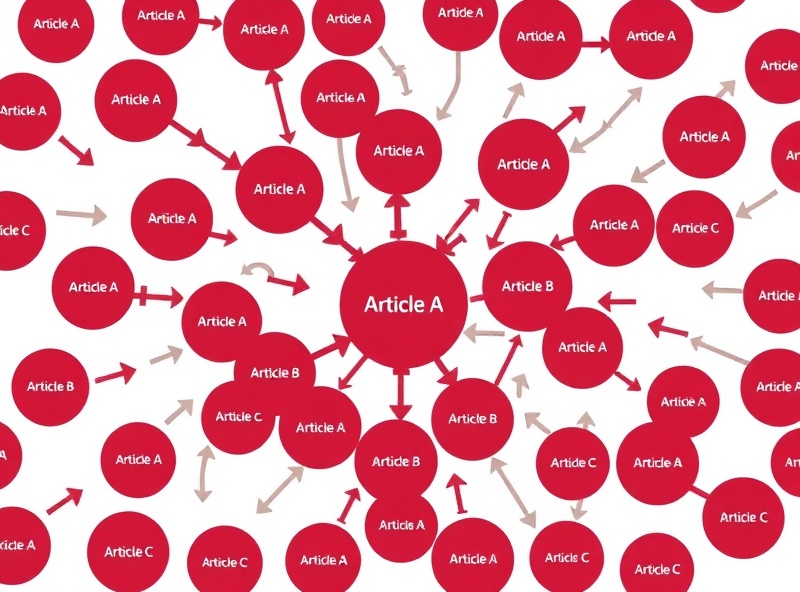
Here is what the average content site looks like on the inside: 80 articles on broadly related topics, published whenever inspiration struck, with H1 titles that overlap in meaning even if they differ in exact phrasing. Three articles ranking for variations of the same keyword, none of them fully ranking for any of them. A pillar page that exists but links to nothing. Cluster articles that link back to nothing.
The weekly time cost of this disorder is not obvious until you try to scale. Every new article requires a manual check against existing content to avoid cannibalization. Every internal linking pass takes hours because the site architecture was never planned — it accumulated. Every content brief requires re-researching a topic that was already half-covered three years ago.
Conservative estimate across a 500-post site: 3–5 hours per week of friction caused directly by the absence of a cluster map. Over a year, that is 150–260 hours of overhead that a single 45-minute session could eliminate.
The semantic cluster map is not a content calendar. It is not a keyword list. It is a structural document that answers one question: for every topic this site covers, which pages are the authority pages, which pages are the supporting pages, and which gaps have no pages at all?
The Automated Replacement: How to Build Semantic Content Clusters in Four Phases
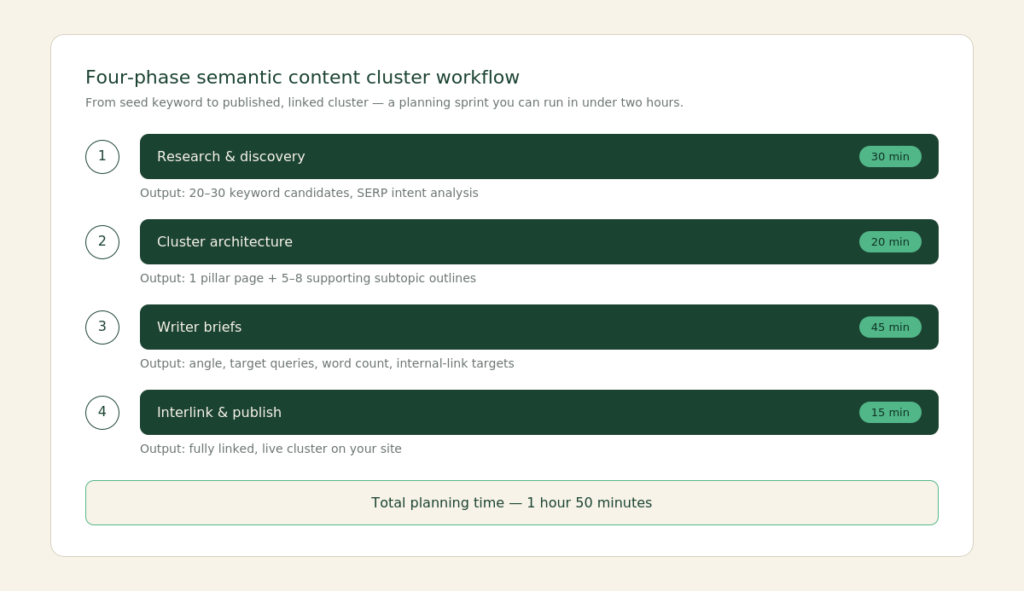
The workflow runs in four sequential phases. Each phase has a defined trigger, a defined action, and a defined output. Do not skip phases. The output of each phase is the input for the next.
Phase 1: Export Your Existing Page Inventory (8 minutes)
Trigger: You have a site with published content and no documented cluster structure.
Action: Export all indexed URLs from Google Search Console (Performance → Pages → Export) or from Ahrefs Site Explorer (Top Pages → Export). Filter for pages with at least one impression in the last 90 days. This removes redirect chains, orphaned drafts, and near-duplicate URLs from the working set.
Output: A flat CSV file containing every live, traffic-receiving URL on your site. For a 500-post site, expect 300–450 URLs after filtering. For a 2,000-post site, cap the export at your top 500 by impressions — the long tail will cluster naturally once the main architecture is mapped.
If you are starting a new site with no published content, skip Phase 1 and begin at Phase 2 with your target topic domain instead of an existing page list.
Phase 2: Generate the Cluster Map with an AI Prompt Chain (20 minutes)
Trigger: You have your URL inventory CSV open.
Action: Copy the page titles (not the full URLs — titles carry the semantic signal) into a structured prompt. The prompt has two parts.
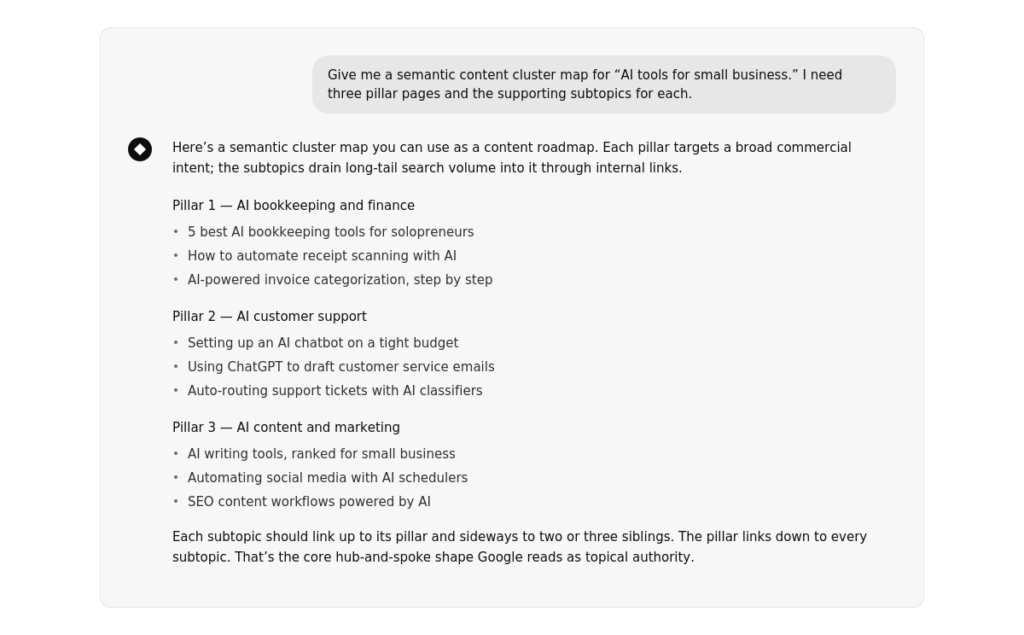
Part A — Cluster Generation:
“Here is a list of article titles from a content site. Group them into semantic clusters based on shared topic territory and user intent — not keyword overlap. Each cluster should have one pillar topic (the broadest, highest-authority angle) and 3–12 supporting subtopics. Name each cluster with a single phrase that represents the full territory. Flag any articles that appear to compete for the same search intent as ‘cannibalization risk.’ Flag any obvious topic gaps where a pillar or sub-topic appears to be missing. Here are the titles: [paste titles]”
Part B — Gap Analysis (run immediately after Part A output):
“Based on the clusters you generated, list the top 5 missing pillar topics and the top 10 missing subtopic articles that would complete the topical coverage. Prioritize gaps where competing sites are likely to have coverage that this site currently lacks.”
Output: A structured cluster map with named clusters, pillar designations, supporting article assignments, cannibalization flags, and a prioritized gap list. For a 500-article site this typically produces 8–15 named clusters with clear hierarchies. Save this output as a working document — this is the architecture layer everything else plugs into.
One clarification on what this step does and does not do: the AI is grouping by semantic meaning and intent, not by exact keyword match. “How to write a content brief” and “content brief template” will land in the same cluster. “Content brief” and “editorial calendar” will land in adjacent but distinct clusters. This distinction matters for internal linking logic, which comes in Phase 3.
ChatGPT-4o handles this well at the free tier for sites under 800 articles. Claude 3.5 produces comparable output and is worth running as a second pass if your cluster assignments feel ambiguous.
Phase 3: Validate Against Search Console Signals (12 minutes)
Trigger: You have your AI-generated cluster map.
Action: For each cluster, identify the designated pillar page. Pull that page’s top 5 ranking queries from Search Console (Performance → filter by page → Queries tab). Confirm that the pillar page is actually ranking for broad, high-intent queries — not narrow long-tail variations that a supporting article should own.
If a supporting article is outranking the designated pillar for the cluster’s primary query, that is a structural problem. The supporting article has accumulated authority that the pillar should hold. You have two options: consolidate the supporting article into the pillar, or update the pillar to subsume the ranking signals. Do not let this situation persist — it is the definition of cannibalization within a semantic content cluster.
Also check: is the pillar page receiving internal links from its supporting articles? In most unstructured sites, it is not. The internal linking audit comes next.
Output: A validated cluster map with each pillar confirmed by actual ranking data. Cannibalization cases are flagged with a specific recommended action (consolidate or redirect). Expected time: 2–3 minutes per cluster for a site with 8–10 clusters.
Phase 4: Build the Internal Linking Spec (10 minutes)
Trigger: You have a validated cluster map with confirmed pillar pages.
Action: For each cluster, produce a simple linking rule in this format:
Every supporting article in [Cluster Name] must contain at least one contextual internal link to [Pillar Page URL]. The anchor text should use a variation of [core cluster phrase] — not generic text like ‘click here’ or ‘read more.’
Then run a reverse check: does the pillar page link out to each of its supporting articles? Pillar pages should function as hub documents that distribute authority downward into the cluster. A pillar page that does not link to its supporting content is a dead end — it accumulates clicks but does not pass topical coherence signals through the site.
Output: A linking spec document with explicit rules for every cluster. This is handed off as an editing task — systematically applied to existing content before any new content is written.
Setup Requirements for the Semantic Cluster Workflow
Time: 45–60 minutes for the initial map. 2–4 hours to implement the linking spec across existing content (this scales with site size).
Tools required:
- Google Search Console (free) — for page inventory and ranking validation
- Ahrefs or Semrush (optional, paid) — for deeper inventory export and cannibalization checking
- ChatGPT-4o or Claude 3.5 (free tier sufficient for sites under 800 articles)
- A spreadsheet (Google Sheets works fine for the cluster map document)
Technical skill required: None beyond copy-paste and basic spreadsheet work. This workflow does not require any API access, browser extensions, or code.
Setup cost that most people underestimate: The linking spec implementation. Mapping the clusters takes under an hour. Updating 400 existing articles to include correct internal links takes several hours of work — either your time or a contractor’s. Budget for this before starting. The map is worthless without the linking layer.
Failure Modes: Where Semantic Content Clusters Break Down
Three specific points where this workflow breaks:
Failure Mode 1 — Treating the AI cluster output as final. The AI does not know which of your articles actually ranks, which ones are outdated, or which ones you plan to delete. Phase 3 validation exists for this reason. Skipping it produces a cluster map built on phantom authority.
Failure Mode 2 — Mapping without a consolidation decision. The gap analysis will surface 10–20 missing articles. The cannibalization audit will surface 5–10 conflicting pages. If you start creating the new content before resolving the conflicts, you are building new architecture on top of a structural problem. Consolidate first. Create second.
Failure Mode 3 — Building the map once and forgetting it. A cluster map is a living document. Every new article published should be assigned to a cluster before it is written — not categorized after publication. The map degrades the moment you start publishing outside of it.
The Friction Box
- AI cluster generation is only as good as your article titles. Vague titles like “Tips for Better Results” produce vague cluster assignments. Rename before prompting if your titles are weak.
- Sites with more than 1,500 articles should batch the prompt in groups of 200–300 titles. Single large batches lose coherence in the cluster output.
- Google Search Console data has a 48–72 hour lag. If a page was recently published or updated, its ranking data may not reflect current state.
- The workflow does not address external authority signals — backlinks, brand mentions, or E-E-A-T signals are outside this scope. Cluster architecture improves internal topical coherence. External authority requires a separate strategy. For a deeper look at the full topical authority picture, Keyword Insights has a thorough breakdown of the seven-step framework worth reading alongside this workflow.
- For new sites with no existing content, Phase 1 and Phase 3 are skipped entirely. The workflow compresses to approximately 25 minutes: generate the cluster map for your target topic domain, define pillar pages, write the linking spec as a publishing rule applied from day one.
Frequently Asked Questions About Semantic Content Clusters
What are semantic content clusters?
Semantic content clusters are groups of related articles organized around a single pillar topic. The pillar page covers the broadest angle on a subject; supporting articles address narrower subtopics and specific user intents within the same territory. Internal links connect the cluster so search engines read the topical relationship between pages, and no individual page has to rank in isolation.
How are semantic content clusters different from keyword clusters?
Keyword clusters group content by shared keyword strings. Semantic content clusters group content by shared user intent and topic territory — two articles can use completely different keywords and still belong to the same semantic cluster. This distinction matters for internal linking: you link based on topical relationship, not keyword overlap. “How to write a content brief” and “content brief template” are the same cluster; “content brief” and “editorial calendar” are adjacent but distinct.
How many semantic content clusters should a site have?
A 500-article site typically produces 8–15 named clusters when mapped using the Phase 2 AI prompt chain. A newer site with 50–100 articles might produce 4–8. The number is a function of topic diversity, not article count. Forcing too many clusters fragments authority; too few means supporting articles are not differentiated enough to rank independently.
How long does it take to build a semantic content cluster map?
The initial mapping session takes 45–60 minutes using this four-phase workflow. The follow-on work — implementing the internal linking spec across existing articles — takes 2–4 hours for a 400–500 article site. Budget the implementation time before starting. The map session is fast; the editing task that follows is where most of the clock goes.
Do semantic content clusters work for new sites with no published content?
Yes, but the workflow compresses. Skip Phase 1 (no inventory to export) and Phase 3 (no ranking data to validate). Run Phase 2 against your target topic domain instead of an existing title list to generate your cluster architecture. Write the Phase 4 linking spec as a publishing rule applied from your first article — the map becomes a planning document rather than a remediation one. The workflow compresses to approximately 25 minutes in this scenario.
What is the most common mistake operators make when implementing semantic content clusters?
Skipping the consolidation step. The gap analysis surfaces missing articles; the cannibalization audit surfaces conflicting pages. Most operators start publishing new content immediately without resolving the conflicts first. The result: new articles compete with existing articles inside the same cluster, compounding the structural problem rather than fixing it. Consolidate first. Create second.
The Straight Talk
This workflow is for site operators who have been publishing content for at least 6–12 months and suspect — or already know — that their existing articles are undermining each other. If your Search Console shows 3–5 pages splitting impressions for the same query, this is the session that stops that bleed.
Skip this if you have fewer than 30 published articles. At that scale, a semantic content cluster map is premature — the work should go into writing better individual posts, not architecting a structure that does not yet have enough content to populate.
The next concrete action: export your Search Console page inventory today, copy the titles into the Phase 2 prompt, and spend 20 minutes generating your first cluster map. Everything else in this workflow follows from that output.
For the companion piece on what a high-authority pillar page actually contains and how to structure one from scratch, see how to build a pillar page. If the Phase 4 linking spec implementation is your immediate next step, the internal linking workflow for existing content sites covers the editing process end to end. The content brief format that keeps new cluster articles on-topic from the first draft starts at content brief workflow.