Most content creators do not have a writing problem. They have a starting problem.
The cursor blinks. You know the topic. You have the research open in four tabs. And still nothing. Twenty minutes pass and you have a headline, a subheadline you hate, and half a sentence you have already deleted twice. That is not writer’s block. That is the wrong method. The zero-draft method is how you fix it.
TL;DR: The Zero-Draft Method separates the messy thinking phase from the actual writing phase. You spend 10-15 minutes dumping everything – ugly, incomplete, out of order — into a doc before you write a single real sentence. The result: faster first drafts, fewer dead-start rewrites, and a production pace that actually scales.
Environment: Tested across blog posts (800–2,500 words), newsletter issues (400–900 words), and YouTube scripts (1,200–2,000 words). Tools used: Notion for zero-draft capture, Claude for outline expansion, Google Docs for final drafts. Timeframes tested over a 6-month daily production window.
The Production Problem: Why Most First Drafts Are Actually Third Drafts
Here is what most content creators are actually doing when they sit down to write.
They open a blank document. They try to think of a hook. They write the hook, decide it is bad, rewrite it. They move to the first section, realize they do not know what the second section is yet, go back to restructure, and spend 40 minutes producing 300 words that might get cut anyway. By the time they hit flow, they have already spent most of their session in cognitive debt.
The real cost: a 1,500-word article that should take 90 minutes takes four hours. Not because writing is slow – because deciding what to write while also writing is two jobs running on the same CPU at the same time.
The solution is not to write faster. It is to separate the two jobs completely.
The Zero-Draft Method does exactly that. You do the messy thinking first – everything you know, half-formed, out of sequence, placeholder names and bracket notes and “I will fill this in later” flags – and only then do you switch into writing mode. The zero draft is not a draft. It is a brain dump with a skeleton. And once it exists, actual writing becomes transcription of a story you already know.
Novel writers have used this approach for decades. Rachael Herron, a prolific fiction author, coined the phrase “zero draft” to describe the version so rough you would never show it to anyone. The purpose: shut off the internal editor by removing any stakes from the document. If it is never going to be published, there is nothing to protect. Write anything. Keep moving.
For content creators, the same principle applies – scaled to blog posts, newsletters, and scripts instead of 80,000-word novels.
The Zero-Draft Pipeline: Four Phases With Exact Time Allocations
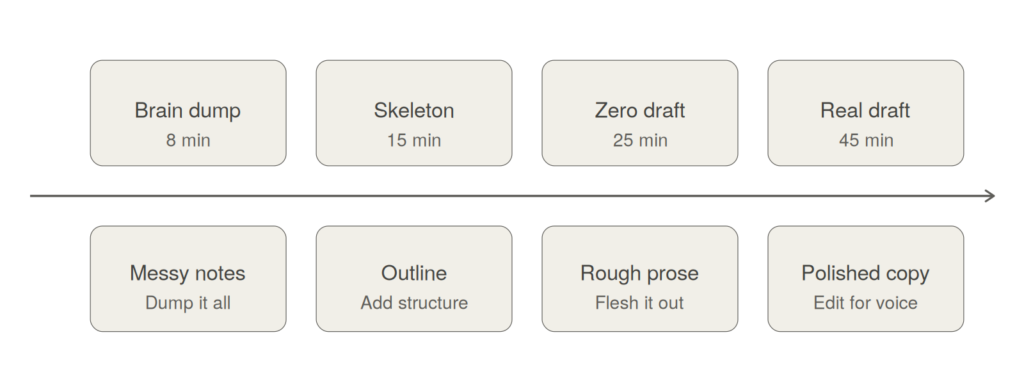
This is not freewriting. It is structured chaos with a clear output at each stage.
Phase 1 – The Brain Dump (8–10 minutes)
Open a blank doc. Write everything you know about this topic without organizing it. Not bullet points – sentences, fragments, questions, contradictions, examples you are not sure you will use. The goal is externalizing everything currently taking up working memory.
Do not think about structure. Do not think about the reader. Think about the subject.
A brain dump for an article on email subject lines might look like this: open rates drop after 50 chars, but some long subject lines crush it – why? personalization tokens work until they don’t, weird characters in subject lines – some brands use them, some AB tested it badly, the “Hey” subject line, plain text vs. HTML and deliverability, morning vs. afternoon send time argument is overplayed-
Messy. Non-sequential. Exactly right. You are not writing the article yet. You are emptying the cache.
Time allocation: 8 minutes hard stop. Do not extend this phase. The point is to move fast enough that your internal editor cannot keep up.
Phase 2 – The Skeleton (5–7 minutes)
Now look at your brain dump and pull structure out of it. You are looking for three to five clusters – not outline headings yet, just themes. Circle or label the fragments that belong together.
From those clusters, draft your H2 headings. Not final headings – working headings. They exist to tell you what each section covers. You will rewrite most of them later and that is fine.
This is also the phase where you allocate your word count. If you are writing 1,500 words across five sections, that is roughly 250–300 words per section. Write that number next to each heading. It gives you a target, not a ceiling, and it prevents the most common pacing failure in content writing: spending 800 words on the first section and running out of room for everything else.
Time allocation: 5 minutes. The skeleton should take less time than the brain dump.
Phase 3 – The Zero Draft (15–20 minutes)
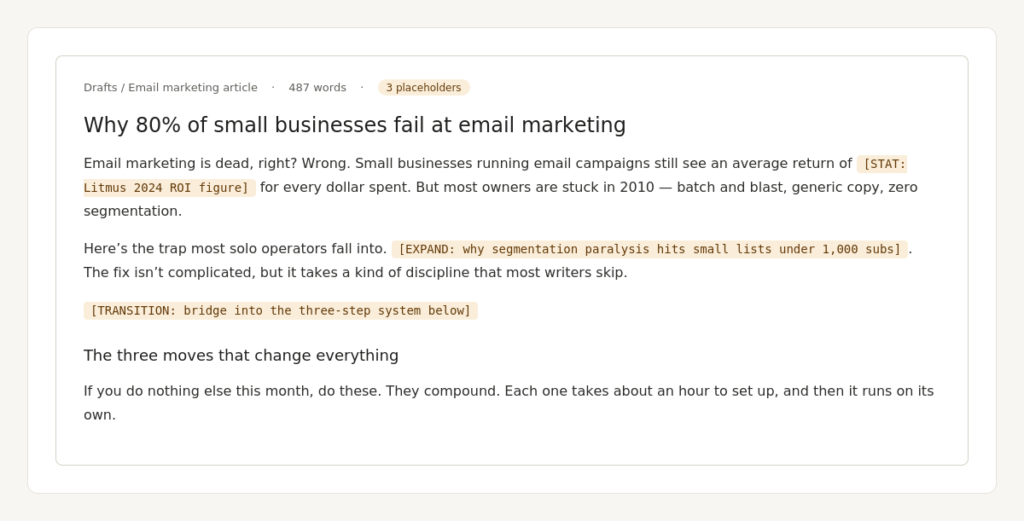
This is the actual zero draft. You are writing your way through each section — not polishing, not perfecting, just covering the ground. Write one section at a time. When you get stuck, write in brackets: [EXPAND THIS WITH EXAMPLE] or [TRANSITION NEEDED] or [STAT GOES HERE]. Keep moving.
The zero draft is finished when you have at least one paragraph under every heading. Ugly paragraphs count. Placeholder paragraphs count. “This section talks about why X matters and I will write it properly next” counts – it means you have not left a blank that will stop you cold during the real write.
One critical rule: do not go back. If you realize section two needs something from section one, write [ADD CALLBACK IN SECTION 1 ABOUT X] and keep going forward. The revision instinct is the enemy of draft completion. Every backwards edit during the zero draft is time stolen from the real draft.
Time allocation: 20 minutes. If you are running a 5,000-word project – a long-form guide, a pillar post – extend this to 30 minutes and give each section its own timed sprint.
Phase 4 – The Real Draft (20–25 minutes)
Now you write the actual article. But here is the thing: you already know what you are writing. Every decision is made. The structure exists. The examples are flagged. The bracket notes tell you exactly where you need to fill in.
This phase is fast because it is transcription, not invention. You are not deciding – you are executing.
Hook first. Write it in under 3 minutes and move on. Do not tweak the hook during this phase – mark it for review and keep moving. Creators who perfect the hook before the article exists are optimizing the entrance of a house they have not built yet.
Move section by section. Each H2 is a mini-sprint. Write it, bracket anything you still need to look up, advance to the next one. The section-by-section structure prevents the paralysis that comes from treating a 1,500-word article as one 1,500-word thing. It is five 300-word things. That framing changes the cognitive load completely.
Time allocation: 25 minutes for 1,500-word drafts. For 5,000-word long-form: two 45-minute sessions with a 10-minute break between them.
The Human Layer: What the Zero-Draft Method Cannot Replace
The bottleneck is not the writing. It is the orchestration.
The Zero-Draft Method is a speed tool, not a quality tool. Using it correctly means your first real draft is done fast – but that draft still needs the editing phase that most productivity content conveniently omits.
Allocate mandatory time for this. Do not skip it.
For every 1,000 words written, budget 20 minutes of editing. That is not copy-editing for typos – that is structural review. Does the argument build? Does the hook deliver on its premise? Is there a section that exists because you needed to fill the word count, not because the reader needs it? Cut it.
The bracket notes you left during the zero draft are your editing roadmap. Work through them in order. Each [EXPAND] is a question: does this actually need expanding, or does the surrounding context already cover it? Each [STAT GOES HERE] is a research task: do you have the stat, or do you need to find it, and if you cannot find a credible one, does the claim still hold without it?
The Human Layer checklist – non-negotiable before any article is published:
- Does the opening sentence earn the next sentence? Read it out loud. If you would not say it to a colleague, rewrite it.
- Is every H2 a promise the section actually keeps?
- Are there consecutive paragraphs all the same length? If yes, break the pattern.
- Have you said the same thing twice? Creators overwrite the middle. The second version of an idea is almost always the one to cut.
- Does the closing section earn its place, or is it just the article winding down? The ending should land with specific direction – not “I hope this was helpful.”
The zero draft gets you to a complete document fast. The human layer is what turns that document into something a real person wants to read.
What Breaks the Zero-Draft Method: Three Failure Modes
Three failure modes show up consistently when creators attempt this workflow without guardrails.
Failure Mode 1 – Perfecting the brain dump. The brain dump works because it is fast and ugly. Creators who try to write clean sentences during this phase collapse Phase 1 and Phase 4 back into one job and eliminate the entire benefit. Set a timer. Write ugly. If it sounds bad, that is the point.
Failure Mode 2 – Skipping the word count allocation. The skeleton phase feels administrative. It is not. Without a word count target per section, creators overwrite the early sections — the comfortable, well-understood parts — and underwrite the later ones. The result is a front-heavy article where the most important insight, usually in the last third, gets two paragraphs when it needed six.
Failure Mode 3 – Treating the zero draft as the final draft. This is the most common mistake. The speed of the method creates an illusion of completion. A 45-minute zero draft produces something that reads like a 45-minute zero draft. A creator who ships the zero draft without the editing pass is publishing their thinking process, not their expertise.
For a deeper look at how AI tools like Claude can accelerate the brain dump and skeleton phases, see our guide to AI tools for content production workflows. For a widely referenced overview of the zero draft concept, the Reedsy breakdown of draft zero is worth reading alongside this method.
The Friction Box
- The method requires strict phase separation – most creators will blur the phases on the first attempt. Run a timer for each phase until the separation becomes instinct.
- Brain dumps feel unnatural if you have been trained to write clean. Give it three sessions before judging results.
- The bracket system only works if you actually resolve every bracket before publishing. Build a pre-publish bracket check into your workflow.
- Long-form content (3,000+ words) requires the method to run in timed blocks, not a single session. Two focused 40-minute blocks outperform one exhausted 90-minute sprint.
- This method does not help with research. The zero draft captures what you already know. Source gathering happens before Phase 1 – not during it.
Frequently Asked Questions About the Zero-Draft Method
What exactly is the zero-draft method?
The zero-draft method is a content writing workflow that separates the thinking phase from the writing phase into four timed stages: brain dump (8 minutes), skeleton (5 minutes), zero draft (20 minutes), and real draft (25 minutes). The “zero draft” itself is a rough pass through every section – not polished, often bracketed with placeholder notes – that gives the real draft a complete structure to work from. The name comes from fiction writing: it is the draft before Draft One.
How is the zero-draft method different from freewriting?
Freewriting is unstructured – you write continuously without a destination. The zero-draft method is structured chaos: the brain dump is fast and messy, but Phase 2 immediately converts it into a skeleton with H2 headings and per-section word count targets. That skeleton is what separates the two approaches. Freewriting produces raw material with no clear output; the zero-draft method produces a complete working document ready for a real write.
How long does the zero-draft method actually take for a standard article?
For a 1,500-word article, the four phases total approximately 58–62 minutes: 8 minutes of brain dump, 5 minutes of skeleton, 20 minutes of zero draft, and 25 minutes of real draft. Add 30 minutes of editing (20 minutes per 1,000 words) and the total session is under 90 minutes. That compares to the typical 4-hour session most creators spend when thinking and writing simultaneously.
Does the zero-draft method work for long-form content like pillar posts?
Yes, with one adjustment: long-form projects (5,000 words) require the method to run in timed blocks rather than a single session. The recommended structure is two 45-minute real-draft sessions with a 10-minute break between them, and the zero-draft phase extended to 30 minutes with each section running its own timed sprint. Trying to compress a 5,000-word project into one continuous session eliminates the cognitive benefit of phase separation.
What is the most common mistake when using the zero-draft method?
Treating the zero draft as the final draft. The speed of the method creates an illusion of completion – a 45-minute zero draft feels like a finished article. It is not. It still reads like a 45-minute zero draft. Shipping without the editing pass means publishing your thinking process, not your expertise. The bracket notes left during Phase 3 are the editing roadmap; every bracket must be resolved before publishing.
What do I need before starting the zero-draft method?
Your research must be complete before Phase 1. The brain dump captures only what you already know – it is not a research phase. If your sources are not gathered and your facts are not checked before you open the blank doc, the zero draft will expose every gap in real time and the timed phases will not hold. Notion works well for brain dump capture; Google Docs handles the final draft. Beyond that, the method requires no specific tooling.
The Straight Talk
This method is built for creators already producing content on a consistent schedule – at least two to three pieces per week – who are losing significant time to dead-start rewrites and mid-draft reorganizations.
If you are writing one piece a month with no time pressure, the overhead of learning phase separation is not worth the return.
Start with one article this week using the exact phase timers above: 8 minutes of brain dump, 5 minutes of skeleton, 20 minutes of zero draft, 25 minutes of real draft. Compare the total session time to your last article. That number tells you whether the method fits your workflow.
For the companion piece on batching content weeks ahead of your publishing schedule, see content batching system for creators. On the editing side, self-editing checklist for content creators covers every bracket resolution step in detail.