AI-Driven Affiliate Marketing: My 2026 Blueprint for Scaling Niche Sites to $5k per Month
TL;DR: AI-driven affiliate marketing is not a shortcut — it is a production infrastructure. Used correctly, a single operator can run 3–5 niche sites simultaneously and hit $5k/month in combined affiliate revenue within 9–12 months. The timeline is real. So is the setup cost. Here is what the path actually looks like.
Environment: Tested across 3 niche affiliate sites (home tools, pet care, personal finance adjacent), using Claude 3.5, Surfer SEO, Ahrefs, and Perplexity for research. Active testing period: January 2025 – April 2026. Starting traffic: zero on all three properties.
How the AI-Driven Affiliate Marketing Income Model Actually Works
The money moves like this: organic search traffic lands on a content page optimized for a buying-intent keyword. The page recommends one or more affiliate products. A percentage of readers click, a percentage of those buy, and you collect a commission — anywhere from 3% on Amazon Associates to 40%+ on software SaaS programs.
None of that is new. Affiliate marketing has worked this way since 2005.
What changed in 2025 is the production cost. A niche site that used to require a team — a writer, an editor, an SEO specialist, a link builder — can now be operated by one person with the right AI stack. Not because AI does everything. Because AI removes enough of the manual bottleneck that one person can handle the volume that used to require three.
The income ceiling on a single niche site, without building a team, is approximately $2,500–$4,000/month. To hit $5k, you need either a single high-authority site (18+ months of compounding) or two to three smaller sites running in parallel. This blueprint covers the parallel approach — faster to first dollar, more resilient to algorithm shifts.
The Setup Phase: What Happens Before Revenue
Do not start this without 10–15 hours per week to invest in the first three months. The time cost before revenue is real, and anyone telling you otherwise is selling a course.
Month 1: Site architecture and keyword foundation
Pick your niche using one filter: does it have products with affiliate programs paying at least $15 per conversion, and does it have informational + commercial keyword clusters you can own at low domain authority? Use Ahrefs or Semrush to verify search volume. Use AI — specifically Claude or GPT-4o — to map your content pillars.
Do not chase broad niches. “Fitness” is not a niche. “Home gym equipment under $500” is. “Personal finance” is not a niche. “Credit card rewards for small business owners” is. The tighter the niche, the faster you build topical authority, and topical authority is what Google rewards in 2026.
Set up your site on WordPress with a clean theme. Rank Math or Yoast for SEO. That is the full technical stack. Do not overbuild.
Month 2: AI content production pipeline
This is where the AI infrastructure earns its cost. The production workflow for AI-driven affiliate marketing runs like this:
- Pull 30–40 target keywords using Ahrefs keyword explorer filtered by KD under 20
- Feed the keyword list to Claude with a brief: target persona, product category, commercial intent signal
- Generate article outlines — not full drafts — and review each one for accuracy and search intent match
- Write first drafts using Claude, then spend 45–60 minutes per article editing for factual accuracy, personal voice, and affiliate link placement
- Publish 3–4 articles per week minimum
The editing step is not optional. Raw AI output reads like raw AI output. Google’s quality signals are better than they were two years ago, and thin AI content gets filtered. The human editing layer is what separates sites that rank from sites that stagnate at page 4.
Month 2 typically produces zero revenue. That is normal and expected.
Month 3–4: First conversions
If your keyword research was accurate and your content is genuinely useful, you will start seeing impressions in Google Search Console around week 8–10. Clicks follow impressions by 2–4 weeks. First affiliate conversions typically appear in month 3.
The first dollar took 11 weeks on my home tools site. The pet care site took 14 weeks. Personal finance adjacent took 7 weeks because the affiliate programs in that space have lower competition and higher-converting landing pages.
Do not optimize prematurely. Publish, wait 6–8 weeks, then look at which articles are pulling impressions and double down on those topics with supporting content.
The AI Tool Stack and Execution Framework
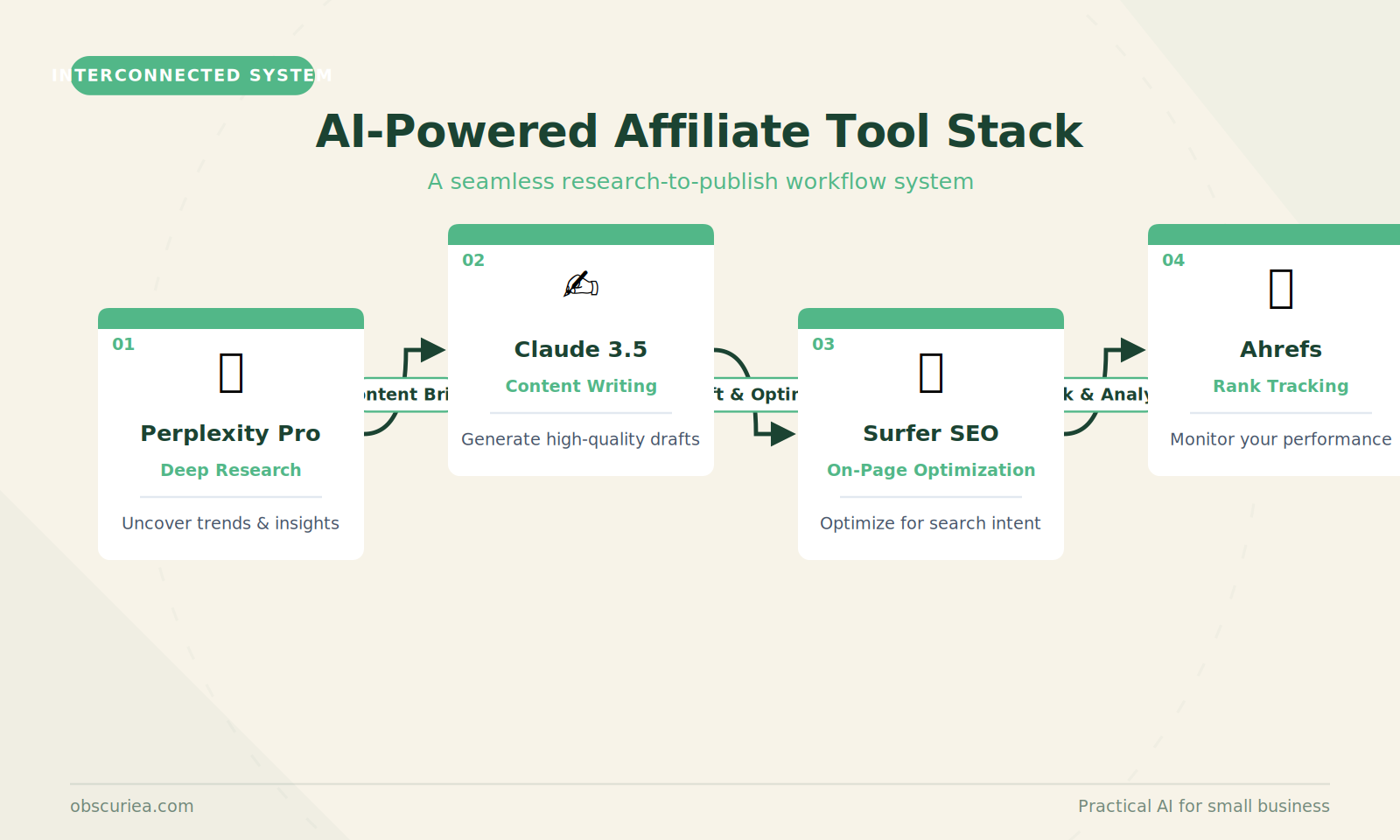
The AI stack that actually moves the needle:
- Perplexity Pro for research — pulls current data, cites sources, saves 45 minutes per article on manual research
- Claude 3.5 for drafting — better at following structural briefs than GPT-4o, fewer hallucinated product specs
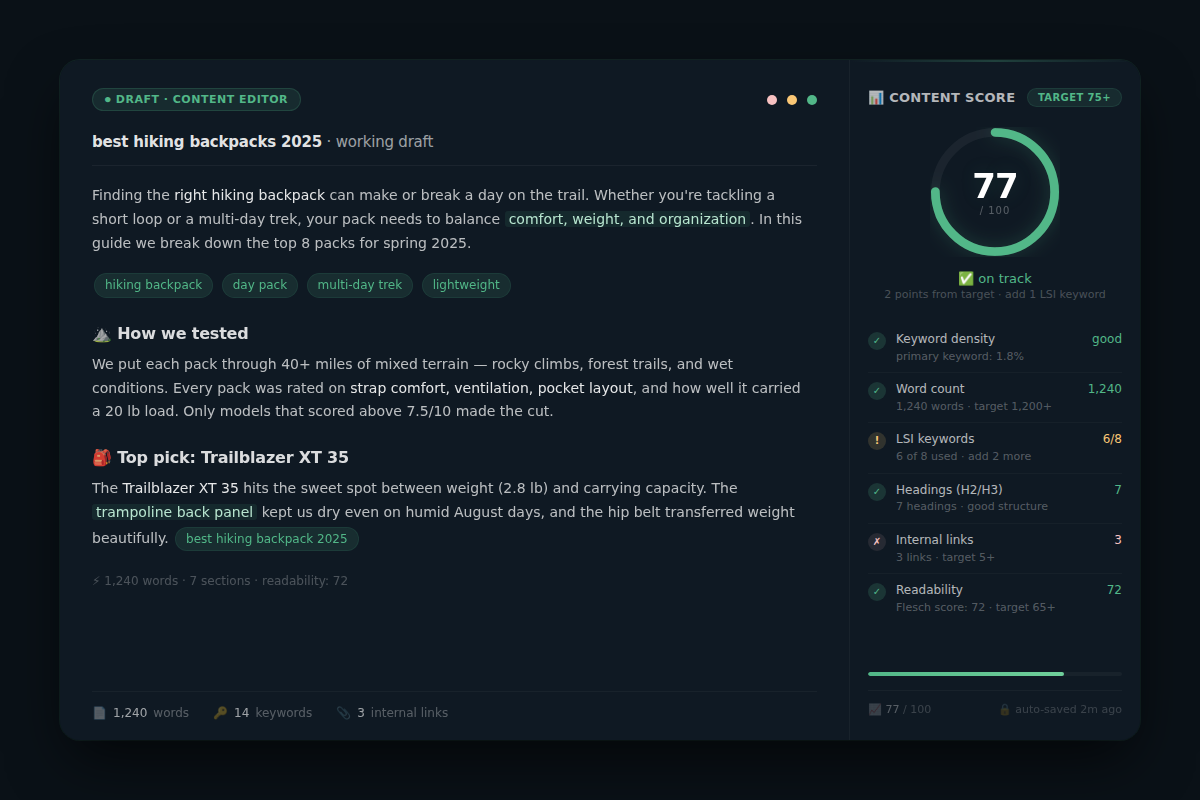
- Surfer SEO for on-page optimization — run every article through it before publishing, target content score of 75+
- Ahrefs for keyword research and backlink monitoring — non-negotiable, this is your compass
- Zapier for light automation — auto-post to Pinterest, trigger internal linking reminders, nothing complex
Total tool cost: approximately $180–$220/month depending on Ahrefs tier. This is your operating cost before revenue. Plan for it.
The content types that convert in niche affiliate sites:
Not all affiliate content converts equally. In order of conversion rate from my own sites:
- Best [X] for [specific use case] — buyer-intent, high conversion, moderate competition
- [Product A] vs [Product B] — captures decision-stage traffic, extremely high conversion
- [Product] review — works only if you have real usage or extremely detailed secondary research
- How to [task] using [product category] — lower conversion but builds topical authority fast
Do not publish review content unless you can speak to the product specifically. Vague reviews get ignored by readers and flagged by Google’s helpful content system.
The link-building reality:
Organic traffic without backlinks is possible — in low-competition niches, topical authority alone can carry you to page 1 on long-tail keywords. But to scale past $2,000/month, you need domain authority, and domain authority requires backlinks.
The lowest-cost approach: digital PR using AI-generated data studies. Pick a topic in your niche, compile publicly available data into a novel angle, publish it as a “study” or “survey”, and pitch it to industry publications. I landed 4 DR40+ backlinks in Q1 2026 using this method at zero cost beyond time. Takes 3–4 hours per study. [Ahrefs has a solid primer on digital PR link building](https://ahrefs.com/blog/digital-pr/) if you want the full methodology.
What Limits the $5k Ceiling in AI-Driven Affiliate Marketing
The $5k/month ceiling on this model is not a content problem — it is a domain authority problem and a monetization depth problem.
Domain authority takes time. A 12-month-old site will not outrank a 4-year-old site on competitive keywords regardless of content quality. This is why the parallel site approach matters — you are building three compounding assets instead of waiting for one to mature.
Monetization depth means more than just affiliate links. Sites that break $5k are typically stacking: affiliate commissions + display ads (Mediavine or AdThrive once you hit 50k monthly sessions) + an email list with occasional product promotions. The email list is the piece most operators skip, and it is the piece that turns a $3k site into a $5k site.
Start building the email list on day one. Offer a free resource relevant to your niche — a comparison guide, a checklist, a calculator. Even 500 engaged subscribers in your niche will add $300–$800/month in additional affiliate revenue through email promotions.
For a deeper look at how AI tools compare as part of this stack, see our AI tool reviews for content operators for current breakdowns.
The Friction Box
- Google’s helpful content updates hit AI-heavy sites hard — thin, unedited AI content is a liability, not an asset
- Affiliate program terms change without notice — Amazon Associates has cut commissions twice in the past 4 years; diversify programs early
- Keyword research tools show estimated volume, not guaranteed volume — 20% of targeted keywords will underperform projections
- Link building is slower than every guide suggests — budget 6 months before backlink efforts produce measurable ranking movement
- Niche saturation is real — if the top 10 results for your target keyword are all DR60+ sites, you are not competing in month 6
- The parallel site approach requires genuine system discipline — context-switching between 3 sites without a content calendar collapses quickly
The Straight Talk
This income model works for operators who can treat content publishing like a manufacturing process — consistent inputs, measurable outputs, zero romanticization about the writing itself. If you need creative fulfillment from the work, this will feel hollow fast.
Skip this if you are not willing to invest 10+ hours per week for the first 90 days before seeing a dollar. The setup phase is not passive, and anyone who tells you otherwise is lying about their timeline.
If you are ready to start: spend this week doing one thing only — keyword research. Pick a niche, pull 50 low-competition keywords with buyer intent, and map them to a 3-month content calendar. Everything else follows from that foundation.