AI Content Auditing: How to Refresh 100 Old Blog Posts in a Single Weekend
The bottleneck is never what you think it is. You sit down to refresh your content archive and immediately drown — 200 posts, no system, no triage, no idea where to start. Three hours later you’ve rewritten one intro and answered six Slack messages. Weekend gone.
That’s the real problem with AI content auditing at scale. Not the writing. The orchestration.
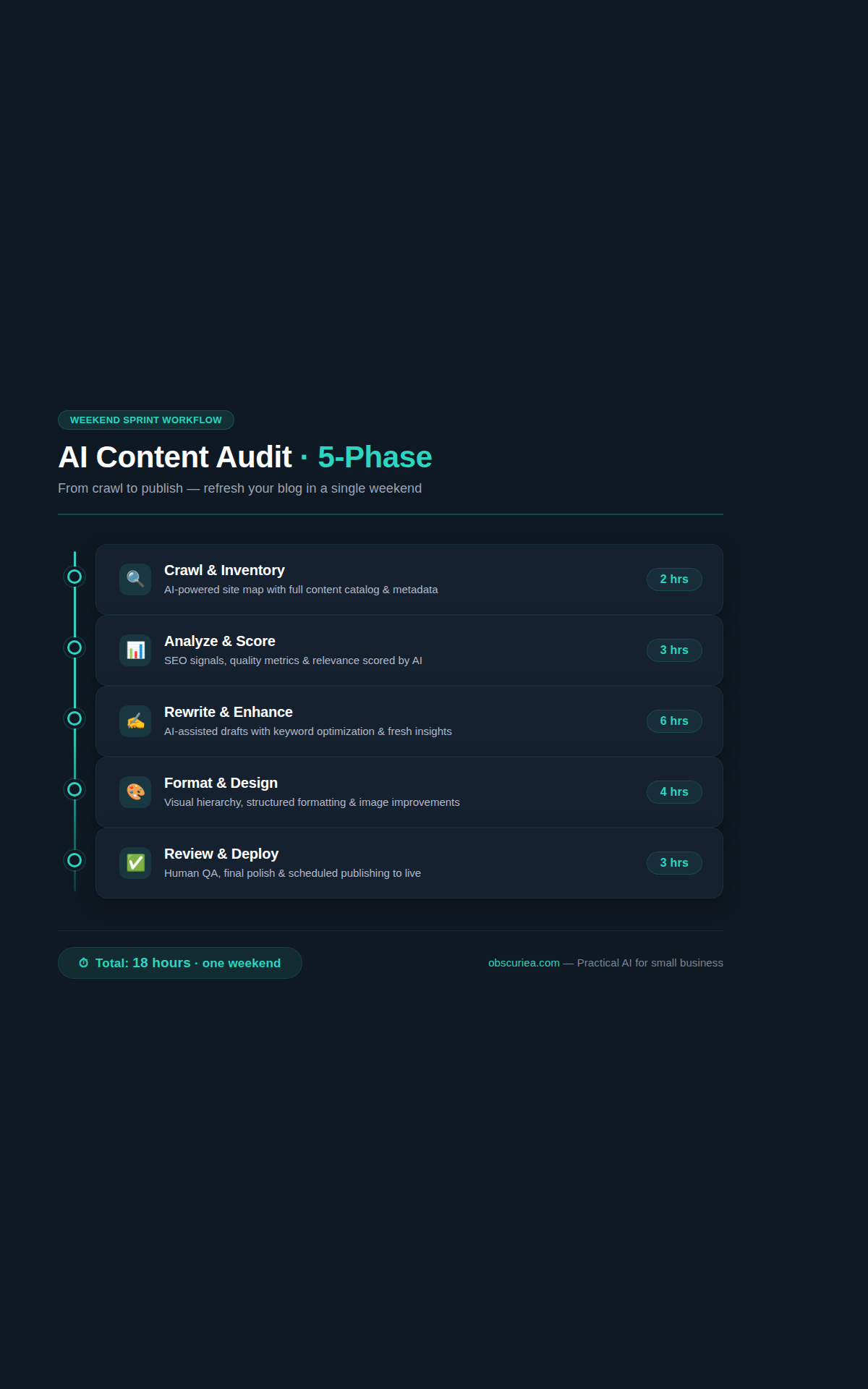
TL;DR: Using AI to audit and refresh 100 old blog posts in a weekend is possible — but only if you separate the triage phase from the rewrite phase, assign AI the right jobs, and keep humans on the decisions that actually move rankings. This workflow runs in five phases over two days. The output is a categorized audit spreadsheet, prioritized rewrite queue, and 20–30 fully refreshed posts ready to republish.
Environment: Workflow tested across a 200-post blog archive. Tools used: ChatGPT-4o (analysis and rewrite drafts), Google Search Console (performance data export), Screaming Frog free tier (crawl), Airtable (triage tracker). Test period: single weekend sprint, approximately 16 working hours.
Why Your Blog Archive Is Bleeding Traffic Right Now
Here’s a number that should stop you cold: 61–80% of your organic traffic comes from older posts. Not the shiny new piece you published last Tuesday. The post from 2021 about a topic you half-remember writing.
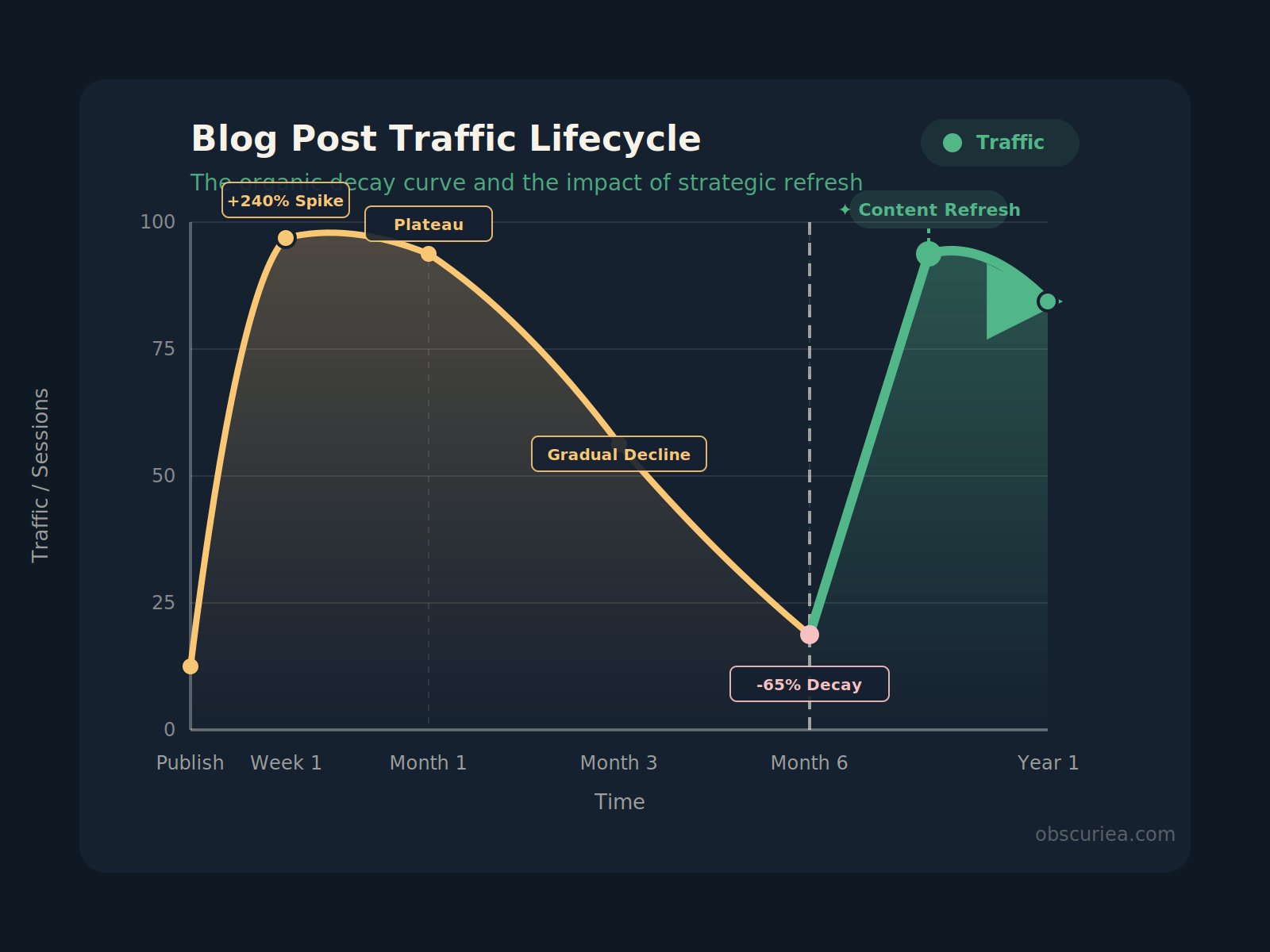
That post is decaying. Quietly, consistently, post by post. Position 1 captures roughly 39.8% click-through rate. Position 2 drops to 18.7%. That’s a 53% traffic loss from a single ranking slip. If you have fifty posts sitting in positions 4–20, you are not looking at a content gap problem. You are looking at a content maintenance problem.
The traditional fix is manual. One editor. One post at a time. A full content audit for a 100-post archive, done manually, takes most solo operators or small teams somewhere between three and six weeks. That timeline kills the strategy before it starts.
AI doesn’t remove the human layer. It compresses the phases that don’t require human judgment — the classification, the gap spotting, the first-draft restructuring — so the human editing hours go toward the posts that actually deserve them.
The 5-Phase AI Content Auditing Pipeline: Two Days, Real Output
Do not attempt to audit and rewrite simultaneously. These are two separate cognitive modes and two separate jobs. Mixing them guarantees you finish neither.
Phase 1 — Data Pull and Triage Scoring (Friday Evening, 90 minutes)
Start with Google Search Console. Export 12 months of page-level performance data: clicks, impressions, average position, CTR. Export to a spreadsheet.
Add three columns:
– Action Tag: REFRESH / REWRITE / PRUNE / KEEP
– Priority Score: 1–3 (1 = highest)
– AI Assigned: Yes / No
Now run your posts through a quick triage filter. Allocate 20–30 minutes to this, not more.
PRUNE candidates (delete or noindex, do not spend time on these):
– Under 50 pageviews per month for six consecutive months
– Under 500 words with no unique angle
– Duplicate topic coverage — three weak posts competing for the same keyword
– Bounce rate above 85% combined with average session under 30 seconds
KEEP for now (strong performers, leave alone):
– Ranking positions 1–3 with stable or growing clicks
– Posts with 5+ referring domains and consistent traffic
REFRESH candidates (light update, AI handles first pass):
– Positions 4–20, impressions exist but CTR is low
– Evergreen topic, structure sound, just dated examples or statistics
REWRITE candidates (structural overhaul, human-led with AI assist):
– Traffic declined more than 20% year-over-year
– Search intent has shifted — what ranked in 2021 for this keyword now looks nothing like current SERP results
– Post attracts informational readers but you need commercial intent
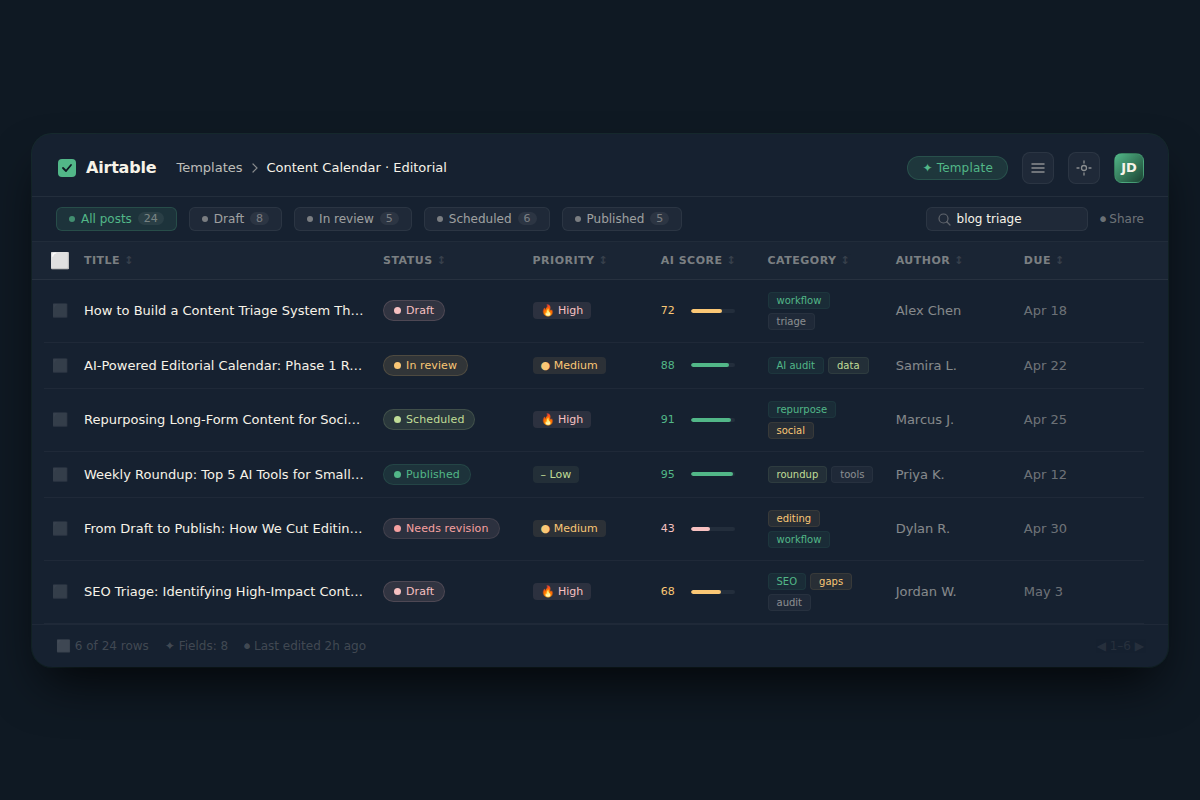
Target output from Phase 1: a spreadsheet with every post tagged, sorted by priority score, with a column flagging which posts go to AI first-pass and which go straight to human editing queue.
Imperfect triage that gets done is better than perfect triage that takes three days.
Phase 2 — SERP Audit with AI Assistance (Saturday Morning, 2 hours)
Pull your top 30 REFRESH and REWRITE candidates. For each one, you need to know what the current SERP looks like for its target keyword. This is the step most people skip, and it’s the reason refreshed content still doesn’t rank.
Google changes its intent interpretation constantly. A post optimized for a listicle format in 2022 may now be competing against how-to guides, comparison pages, or featured snippet content. Rewriting into the wrong format wastes the refresh entirely.
Use ChatGPT to speed this up. Build a prompt template and run it in batches:
“Analyze the current search intent for the keyword [X]. Based on the types of content currently ranking, what format, structure, and angle does Google appear to be rewarding? What questions does the current top-ranking content answer that a 2021 post might have missed?”
This is not asking AI to do your SEO. It’s asking AI to synthesize pattern recognition across SERP formats so you can make faster structural decisions. According to SEOptimer, AI tools including Google’s AI Overviews now appear in 13% of all US desktop searches — which means your refreshed content needs to be structured for AI citation, not just traditional ranking. [External: https://www.seoptimer.com/blog/republishing-content/]
Log the output in your triage spreadsheet: format shift needed (yes/no), primary content gap identified, new angle recommendation.
Time allocation: 2 hours for 30 posts. That’s 4 minutes per post. Keep moving.
Phase 3 — AI First-Pass Drafts for REFRESH Queue (Saturday Midday, 3 hours)
This is where AI earns its place in the workflow. REFRESH posts — the ones with good bones but outdated content — are exactly what AI handles well. The structure is already there. The internal logic is already there. You’re asking AI to update statistics, tighten explanations, and surface missing subtopics.
Prompt structure for each REFRESH post:
“I am refreshing this blog post for 2025. Original post: [paste full text]. Target keyword: [X]. Based on current best practices, please: (1) identify statistics or examples that are outdated, (2) flag any sections where a competitor might cover this topic more thoroughly, (3) rewrite the opening paragraph to reflect current search intent, (4) suggest 2–3 subheadings that are missing from this post. Do not rewrite the entire post. Produce a structured update brief.”
You are not asking AI to rewrite. You are asking AI to produce an update brief. The distinction matters. Full AI rewrites lose the post’s existing authority signals — the phrasing patterns Google already associated with rankings. Update briefs tell you exactly what to change and why, then a human executes.
Batch this. Paste 5–6 posts into a session, run the prompt for each, copy outputs back to your spreadsheet. At 15 minutes per post including copy-paste time, 3 hours covers 12 posts.
Time allocation: 3 hours. Output: 12 AI-assisted update briefs ready for human execution.
Phase 4 — Human Editing Pass (Saturday Afternoon into Sunday, 8 hours)
This is the phase AI cannot own. Allocate mandatory time for this — do not skip it or compress it.
For REFRESH posts: work from the AI update brief. Your job is to execute the specific changes flagged, write the new opening paragraph yourself (not from AI), and read the post aloud once before republishing. If a sentence does not sound like something you would say to a colleague, delete it. That test catches AI-generated insertions that survived the brief process.
For REWRITE posts: use AI for structure scaffolding only. Paste the original post and ask for a new outline based on the updated intent. Then write the sections yourself. These posts need your voice, your specific examples, your editorial judgment about what the reader actually needs to know. AI can draft and you can edit heavily — but if AI writes 80% and you edit 20%, the result will read like 80% AI. That’s detectable and it undermines the E-E-A-T signals that are increasingly critical for both Google rankings and AI Overview citations.
A realistic editing pace for a REFRESH post: 25–30 minutes. For a REWRITE: 45–60 minutes.
Over 8 hours, with focused execution:
– REFRESH posts completed: 14–16
– REWRITE posts completed: 6–8
– Total posts republished: 20–24
That’s not 100 posts. But it’s 20–24 high-priority posts refreshed in a single weekend — the ones most likely to move from position 8 to position 2 — with the remaining audit work logged, triaged, and queued for the following two weeks.
Phase 5 — Republish and Crawl Signals (Sunday, 30 minutes)
Change the published date on every refreshed post. Update the meta description. Add one internal link from a recent high-traffic post to each refreshed page — this sends crawl signal and directs link equity toward the newly updated content. For a deeper look at how internal linking supports content refreshes, the approach documented by Apricot Studio’s B2B content refresh process is worth reviewing. [External: https://www.apricot-studio.com/blog/how-to-update-old-blog-posts-to-win-more-leads-content-refresh-process]
For posts targeting positions 4–10, submit the URL in Google Search Console’s URL Inspection tool for faster re-indexing. This is not guaranteed to accelerate ranking changes but it accelerates the crawl, which is the prerequisite.
Do not republish all 20+ posts simultaneously. Stagger over Sunday afternoon. Ten posts at midday, ten posts in the evening. No meaningful SEO reason for this, but it gives you a cleaner window for monitoring which specific updates drive which traffic responses.
The Human Layer: What AI Cannot Replace in a Content Audit
Three things break when you over-delegate to AI in a content audit:
Intent judgment. AI can tell you what format currently ranks for a keyword. It cannot tell you whether that format serves your specific audience. A how-to guide may dominate the SERP for your keyword, but if your readers are practitioners who already know the how-to, you need a different angle. That call is yours.
Voice preservation. Your highest-ranking posts have a voice. Readers recognize it. It built the trust that earned the backlinks. AI rewrites strip that voice even when instructed not to. The editing pass exists specifically to restore it.
Prune decisions. The data flags prune candidates. But the decision to delete a post — especially one with even minimal backlink equity — requires editorial judgment about whether consolidating it into a stronger piece makes more sense than deleting it entirely. AI will not make that call correctly without extensive context about your content strategy.
The Friction Box
- The triage phase feels slow and unglamorous. Most operators rush it or skip it entirely, then spend the weekend rewriting posts that should have been pruned. Do the triage first.
- AI update briefs require a tight, consistent prompt. The first two posts will produce inconsistent output while you calibrate the prompt. Budget for this — do not count those first two posts in your time estimates.
- Screaming Frog free tier caps at 500 URLs. For archives larger than that, you’ll need a paid tier or a manual crawl of just the flagged posts from Search Console.
- Republishing 20+ posts over a weekend can temporarily disrupt ranking signals as Google re-crawls and re-evaluates. Expect a 2–3 week settling window before drawing conclusions from post-refresh traffic data.
- The editing phase consistently runs over time on the first weekend you run this workflow. The second time, you’ll be 30% faster. Build the process before you optimize the speed.
The Straight Talk
This workflow is built for solo content operators and small teams with archives of 50+ posts that haven’t been touched in 12–18 months. If your blog is under 30 posts, the overhead of setting up this triage system exceeds the return — just refresh manually.
If you’re expecting AI to handle the whole thing while you watch, skip this. The human editing phase is non-negotiable and it’s where the actual SEO improvement happens. AI is the triage engine and the first-pass analyst. You are the editor.
Start with the Google Search Console export tonight. Everything else follows from that data.