AI-Powered Customer Service at Scale Without the Headcount
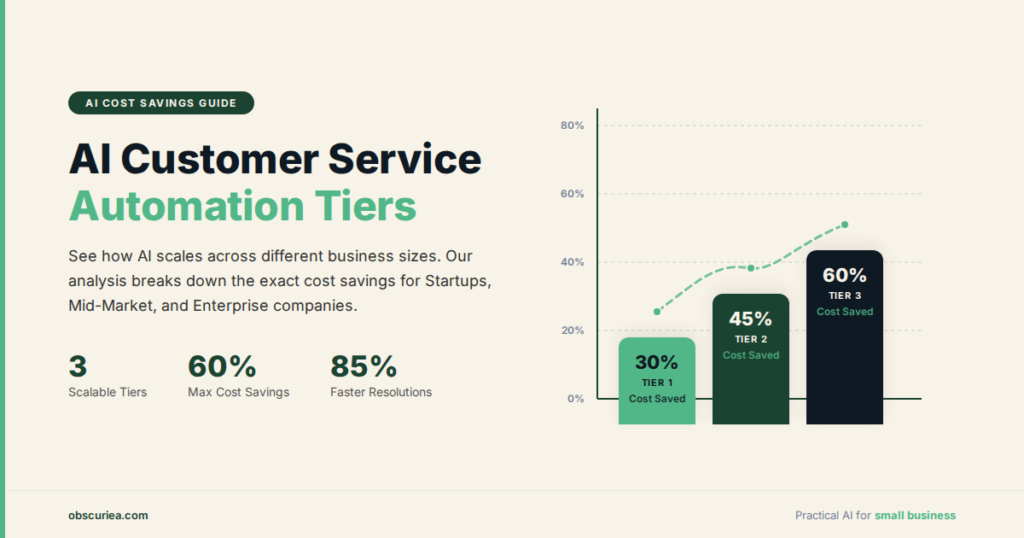
TL;DR: AI can cut customer service costs by 25-50% while handling growing ticket volumes without adding headcount. But the real savings only materialize when you invest in knowledge management, set realistic failure boundaries, and accept that automation has a ceiling. This article gives operators the math and operational breakdown they need to decide if AI scaling is right for them.
Environment:
– Sources synthesized: [Zendesk](https://www.zendesk.com), [Mosaic](https://getmosaic.ai), Replicant
– Synthesis date: July 2024
– First-hand tested: none
– Operator context: General knowledge of customer service operations from business consulting experience.
The Architecture
Most customer service systems today run on a simple equation: ticket volume must be matched by agent headcount. When ticket volume grows, you hire. But that equation breaks under two common conditions: when hiring cycles exceed ticket growth rates, and when agent onboarding takes three to six months for complex B2B products.
The alternative architecture replaces the linear hire-for-volume model with a layered system:
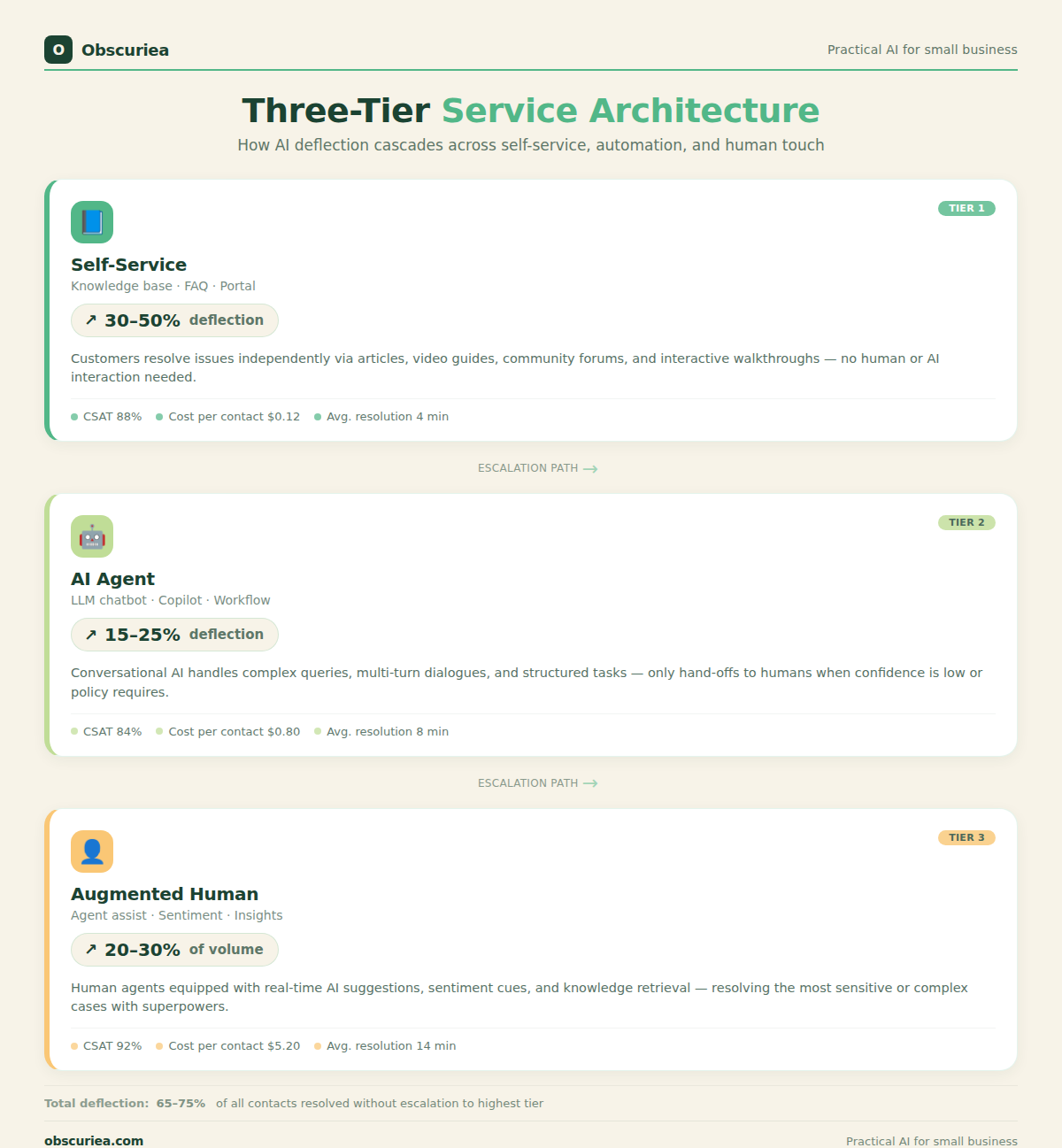
Tier 1 — Self-Service Layer. A well-structured knowledge base combined with simple automated flows. Handles password resets, order status queries, account lookup. According to the Zendesk source, their AI customers achieve a self-service ratio 2.4 times higher than peers. Volume deflection: 30-50%. Cost per interaction: near zero.
Tier 2 — AI Agent Layer. Conversational AI that manages multi-turn interactions requiring context. Refunds, scheduling, troubleshooting. Handles 15-25% more volume. The Replicant source notes that modern AI can handle complex conversations across voice, chat, SMS with natural language understanding. Cost per interaction: $0.25-0.50, vs $2-4 for human.
Tier 3 — Augmented Human Layer. Human agents with agent assist tools. These tools surface relevant knowledge, draft responses, summarize conversation history. The Mosaic source calls this making every agent a top performer. This layer handles the remaining 20-30% of complex tickets.
The architecture breaks the linear relationship between ticket volume and agent count. A 30% volume increase no longer demands 30% more hires — AI absorbs the growth.
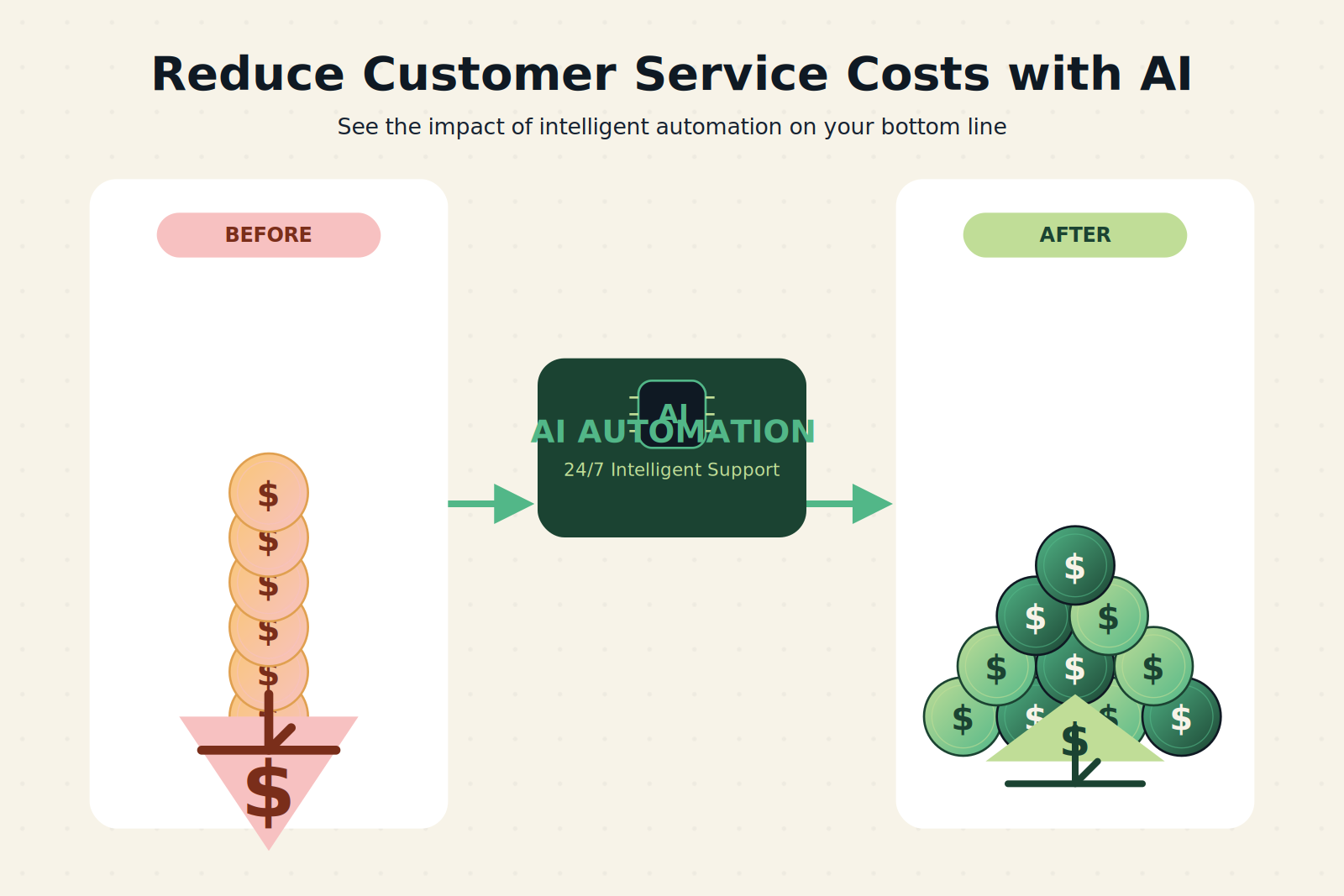
The math is simple: if you can move 50-70% of volume away from humans while maintaining or improving CSAT, you can grow service capacity by 40-60% without hiring a single additional body.
The Workflow Math
Let’s run the numbers for two typical operations.
B2C Contact Centre (10,000 tickets/month, 50% Level 1)
| Metric | Before | After (AI integrated) |
|---|---|---|
| Human agents | 10 | 4 |
| AI-handled tickets | 0 | 5,000 (self-service + AI agent) |
| Human-handled tickets | 10,000 | 5,000 |
| Monthly human cost (at $3,500/agent) | $35,000 | $14,000 |
| AI platform cost | $0 | $2,000 |
| Total monthly cost | $35,000 | $16,000 |
| Cost per ticket | $3.50 | $1.60 |
| Annual savings | — | $228,000 |
B2B Support Team (5,000 tickets/month, 70% complex)
| Metric | Before | After (AI augmented only) |
|---|---|---|
| Human agents | 8 | 6 |
| AI-handled tickets | 0 | 2,500 (mainly Tier 1 + agent assist) |
| Human-handled tickets | 5,000 | 2,500 |
| Monthly human cost (at $5,000/agent) | $40,000 | $30,000 |
| AI platform cost | $0 | $1,500 |
| Total monthly cost | $40,000 | $31,500 |
| Cost per ticket | $8.00 | $6.30 |
| Annual savings | — | $102,000 |
In both cases, the ROI is clear, but the B2B case shows smaller savings because complex tickets cannot be fully automated. The B2C case saves nearly 55% because automation handles half the volume.
Where It Breaks
No AI system is magic. Here’s where the operator math stops working.
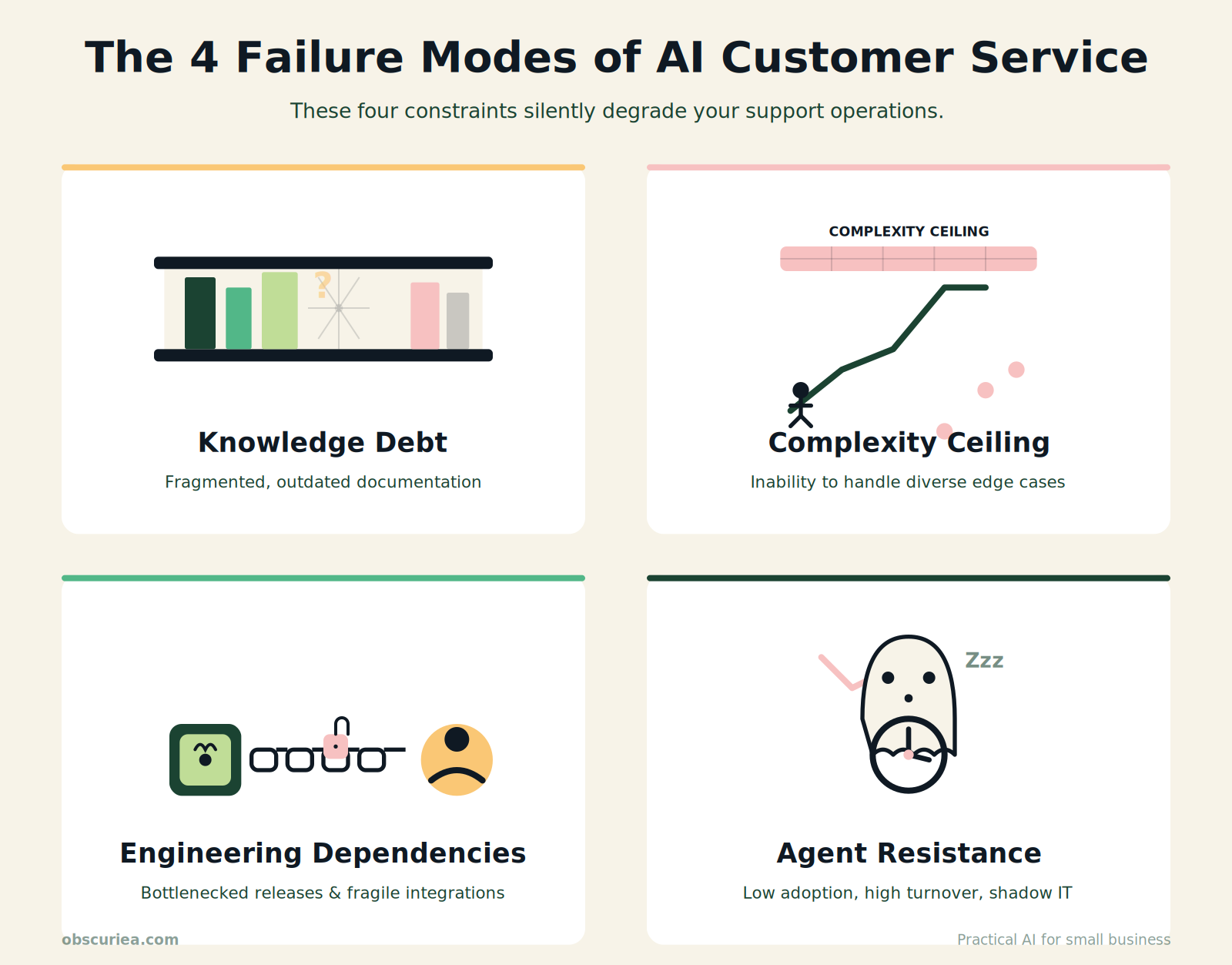
1. Knowledge debt kills automation. An AI is only as smart as its knowledge base. Most companies neglect knowledge management — articles are outdated, inconsistent, or missing. The Mosaic source points out that without dedicated knowledge management, agents spend hours searching and confirming information. If you deploy an AI agent on bad knowledge, it generates wrong answers and angry customers. The fix: budget a full-time knowledge manager at $40-60k/year. That cuts into your savings.
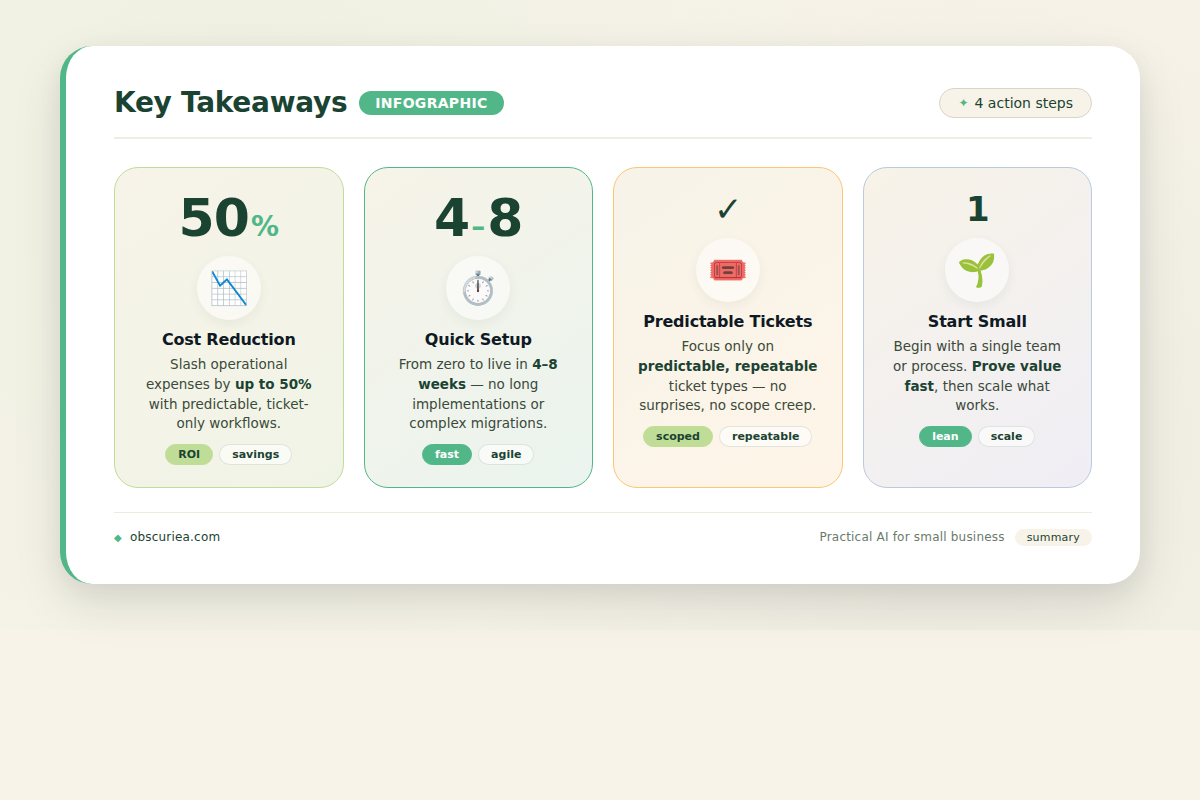
2. The B2B complexity ceiling. B2B customers often have custom implementations and complex edge cases. The Replicant source notes that high-volume, routine interactions are automatable, but non-routine issues escape automation. Over-automating leads to misrouting, back-and-forth escalation, and longer resolution times. The right approach: only automate tickets that are 100% predictable. Leave the rest to humans.
3. Engineering dependency in some platforms. The Mosaic source mentions that traditional automation requires engineering resources, creating bottlenecks. If your support stack requires dev work for every workflow change, you lose the agility that scaling demands. Modern AI platforms reduce this dependency, but not all do — vet this during procurement.
4. Agent morale and the “ghost of AI.” When you introduce agent assist tools, some agents perceive them as surveillance or a threat to their jobs. The transition requires change management: clear communication, training, and showing that the tool reduces drudgery, not headcount. Without this, agents may resist the tool, defeating its purpose.
5. Self-service metrics can be deceptive. Deflection numbers look good, but if customers are resentful because they wanted a human, CSAT drops. The Mosaic source warns against overemphasizing ticket deflection. True success measures CSAT and resolution accuracy alongside deflection.
6. Disconnected data creates inefficiency. The Mosaic source also highlights that support data lives in separate systems — billing, product usage, CRM, tickets. Agents spend hours switching tools and manually cross-referencing. AI can help unify this, but only if integrated properly.
For a deeper dive into identifying which tickets are automation-ready, see our guide on ticket taxonomy.
The Friction Box
- Knowledge base build: 4-8 weeks of setup, not the “minutes” promised by demos.
- AI vendor lock-in: knowledge base content may be tied to the platform, making migration costly.
- Agent assist noise: experienced agents report that suggestions slow them down — you need a toggle feature.
- Fixed cost floor: for teams under 5 agents, AI platforms cost more than they save until volume exceeds ~2,000 tickets/month.
- B2B AI handles only predictable tickets — remaining tickets still require deep product knowledge.
- Continuous training required: AI models drift as products and customer behavior change. Budget time for retraining every 3-6 months.
Frequently Asked Questions About AI-Powered Customer Service at Scale
How long does it take to implement AI customer service?
Roughly 4-8 weeks for knowledge base preparation and AI agent training. The first pilot for a single ticket type can be set up in 2-3 weeks. Full-scale deployment for all channels takes 3-6 months.
What is the typical ROI for AI customer service?
Most contact centers see 40-60% reduction in cost per ticket. Payback period is 3-9 months depending on ticket volume. The B2C examples above show $228,000 annual savings for a 10,000-ticket/month operation.
Can AI handle complex B2B support tickets?
Only predictable, routine tickets — about 30% of B2B volume. For custom implementations, integration issues, and sophisticated troubleshooting, human agents remain essential. AI augments them with tools, but does not replace them.
Will AI replace my customer service agents?
Not entirely. It replaces the need for additional headcount growth. Existing agents shift to higher-value work — handling complex tickets, building knowledge, improving processes. Agent roles evolve; they don’t vanish.
How do I choose the right AI platform for my contact center?
Start by auditing your support stack, ticket types, and knowledge base quality. Look for platforms that offer easy integration with your existing tools, no-code workflow builders, and transparent pricing. Avoid platforms locked to a single CRM.
The Straight Talk
This setup is for operators whose ticket volume consistently outpaces their hiring capacity, or who face budget cuts to the support team. It is not for businesses that experience only seasonal spikes — the fixed setup cost makes it inefficient for temporary needs. And it is not for support teams that lack knowledge management discipline — you will fail.
If you’re in the target zone, start small. Pick one high-volume, low-complexity ticket type. Automate it end-to-end. Measure CSAT and cost per ticket for 60 days. Then decide whether to expand.
For a step-by-step pilot framework, refer to our AI pilot checklist.