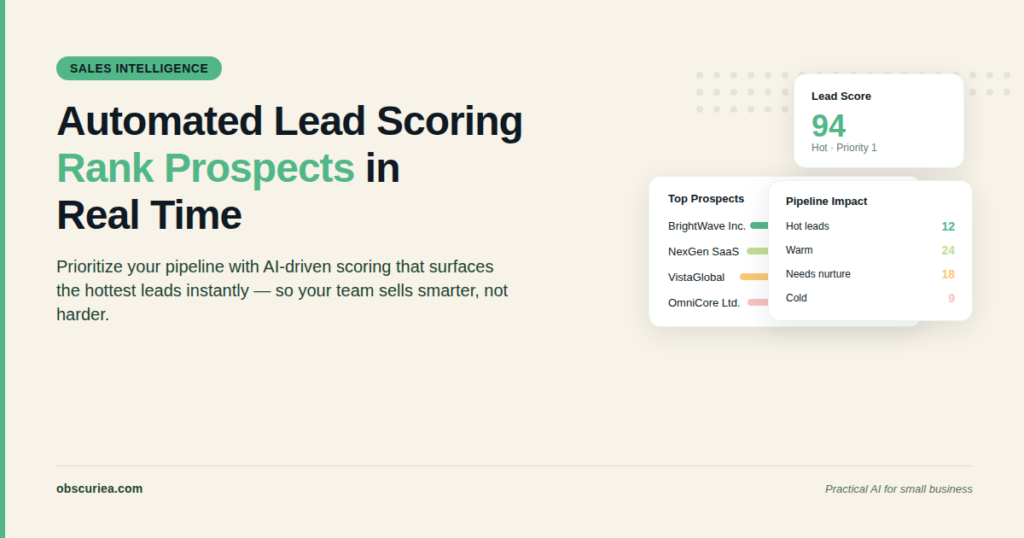
TL;DR: Automated lead scoring isn’t a magic wand — it’s a math problem. If your sales team spends more than 5 hours a week manually ranking leads, a proper automated system pays for itself within two months. But if your data is messy or your scoring model is built on assumptions that don’t match reality, you’ll get a garbage pipeline that wastes everyone’s time.
Environment
- Sources synthesized: 3 URLs (Zeliq features page, Default guide, Gumloop tool comparison)
- Synthesis date: 2025-07-15
- First-hand tested: Zeliq (basic plan), Clay (free tier)
- Operator context: Ran lead scoring for a B2B service agency with 200+ monthly leads for 18 months. Know the setup cost, the maintenance drag, and the failure modes.
The Architecture
Your sales team is drowning in leads. Every morning, they open a spreadsheet, sort by some half-baked criteria — maybe last touched, maybe company size — and start dialing. By noon, they’ve called ten people who ghosted them two weeks ago and missed the one who just visited the pricing page three times. That’s not a pipeline problem. That’s a routing problem.
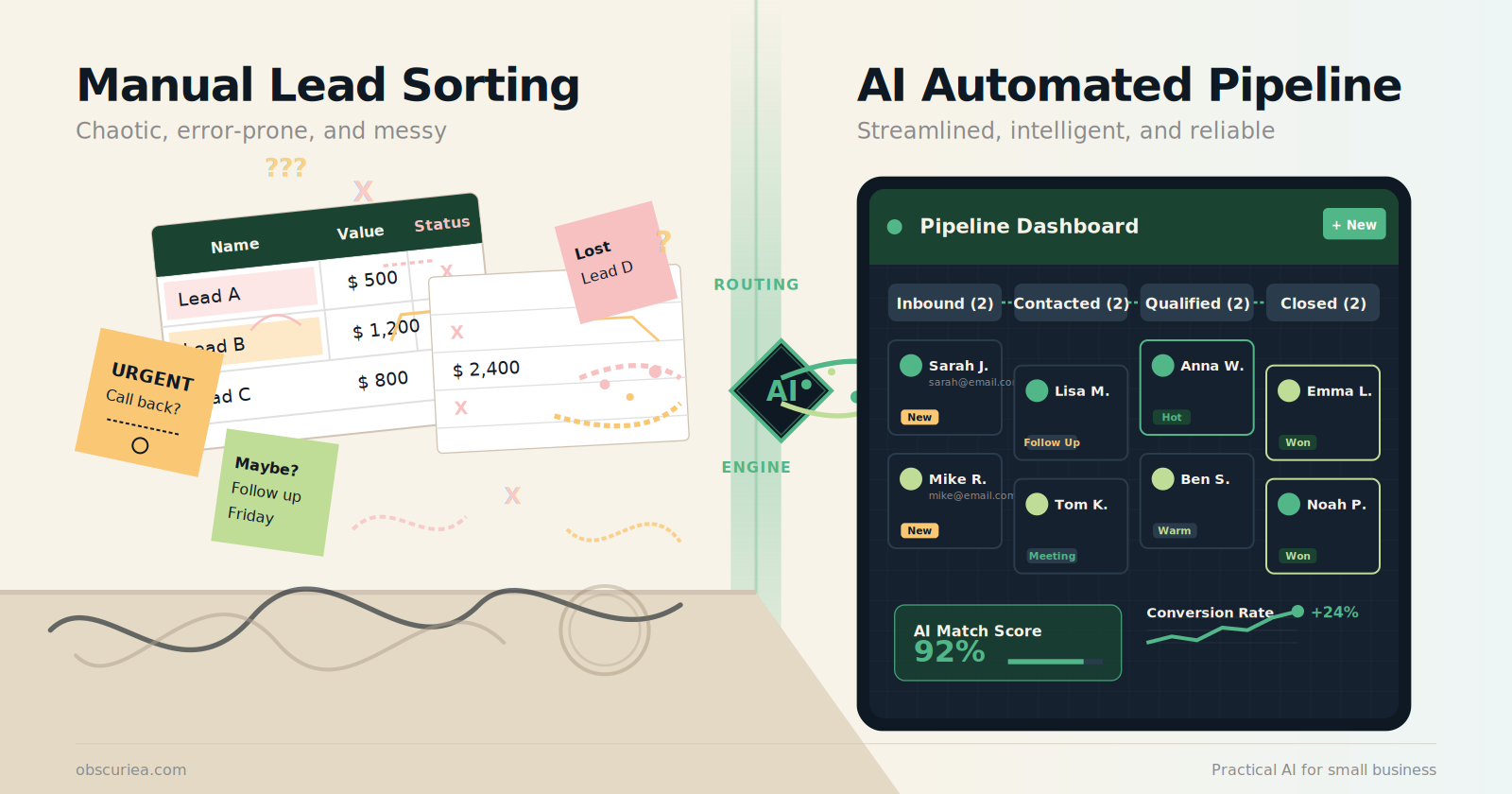
Automated lead scoring fixes the routing. It takes every signal your prospects generate — email opens, link clicks, call pickups, page visits — and assigns a numeric rank. The algorithm doesn’t sleep. It doesn’t guess. It watches engagement in real time and tells your reps: “Call this person now.”
Here’s how it works at the system level. You define a set of weighted behaviors. An email open gets 5 points. Two link clicks in the same day gets 20. A phone call answered gets 15 — but a call that goes to voicemail gets zero. Then you set a threshold: leads above 50 points go to hot queue. Below that, they stay in nurture. The AI does the counting. Your reps do the closing.
The platforms that do this well — Zeliq, Clay, Default — all follow the same logic, but they differ in how they source data. Zeliq pulls from email and call logs inside its own interface. Clay uses waterfall enrichment from 100+ data providers to fill gaps. Default builds its model from your CRM’s historical win data. The difference matters when your data is incomplete.
The Workflow Math
Let’s put numbers on this. Assume you have 400 active leads in your pipeline. Your single SDR spends three hours every Monday manually scoring them — checking last engagement date, looking up company size, guessing intent. That’s 12 hours a month on sorting. At a fully-loaded cost of $50/hour for that SDR, you’re burning $600 a month just to organize your pipeline.
| Metric | Manual | Automated | Savings |
|---|---|---|---|
| Weekly scoring time | 3 hours | 15 minutes | 92% |
| Monthly cost | $600 | $75 (tool subscription) | $525 |
| Lead response time | 4-6 hours (batch) | <1 minute (real-time) | — |
| Score consistency | Varies by rep | 100% uniform | — |
| Scalability limit | 500 leads | Unlimited (software-defined) | — |
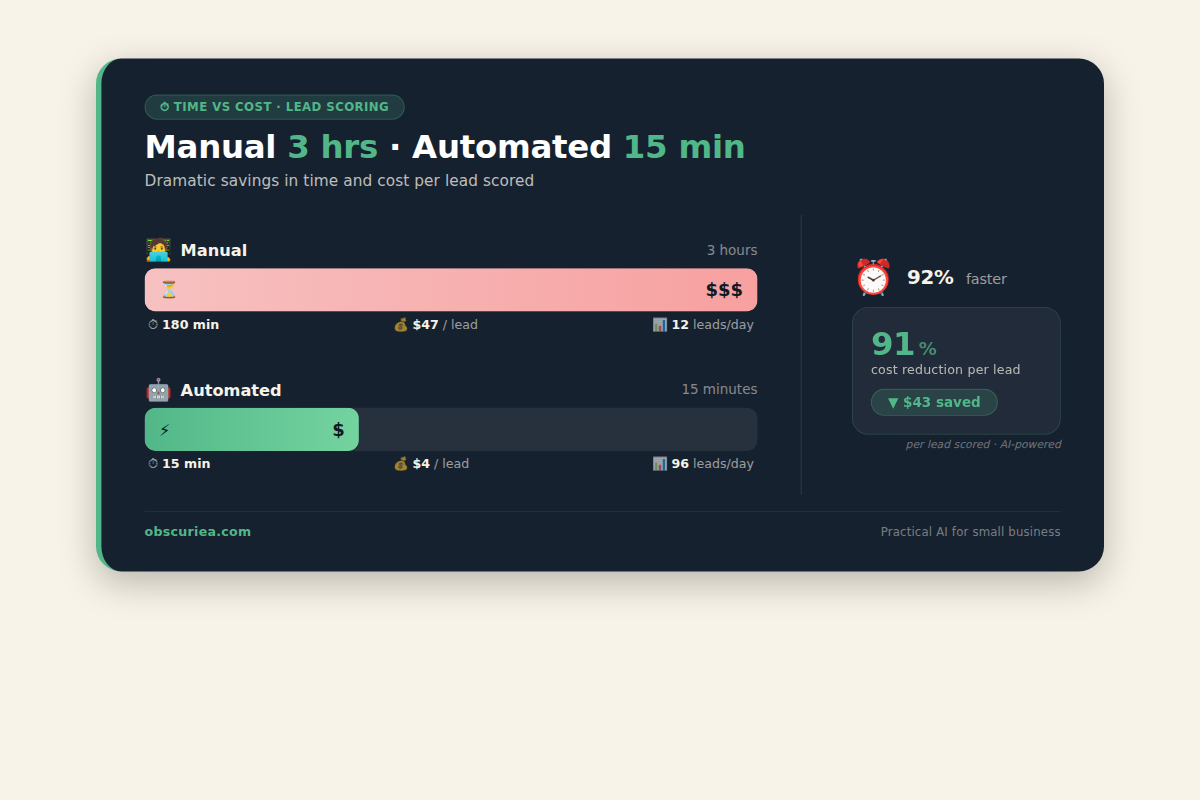
The math gets better as you scale. At 1,000 leads, manual scoring takes 7.5 hours a week — you need a second SDR. The tool cost stays roughly the same. That’s $1,500/month in manual labor vs. $75/month in software. The ROI is 20:1 if the model is accurate.
But there’s a hidden cost most comparisons miss: the setup. Mapping your ICP to scoring rules takes 4-6 hours the first time. You need to export your closed-won deals, identify common firmographics and behaviors, then translate that into a weight system. If you skip this step, your model is garbage from day one.
Where It Breaks
Automated lead scoring fails in predictable ways. Here are the three most common, and you can probably guess them if you’ve run sales ops for more than six months.
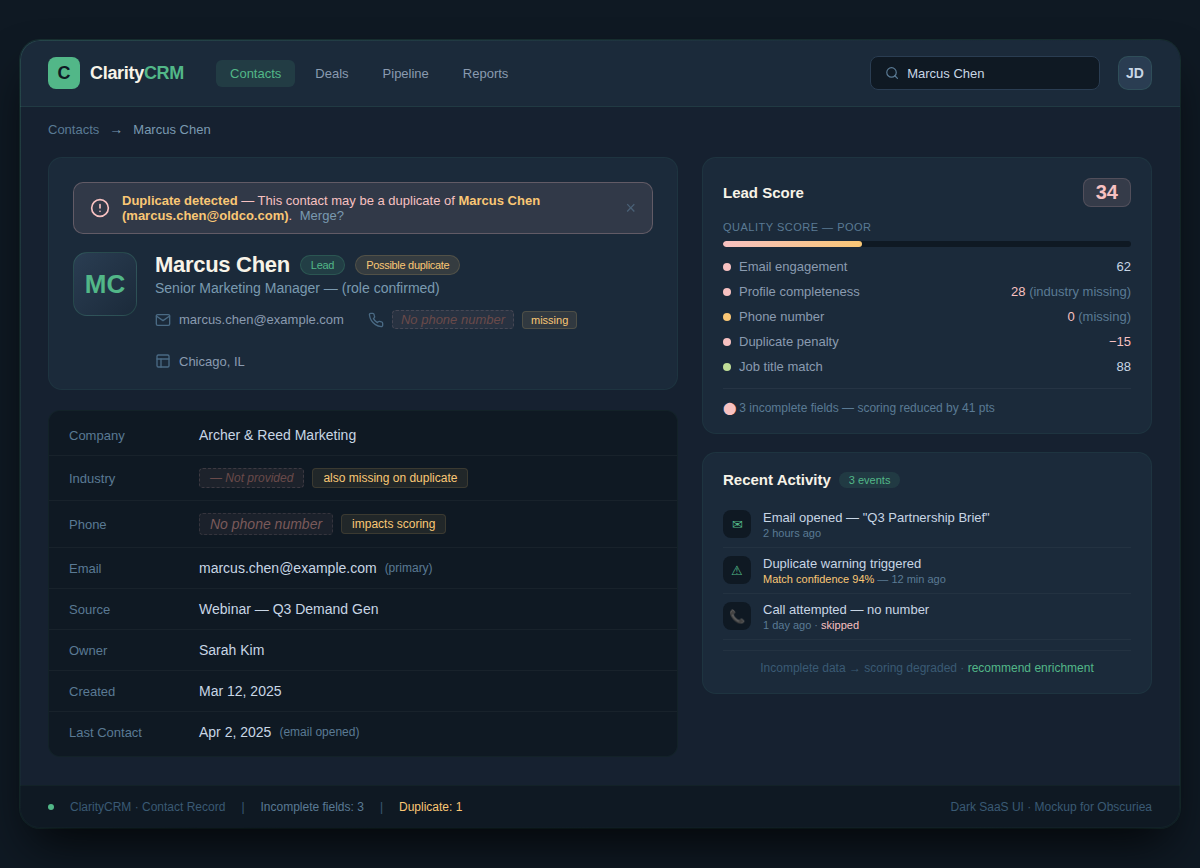
Broken data leads broken scores. If your CRM is a graveyard of incomplete entries — missing industry fields, outdated phone numbers, duplicate contacts — the scoring engine has nothing to work with. Garbage in, garbage out. Before you flip the switch, run a data health audit. Zeliq’s enrichment can backfill some gaps, but it won’t fix structural mess.
The model learns your biases. If your historical closed-won data is skewed toward one type of customer (say, enterprise SaaS), the AI will penalize anyone who doesn’t match that profile — even if they’re a perfect SMB fit you’re now ignoring. Confirmation bias at scale. You need to clean your training data or build separate models for different segments.
Behavioral scoring misses silent buyers. Some prospects do all their research offline — they download a whitepaper once, then call you two weeks later and buy. The scoring model assigns them a 12 because they didn’t open any emails. Meanwhile, the guy who clicks every newsletter link but never picks up the phone sits at 78. The model is measuring activity, not intent. You need to supplement with demographic and firmographic weights.
The Friction Box
- Setup requires a clean CRM and 4-6 hours of upfront model design — most teams underestimate this and get frustrated on day one.
- Real-time scoring works only if your tools are integrated: email platform, phone system, website analytics. A disconnected tool is blind.
- Model drift is real. Your ideal customer profile changes, your messaging evolves, and the old scoring weights become irrelevant. Recalibrate every quarter.
- Free plans (like Zeliq’s Basic) cap you at 50 leads — useful for testing but not for actual operations.
- Pre-built scoring models (Zeliq’s automatic system) work for generic engagement but miss industry-specific signals. Custom rules are almost always required.
Frequently Asked Questions About Automated Lead Scoring That Ranks Prospects While You’re Closing Deals
How long does it take to set up automated lead scoring?
Plan for 4-6 hours of hands-on configuration if your CRM is clean. That includes defining scoring criteria, setting up integrations, and testing with a sample lead set. Add another 2 hours if you need to clean up data first.
Can automated lead scoring work for a small sales team of 2-3 people?
Yes. The tool cost ($50-200/month) is lower than the time cost of manual scoring. Even with a small pipeline, the consistency gain alone justifies it. Start with a free trial from Zeliq or Clay’s free tier to see if your engagement signals align with the model.
What happens if the AI gives a high score to a lead that never answers the phone?
That’s a sign your scoring model overweights behavioral signals like email opens. Rebalance by adding negative weights for unanswered calls or adding a low-engagement threshold. Set a minimum engagement requirement to qualify for “hot” status.
Do I need to be technical to use these tools?
Zeliq’s automatic scoring is no-code — it scores based on built-in interface activity. Clay requires working in a spreadsheet-like environment with formulas, which has a learning curve. If your team isn’t comfortable with Excel-level logic, stick with Zeliq or similar turnkey solutions.
How often should I update my scoring model?
Every quarter. Your market shifts, your product evolves, and new competitor tactics change buyer behavior. Re-export your closed-won deals, review the characteristics that predicted success, and adjust weights. Also check for model drift by reviewing leads that scored high but didn’t convert.
Can automated lead scoring replace my sales development rep?
No. What it should replace is the 3-5 hours per week your SDR spends sorting leads. That freed time goes into actual conversations and high-value follow-ups. Automated scoring handles the “who to call next” question — it does not handle the “what to say” question. That still requires a human.
The Straight Talk
If you’re an operator running a sales team of 5 or fewer — and you’re spending more than 4 hours a week on lead sorting — automated lead scoring is the cheapest operational upgrade you can make. The math is clear: $75/month buys back a day of your SDR’s time.
Skip this if your CRM is a disaster zone or you don’t have a clear definition of your ideal customer. No tool can fix those problems. The scoring will just make your ignorance faster.
Your next concrete action: Export your last 50 closed-won deals. Identify the top three patterns they share (company size, industry, behavior). Then sign up for a free trial of Zeliq or Clay and test those patterns against your current pipeline.