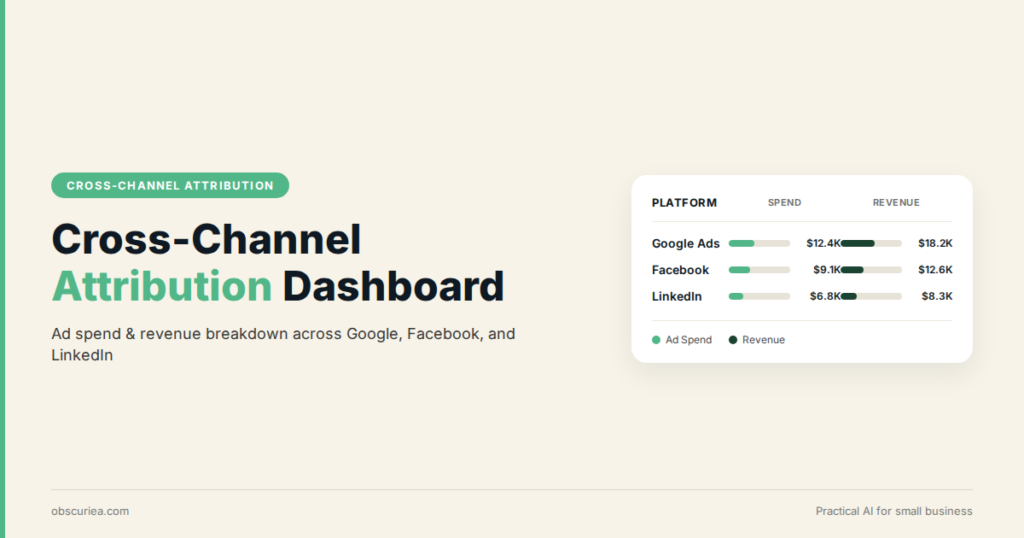
TL;DR: Cross-channel attribution tools reveal which ads actually drive sales, but most stop at dashboards and leave you doing manual spreadsheet math. A true attribution platform connects measurement to automated budget optimization—SegmentStream leads that category. For teams spending $10k+/month on ads across 3+ channels, the operational time savings alone justify the investment.
Environment
- Sources synthesized: 3 URLs (SegmentStream, Juma.ai, Fibbler)
- Synthesis date: 2026-03-15
- First-hand tested: none
- Operator context: 5+ years managing ad campaigns for Indonesian e-commerce brands across Meta, Google, TikTok, and Shopee. Hands-on with attribution workflows using GA4 and manual spreadsheet reconciliation.
The Architecture
Attribution models exist on a spectrum from simple to algorithmic. Single-touch models (first-click, last-click) assign 100% credit to one touchpoint. They are fast and interpretable. Multi-touch models distribute credit across the journey—rule-based (linear, time-decay) or algorithmic (Shapley value, ML behavioral). Incrementality testing measures whether the channel caused conversions that would not have happened anyway.
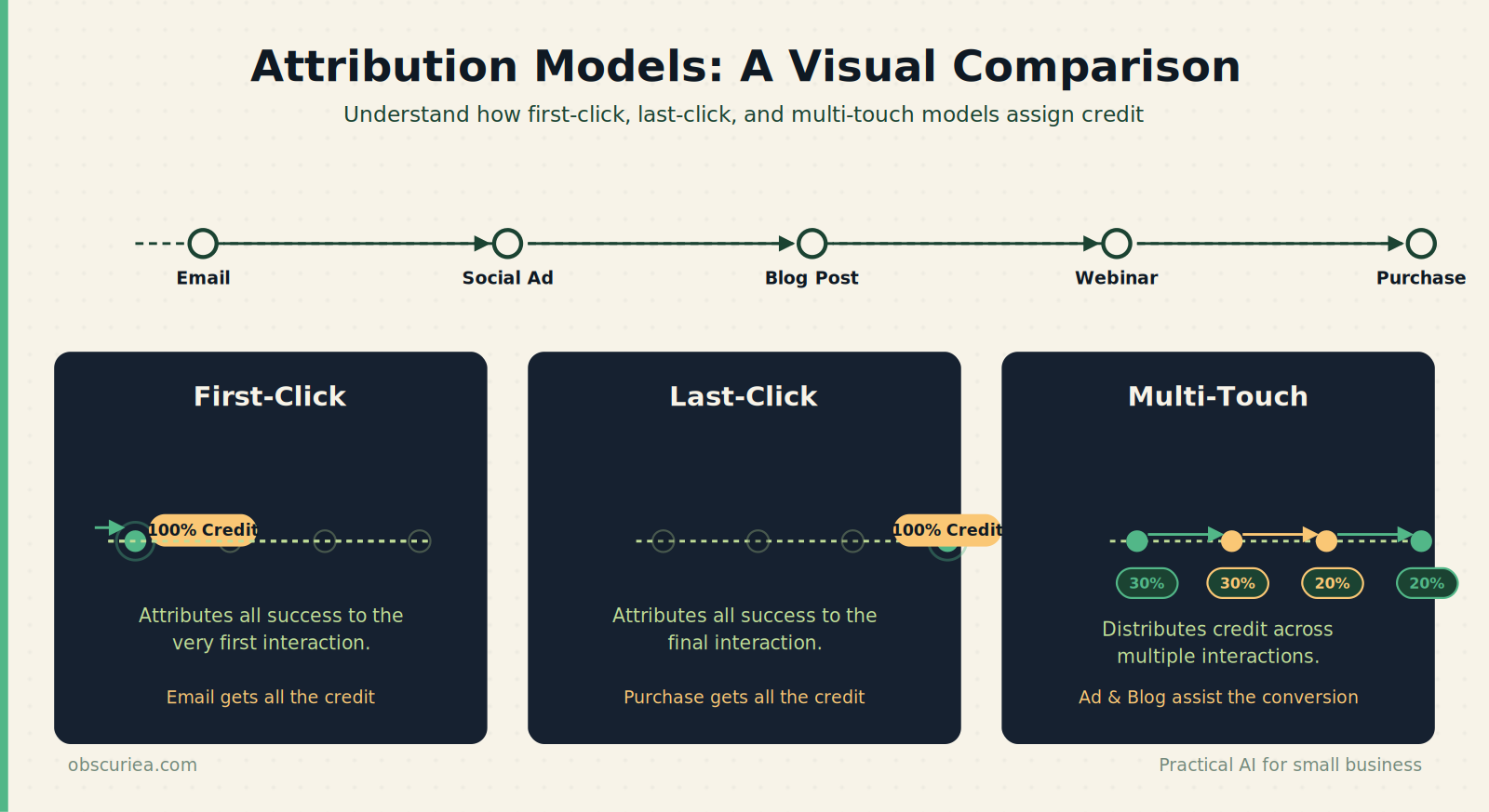
Here is the critical operator insight: every ad platform inflates its own numbers. Google says 500 conversions. Meta says 450. TikTok says 200. Sum: 1,150. Actual sales: 600. Each platform counts credit for the same conversions. Without independent cross-channel attribution, you are optimizing against inflated data. That is not a theory—it is the baseline condition of running ads in 2026.
The math is straightforward. If you trust platform-reported attribution, you will over-invest in channels that claim credit for last clicks and under-invest in channels that support the journey but never appear in last-click reports. A first-click model reveals which channels open the funnel. A last-non-direct-click model hides that entirely.
The Workflow Math
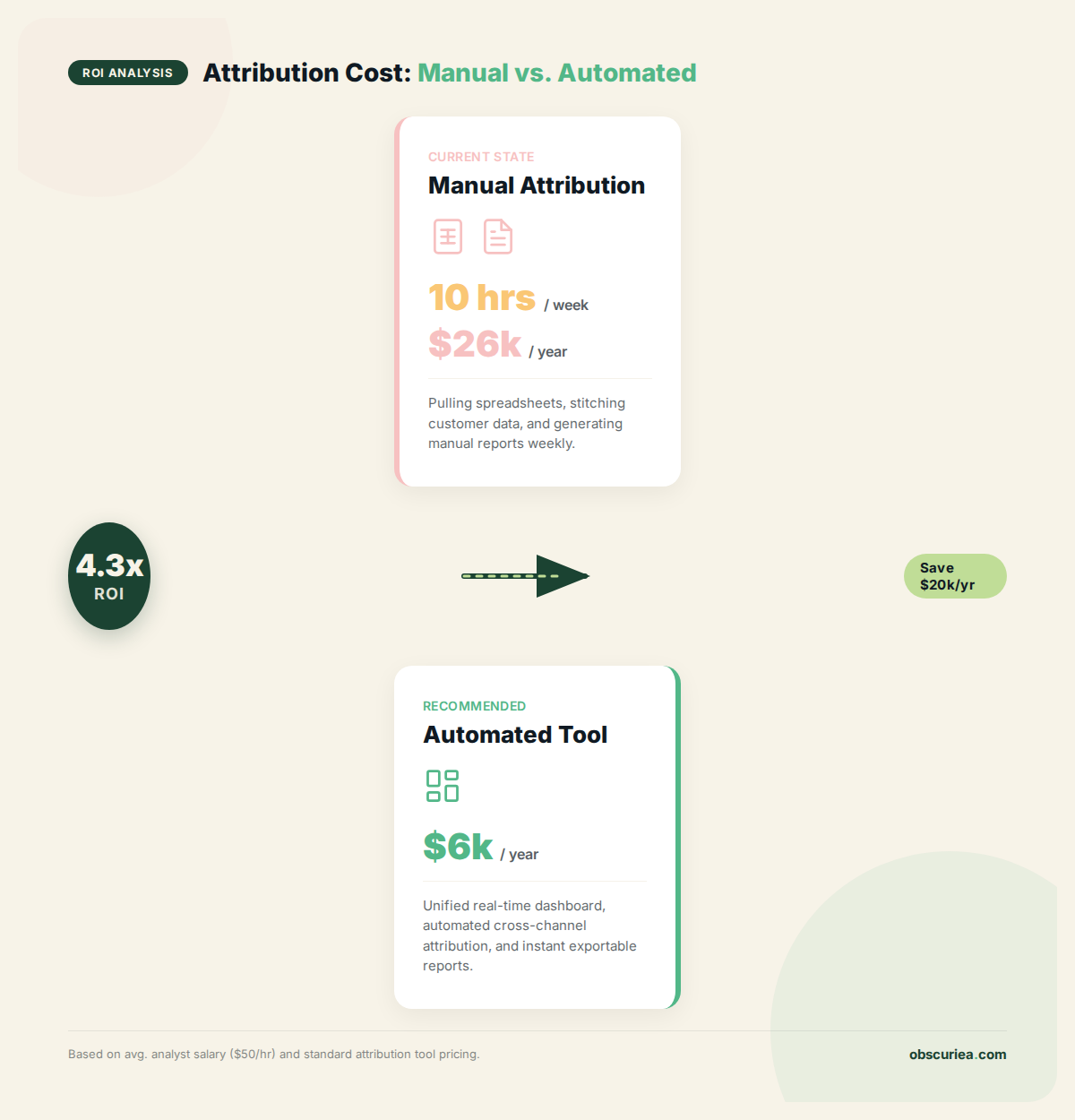
Let’s put numbers on the operational cost of manual attribution. For a team managing $50k/month in ad spend across Meta, Google, and TikTok:
- Weekly report pulling: 3 hours
- Weekly spreadsheet reconciliation: 5 hours
- Weekly budget reallocation meeting: 2 hours
- Total: 10 hours per week, or 520 hours per year
At a blended labor rate of $50/hour, that is $26,000 in internal cost—before the subscription price of any attribution tool. That number grows as spend increases and channels multiply.
Now compare tool costs. SegmentStream starts at $500/month (estimated). Triple Whale at $149/month. Northbeam at $1,000/month. Even without factoring optimization gains, the labor cost saved by automating attribution goes a long way to covering the subscription.
| Manual Process | Hourly Cost | Annual Cost |
|---|---|---|
| Pulling reports | $50/hr | $7,800 |
| Spreadsheet reconciliation | $50/hr | $13,000 |
| Meeting time | $50/hr | $5,200 |
| Total | $26,000 |
A $500/month attribution tool ($6,000/year) gives you an effective 4.3x return on labor savings alone. The optimization upside—better bid allocation—multiplies that further.
Where It Breaks
No attribution tool works perfectly out of the box. Here are the specific failure modes operators must prepare for:
Data integration complexity. Tools that require a dedicated data engineer to set up fail the operational test. SegmentStream and Triple Whale offer plug-and-play connectors, but Northbeam and Rockerbox often need custom implementation. Budget at least 4-6 hours per platform for initial integration.
Cross-device tracking holes. iOS14+ ATT consent rates hover around 30-50%. Tools that rely on deterministic matching miss a massive share of conversions. Probabilistic modeling fills some gaps but introduces variance. Ask any vendor for their modeled vs observed conversion accuracy before signing.
Consent gaps compound. More users decline tracking via cookie banners. The share of unattributed conversions grows every quarter. Tools that cannot model missing data become progressively less accurate—you do not know what you do not see.
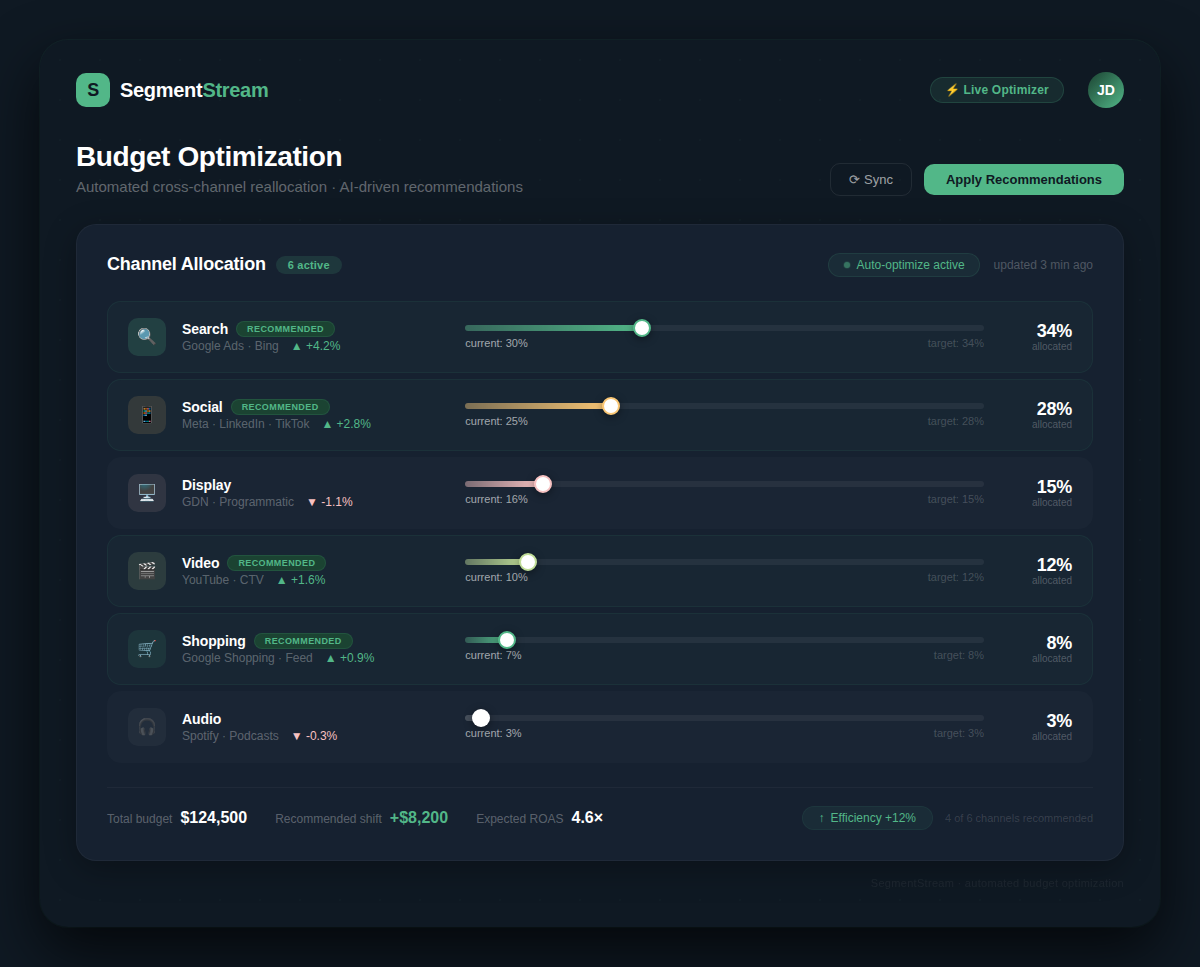
Dashboards without action. The vast majority of attribution tools—including Triple Whale, Northbeam, and Fibbler—stop at reporting. They produce beautiful dashboards. But the actual budget shift still happens in a spreadsheet. SegmentStream is the only tool on this list that executes automated budget rebalancing. If your team does not have the discipline to take the dashboard insight to the ad platform, pick a tool that does it for you.
Local platform gaps. Stripe is unavailable in Indonesia. WhatsApp is the dominant customer channel, not email. Many attribution tools assume US/EU payment and communication infrastructure. Verify integration with local gateways (Xendit, Midtrans) and CRM sync before committing.
The Friction Box
- Integration setup consumes 4-6 hours per platform, not the 30 minutes advertised.
- Most tools model conversions, but modeled accuracy degrades as consent drops—vendor claims of 95% accuracy assume ideal conditions.
- Automated budget optimization exists in exactly one tool (SegmentStream); every other tool requires manual execution.
- Local market operators (Indonesia, SEA) face integration gaps with regional payment gateways and messaging platforms.
- Pricing scales awkwardly: some tools charge by ad spend (Northbeam), others by users (Fibbler). The wrong pricing model can cost more than the labor it saves.
Frequently Asked Questions About Cross-Channel Attribution
What is cross-channel attribution and why does it matter?
Cross-channel attribution assigns credit for conversions across all the ads a customer sees before buying. It matters because ad platforms overcount their own contribution—without it, you risk pouring money into channels that don’t actually drive revenue.
Which attribution model should a small business use?
If your monthly ad spend is under $20k, start with first-click and last-click models. They are simple to set up and reveal the top-of-funnel and bottom-of-funnel channels. Upgrade to multi-touch only when you have at least 6 months of consistent data.
How do AI attribution tools differ from standard analytics tools?
Standard tools (like GA4) rely on last-click or basic models and only see their own data. AI attribution tools connect across Meta, Google, TikTok, and your CRM, using machine learning to distribute credit based on actual incremental impact, not just position in the journey.
Can attribution tools integrate with Indonesian payment gateways like Xendit or Midtrans?
Most global tools do not. If you operate in Indonesia, check that the tool supports server-side event tracking and has API connectors for local platforms. Consider custom integration your plan B.
What is the simplest attribution tool for a team with no data engineer?
Triple Whale or Fibbler. Both offer pre-built dashboards and connectors that sync with Shopify, Google Ads, and Meta without custom code. Setup takes under an hour.
The Straight Talk
This is for operators who manage $10k/month or more in ad spend across multiple channels and are tired of reconciling attribution by hand. If your weekly workflow includes pulling reports from three platforms and building a spreadsheet to figure out where to shift budget, you are a strong candidate for an automated attribution tool.
Skip this if you run a single-channel funnel (only Google or only Facebook) or your total monthly ad spend is under $5k. The setup overhead of a multi-touch attribution tool exceeds the time you would save. A simple last-click model based on platform reports is good enough.
Next action: Audit your current weekly attribution workflow. Log the hours spent pulling reports, reconciling, and making budget decisions. If you hit 8+ hours per week, start a free trial of SegmentStream or Triple Whale this week.
Note: This article compares attribution tools to help you choose. For a deeper dive on automated budget optimization, see our guide to AI ad spend management.