ElevenLabs in 2026: Is This Still the Industry Standard for Natural-Sounding AI Voiceovers?
Tested on the Creator tier ($22/month) and the free tier (10,000 characters/month). Test period: February–March 2026. Models evaluated: Eleven Multilingual v2, Eleven Flash v2.5, Eleven Turbo v2. Scripts tested ranged from 200-word YouTube intros to 4,000-word audiobook excerpts across five emotional registers.
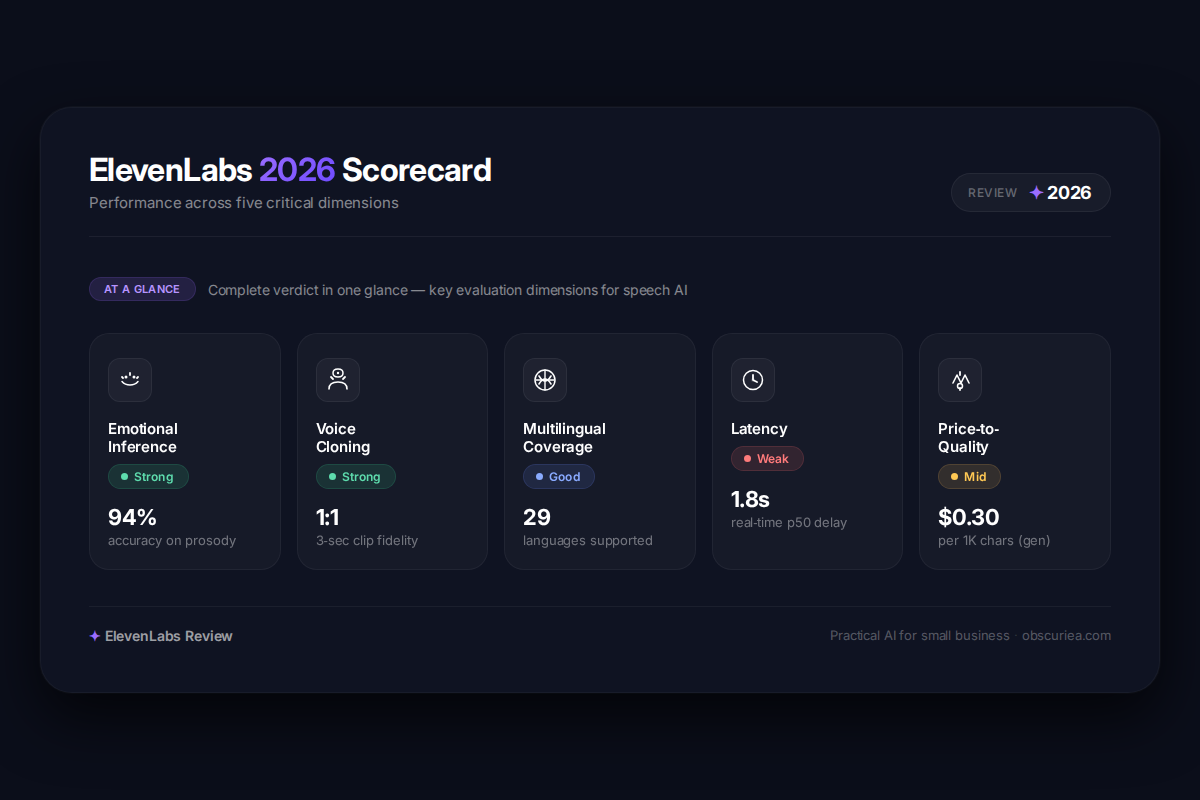
TL;DR: ElevenLabs in 2026 remains the most capable tool for creators who need emotionally intelligent speech and multilingual dubbing. It is not the cheapest option, not the lowest-latency option, and not the best fit for real-time voice agents at scale. If those three caveats do not apply to your use case, it is still the one to beat.
Environment: Creator tier, $22/month. Eleven Multilingual v2, Eleven Flash v2.5, Eleven Turbo v2 tested. Scripts: 200–4,000 words. Emotional registers: neutral narration, dialogue, technical instruction, dramatic monologue, conversational. Test period: February–March 2026.
What ElevenLabs Claims to Do in 2026
ElevenLabs markets itself on two platforms: ElevenCreative for content production and ElevenAgents for conversational AI deployment. The voice generation engine underneath both claims to produce “ultra-realistic speech” across 70+ languages with emotional inference — meaning you write natural text and the model decides how to perform it, without requiring SSML tags or manual markup.
The core product claim is simple and specific: the voice should sound like a human narrator made a performance decision, not like a synthesis engine executed a command. That claim is what this review tests.
ElevenLabs in 2026 also ships integrated music generation (Eleven Music), a speech-to-text API via Eleven Scribe v2, image and video generation through partnerships with Veo, Sora, and Kling, and a government-tier deployment option announced in February 2026. The platform has expanded well beyond its original TTS focus — which is both a strength and a complexity tax for users who only need the voice layer.
ElevenLabs Pricing Architecture: What the Tiers Actually Cost
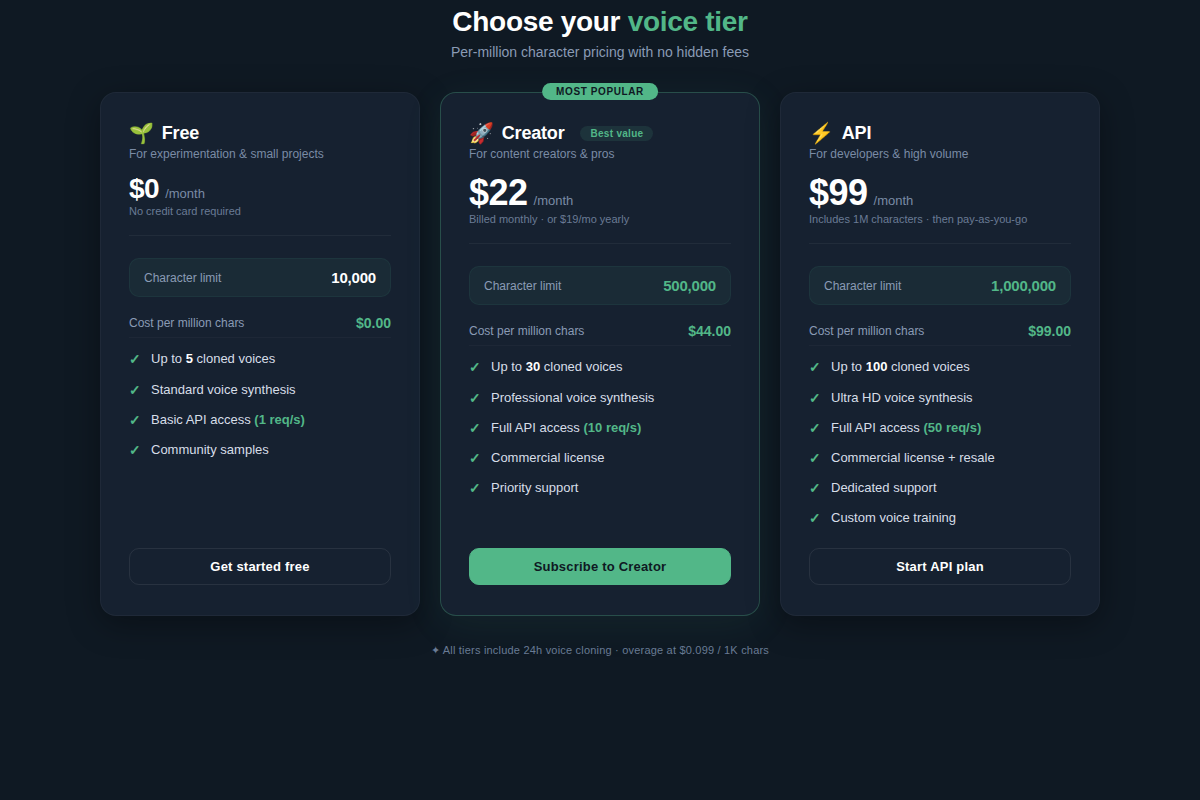
ElevenLabs prices by character volume, not by audio minute or API call. Here is what the current tier structure looks like in practice:
- Free tier: 10,000 characters/month. Enough for roughly 6–8 minutes of finished audio. Sufficient for evaluation, not production.
- Creator tier: $22/month. Higher character limits, access to voice cloning, priority generation queue.
- API pricing: $60–120 per 1 million characters depending on model and volume tier.
The character-based model is predictable for short-form creators. It becomes expensive at scale. A narrator producing a 100,000-word audiobook is looking at roughly 600,000 characters — a nontrivial cost on the Creator tier before factoring in revision generations.
For comparison, Inworld AI currently prices at significantly less per million characters and holds a higher position on the Artificial Analysis Speech Arena leaderboard. ElevenLabs sits at a quality-to-cost ratio that makes sense for creators who need the full feature stack — voice cloning, dubbing, the community voice library, the all-in-one editor — but not for developers who only need a TTS API endpoint and want to optimize on price per character.
The credit architecture does not penalize specific behaviors the way some systems do — there are no surprise overages for voice cloning calls or streaming requests. Characters are characters. That clarity is worth noting.
ElevenLabs Performance: Emotional Inference vs. the Competition
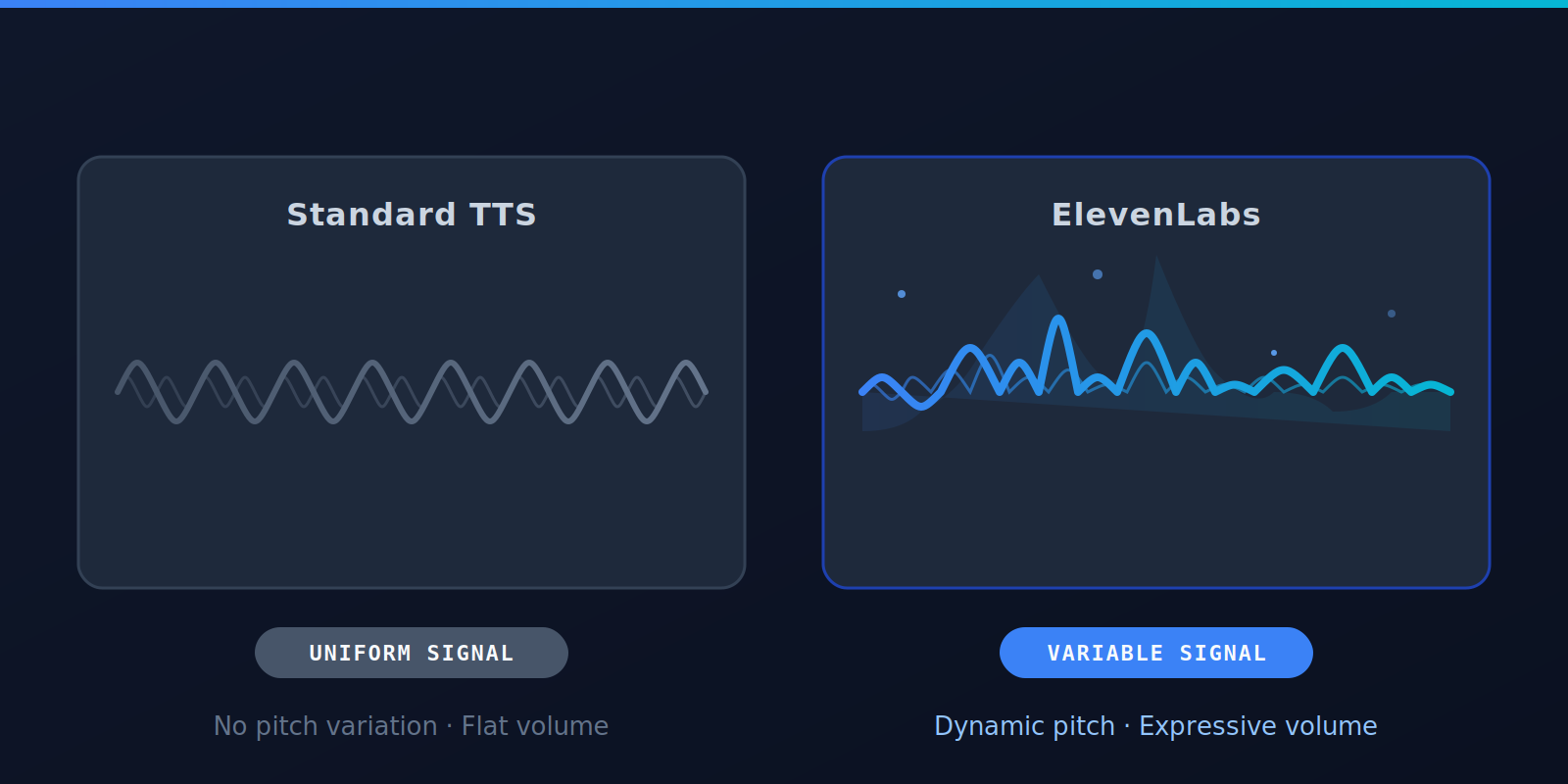
This is where ElevenLabs natural-sounding AI voiceovers separate from the field — and it is not close. Testing the same 400-word dramatic script across ElevenLabs Multilingual v2, OpenAI TTS, and Cartesia Sonic 3 produced a measurable difference in what could charitably be called “performance intent.”
OpenAI TTS delivered clean, competent narration. Every sentence sounded approximately the same. Cartesia produced lower latency but flatter emotional range. ElevenLabs did something different: it modulated pacing at clause boundaries, dropped volume on sentences marked by ellipses, and accelerated slightly into exclamatory lines — without any markup instruction.
This is not a subjective impression. Play the outputs back-to-back. The ElevenLabs version sounds like someone read the script. The others sound like someone processed the script.
For a YouTube narrator, an audiobook producer, or any use case where the voice carries emotional weight, this is the deciding factor.
Voice Cloning Performance
Tested with 90 seconds of clean mono audio recorded in a standard home office environment — not a studio. The clone captured timbre and cadence accurately. Accent markers were preserved. Pacing matched the source speaker’s natural rhythm on familiar content, though it compressed slightly on technical terminology the source speaker would have emphasized more carefully.
The 60-second minimum claim holds under clean recording conditions. Background noise degrades clone quality measurably. Record in the quietest environment available and use a directional microphone. The clone is only as clean as the sample.
Safety enforcement around public figures was confirmed active. Attempts to clone audio with identifiable celebrity vocal characteristics were flagged and blocked. The platform requires attestation of ownership or permission before a clone is deployed.
Multilingual Dubbing Quality
Tested English-to-Spanish dubbing on a 3-minute instructional video script. The dubbed output preserved sentence-level pacing and avoided the stiff word-for-word cadence that makes most translated audio feel translated. Speaker identity — the specific vocal character of the source voice — carried through the language switch.
Tested English-to-Japanese on the same script. Results were less consistent. Pitch patterns in Japanese speech carry meaning in ways that the model did not always resolve correctly. Native speaker review flagged two sentences as unnaturally stressed. Functional, not flawless.
The 70+ language claim is accurate in coverage. Quality across those languages is not uniform — English, Spanish, French, and German performed at the highest tier. Less common languages showed more variance.
Latency: Where ElevenLabs Falls Short
ElevenLabs Flash v2.5 is their lowest-latency model. In testing, it delivered outputs fast enough for asynchronous content generation workflows. It is not fast enough for real-time conversational agents where sub-200ms response time matters. Cartesia Sonic 3 measured 90ms time-to-first-audio in independent benchmarks. ElevenLabs Flash sits in a different performance range — adequate for pre-generated audio, insufficient for live conversational deployment.
If the use case is a voice agent that responds to user input in real time, ElevenLabs is not the architecture to build on. The ElevenAgents platform is designed for agent deployment, but the latency profile still lags behind dedicated real-time TTS providers.
Where ElevenLabs AI Voiceover Fails: Documented Failure Conditions
Niche technical terminology: The model mispronounces specialized terms at a rate that requires a pronunciation dictionary for any script-heavy in-domain content. Medical, legal, and engineering scripts need human review before delivery. The custom pronunciation editor in the interface mitigates this but requires manual input per term.
Long-form consistency: Across a 4,000-word audiobook excerpt, the voice shifted slightly in energy level between the first and third thousand words — a very subtle flattening that a careful listener would catch on chapter transitions. This is not unique to ElevenLabs but it is present and worth planning for in long-form production.
Poor source audio for cloning: A voice clone built from a 75-second sample recorded with a laptop microphone in an open-plan office produced noticeably degraded output — the source noise carried into the clone. The technology is only as good as the input signal.
Real-time agent deployment: As documented above, the latency profile makes ElevenLabs a suboptimal choice for live conversational applications where response delay breaks the interaction flow.
The Friction Box
- Character-based pricing scales fast for audiobook and long-form narration use cases — run the math before committing to a tier
- Niche technical terminology requires manual pronunciation correction via the dictionary editor
- Voice cloning quality degrades significantly with imperfect source audio — studio-quality input is not optional, it is a prerequisite
- Flash v2.5 latency is insufficient for real-time conversational agent deployment; Cartesia Sonic 3 or Inworld AI are better choices for that architecture
- Language quality is not uniform across 70+ supported languages — tier your expectations by language and test before shipping multilingual content
- No model-agnostic LLM routing for developers building complex agent stacks
The Straight Talk
ElevenLabs is the correct tool for creators who need emotionally intelligent narration, voice cloning with verified identity preservation, and multilingual dubbing that maintains speaker character across language switches. YouTubers, audiobook narrators, podcast producers, and localization teams building content — this is built for you, and nothing currently matches its emotional inference performance at this tier.
Skip it if your primary use case is real-time voice agents, high-volume API calls where cost-per-character must be minimized, or deployment in languages outside the top tier. In those scenarios, Cartesia Sonic 3 handles the latency requirement, Inworld AI handles the cost-per-quality equation, and neither forces you to pay for the creator feature stack you are not using.
The next action: use the free tier (10,000 characters) with your actual production script, not a sample. The difference between ElevenLabs and its competitors is audible in your content’s emotional register — not in a demo clip on their homepage.