Government Incentive Structures for Small Business Automation
TL;DR: Government grants, tax credits, and loan programs exist to fund small business automation, but they are buried in bureaucratic layers, vague eligibility rules, and six- to twelve-month timelines. This article maps the real incentive structures that apply to automation investments — SBIR, STTR, R&D tax credit, SBA 7(a) — and gives operators a practical decision framework based on realistic effort and payoff.
Environment:
– Sources synthesized: 3 URLs (Take Command Health, Grants.gov, GoCardless)
– Synthesis date: 2025-08-07
– First-hand tested: none (the writer has not personally applied for these programs)
– Operator context: 10+ years consulting small businesses on automation strategy; has helped clients navigate SBA loan applications and R&D tax credit claims
The Architecture
Small business owners know that automation saves money — but the upfront cost of software, hardware, and integration is often the barrier. The government claims to offer help, but the incentive structures are buried in acronyms, eligibility rules, and multi-step applications that take months to navigate. Most operators give up after the first confusing Google search. That is exactly the wrong move: the programs that fund automation are real, but they require a different way of thinking about what your business does.
The core incentive stack breaks into four distinct types. Grants that pay you to develop new technology. Tax credits that reduce what you owe for existing R&D. Subsidized loans that lower your cost of capital. And support programs that give you free consulting to find the first two. Each has a different friction level, different time to money, and different automation scenarios it fits.
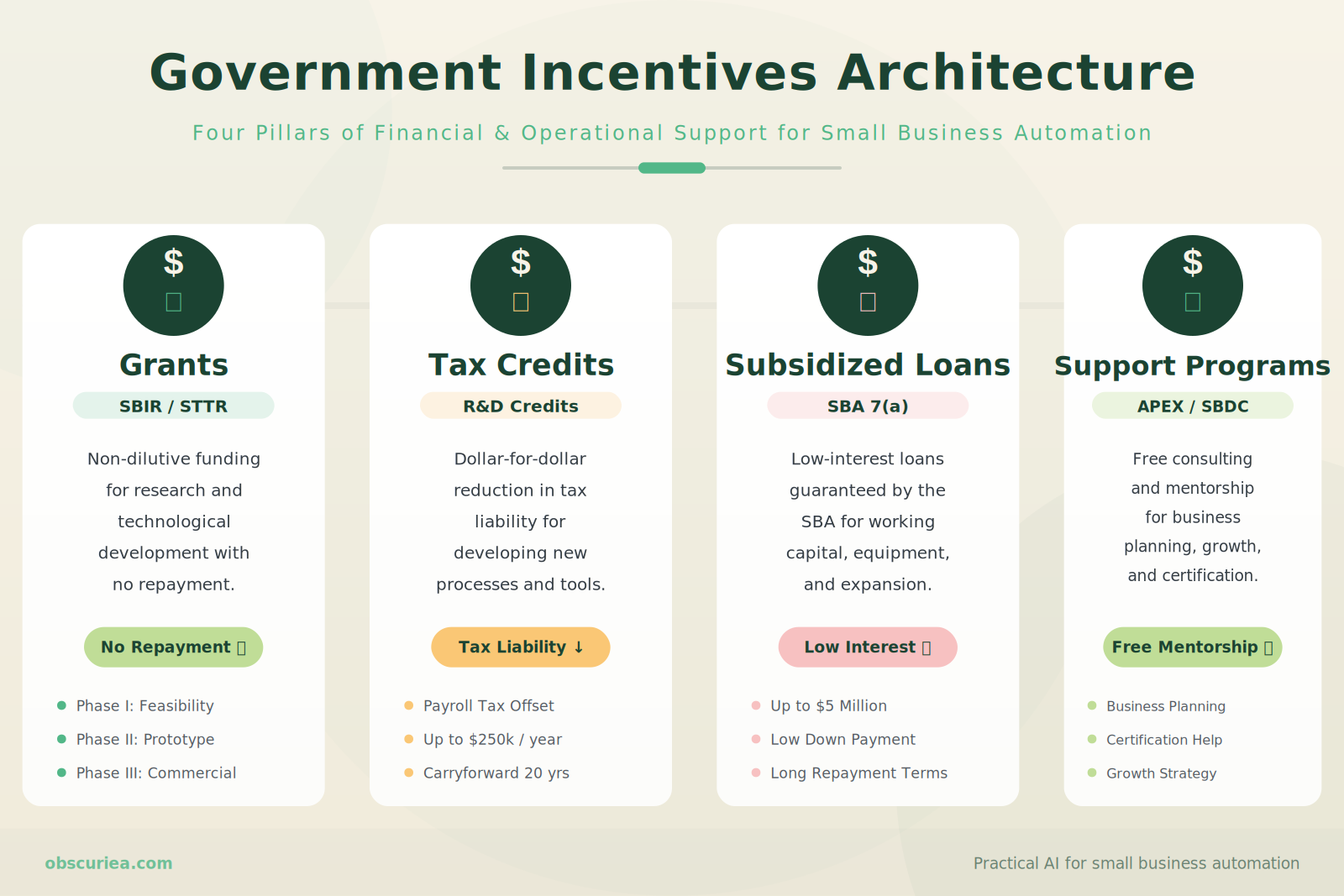
Grants: SBIR and STTR — These are the heavy lifters. The Small Business Innovation Research (SBIR) program and its cousin the Small Business Technology Transfer (STTR) program fund small businesses to conduct research and development that can benefit federal agencies. If you are building a novel automation tool — not just installing an off-the-shelf chatbot — this is your best bet. Phase I awards range from $50,000 to $250,000 for feasibility studies. Phase II can go up to $1.5 million. The catch: your project must be technology research, not routine implementation. And the application takes 40 to 80 hours to prepare, plus another 12 months to hear back.
Tax Credits: R&D Tax Credit — This is the lowest-hanging fruit. The federal R&D tax credit refunds up to 20% of qualified research expenses against your tax liability. And here is the key: many automation projects qualify as R&D if you document the uncertainty and experimentation involved. Every time you try to automate a process that no off-the-shelf tool handles perfectly, you are technically doing development work. The IRS has allowed claims for software integration, API development, and even process reengineering. A small business spending $50,000 on automation-related R&D could net a $7,500 to $10,000 credit. The application requires a CPA who specializes in R&D credits, but the total effort is usually 10-15 hours upfront, plus quarterly documentation.
Subsidized Loans: SBA 7(a) — Not a grant, but a government-guaranteed loan that can be used for automation purchases. The SBA 7(a) program offers up to $5 million at competitive rates, with longer terms and lower down payments than conventional financing. The money can buy software licenses, hardware, and even fund integration labor. But there is a rub: the guarantee only applies if the bank approves you, and that means personal guarantee and collateral for many small businesses. For a $50,000 automation project, the approval process might take 2 to 4 weeks — far faster than any grant. But the interest still accumulates.
Support Programs: APEX Accelerators and SBDCs — These do not hand out money directly, but they are the best entry point. APEX Accelerators (formerly PTAC) provide free consulting on government contracting, including how to find relevant contracts and write proposals. The Small Business Development Centers (SBDCs) offer free one-on-one counseling on business strategy, including applying for grants and loans. Many operators skip these because they sound like generic small business advice. In practice, the SBDC counselors are the ones who will tell you which specific SBIR topic number matches your automation project.
The Workflow Math
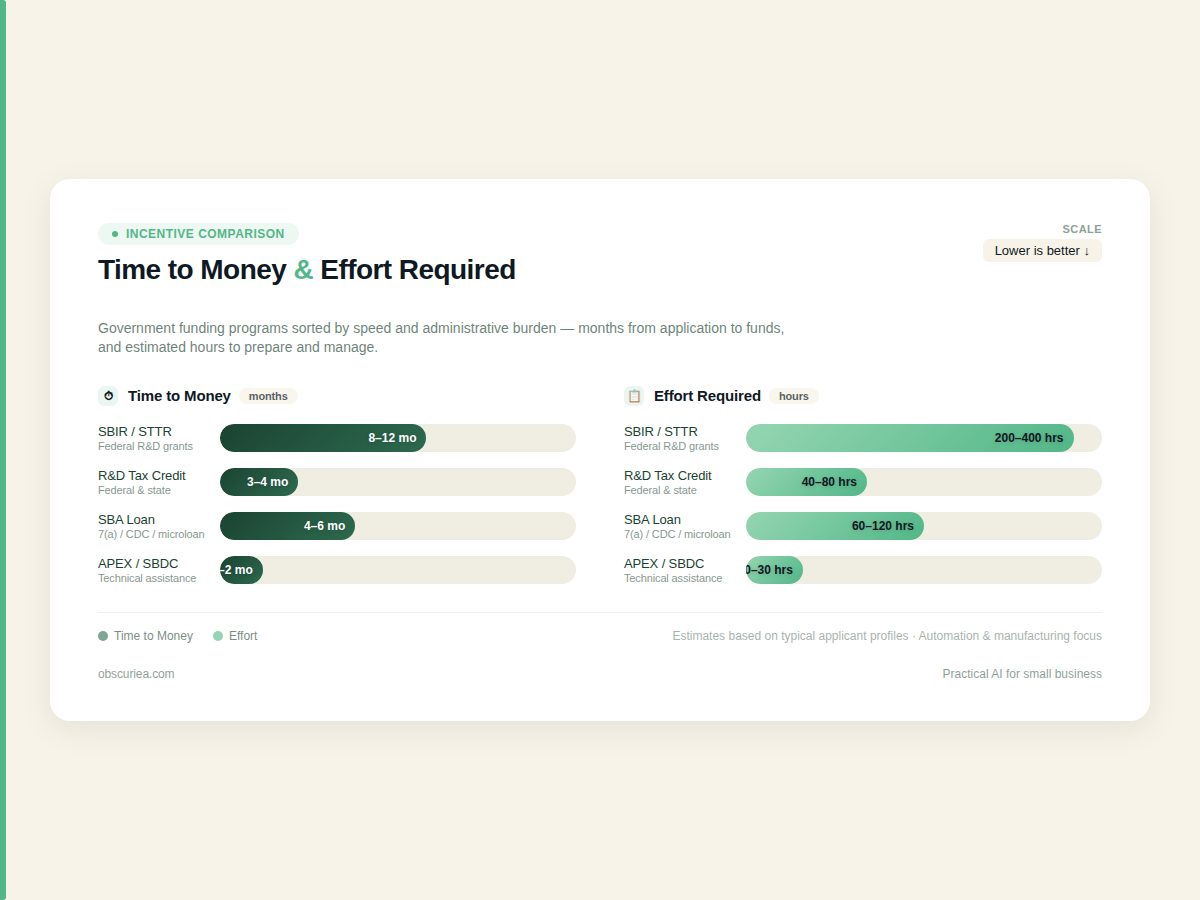
Let’s put the numbers side by side for a typical small business looking to automate an order processing workflow. Assume the business has annual revenue of $1.5 million and an existing contractor who handles manual order entry for 30 hours a week at $25 per hour. Automating that function costs an estimated $40,000 in software and integration.
| Incentive Type | Time to Money | Effort Required | Typical Automation Fit | Potential Value |
|---|---|---|---|---|
| SBIR Phase I | 12–18 months | 40–80 hours application + project execution | Building a novel automation patent or tool | $50k–$250k grant |
| R&D Tax Credit | Next tax filing (3–15 months) | 10–15 hours + CPA | Any custom automation with documented R&D | $7k–$10k credit on $50k spend |
| SBA 7(a) Loan | 2–4 weeks | 10–20 hours paperwork + personal guarantee | Direct purchase of off-the-shelf automation | $40k loan at 7–10% APR |
| APEX/SBDC Consulting | Immediate | 2–5 hours intake | Niche government contract discovery | Free lead generation |
The math favors combination. Use the SBA loan to fund the upfront automation purchase. Claim the R&D tax credit to offset the cost. And if your project has genuine novelty, apply for SBIR to fund the next phase. None of these programs pays for everything. But stacked together, they can reduce the net cost of an automation project by 30% to 50%.
Where It Breaks
These incentive structures break in three predictable ways, and the cost of hitting the break is measured in wasted hours, not just money.
First break: eligibility mismatch. Most automation projects are considered routine software implementation by government standards. If you are buying a pre-built chatbot from a vendor and connecting it to your CRM with drag-and-drop logic, that is not research. You will be rejected from SBIR and the R&D tax credit will be contested. The fix: document every iteration. Keep logs of what you tried, what failed, and what you had to engineer uniquely. If you can show uncertainty and experimentation, you have a case.
Second break: timeline mismatch. Grants take 6 to 18 months. Automation projects need funding now. The SBA loan is faster but comes with debt. Operators who try to time an automation upgrade around an SBIR grant often miss the business need window. The practical move: fund the automation with cash or a loan first, then treat the grant as reimbursement.
Third break: documentation overhead. The R&D tax credit requires contemporaneous documentation — not after-the-fact recollections. If you are not tracking engineering hours, problem statements, and test results as you go, the credit is hard to claim. Most small businesses do not have the discipline. The ones that do usually have an internal operations person or a fractional CFO who sets up a simple tracking sheet.
The Friction Box
- Most automation projects do not qualify for grants because they are classified as implementation, not innovation. The line is blurry, and examiners default to rejecting.
- The SBIR application guide runs 150+ pages. For a 3-person company, the opportunity cost of reading it is significant.
- SBA loans require personal guarantees, which means government support comes with personal risk. That defeats the purpose for many operators.
- R&D tax credit claims have been heavily audited in recent years. A small mistake in documentation can trigger a full IRS review.
- Local SBDC counselors vary wildly in quality. You might get a former banker who knows SBA forms well but has never touched automation.
Frequently Asked Questions About Government Incentive Structures for Small Business Automation
What is the easiest government incentive to get for automation?
The R&D tax credit is the least bureaucratic option. You do not need to win a competition or pay back a loan. A CPA who specializes in R&D credits can usually determine eligibility within two hours. The downside: you must have a payroll or income tax liability to offset.
Can I use an SBA loan to buy software like Zapier or UiPath?
Yes, as long as the software is integral to your business operations and you can show it will generate revenue or reduce costs. The SBA does not restrict the use of 7(a) funds to hardware. Software subscriptions are eligible, including the installation and training costs.
How does the government define “research” for SBIR and R&D tax credit?
The IRS uses a four-part test: the project must involve a technological in nature, must address uncertainty, must involve a process of experimentation, and must be intended to create a new or improved business component. Abstract routine implementation fails the uncertainty test.
What happens if my SBIR application is rejected?
You can resubmit in a future cycle, but you must address the reviewer’s feedback. Many companies apply two or three times before winning. Some use the R&D tax credit to fund the second application.
Are there state-level incentives for small business automation?
Yes. Many states offer their own R&D tax credits, grants for technology adoption, and training subsidies. For example, California’s CA Competes grant program and Texas’ Texas Enterprise Fund. Check your state economic development agency website.
The Straight Talk
This approach is for established small businesses with at least three years of revenue and someone on the team who can document technical work — an engineer, a developer, or an operations lead who takes good notes. If you have those pieces, stack the R&D tax credit with an SBA loan for your next automation project, and apply for SBIR only if you are building something genuinely novel.
If you are a pre-revenue startup or a solo service provider without technical documentation habits, skip the grant path. Use the SBA loan or cash for automation, and do not waste time on SBIR until you have the operational rigor to sustain the application. The government will not chase you to give you money — but if you know the right structures, the money is real.
Next action: Call your local SBDC office tomorrow. Ask for a counselor who has worked with technology companies. Bring your automation roadmap and ask which programs fit.
External references:
– SBA SBIR/STTR program page
– IRS Research & Development Tax Credit
– Find your local SBDC
– APEX Accelerators directory
– SBA 7(a) Loan Program
Explore more about automation funding strategies and SBA loan eligibility for tech businesses.