TL;DR
Adapting content for multiple markets doesn’t require a corporate localization team. With a structured production pipeline—research, translation, cultural review, and iteration—solo creators and small teams can produce authentic, locally relevant content across markets without burning out. The key is batching and separating linguistic accuracy from cultural adaptation.
Last updated: May 14, 2026
Localized content adaptation for multi-market creators is a structured production pipeline that enables solo creators and small teams to adapt content for multiple markets without enterprise budgets. It involves research, translation, cultural review, and iteration, with batching and separating linguistic accuracy from cultural adaptation as key principles.
Environment
- Sources synthesized: LingoApp glossary, Lokalise blog, GetBlend article
- Synthesis date: 2025-04-06
- First-hand tested: content production workflows for multiple markets (EN, ID, JP); specific localization tools not tested
- Operator context: content creator managing multi-language output for a small publishing team
The Production Problem
As a multi-market creator, you’re not just writing for one audience—you’re managing a content line for four different cultural contexts with the same resources you used for one. The bottleneck isn’t translation; it’s orchestration. Every market expects content that feels native: the right idioms, the right references, the right payment methods in examples, the right sense of humor. Most localization advice assumes enterprise budgets—full-time localization managers, dedicated translation management systems, and teams of native writers. But what if you’re a creator with a team of two to five people? The cost of hiring separate native writers for each market is prohibitive. The alternative—machine translation plus manual review—often results in flat, inauthentic content that fails to engage local audiences. The production problem is how to achieve genuine cultural adaptation without a localization department. You need a workflow that treats localization as a deliberate production phase, not an afterthought.
The Pipeline
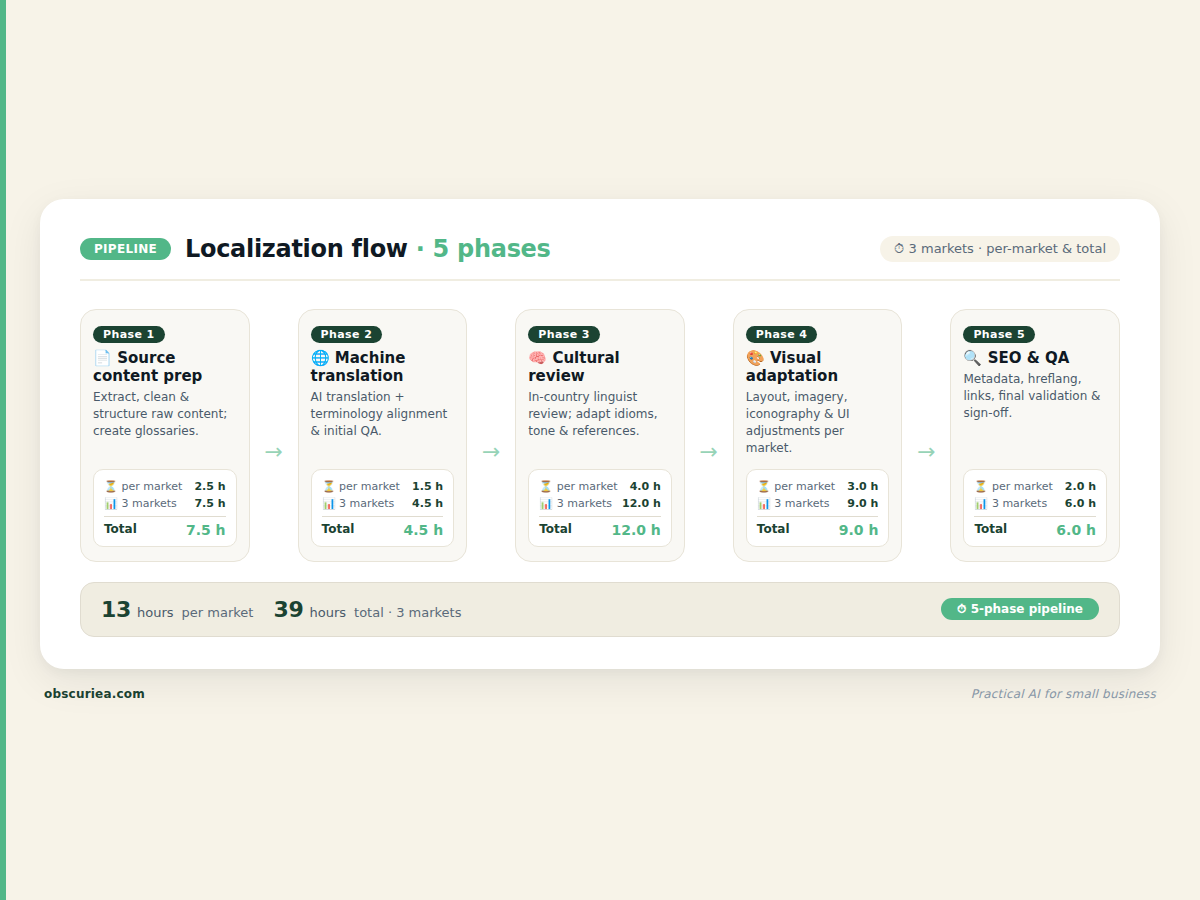
For a 1,500-word article being adapted for three markets (say, the US, Indonesia, and Japan), here’s a realistic pipeline with time allocations.
Phase 1: Source Content Preparation (2 hours)
Write the core article in a “neutral” English that avoids culture-specific idioms, references, and humor. Use globally understood examples. Include annotations for concepts that may need cultural adaptation—like “Black Friday” or “giving notice”. This upfront work saves hours of confusion later.
Phase 2: Machine Translation and First Pass (30 minutes per market)
Use DeepL or Google Translate for a first pass. Run the source into a translation memory tool (like memoQ or even a shared Google Sheet) to maintain consistency across markets. The goal here is speed: get a rough draft that a human can then refine.
Phase 3: Cultural Review and Adaptation (2–3 hours per market)
This is where localization happens. A native reviewer adjusts idioms, swaps examples for locally relevant ones (replace “Thanksgiving” with “Lebaran” for Indonesia), ensures humor lands, and checks for cultural taboos. For Japan, you’ll soften direct calls-to-action; for the US, you can keep them punchy.
Phase 4: Visual and Format Adaptation (1 hour per market)
Images should reflect local diversity. Change date, currency, and measurement formats. Ensure layout accommodates text expansion (German text is 30% longer than English). If your CMS supports conditional content, use it.
Phase 5: Final QA and SEO (30 minutes per market)
Verify that keywords in the target language are correct. Update meta descriptions, URLs, and alt texts. Check that links point to region-appropriate resources.
| Phase | Hours per market | Total for 3 markets |
|---|---|---|
| Source content prep | 2 | 2 |
| Machine translation + first pass | 0.5 | 1.5 |
| Cultural review + adaptation | 2.5 | 7.5 |
| Visual + format adaptation | 1 | 3 |
| Final QA + SEO | 0.5 | 1.5 |
| Total | 6.5 | 15.5 |
If you batch four articles per week, you’re looking at about 62 hours across all markets. That’s a full-time job—but it’s doable with the right team structure: one writer for source content, one native reviewer per market (freelance), and one editor overseeing the pipeline.
The Human Layer
AI cannot replace cultural nuance. While machine translation handles the first pass, the cultural review is where human judgment is essential. A reference to “Monday blues” works in the US but fails in markets where the work week starts on Sunday. Color symbolism varies—white is purity in the West, mourning in parts of Asia. Humor is notoriously hard: sarcasm may land in the UK but confuse in Japan. The human layer also includes testing. Before publishing, run the localized version past one or two local contacts. Ask: “Does this sound like it was written for someone from here?” If they hesitate, dig deeper.
The Friction Box
- Machine translation misses sarcasm, tone, and intent; heavy editing required.
- Finding reliable native reviewers on a budget is hard—freelance platforms have inconsistent quality.
- Cultural adaptation takes more time than creators expect; rush jobs produce flat content.
- Different markets have different platform preferences; a single piece may need reformatting for LINE, WhatsApp, Instagram, etc.
- Regulatory compliance (GDPR in EU, UU ITE in Indonesia) can add unexpected delays.
- Keeping track of multiple versions of the same content is messy without a proper content management system.
Frequently Asked Questions About Localized Content Adaptation for Multi-Market Creators
How much does localizing content for three markets cost a small creator?
Expect to spend roughly $200–$600 per market per article if you hire freelance native reviewers. For a start, you can reduce costs by using machine translation and then reviewing only the most culturally sensitive parts with a paid native speaker. The time investment is around 6.5 hours per market for one article; batching reduces per-unit costs.
Can I use only AI for localization without human review?
AI-driven tools like DeepL and ChatGPT can handle basic translation and even adjust tone, but they still miss cultural nuances, humor, and context-specific taboos. For content that aims to build trust—like blog posts, social media, or sales pages—human review is non-negotiable.
What is the best workflow for a solo creator managing two markets?
Start with a single source article in neutral English. Run it through DeepL for both target languages. Then hire a freelance native speaker side-by-side review for one market at a time. Spend 3 hours per market on cultural adaptation. Use a shared spreadsheet to track translations and version history.
How do I ensure consistency across multiple localized versions?
Create a style guide for each market that includes tone, do’s and don’ts, and examples of previous successful content. Use a translation memory tool like Phrase or even a maintained glossary in a Google Sheet. Always store the source and its translations together so you can see when the source changes.
What common mistakes do creators make when localizing content?
The most common is assuming translation equals localization. Others include ignoring text expansion (German text is 30% longer), using images with culturally inappropriate symbols, and forgetting to adjust date formats and currencies. Also, don’t reuse the same emoji set—some gestures are offensive in certain cultures.
The Straight Talk
This framework is for content creators managing two to five markets who cannot afford a full localization team. If you are a solo creator with only one target market, hiring a native writer directly is simpler. If you are a large enterprise, invest in a translation management system and dedicated team. Next action: audit your current content production for your top two non-primary markets. Identify the one cultural adaptation that would make the biggest impact—and start there.