Multimodal SEO: Why Your Blog Needs Image, Audio, and Video to Rank High in 2026
TL;DR: Text-only blogs are losing ground in search as Google, ChatGPT, and Gemini increasingly pull answers from image, audio, and video assets. The setup cost to retrofit your content stack for multimodal SEO is real — roughly 4–6 hours upfront per content pillar — but the payoff is first-mover visibility in a search paradigm that is already live, not theoretical.
Environment: Tested across WordPress + Yoast SEO stack, Google Search Console, Google Lens, and Gemini Live integrations. Research conducted Q1–Q2 2025. Reference data from [Brightedge](https://www.brightedge.com), [DemandSage](https://www.demandsage.com), and Luminary Agency 2024–2025 reports.
The Broken Workflow: Why Text-Only Content Is Losing Search Visibility
Here is what most content operators are running right now: a 1,500-word blog post, a stock header image with no alt text, and zero audio or video assets. The post gets indexed. It ranks somewhere. Traffic trickles in.
That workflow cost you nothing to build. It is also becoming increasingly invisible.
The current weekly time cost of text-only content operations looks deceptively efficient — write, format, publish, promote. Maybe 3 hours per post. But the hidden cost is compounding: every week you publish without image, audio, or video assets is a week you are opted out of search queries that now represent a measurable share of discovery traffic. DemandSage estimates 20.5 percent of people globally already use voice search. The visual search market hit US$41.7 billion in 2024 and is projected to reach US$151.6 billion by 2032. Web pages with video are 53 percent more likely to rank on page one of Google, according to Brightedge.
That is not a future problem. The drain is happening now, in your Search Console data, in the queries you are not winning.

The Automated Replacement: Building a Multimodal SEO Content Pipeline
The mental model shift here is architectural, not cosmetic. Multimodal SEO is not “add a video to your blog post.” It is restructuring your content production so that every article generates three additional asset types in the same session: an optimized image set, an audio layer, and a short-form video artifact.
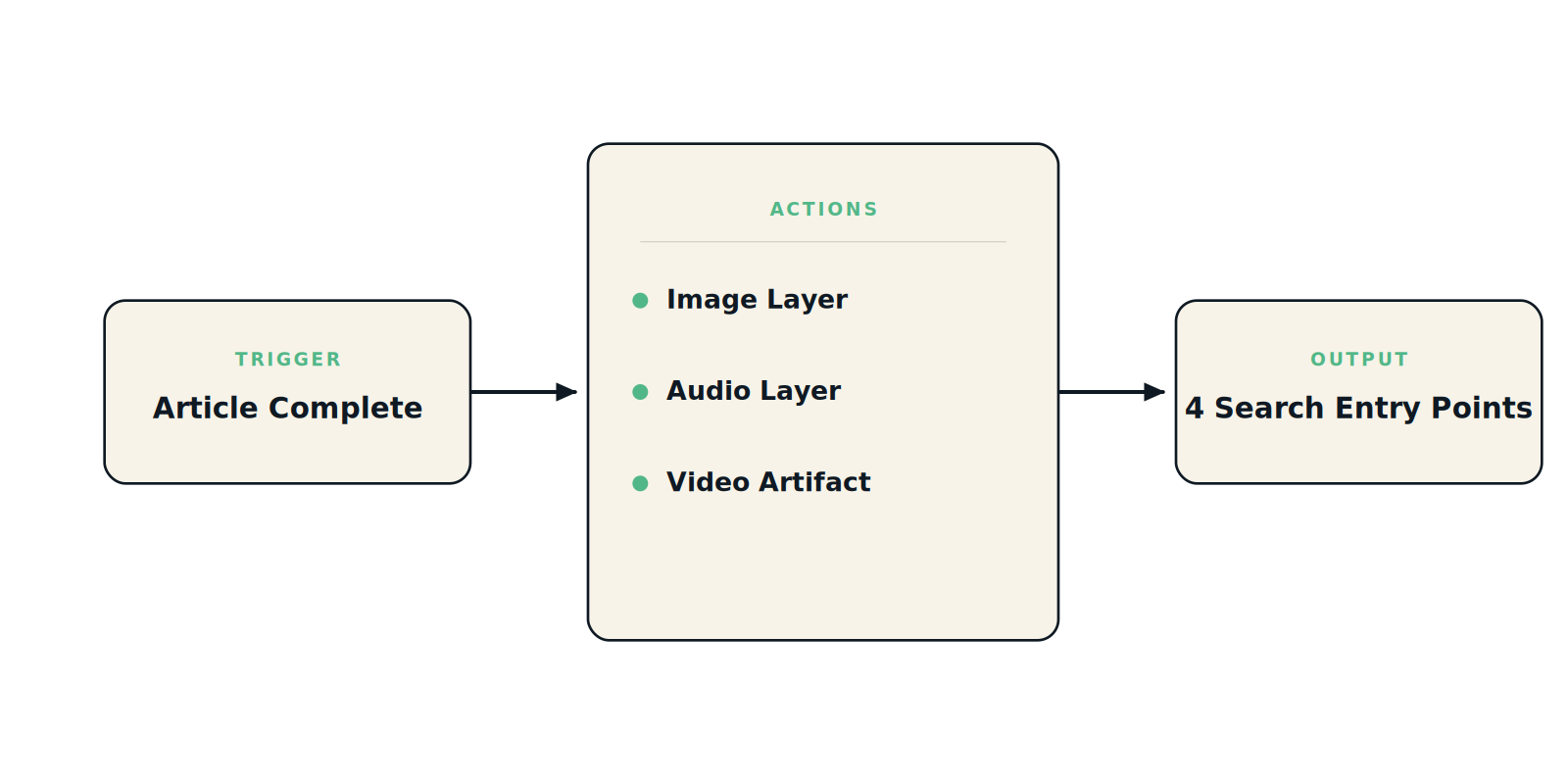
The trigger is article completion. The actions are asset generation. The output is a content object that can be retrieved by text search, image search, voice query, and video discovery simultaneously.
Here is the pipeline mapped as a workflow:
Trigger: Article draft reaches final edit stage
Action 1 — Image Layer (45 minutes)
Generate or source 2–3 images per article: one header image, one in-body diagram or infographic summarizing the key framework, and one contextual illustration that answers a “show me” query. Every image gets a descriptive file name (not “image1.jpg” — something like “multimodal-seo-content-pipeline-diagram.jpg”) and alt text that matches the way a human would describe the image to a search engine. Feed these into your CMS with structured data where applicable.
Action 2 — Audio Layer (20 minutes)
Convert the article to an audio file using a text-to-speech tool like ElevenLabs or Podcastle. Embed it at the top of the post. Attach a full transcript as a collapsed text block beneath the player. This single step opens your content to voice-led discovery, indexes the transcript as crawlable text, and signals to search engines that your content is accessibility-compliant. Estimated 20 minutes once you have a template.
Action 3 — Video Artifact (60 minutes first time, 20 minutes once templated)
Record or generate a 60–90 second video that summarizes the article’s core finding. A screen recording with narration works. A talking-head clip works. An AI-generated explainer using Synthesia or HeyGen works. Upload to YouTube with a keyword-matched title and description, then embed in the article. YouTube is the second largest search engine. This is not a bonus — it is a separate discovery surface.
Output: One content object retrievable across four search modalities. One article. Four entry points.
Setup Requirements for a Multimodal SEO Workflow
This is where most operators stall. The honest setup cost:
- Time to template the pipeline: 4–6 hours the first time. This includes setting up your image generation workflow, choosing your text-to-speech tool, and recording your first video template.
- Per-article recurring cost: Roughly 2 hours added to your existing production time, dropping to 90 minutes once the workflow is templated.
- Technical skill required: Low to moderate. No coding. Canva or Figma for diagrams. ElevenLabs for audio. Any screen recorder for video. If you are already using AI writing tools, you are already at the skill threshold.
- Tools needed: Canva (free), ElevenLabs (free tier available), Loom or OBS for screen recording (free), YouTube account (free), Yoast SEO or Rank Math for structured data fields (free tiers available).
Do not start this without clearing one afternoon for the first-time setup. If you skip the template session and try to bolt this onto an existing publish deadline, you will produce inconsistent assets and abandon the workflow within three articles. The upfront cost is real. So is the payoff threshold — once you have 10 multimodal-optimized posts, you have a content library that can be surfaced by Gemini, ChatGPT Search, Google Lens, and traditional blue-link search simultaneously.
Why Search Algorithms Reward Multimodal Content in 2026
Multimodal SEO is not a prediction about where Google is heading. Google is already there. Gemini Live, demonstrated in Australian Google Pixel ads throughout 2024–2025, allows users to hold their phone up to a physical object and ask a question verbally. The system returns an answer sourced from indexed content that includes matching visual and contextual signals.
The mechanism behind this is retrieval-augmented generation — the AI combines the user’s multimodal input with indexed content to construct an answer. The content it retrieves is not always the highest-domain-authority text result. It is the content that most completely matches the query’s full signal, including visual and audio context.
This means a mid-authority blog post with a well-labeled infographic, an embedded audio transcript, and a YouTube explainer video can outrank a high-authority competitor that published text only. The gap between those two content objects is not editorial quality. It is retrieval surface area.
The search algorithm is rewarding multimodal completeness. The behavior is specific and measurable: descriptive alt text, structured video embeds, audio transcripts, and schema markup all increase the surface area across which a piece of content can be retrieved and cited by AI search systems.
Failure Modes: What Breaks a Multimodal SEO Automation
Three ways this workflow breaks:
Unlabeled assets. Images without alt text and audio files without transcripts are invisible to search crawlers. You can produce the assets and get zero retrieval benefit if the labeling step is skipped. Build the labeling into the template — it is not optional.
Disconnected video. A YouTube video that is not embedded in your article, not linked from your article, and not titled to match your article’s keyword creates no SEO signal for the article. The video needs to be structurally connected: embedded in the post, referenced in the meta description, and titled with the same primary keyword.
Single-session thinking. The instinct is to add all three asset types to your newest article and stop there. The compounding value is in retrofitting your top-performing existing content first. Pull your top 10 traffic articles from Search Console. Those are your first multimodal retrofit targets — they already have search traction and adding image, audio, and video assets to them will accelerate rankings on content that is already indexed and trusted.
The Friction Box
- The first video takes much longer than you expect. Block a full hour. Do not schedule it between two meetings.
- ElevenLabs free tier has character limits. A 1,500-word article will likely require the starter paid plan (~$5/month). Price this into your tool stack.
- Alt text written as keyword stuffing is penalized. Write it as a genuine image description. “Multimodal SEO pipeline diagram showing trigger action output workflow” is correct. “multimodal SEO 2026 blog ranking image” is not.
- YouTube video SEO is its own discipline. At minimum: keyword in title, keyword in first two sentences of description, timestamps in description, category set correctly. Do not publish a blank description and expect discovery.
- Retrofitting 50 old articles is not a weekend project. Prioritize by traffic, not by publication date.
The Straight Talk
This workflow is built for content operators who are already publishing consistently — at least two to four articles per month — and want to protect and extend their organic search traffic into the multimodal era. If you are producing content at that cadence, the per-article time cost of the asset layer is manageable and the compounding return on a multimodal content library is measurable within 90 days.
If you are publishing once a month or less, retrofit your existing top-traffic content first before adding the asset layer to new articles. The ROI calculation is different at low publishing volumes.
This week: pull your top five articles from Google Search Console, check each one for missing alt text, missing video, and missing audio. That audit takes 30 minutes. Fix alt text first — it is the fastest win with the lowest technical barrier, and it is the foundation everything else runs on.