TL;DR:
Automated referral tracking cuts manual coordination from 8 hours a week to under 30 minutes, but the real gains come from preventing fraud and identifying your top referrers. However, the wrong system creates new problems—reward disputes, scaling pains, and hidden costs. Here’s what operators need to know before committing.
Environment:
– Sources synthesized: 3 URLs (impact.com referral tracking guide, NextBee referral software page, Tremendous best referral tools list)
– Synthesis date: 2026-07-15
– First-hand tested: none (synthesis-based with operator context)
– Operator context: Managed referral marketing and automated reward systems for small-to-medium ecommerce businesses (2019–2024)
The Architecture
Every word-of-mouth business faces the same structural problem: you know your best customers are sending people your way, but you have no way to connect the dots. Unless you’re logging every conversation and transaction manually—which breaks down around 20 referrals a month—you’re flying blind on one of your most valuable acquisition channels.
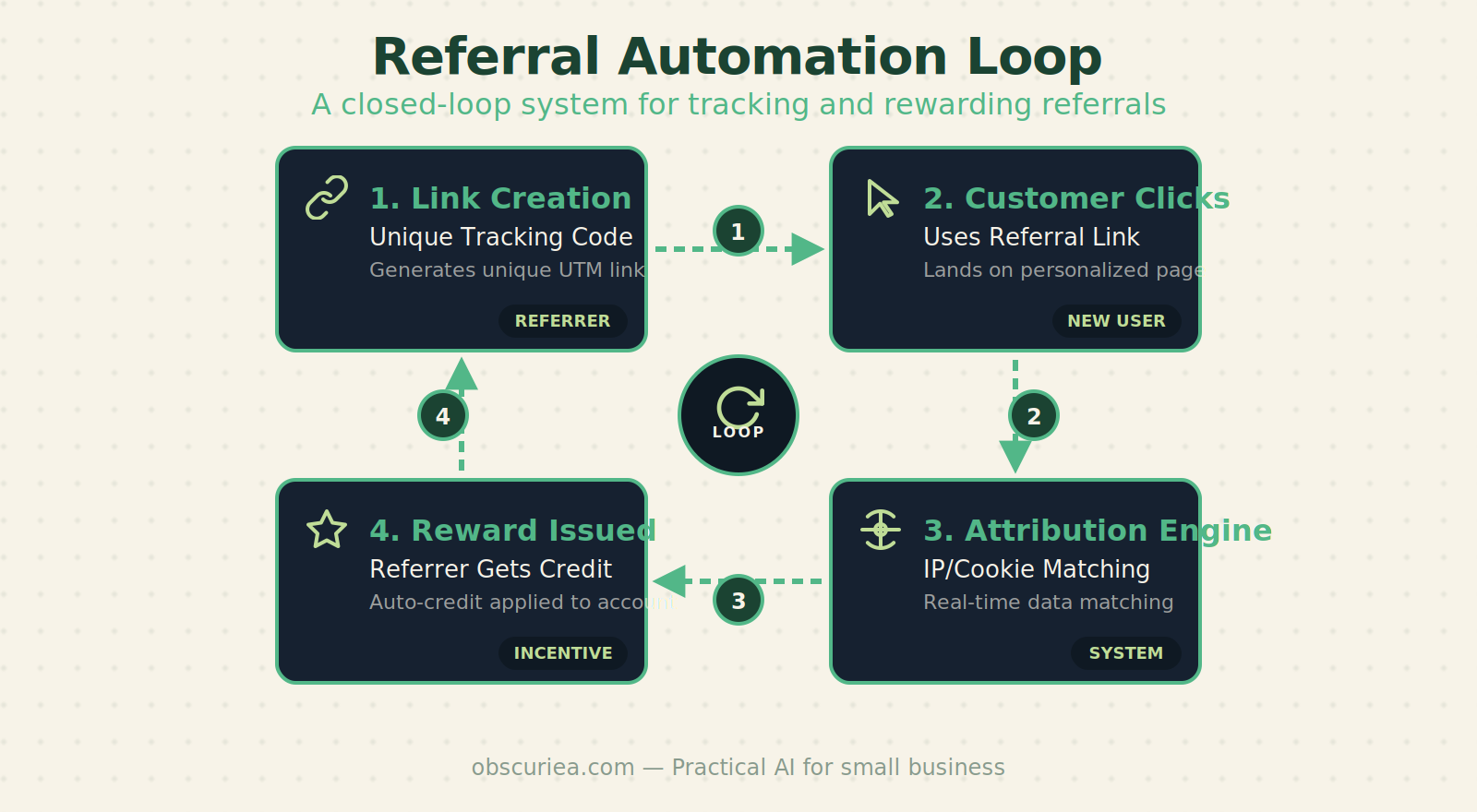
Referral tracking and reward automation systems solve this by building a closed loop: a unique identifier (link, code, or QR) is assigned to each referrer, tracked through attribution windows (typically 30–90 days), and then triggers a reward when a conversion event happens. The architecture has four components:
- Referral generation — automatic creation of shareable links/codes
- Attribution engine — matches referrers to conversions using cookies, IP, or order data
- Fraud detection layer — flags suspicious patterns (self-referrals, bot traffic, duplicate accounts)
- Reward orchestration — triggers payouts (discounts, gift cards, cash) when conditions are met
The math here is straightforward: if you process 50 referrals per week and each takes 10 minutes to track manually, that’s over 8 hours a month just in data entry. Automation reduces that to near zero—but only if the system is configured correctly and your team doesn’t end up spending those 8 hours reviewing false fraud alerts.
The Workflow Math
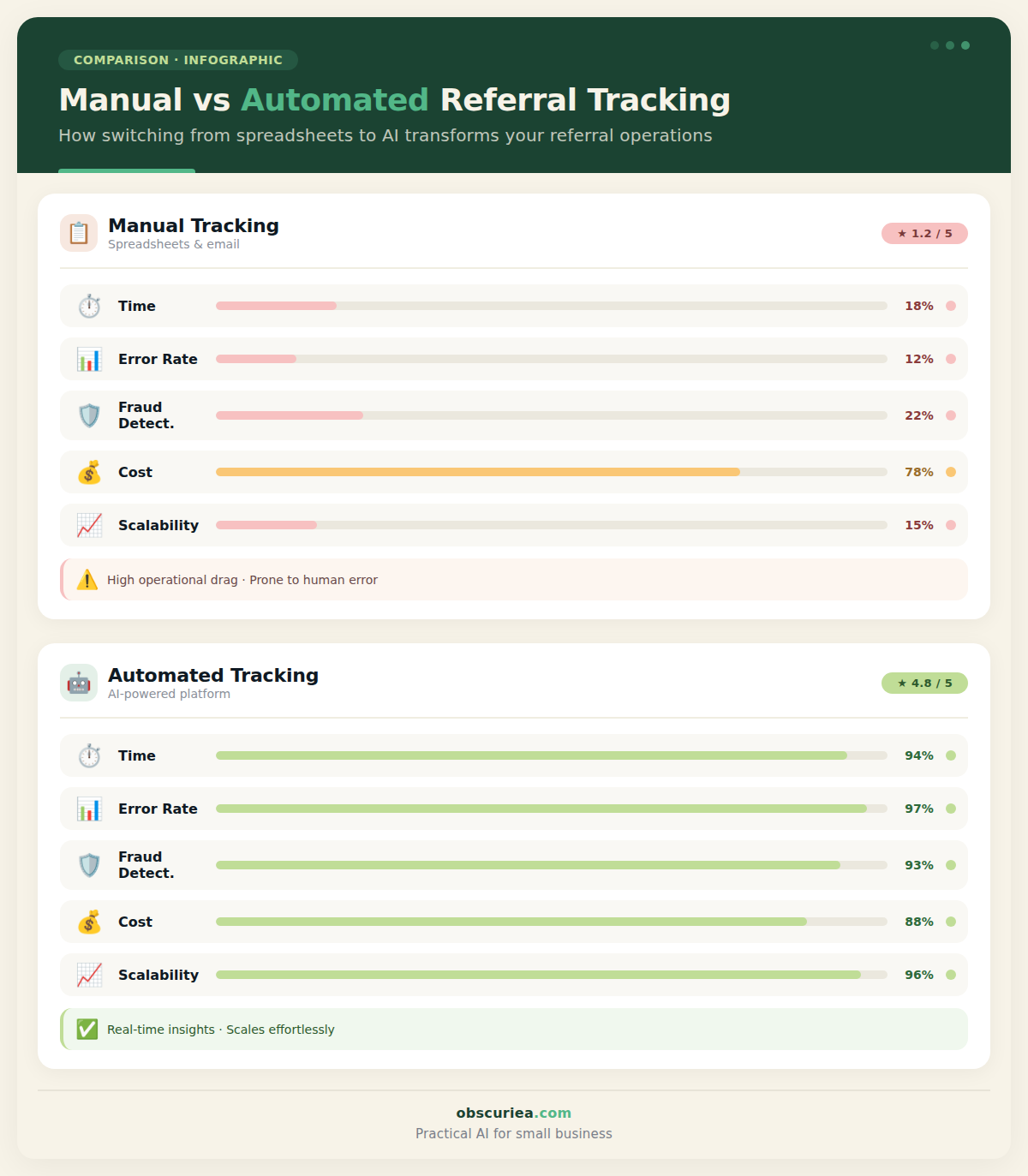
| Metric | Manual (50 refs/wk) | Automated (50 refs/wk) |
|---|---|---|
| Weekly tracking time | 8 hours | 30 minutes |
| Error rate (rewards) | ~8% (late/missed) | <1% |
| Fraud detection | Reactive, after payout | Real-time flags |
| Reward fulfillment speed | 1–7 days | Instant |
| Cost (software) | $0 | $100–$500/month |
| Scalability limit | ~100 refs/mo | 10,000+ refs/mo |
The trade-off is clear: automation pays for itself once you cross around 50 referrals per month, assuming a labor cost of $20/hour. Below that, a well-maintained spreadsheet is cheaper.
But the cost of the software isn’t the only expense. Most platforms charge based on the number of referrals processed (transactional pricing) or tiered monthly fees that jump sharply. For example, [Lootly](https://www.lootly.io) starts at $299/month for 1,000 customers, but scaling to 10,000 customers can cost $1,000+/month. [Friendbuy](https://www.friendbuy.com) doesn’t even publish pricing—a sign that enterprise contracts are the norm.
Southeast Asian operators face an extra layer: payment gateways like [Xendit](https://www.xendit.co) and [Midtrans](https://midtrans.com) don’t integrate natively with most US-built referral tools. You may need a middleware layer (Zapier, Make) to connect the reward trigger to an Indonesian payment provider, adding both complexity and cost.
Where It Breaks
No automated system is perfect. Here are the failure modes I’ve seen repeatedly:
Fraud detection false positives
Algorithms are trained on US/European traffic patterns. An Indonesian customer sharing a link from a shared Wi‑Fi (IP range mismatch) will get flagged as suspicious. You then spend time manually clearing legitimate referrers, which destroys the trust automation was supposed to build.
Attribution disputes
Cookies expire. Users block tracking scripts. A referred customer might open a link on mobile but purchase on desktop—without a unified attribution system, that conversion is lost. The referrer doesn’t get credited, and you lose a promoter.
Reward abuse at scale
Some referrers game the system by posting codes on coupon forums. The automated reward orchestration keeps paying out. By the time you notice, you’ve handed out $2,000 in discounts to people who never even visited your site. Proper fraud rules (like requiring the referred user to make a purchase within 30 days) can mitigate this, but not eliminate it.
Scalability plateaus
The system works beautifully at 500 referrals. At 5,000, the dashboard slows, the API rate limits kick in, and manual review queues pile up. Many platforms claim enterprise scalability but reveal their infrastructure limits only after you’ve signed a yearly contract.
Integration spaghetti
You have to connect referral software to your ESP, CRM, payment provider, and ecommerce platform. Each integration is a potential failure point. If your Shopify site gets a traffic spike, the referral plugin might time out and lose attribution data.
The Friction Box
- Most “automated” systems still require manual review of flagged referrals – the automation is a spectrum, not a binary.
- Fraud detection algorithms false-flag legitimate referrers from emerging markets due to IP differences.
- Pricing is opaque: Lootly starts at $299/mo but can jump to $1,000+ at 10,000 customers; Friendbuy hides pricing entirely.
- Attribution cookies break in privacy-first browsers (Safari, Brave); you’ll lose 20–30% of referrals without server-side tracking.
- Southeast Asian payment gateways like Xendit lack native integrations; custom middleware adds $50–200/month in Zapier/Make costs.
- Reward fulfillment still requires human sign-off for large payouts – “instant” is only instant for small rewards.
Frequently Asked Questions About Referral Tracking and Reward Automation
How do referral tracking tools prevent fraud?
Automated systems use rule-based checks (IP matching, device fingerprinting, purchase history) to flag suspicious referrals. Most tools require a referral to result in a paid order before issuing a reward. However, false positives are common in emerging markets—be prepared to review flags manually.
What is the cost of automated referral software?
Basic plans start around $100–$300/month for up to a few thousand customers. Enterprise plans with full integrations and dedicated support range from $1,000 to $5,000/month. Transactional pricing (per referral) can work better for low-volume programs, but watch for caps.
Can referral automation scale with my business?
Most platforms are architectured for scale, but the pricing tiers increase steeply. At 5,000 referrals per month, expect to be on a custom enterprise plan. Also, dashboard speed and API rate limits can become bottlenecks—test with a volume close to your projected peak.
How to choose between manual vs automated referral tracking?
If you process fewer than 50 referrals per month and your total customer base is under 1,000, manual tracking in a spreadsheet is adequate. Above that, the time savings and fraud prevention from automation justify the monthly cost. Also consider whether your payment gateway integrates easily.
Do referral tracking tools work for local businesses in Southeast Asia?
Yes, but with extra setup. Most top-tier tools (Talkable, Friendbuy, Lootly) don’t natively support Indonesian gateways like Xendit or Midtrans. You’ll need Zapier or a custom middleware layer, which adds $50–200/month and may introduce latency in reward fulfillment.
How long does it take to set up referral automation?
A basic implementation with widget embedding and email triggers takes 1–2 weeks. Full customization (branded landing pages, advanced fraud rules, API integrations) can take 4–6 weeks. Plan a 30-day trial with your top customers to validate the workflow before going all-in.
The Straight Talk
This is for the operator who is processing more than 50 referrals per month and spending more than 4 hours a week on manual tracking. If you fit that description, switching to an automated system will free up time and reduce friction for both you and your referrers.
This is not for the business with fewer than 1,000 customers in total. At that scale, a spreadsheet with a few basic formulas costs nothing and gives you all the data you need. The complexity of an automated platform will outweigh its benefits.
Start with a 30-day automated trial using your top 100 customers, then compare the manual tracking metrics you’ve been keeping against what the automation reveals. That comparison alone will tell you whether to scale or stay put.
Get a better handle on your referral program? Read our guide on scaling referral programs. Also check out our ecommerce automation playbook for related workflows.
External references:
– impact.com referral tracking guide
– [Tremendous best referral marketing tools](https://www.tremendous.com/blog/referral-marketing-tools/)
– [Talkable referral platform](https://www.talkable.com)
– Xendit payment gateway
– Midtrans payment gateway