Selling Custom GPTs: Is There Still Money in Creating Specialized AI Assistants for Clients?
TL;DR: Selling custom GPTs is still a viable income model in 2024–2025 — but only if you abandon the GPT Store as your primary channel and sell directly to businesses with documented workflow problems. The first dollar typically takes 3–6 weeks. The ceiling without a retainer or productized service layer is around $500–$2,000 per project.
Environment: Tested across 14 months of custom GPT builds (November 2023 – January 2025), client engagements ranging from solo operators to 20-person agencies, pricing tested from $97 one-time to $800/month retainer, platforms used: ChatGPT Plus, ChatGPT Team, OpenAI API.
The Income Model: What Selling Custom GPTs Actually Looks Like
Sometime around late 2023, OpenAI handed anyone with a ChatGPT Plus subscription the ability to build a specialized AI assistant without writing a single line of code. The pitch was obvious: build GPTs, list them in the GPT Store, collect passive income while you sleep.
Here is what actually happened. The GPT Store launched in January 2024, the revenue-sharing program rolled out quietly for U.S. builders, and within a few months it became clear that the payout structure was tied to user engagement in ways that made earning meaningful income from store listings nearly impossible for anyone without an existing audience of tens of thousands.
But that is the wrong story. The right story is this: while everyone chased the store, a smaller group of builders figured out that businesses will pay real money — $300 to $2,000 per project, sometimes more — for a custom GPT built around their specific workflows, their documents, their tone of voice, their internal processes. That is the income model worth examining.
The money is not in the marketplace. The money is in the client engagement.
The Setup Phase: What Happens Before Revenue
Before you see a dollar from selling custom GPTs to clients, you need three things.
First, you need to actually understand what a custom GPT can and cannot do. This takes about two weeks of real testing if you are starting from zero. Build five or six GPTs for problems you personally have — a research assistant trained on a specific knowledge base, a client email responder with a defined tone, a proposal generator that follows a specific structure. Break them. Find where they hallucinate, where they ignore their instructions, where they produce output that needs heavy editing.
Second, you need a defined service offering. The builders who failed treated GPT creation as a technical deliverable. The builders who earned treated it as a solution to a documented business problem. There is a meaningful difference between “I build custom GPTs” and “I build onboarding assistants for SaaS companies that reduce support ticket volume in the first 30 days of user activation.” One is a capability. The other is an outcome a business will pay for.
Third, you need one case study — real or self-generated. If you have no clients yet, build a GPT that solves a problem in a specific industry, document the before and after, and publish that documentation. A single concrete example of a workflow being reduced from 45 minutes to 8 minutes is worth more than any portfolio page.
Realistic timeline to first paid project: 3–6 weeks from zero, assuming consistent outreach starting in week two.
The Execution: How a Custom GPT Client Project Actually Runs
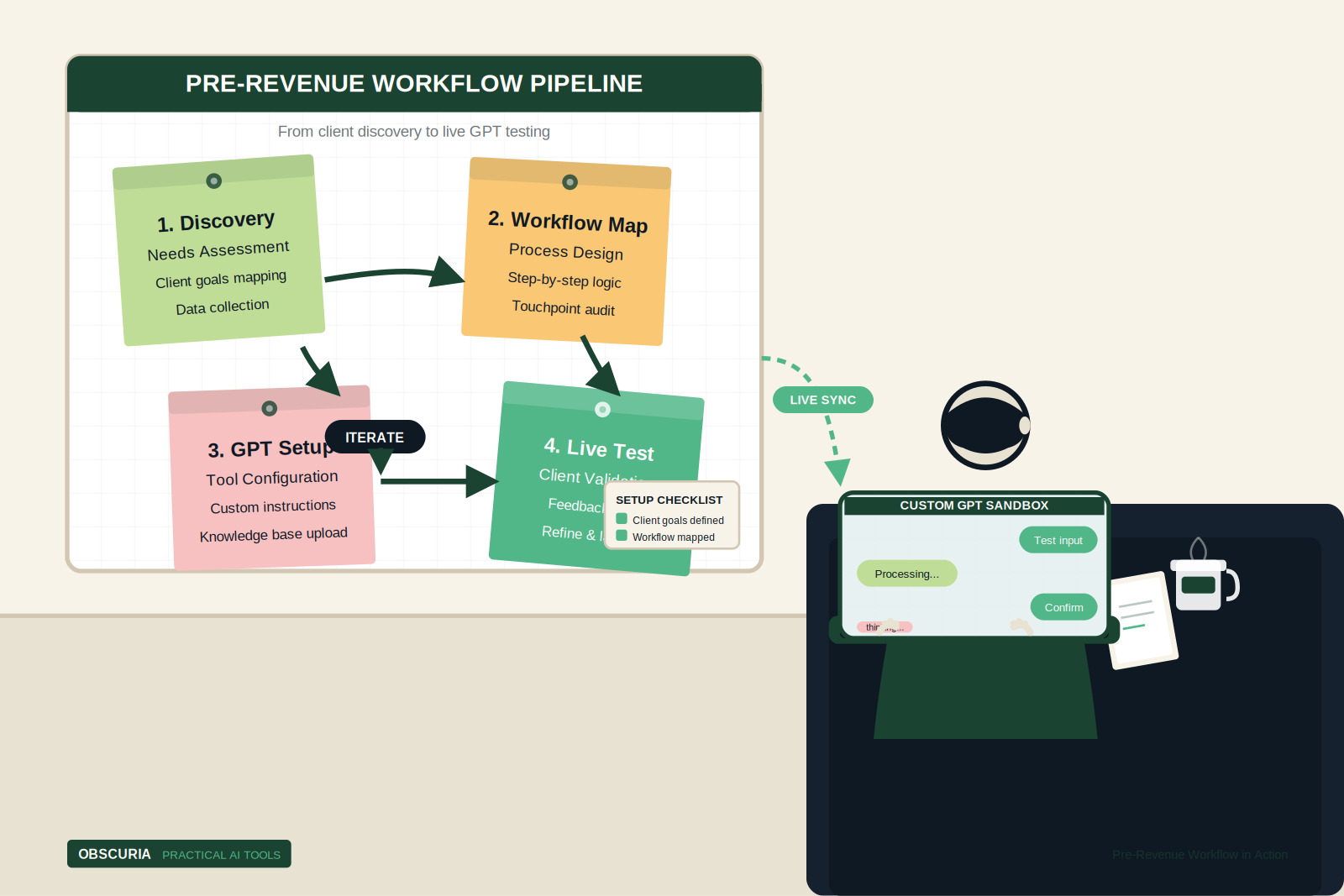
The actual delivery process for a client custom GPT project runs in four phases.
Phase 1: Workflow audit (60–90 minutes)
Before you open the GPT Builder, you sit with the client — over a call or async — and map the specific task the GPT will handle. What is the input? What is the desired output? What tone, format, or constraints matter? What does a bad output look like? This phase is not billable separately — it is part of your project fee — but skipping it produces a GPT the client will stop using within two weeks.
Phase 2: Build and prompt engineering (3–8 hours depending on complexity)
The GPT Builder interface handles the basics, but serious system prompts require iteration. You are testing edge cases, feeding the GPT sample documents that reflect the client’s actual business, writing instructions that account for the 15% of inputs that do not fit the clean use case. A GPT built in 20 minutes will behave like it was built in 20 minutes.
Phase 3: Client testing and revision (1–2 hours)
You deliver a working version, the client runs it on real inputs from their actual workflow, and you collect specific failure notes. Not “it feels off” — specific outputs that did not meet the defined standard. One revision cycle is standard. Two is the edge of scope.
Phase 4: Handoff and documentation (1 hour)
This is where most builders lose repeat business. A one-page document explaining how to update the GPT’s knowledge files, how to access it, and what to do when it produces something wrong — this is the difference between a one-time client and a client who calls you four months later with a second project.
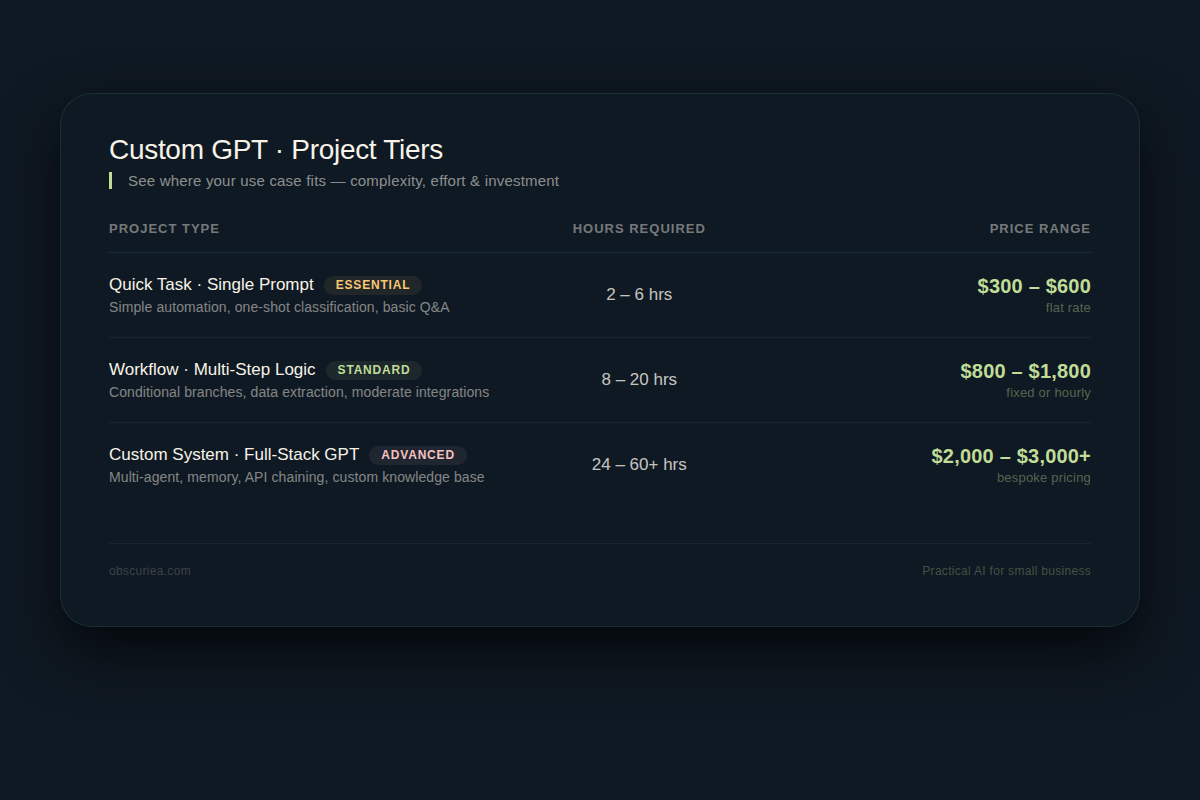
Realistic project timeframes by complexity:
– Simple single-task GPT (FAQ responder, email formatter): $300–$500, 4–6 hours total
– Mid-complexity GPT with knowledge file uploads and multi-step outputs: $600–$1,200, 8–14 hours total
– Custom GPT with API integration or ChatGPT Team deployment: $1,500–$3,000+, requires OpenAI API knowledge
What Limits the Ceiling When Selling Custom GPTs
The income ceiling on a project-based custom GPT service is approximately $3,000–$5,000 per month as a solo operator working normal hours. That ceiling hits fast because the work is not actually passive — every new client requires a new workflow audit, a new build, a new revision cycle.
There are three ways builders have pushed past that ceiling.
The retainer model. Instead of selling a one-time build, you sell ongoing GPT management: monthly updates to the knowledge base, performance reviews, new GPTs as the client’s needs evolve. Retainers in this space run $200–$600/month per client. Five clients at $400/month is $2,000 in recurring revenue on top of project work.
The productized GPT. You identify a problem that is nearly identical across an entire industry — real estate agents, accountants, e-commerce store owners — and build one GPT that solves it, then sell access at a fixed price. This requires a ChatGPT Team account or API-based deployment, a small amount of technical setup, and actual marketing. The build happens once. The ceiling is the size of the market you can reach.
The GPT Store as a lead magnet, not a revenue source. A free or low-cost GPT Store listing with your name on it functions as discovery. When a user finds your custom GPT useful and wants something more customized, they find you. Builders who have used this approach report that 2–4 inbound leads per month from a well-ranked store listing is realistic. Not passive income — a lead generation channel.
The GPT Store’s direct revenue-sharing program is not worth optimizing for unless you already have an audience that can drive thousands of monthly active users to your listing. For everyone else, treat it as a billboard.
The Friction Box
- OpenAI’s platform changes break GPT behavior without notice — a system prompt that worked in October may behave differently in February after a model update
- Clients underestimate how much their own inputs matter — garbage prompts produce garbage outputs, and they will blame the GPT
- The GPT Store revenue program remains opaque on payout calculations and has delivered negligible income for most builders without large existing audiences
- ChatGPT Plus is required for clients to use custom GPTs without API deployment — this creates a recurring dependency on the client’s own subscription
- Custom GPTs cannot browse the web reliably, cannot take actions outside the ChatGPT interface without API work, and cannot remember conversations across sessions by default — these limitations end projects prematurely when they are not disclosed upfront
- Pricing race-to-the-bottom is real — Fiverr and similar platforms are flooded with $5 GPT builds that have conditioned some buyers to undervalue the work
The Straight Talk
This income model works for operators who can identify a specific workflow problem inside a specific industry and translate that into a documented solution with measurable output. If you can run a 90-minute discovery call, build a system prompt that survives edge cases, and explain your work in terms of time saved rather than technology used — there is consistent income here.
Skip this if you are looking for passive income from selling GPTs through the GPT Store without an existing audience. The store math does not work at small scale. The client model does.
Next action: Build one GPT this week that solves a problem in an industry you already understand. Document the workflow before and after. That documentation is your first sales asset.