TL;DR
Skills gap analysis engines powered by AI can identify workforce skill deficiencies and recommend targeted training. But the value depends entirely on how well the system is set up — the taxonomy, the data sources, and the employee buy-in. Expect a 4-8 week setup for a mid-size company and a 20% increase in training engagement if done right.
Last updated: May 14, 2026
A skills gap analysis and training recommendation engine is an AI-powered system that identifies workforce skill deficiencies by comparing current employee skills against a target taxonomy, then recommends personalized training. It works through three layers: a structured skills taxonomy, automated evidence collection from HR and project systems, and a matching algorithm that generates learning paths. Setup takes 4-8 weeks for mid-size companies.
Environment
- Sources synthesized: 3 URLs (Skilltype, MIT Sloan, beam.ai)
- Synthesis date: 2025-09-03
- First-hand tested: none
- Operator context: synthesizing from sources; experience in evaluating AI tools for business operations
The Architecture
A skills gap analysis and training recommendation engine is not a single tool. It is a stack of three layers that work together to turn employee data into actionable training paths.
Layer One: The Skills Taxonomy
This is the foundation. Before any analysis can happen, the organization needs a structured list of skills — both the ones that matter now and the ones that will matter in the next 3-5 years. Johnson & Johnson built a taxonomy of 41 “future-ready” skills grouped into 11 capabilities. Most companies will need something similar, but the scale differs. A 50-person startup might define 15-20 core skills. A multinational might need hundreds.
The taxonomy must be specific enough to be measurable but broad enough to cover adjacent roles. “Data analysis” is too vague. “Python-based statistical modeling with Pandas” is better. The Skilltype approach uses a controlled vocabulary of library-specific skills — that kind of specificity is what makes the engine useful.
Layer Two: Skills Evidence Collection
Once you have the taxonomy, you need data. The MIT research article outlines three sources: HR information system, learning management system, and project management platforms. The key is to use data that already exists rather than asking employees to fill out new surveys. Surveys introduce delay, bias, and fatigue. The J&J approach let employees opt out and made clear the data was not used for performance reviews — that buy-in is critical.
Automation here means the engine continuously scrapes resumes, performance reviews, course completions, and even project participation to build a skills profile for each employee. The Skilltype Talent Audit updates automatically as skills enter or leave the organization. This live nature is a big step up from the traditional once-a-year survey that costs tens of thousands of dollars and is obsolete in six months.
Layer Three: The Matching and Recommendation Engine
This is where the AI does the heavy lifting. The engine takes the current skills profile and compares it against the target skills from the taxonomy, identifies gaps, and then recommends training content from a library. The recommendation engine uses a similarity algorithm — not just matching missing skills but also considering the employee’s role, career aspirations, and learning history. J&J used an LLM to measure proficiency on a 0-5 scale and compared it with self-assessments. The combination of automated inference and self-rating created a more accurate picture.
The training recommendations can come from internal courses (LMS) or external providers. Skilltype indexes over 11,000 training materials. The beam.ai tool offers integration with learning management systems to streamline the assignment of courses.
The Workflow Math
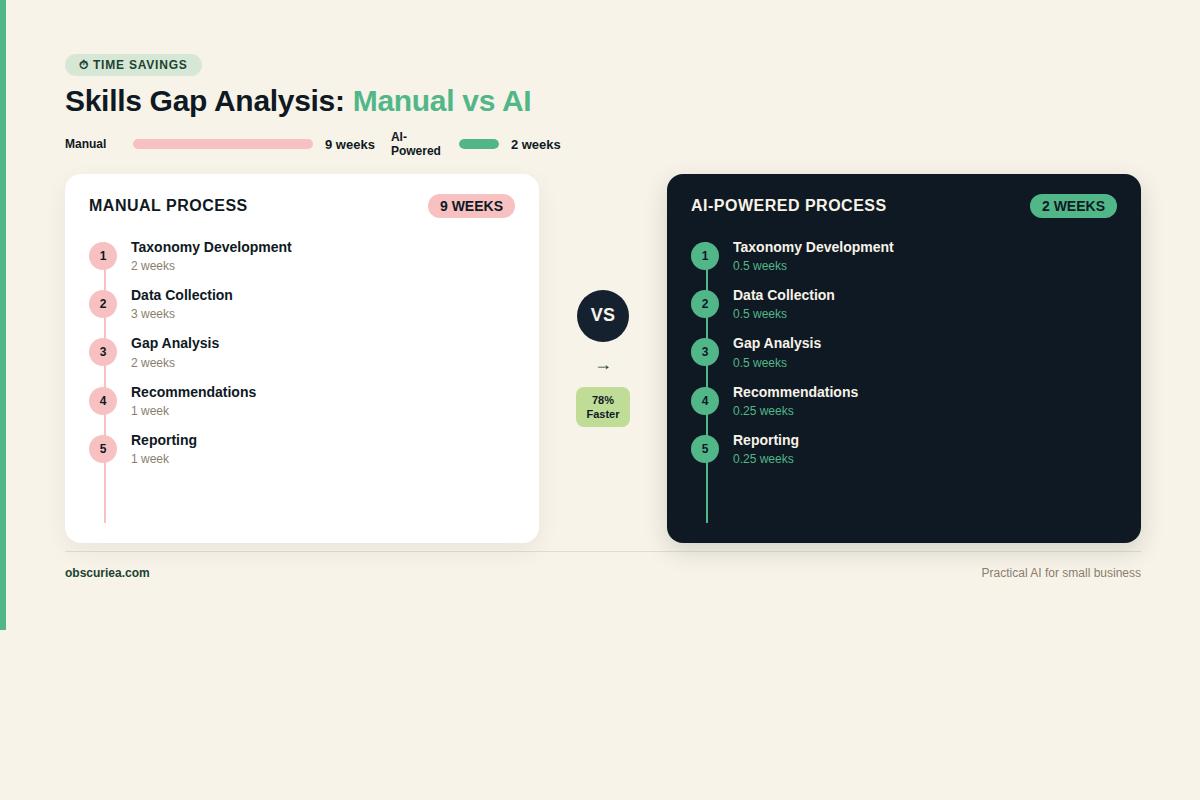
Let’s put numbers on this. For a company of 200 employees:
| Step | Manual Process | AI-Enabled Process |
|---|---|---|
| Skills taxonomy creation | 2 weeks (workshops, manager input) | 1 week (AI suggests initial framework based on job descriptions) |
| Data collection | 3 weeks (survey design, distribution, waiting) | 1 week (integrate existing systems) |
| Gap analysis | 2 weeks (manual comparison) | 2 days (automated matching) |
| Training recommendations | 1 week (HR manually matches courses) | 1 day (engine generates personalized plans) |
| Reporting to management | 3 days (create slide deck) | 1 hour (dashboard) |
| Total | ~9 weeks | ~2 weeks |
Time saved: 7 weeks. For larger organizations, the savings multiply because manual surveys scale poorly. The J&J example involved 4,000 technologists — the manual approach would have taken months.
But here is the catch: the initial setup for the AI version is not free. You need to clean your HR data, define the taxonomy properly, and configure integrations. That upfront cost can be 2-4 weeks of a data analyst’s time. The payoff begins after the first cycle.
Where It Breaks
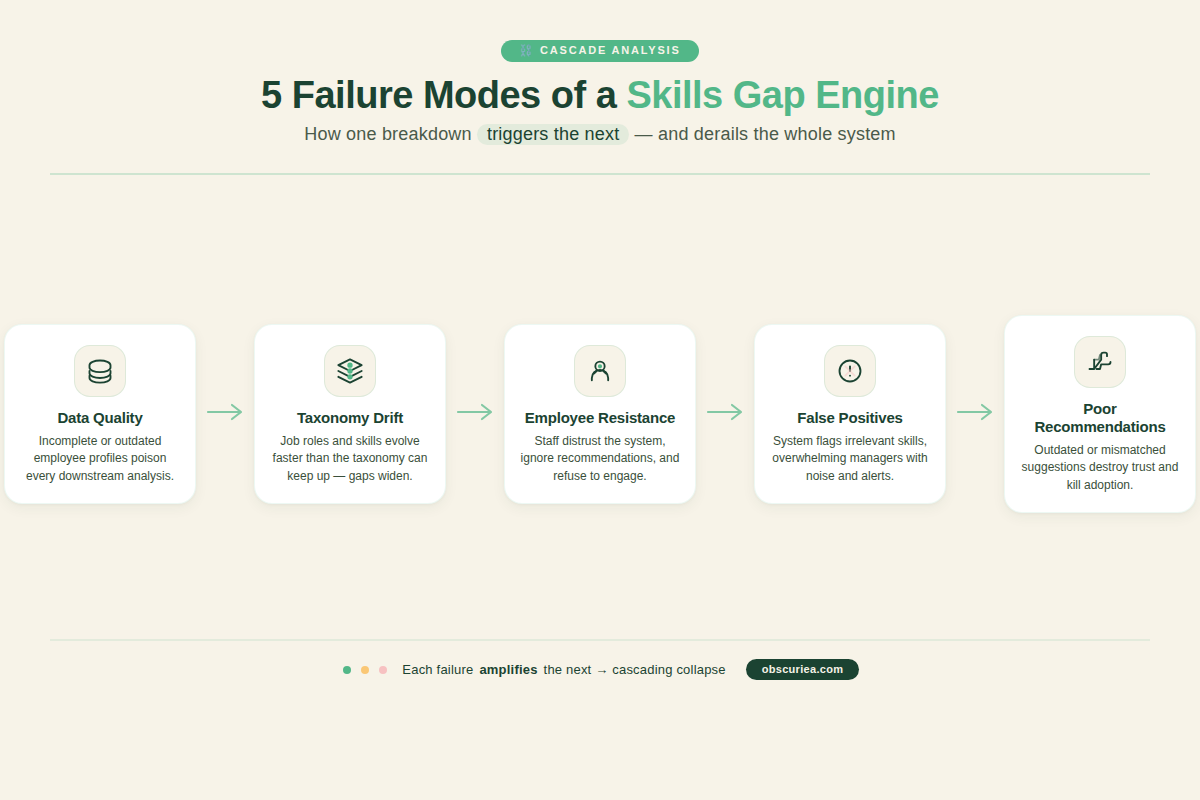
Every skills gap engine has failure modes. Here are the most common ones that source articles hint at but rarely call out directly.
Data quality kills the engine. If your HR system is outdated, or project management tools are not used consistently, the evidence layer produces garbage. The old GIGO rule applies. You need clean, structured data. One department using spreadsheets while another uses Asana means the engine cannot reconcile profiles.
Taxonomy drift. Skills change faster than most companies update their taxonomies. “Robotic process automation” might be a future-ready skill today, but in two years, it could be commoditized. The engine needs a process for periodic taxonomy review — otherwise it recommends training on obsolete skills.
Employee resistance. The MIT article mentions opt-out and non-punitive use. If employees feel their skills profile is used for layoff decisions, they will game the system or refuse to participate. The J&J approach worked because leadership explicitly separated skills inference from performance reviews. Many companies skip this step and wonder why adoption is low.
False positives in gap detection. The LLM-based assessment can overestimate or underestimate proficiency. J&J used a tolerance of 1 point on a 0-5 scale. That is arbitrary. Different roles may need different tolerances. Without calibration, you either waste training dollars on people who already have the skill or miss gaps entirely.
Recommendation engines that recommend poorly. A recommendation engine that suggests generic LinkedIn Learning courses for everyone is useless. The engine must be contextual — matching the training not just to the missing skill but also to the employee’s role, learning style, and schedule. If the engine recommends a 40-hour course for a part-time employee, it will be ignored.
The Friction Box
- Manual survey processes can cost tens of thousands of dollars and become obsolete in months.
- Employee buy-in is fragile; if data is used for firing or demotions, trust evaporates.
- Taxonomy creation is the hardest part — most organizations underestimate the time needed.
- Integration with existing HR and LMS systems is rarely seamless; expect API headaches.
- The recommendation engine is only as good as its training library; if you have few courses, the engine cannot close gaps.
- False positives lead to wasted training budget and employee frustration.
Frequently Asked Questions About Skills Gap Analysis and Training Recommendation Engines
How accurate are AI-based skills gap assessments?
Accuracy depends heavily on data quality and the sophistication of the inference model. The J&J case used a tolerance of 1 point on a 0-5 scale between AI and self-assessment. When the two matched within that range, the scores were considered usable. In practice, expect around 70-80% accuracy in the early cycles, improving as more data accumulates.
What is the typical cost for an AI-powered skills gap solution?
Enterprise-grade platforms can range from $15,000 to over $100,000 per year depending on employee count and features. Open-source options exist but require significant internal data engineering. The manual survey alternative often costs $20,000-$50,000 per cycle, so the ROI can be positive after 1-2 years.
How often should a skills gap analysis be updated?
Continuous update is ideal. The Skilltype platform updates automatically as skills data changes. For organizations that cannot afford that, a quarterly refresh is the bare minimum. Annual analysis is too slow — the data becomes stale within six months.
Do training recommendation engines work for remote teams?
Yes, as long as the engine has access to the same data sources. Remote teams often have more digital footprints (Slack messages, ticket systems, code commits) that can enrich the evidence layer. The bigger challenge is ensuring remote employees trust the system — transparency about data use is even more critical when there is less face-to-face interaction.
Can small businesses benefit from these tools?
For companies under 50 employees, the setup cost often exceeds the benefit. A manually-maintained spreadsheet updated quarterly may suffice. However, some SaaS tools now offer lower-priced tiers for small teams starting around $500/month. The decision hinges on whether the time savings from automated analysis justify the expense.
What happens if an employee refuses to participate?
Opt-out options are essential. The MIT article notes that J&J allowed employees to opt out of skills inference without penalty. Forcing participation destroys trust and leads to inaccurate data. The system should still function for the rest of the workforce; just the missing individual’s skills will be invisible to the engine.
The Straight Talk
This is for any organization with 50+ employees that is facing a skills transformation — whether it is digital, AI, or just a shift in market demands. If you are a solo operator or a very small team, the setup cost likely outweighs the benefit. Stick to simple spreadsheets until you hit that scale.
Your next action: audit your current skills data. Is it clean? Is it structured? Before evaluating tools, know what data you have. Then look at platforms like [IBM SkillsBuild](https://skillsbuild.org), [Gloat](https://gloat.com), or even the specific tools mentioned in the sources. But do not buy until you have fixed your taxonomy.