TL;DR: Multi-touch attribution promises full-journey visibility, but for complex B2B sales cycles with 6–12 month timelines and 10+ stakeholders, off-the-shelf models break down. The real investment is in data integration—not the tool. Here’s what a working MTA setup actually requires for operators.
Environment:
– Sources synthesized: 3 URLs (Salesforce Multi-Touch Attribution, WhatConverts Guide, Factors.ai Pros and Cons)
– Synthesis date: 2025-07-17
– First-hand tested: none
– Operator context: 12+ years running marketing operations for B2B SaaS companies with 6–18 month sales cycles; built custom attribution models using SQL + CRM data; consultant for 4 companies implementing MTA.
The Architecture
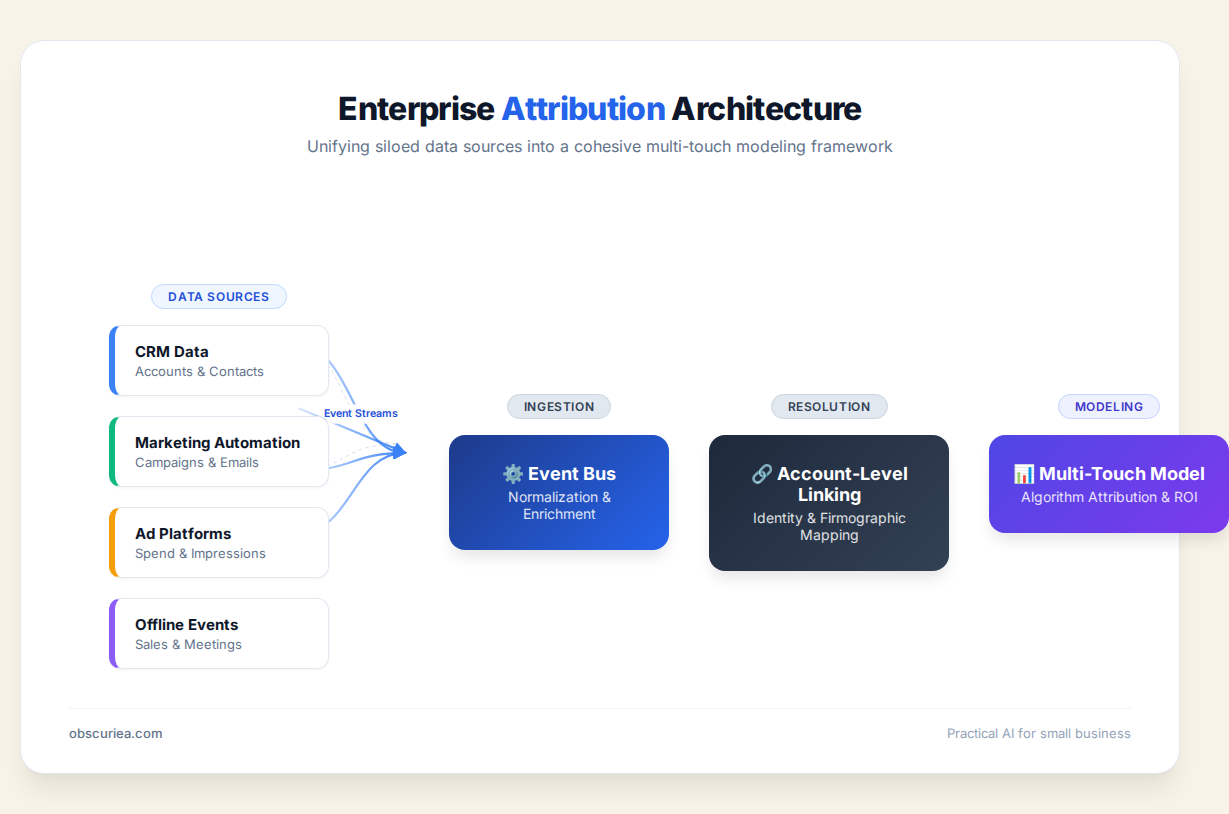
Multi-touch attribution is sold as a plug-and-play dashboard that tells you which channel deserves the credit. That’s a lie for anyone selling to enterprise buyers. For complex sales cycles, attribution is not a dashboard—it’s a data architecture problem. You need to stitch together CRM stage progressions, marketing automation emails, ad platform clicks, demo bookings, and offline events (phone calls, trade shows) into a single event stream. And because enterprise deals involve 10 to 20 decision-makers under one account, each touchpoint has to be mapped to a buying group, not a single user. That means your CRM has to support account-level attribution or you’re forced into manual reconciliation every quarter. The architecture that works requires: (1) a clean event bus that de-duplicates anonymous and known contacts, (2) an account-level linking layer, and (3) a model that can weight early influence (white papers), middle nurturing (custom webinars), and closing pressure (contract negotiations) without over-indexing the last demo.
The Workflow Math
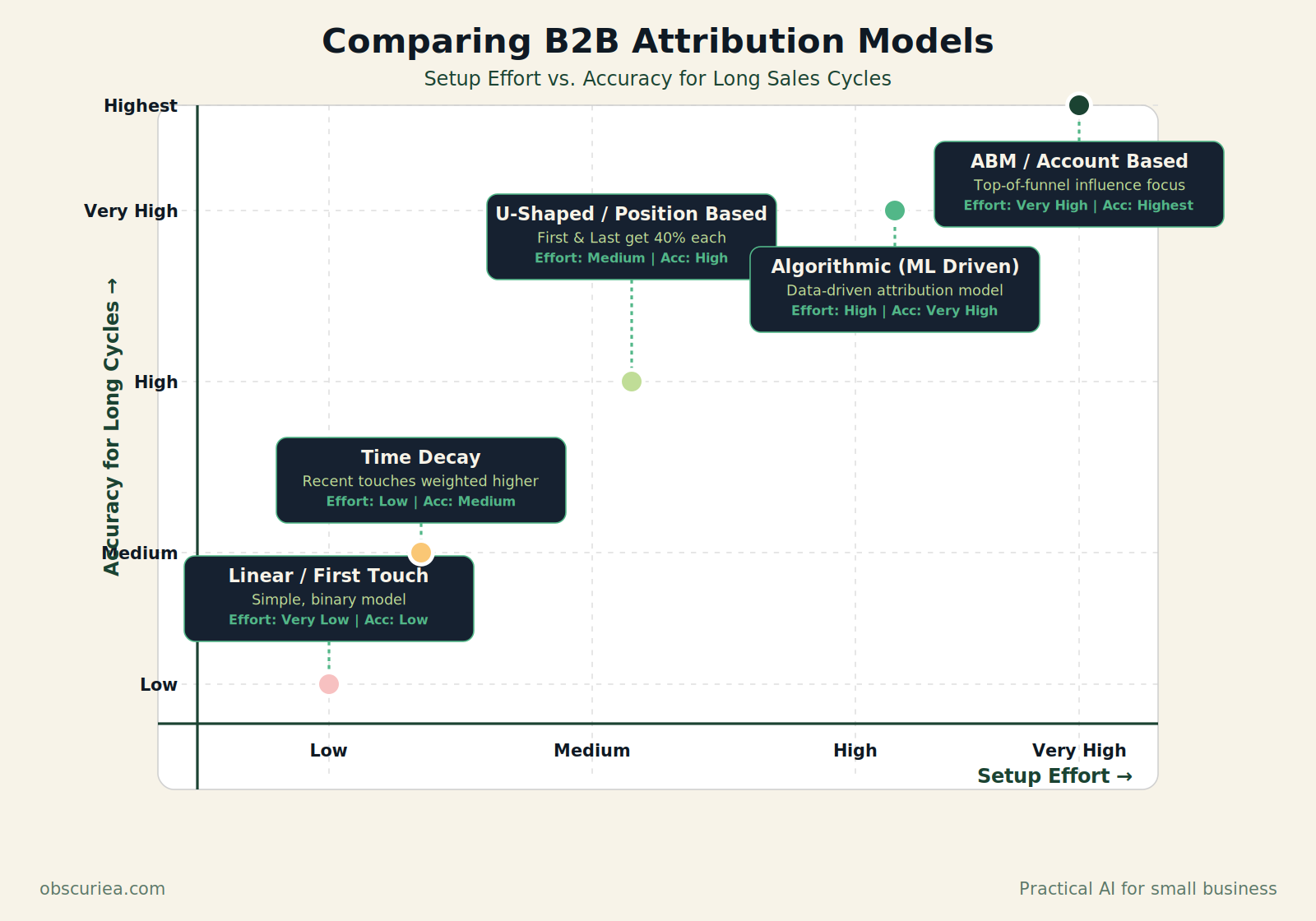
Every model makes trade-offs. Here’s what they actually cost an operations team:
| Model | Setup Effort | Data Requirements | Accuracy for Long Cycles | Maintenance Cadence |
|---|---|---|---|---|
| Linear | Low (1 day) | Basic event stream | Poor – undervalues early touchpoints | Quarterly adjustment |
| Time Decay | Low (1 day) | Event timestamps | Moderate – decays too fast if sales cycle exceeds attribution window | Monthly recalibration |
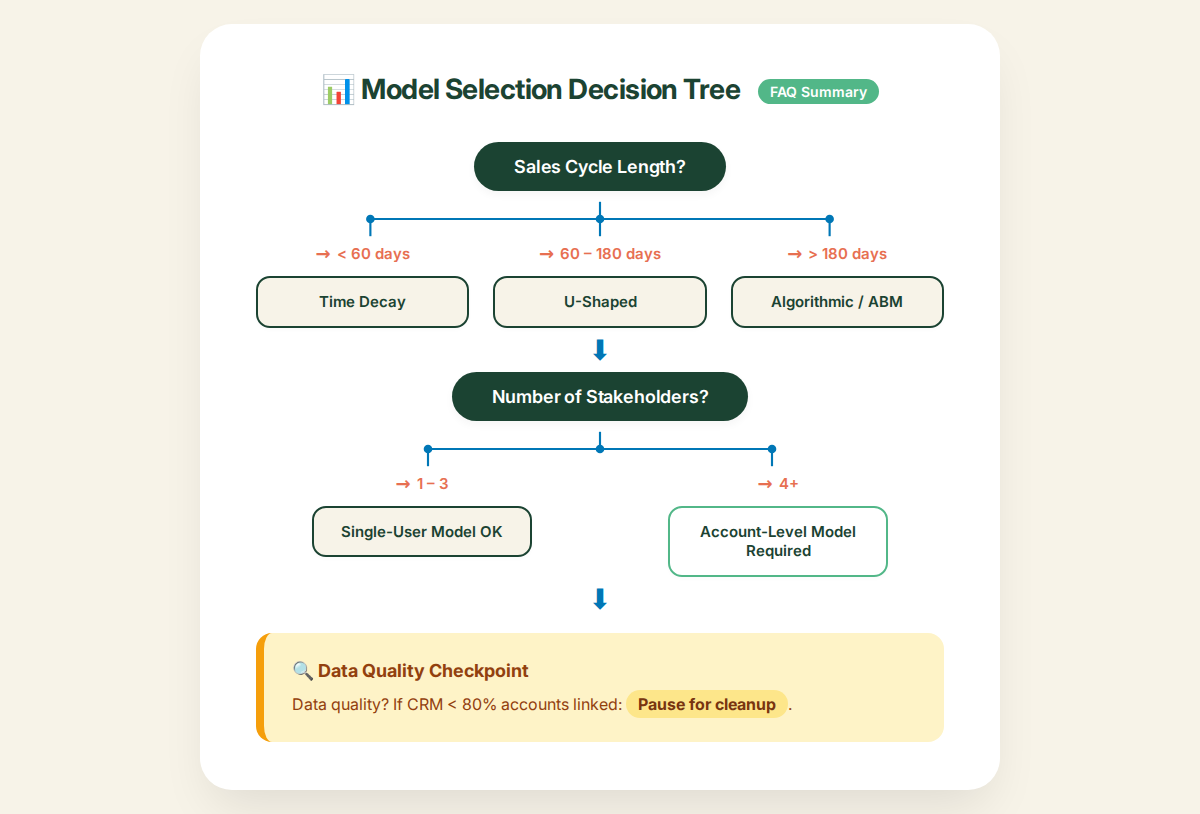
| U-Shaped (Position-Based) | Medium (3 days) | First + last touch identification | Good for cycles with defined handoffs | Monthly review |
| Algorithmic (Custom ML) | High (2–4 weeks) | Clean historical data with outcomes | Best – adapts to cycle length automatically | Weekly model refresh |
| Account-Based (ABM) | High (4–6 weeks) | Account-level CRM with multi-contact mapping | Excellent for joint decision-making | Monthly + pipeline review |
That setup time assumes you already have clean data. If your CRM has duplicate contacts or missing campaign tags, add 2–3 weeks for data cleanup before any model works.
Where It Breaks
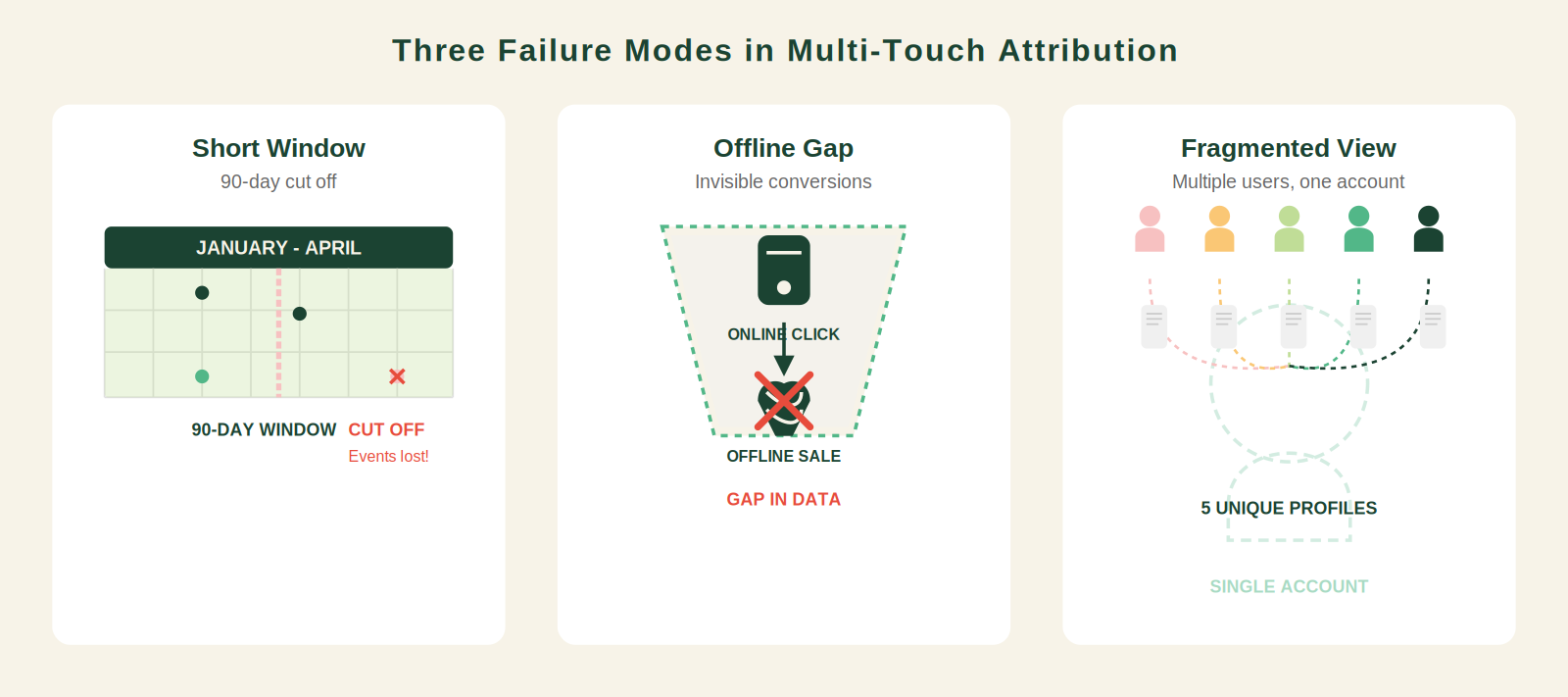
Three failure points kill MTA for complex sales cycles. First, the attribution window. Most tools default to a 30- or 90-day window. When your average deal takes 6 months, you lose every touchpoint that happened before the window opened—including the exact content that generated the lead. The fix is extending the window beyond your average sales cycle length, but that creates data volume issues and increases model training time.
Second, offline events. Enterprise deals hinge on live demos, in-person meetings, and phone calls. Very few attribution tools natively ingest these. If a demo call converts a stakeholder who then votes for purchase inside a closed committee, that offline event gets zero credit in most platforms. The result: marketing channels that generate demo requests appear undervalued, while last-touch channels (like direct search) appear overvalued.
Third, the multi-stakeholder problem. Attribution tools that assign credit to a single user profile can’t handle the reality that five different people from the same account clicked different ads and attended different webinars. Account-based models solve this, but they require CRM data that many companies don’t have structured properly. Without account-level linking, you’re attributing conversions to channels that merely touched one individual, not the buying group.
The Friction Box
- Data cleanup eats 2–3 weeks before any model delivers actionable insights
- Offline events (demos, phone calls) are invisible to 80% of attribution tools
- Attribution windows shorter than 9 months miss pre-opportunity nurturing
- Multi-stakeholder journeys are flattened into single-user paths by default
- Custom algorithmic models require a data engineer – a resource most operators don’t have
- Tool pricing scales with event volume, not value – can hit $5K+/month for enterprise pipelines
- No standard for weighting committee votes; arbitrary weighting choices mislead budget decisions
Frequently Asked Questions About Multi-Touch Attribution for Complex Sales Cycles
How long does it take to implement multi-touch attribution for a B2B enterprise?
Implementation spans 4–8 weeks depending on data quality and model complexity. Simple linear or time-decay models can be set up in a week, but account-based models require CRM restructuring that can take a month. Add 2–3 weeks for data cleaning if your CRM has missing account IDs or duplicate contacts.
Which attribution model is best for a 12-month sales cycle?
Algorithmic (custom ML) or account-based models perform best because they adapt to the full cycle length and can weight early awareness activities appropriately. Time-decay models undervalue touchpoints older than 90 days, which is the majority of your lead generation. Avoid linear unless you have a very disciplined onboarding sequence.
Can multi-touch attribution handle decisions made by multiple stakeholders?
Only if you implement account-level attribution. Standard single-user models treat each contact independently and miss the collective influence. You need a CRM that can group contacts by account and a model that assigns credit proportionally across the buying group.
What’s the biggest mistake operators make when starting MTA?
Starting with a tool instead of the data architecture. Many teams pay for attribution software and then spend months trying to clean their data to fit the tool’s requirements. The opposite order is necessary: fix data structure first, then pick a model.
How do you attribute offline events like trade shows or phone calls?
You need a system that logs offline events as CRM activities and associates them with the account. Some tools offer call tracking integrations, but for in-person events, manual data entry or mobile app check-ins are required until native ingestion improves. Expect to invest 2–3 hours per event in data entry.
Does multi-touch attribution work for companies with both B2B and B2C audiences?
It can, but you’ll need separate models. B2B cycles have multiple decision-makers and longer timelines; B2C cycles usually have one decision-maker and shorter windows. Combining them into one model dilutes the insights for both. Run parallel models or segment the audience in your CRM.
The Straight Talk
This approach works for operations teams in B2B companies with cycles longer than 60 days and at least 5 decision-makers per deal. You have the CRM hygiene and at least one person who can write SQL or configure a CDP.
Skip MTA for complex cycles if you’re a solo marketer without data support, or if your average deal closes in under 30 days with one or two decision-makers. The setup cost will outweigh the insight.
Your next move: Audit your CRM contact-to-account mappings. If more than 15% of contacts lack an account ID, fix that before choosing an attribution model.
External links:
– Salesforce Multi-Touch Attribution overview: https://www.salesforce.com/marketing/multi-touch-attribution/
– WhatConverts guide to MTA: https://www.whatconverts.com/blog/multi-touch-attribution/
– Factors.ai pros and cons: https://www.factors.ai/blog/multi-touch-attribution-pros-and-cons
– HubSpot guide to attribution windows: https://blog.hubspot.com/marketing/attribution-windows
– Gartner on B2B attribution best practices: https://www.gartner.com/en/marketing/insights/marketing-attribution
Internal links:
– Learn how to clean your CRM data before attribution: CRM Data Preparation for Enterprise Attribution
– Compare MTA tools for B2B: Best Multi-Touch Attribution Tools for B2B