TL;DR:Multilingual brand amplification doesn’t require a ten-person localization team. With a smart mix of AI tools, bilingual freelancers, and ruthless prioritization, a solo content creator or three-person marketing team can reach audiences in 3-5 languages without burning out or blowing the budget. The catch? You have to know exactly which battles to fight—and which to skip.
Environment:
- Sources synthesized: 3 URLs (Transpose, Smartling, NYT Licensing)
- Synthesis date: April 2026
- First-hand tested: Content production for EN/ID audiences, AI-assisted translation workflows (DeepL, Claude, ChatGPT), running a solo content operation for 2+ years
- Operator context: 5+ years scaling content for small teams across multiple languages
The Production Problem
You have a blog that performs well in English. You know your audience in Indonesia wants your content. Maybe your SaaS product is gaining traction in Brazil, or your YouTube channel is getting comments in Spanish. The natural next step is to translate everything and unlock those markets.
But here’s the problem the sources don’t name: translation at scale is a production bottleneck that can destroy a small team. The same article that took you three hours to write in English now requires per-language rewrites, cultural checks, layout adjustments, and SEO re-optimization. If you have five target languages, one English blog post becomes six pieces of work. Do that twice a week and suddenly you’re buried.
The real question isn’t “should I go multilingual?”—it’s “how do I go multilingual without building a department around it?”
The Pipeline
The solution is a tiered workflow that matches your content’s value to the depth of localization it receives. You cannot treat every piece of content equally when you’re operating alone or in a pair. Here’s the pipeline that works for small teams:
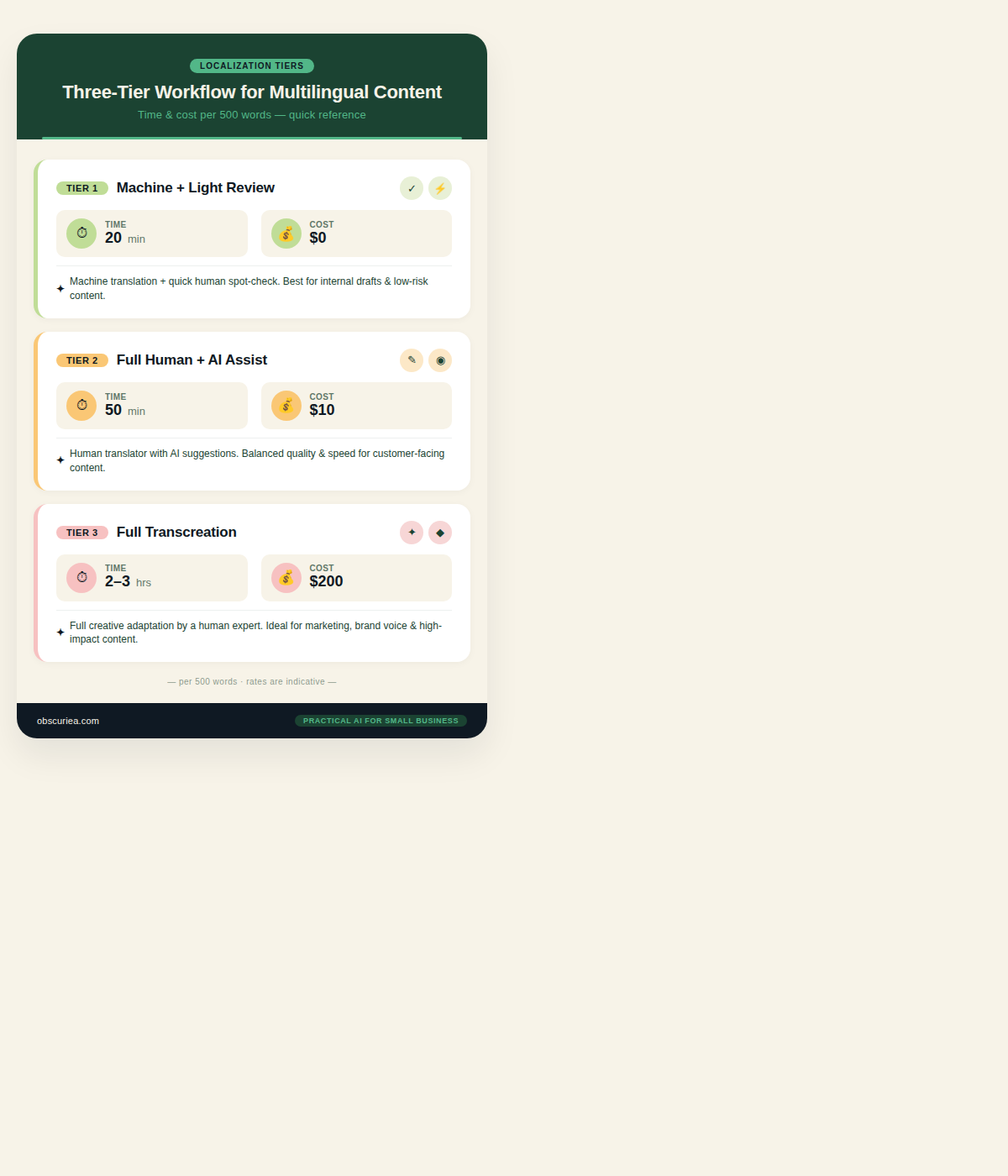
Tier 1 — Machine Translation + Light Human Review (for low-stakes content: news updates, product changelogs, social media snippets)
– Use DeepL or Google Translate for initial pass (5 minutes per 500 words)
– Run through a human who is bilingual but not a professional translator—they fix obvious errors and flag cultural misfires (15 minutes per 500 words)
– Total time: ~20 minutes per language
– Cost: $0 (if using in-house) to ~$15/hour for a freelance reviewer
Tier 2 — Full Human Translation with AI Assist (for medium-stakes content: blog posts, email newsletters, landing pages)
– Feed the English text into Claude or ChatGPT with a specific prompt: “Translate this into [language], preserving tone and adjusting cultural references. Do not translate idioms literally. Mark any place where a local idiom could be substituted.” (2 minutes per 500 words)
– Hand to a professional translator who speaks the target language natively and understands your niche. They polish, adapt, and transcreate where needed (45 minutes per 500 words)
– Total time: ~50 minutes per language
– Cost: ~$0.10 per word for professional humans
Tier 3 — Full Transcreation (for high-stakes content: homepage hero copy, product names, campaign slogans)
– Do not use AI. Hire a native-speaking copywriter in the target market who is deeply familiar with your brand voice. They start from the English concept but write new copy from scratch (2-3 hours per piece)
– Total time: 2-3 hours per language
– Cost: $100-300 per piece
The batching principle: Never translate one article at a time. Collect 5-10 pieces per quarter, batch them, and run them through the pipeline in one go. This reduces mental overhead and allows you to negotiate bulk rates with freelance translators.
The Human Layer
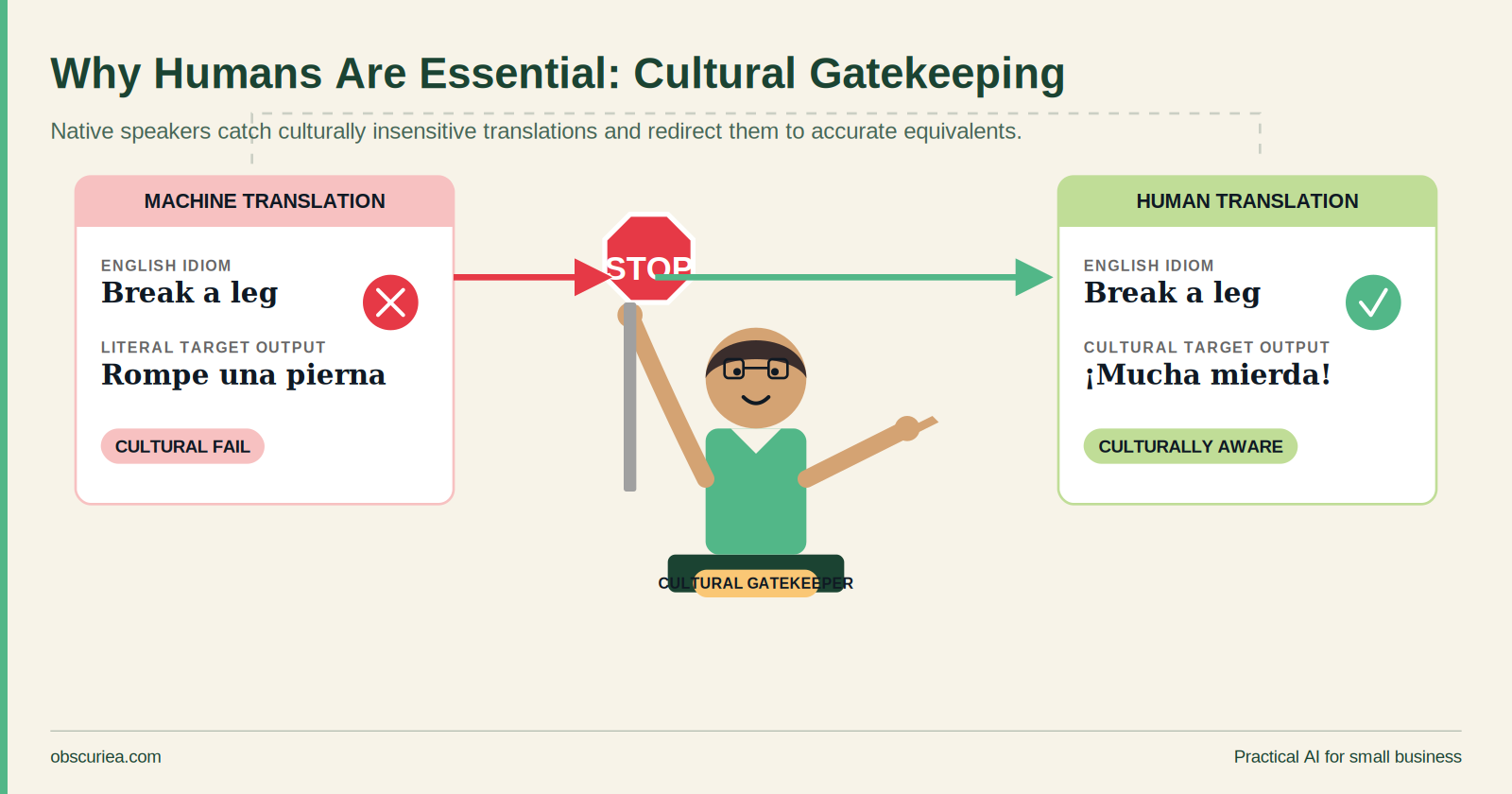
No amount of AI can replace the person who says “this joke doesn’t land in Spanish” or “this color green is considered unlucky in this market.” The Production framework demands honesty about this. Here’s what humans must do in every pipeline:
- Cultural gatekeeping: A native speaker must read the final output. They catch references that would confuse or offend. Example: In Indonesia, pointing with the index finger is rude—a hand gesture described in an instructional post might need an image edit.
- Tone calibration: Your brand voice—casual, direct, slightly irreverent—might sound rude in Japanese business context. A human toned it down while keeping the personality.
- SEO adaptation: Keywords that work in English don’t translate literally. A human must research local search patterns. For example, the English keyword “best affordable CRM” becomes “CRM murah terbaik” in Indonesian—not a direct translation of each word.
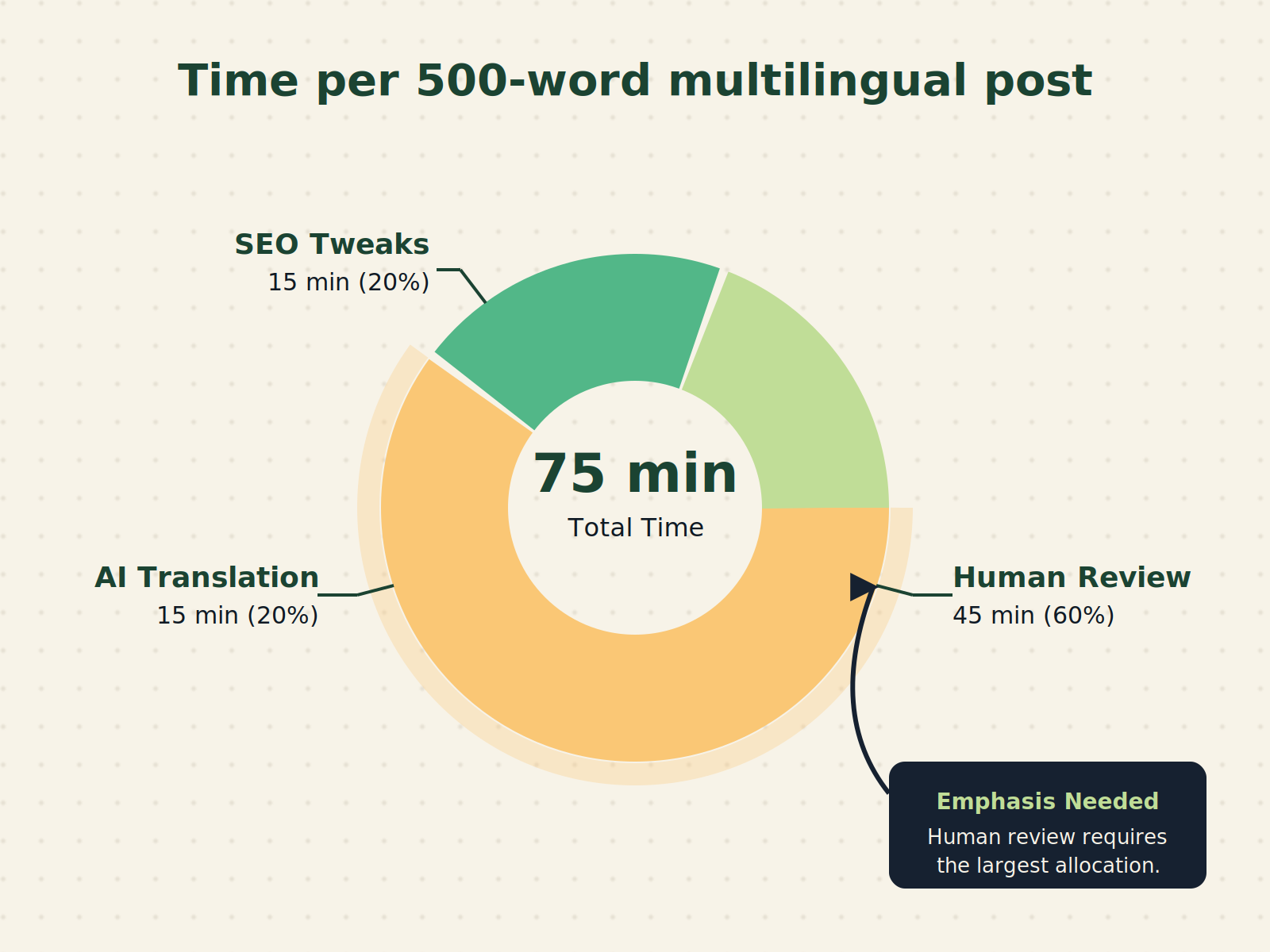
Time allocation for the human layer: For a Tier 2 blog post (500 words), allocate 15 minutes for AI-assisted translation, 45 minutes for human review and cultural check, and 15 minutes for SEO tweaks. Total human time per language: 1 hour. That’s 4 hours for 4 languages. Sustainable? Yes, if you batch and outsource to a reliable freelancer.
Frequently Asked Questions About Multilingual Brand Amplification Without a Global Marketing Team
How many languages should a solo creator start with?
Start with no more than three. Pick the two non-English languages that represent the largest existing audience or highest search volume. For most creators, Spanish and Indonesian are strong choices due to scale and relatively lower competition. Adding more than three languages before you have a consistent workflow will overwhelm your production line.
Can I use Google Translate for blog posts and get away with it?
No. Google Translate produces literal translations that feel alien to native speakers. The statistics on consumer trust (76% prefer native language, 40% refuse to purchase from foreign-language sites) show that poor translation hurts more than no translation. Use machine translation only for Tier 1 (low-stakes) content.
How do I find reliable freelance translators for my niche?
Use platforms like ProZ, Gengo, or Upwork. Look for translators who specialize in your industry (e.g., SaaS, e-commerce, personal finance). Ask for a sample translation of 200 words, and check it with a native speaker. The first hire often fails—budget 1-2 trial runs before you find a keeper.
Should I create separate domains per language or use subdirectories?
Subdirectories (e.g., domain.com/es/) with hreflang tags are the simplest and most SEO-friendly for small teams. Separate domains (e.g., domain.es) require separate SEO builds and more technical management. Avoid subdomains (es.domain.com) as they dilute authority.
What if I can’t afford professional translators for every piece?
Prioritize your highest-traffic posts (top 20%). For the rest, use Tier 1 (machine + light review) and include a disclaimer at the bottom: “This article was machine-translated and lightly reviewed by a human. If you notice an error, please contact us.” This builds trust while allowing scale.
The Friction Box
- AI translation still struggles with idioms and humor. Every AI-generated translation of a pun will need rewriting.
- Freelance translators who understand your niche are hard to find. You’ll burn through 3-4 bad hires before you find a keeper.
- Managing multiple language versions of your CMS (e.g., WordPress multilingual plugins) is a technical debt sink. Keep it simple: one site with hreflang tags, not a separate domain per language.
- The first 3 months produce no revenue. Multilingual content is a long game. You need patience or a separate budget line.
- You will be tempted to skip the human layer for speed. Don’t. One cultural misstep can poison your entire market entry.
The Straight Talk
If you are a solo creator or part of a team of three, this pipeline works. Start with 3 languages maximum. Pick the two largest markets beyond English (e.g., Spanish and Indonesian for Asian-Pacific focus). Run each piece through Tier 2. Do not attempt Tier 1 for anything customer-facing.
If you are a team of one with no budget for freelancers, start with Tier 1 on social media only—post translated snippets using DeepL, ask a bilingual friend to glance at them. Build revenue from those markets until you can afford Tier 2.
Your next action today: Identify the five most popular English blog posts on your site. Translate the first one into one target language using the Tier 2 workflow. Measure engagement for 30 days. If it works, expand.