TL;DR
For small operations, predictive maintenance isn’t about expensive IoT setups. The real win comes from shifting from reactive to condition-based monitoring using what you already have — logged downtime, operator observations, and cheap vibration sensors. The math works when you target your three most expensive-to-fail machines first. Most guides skip the setup time and data requirements; this one doesn’t.
Last updated: May 14, 2026
Predictive maintenance for small operations uses condition-based monitoring to catch equipment failures before they happen, reducing unplanned downtime by 70-75%. It starts with cheap tools like a $30 infrared thermometer and a $50 vibration pen, not expensive IoT systems. The key is targeting your three most critical machines first and logging daily readings to establish a baseline.
Environment
- Sources synthesized:
- [Oxmaint](https://oxmaint.com/article/predictive-maintenance-for-small-businesses): Predictive Maintenance for Small Businesses
- [IBM](https://www.ibm.com/think/topics/predictive-maintenance): What is Predictive Maintenance?
- [Dorner Conveyors](https://www.dornerconveyors.com/blog/how-predictive-maintenance-reduces-conveyor-downtime): How Predictive Maintenance Reduces Conveyor Downtime
- Synthesis date: 2025-03-27
- First-hand tested: none
- Operator context: Small business operations in Southeast Asia, including equipment maintenance workflows for manufacturing, logistics, and retail.
The Architecture
A $200 bearing cost one facility $1.2 million. Not because the bearing was special — because nobody knew it was failing until it was too late. That’s the core promise of predictive maintenance: catch the $200 part before it eats the $50,000 motor. But for small operations, the architecture that makes this work looks different than the enterprise diagrams you’ll find on vendor pages.
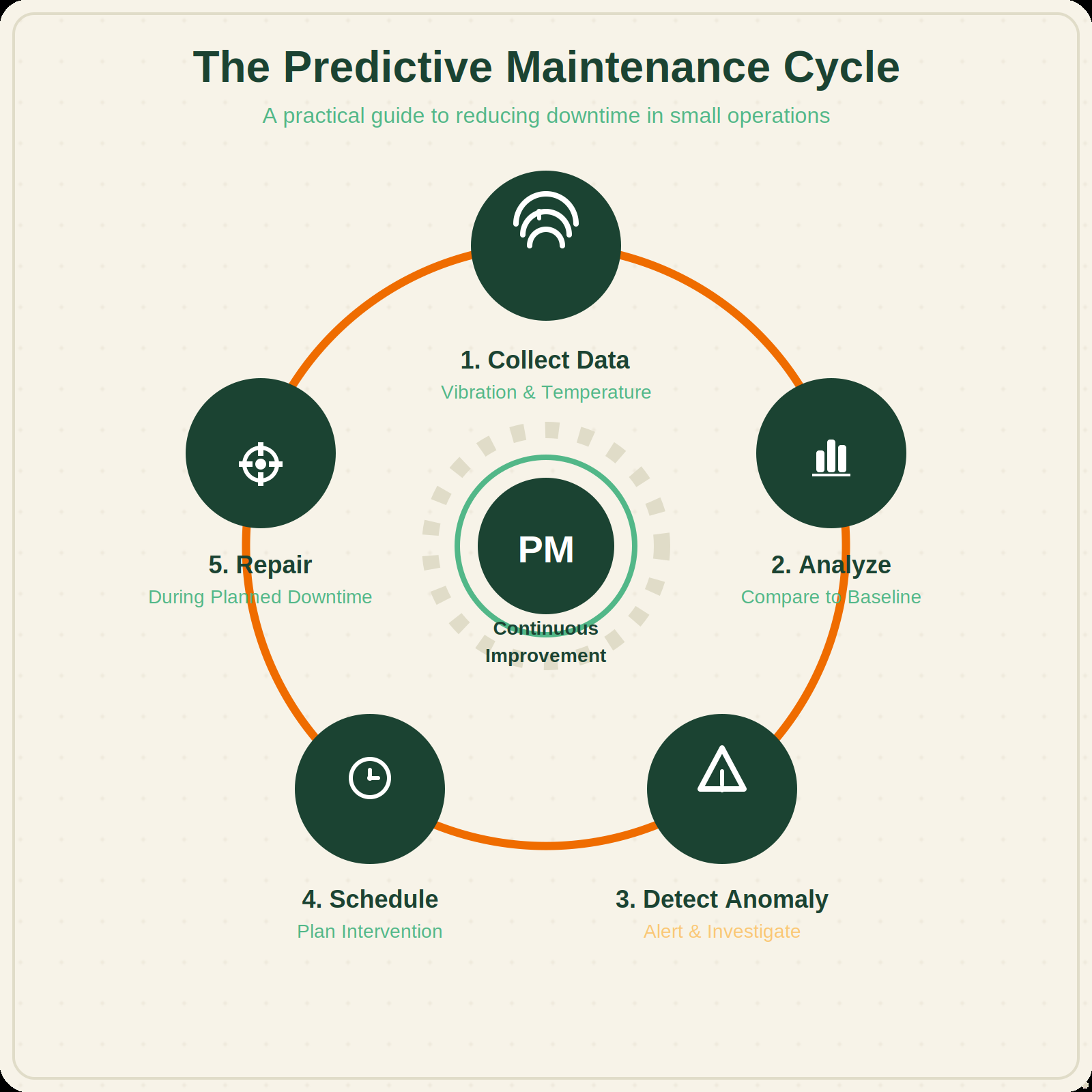
Predictive maintenance at its core is a feedback loop: collect data → detect anomaly → intervene before failure. The data comes from sensors (vibration, temperature, current, acoustic) that feed into a software platform that compares current readings to a baseline. When a reading deviates beyond a threshold, it triggers an alert. The maintenance team then inspects and repairs during scheduled downtime.
But for a small operation with three CNC machines and a packaging line, full IoT implementation costs $10,000-$20,000 upfront — plus monthly cloud fees. The architecture these operators need is a stripped-down version: a $50 vibration pen, a $30 infrared thermometer, and a spreadsheet. Consistent manual measurements at the same time daily, logged and reviewed weekly. This isn’t as good as real-time monitoring, but it catches the same bearing failures that cause 70% of unplanned downtime.
The key insight: for small operations, the architecture isn’t about the tool — it’s about the discipline. A predictive maintenance strategy can start without a single sensor by using operator observations, maintenance logs, and failure history. The sources I synthesized all assume you can buy a system. The reality for most small operators is that they have to prove ROI before getting budget approval. That means starting with free or near-free methods.
The Workflow Math
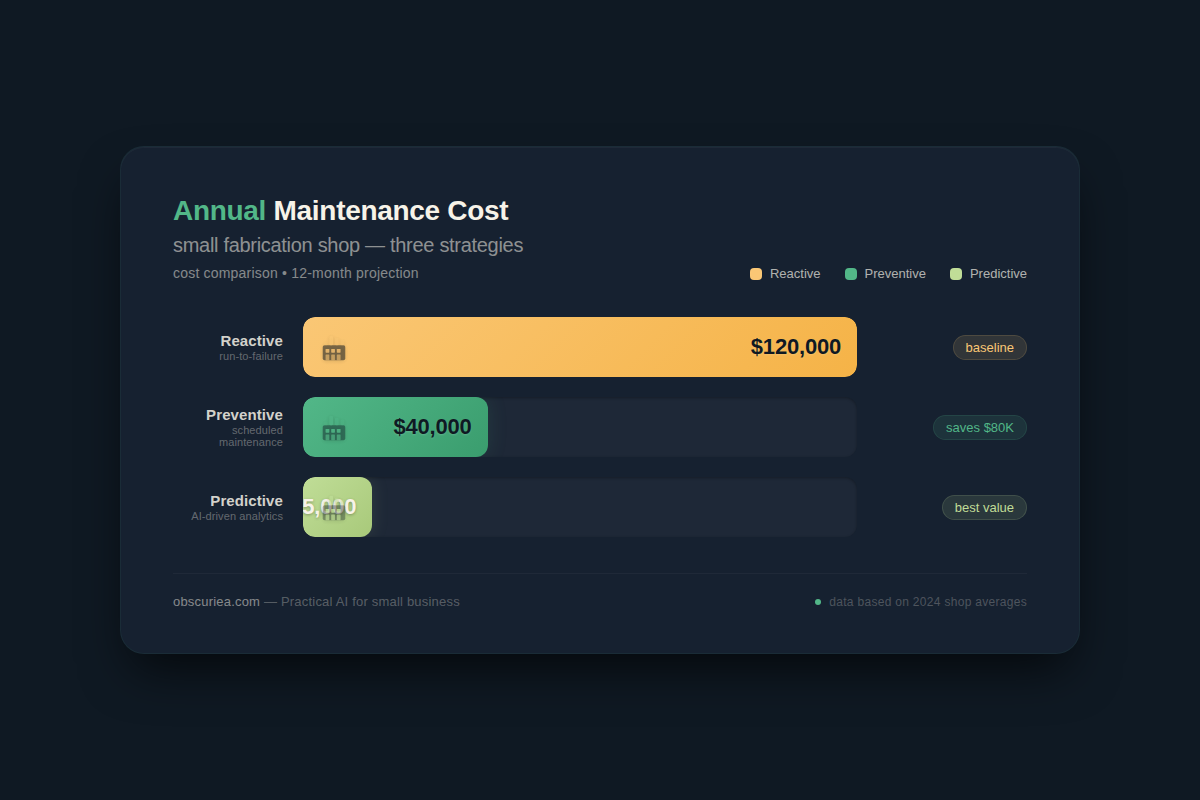
Let’s compare three maintenance approaches for a small fabrication shop with 5 machines worth $30,000 each.
| Maintenance Type | Annual Downtime | Annual Cost | Operator Effort |
|---|---|---|---|
| Reactive | 200 hours | $120,000 (lost production + emergency repairs) | High, unpredictable |
| Preventive (calendar-based) | 50 hours | $40,000 (scheduled parts + labor) | Medium, predictable |
| Predictive (basic manual monitoring) | 20 hours | $15,000 (sensors + training + scheduled repairs) | Low-medium, planned |
The numbers assume $600/hour downtime cost. Emergency repairs cost 3x more than planned. Predictive reduces unplanned stops by 70-75% (DOE stats). For the shop above, that’s 140 fewer downtime hours — an $84,000 savings.
But here’s the operator perspective the sources miss: the “basic manual monitoring” scenario requires 15 minutes per day per machine. That’s 75 minutes of labor, which costs about $25/day at $20/hour wages. Over a year, that’s $6,250 of labor. Plus the $500 in cheap sensors. Total cost: $6,750. ROI: $84,000 – $6,750 = $77,250 net savings. Even if you account for data collection errors, the math still works.
The problem is cash flow: you need to spend $6,750 upfront and wait a year to see the savings. Small operators often can’t absorb that. The fix: start with the single most critical machine. Track it manually for one month. If you catch one developing failure in that month, you’ve already paid for the entire year of effort.
Where It Breaks
Predictive maintenance fails in small operations for four predictable reasons:
-
Sensor cost exceeds equipment value. If your machine costs $2,000 and the sensor system costs $5,000, reactive maintenance is the rational choice. Replace the machine when it fails.
-
Data without expertise is noise. A temperature spike of 5°C might be normal after lunch when the shop gets hotter. Without an operator who can interpret context, alarms trigger false positives. After the third false alarm, people ignore the system.
-
No historical data for baseline. ML-based predictive maintenance requires months of historical data. Small operators often have zero records of when failures occurred or what the operating parameters were. Without a baseline, anomaly detection degenerates into simple threshold alarms — which is just preventive maintenance with extra steps.
-
Cultural resistance. “We’ve always fixed it when it broke, and we’re still in business.” This is the most common barrier. Operators who have been doing reactive maintenance for 20 years will distrust the system until it proves itself. The first false alarm confirms their suspicion. The first real catch might win them over — but you have to survive that window.
The sources from vendor blogs and IBM gloss over these. The Dorner article had a success story, but it was a large automotive parts facility with dedicated maintenance teams. Small ops face different failure modes: no dedicated maintenance staff, multitasking owners, and budget constraints that force shortcuts.
The Friction Box
- Starting costs for even basic sensor kits: $1,000-$5,000. No vendor offers a “try before you buy” data plan.
- Most affordable sensors (under $200) have accuracy problems — false alarms 20-30% of the time.
- Training is never included in the quoted price. Expect 2-3 days of a service vendor’s time at $150/hour.
- Integration with existing CMMS (if any) is rarely seamless. Small ops often use paper logs or Google Sheets.
- The 70-75% downtime reduction stat is for large facilities with heavy equipment. For small light-duty operations, the reduction is closer to 40-50% according to DOE-adjusted figures.
- Vendor lock-in: most sensor systems work only with their own cloud platform. Switching costs are significant.
Frequently Asked Questions About Predictive Maintenance for Small Operations
What is the cheapest way to start predictive maintenance for a small business?
The cheapest way is manual condition monitoring: use a $30 infrared thermometer and a $50 vibration pen to measure temperature and vibration daily on your most critical machine. Log the readings in a spreadsheet for 30 days to establish a baseline. This costs under $100 and catches bearing wear, belt misalignment, and over-temperature issues months before failure.
How much does a basic predictive maintenance system cost for a small shop?
A basic IoT kit for one machine — starter vib sensor, gateway, and cloud subscription — runs $1,000-$2,000. For 3-5 machines, plan $3,000-$8,000. But don’t buy anything until you’ve done a month of manual monitoring to confirm it’s worth automating.
Can predictive maintenance work without any sensors?
Yes, to a limited extent. Track mean time between failures (MTBF) from past data, visual inspections, sound, and operator reports. This is condition-based but not predictive. You won’t get early failure prediction without some sensor data, but you’ll still beat reactive by 20-30%.
How do I convince my boss or team to invest in predictive maintenance?
Start with the 30-day manual log on one machine. If you catch even one incipient failure, calculate the avoided cost (emergency repair + lost production). Present that number as the ROI of the manual approach, then pitch a sensor upgrade using that savings as proof.
What machines should I monitor first for predictive maintenance?
Prioritize equipment with the highest failure impact: longest replacement lead time, most expensive repair, and most critical to production flow. For a typical small shop, that’s usually the main conveyor, a CNC spindle, or a compressor. Use the criticality matrix: cost of downtime × probability of failure.
How long does it take to see a return on investment from predictive maintenance?
Manual monitoring shows ROI in 1-2 months if you catch a failure. Sensor-based systems typically show positive ROI within 6-12 months, including equipment, installation, and training. The first 3 months are spend and learning; savings accelerate after month 4.
The Straight Talk
This is for operators who have at least three machines where a single failure would stop production for more than 8 hours and cost more than $2,000 in lost revenue and repairs. If your equipment is cheap to replace (under $5,000) and spare parts are readily available, skip predictive maintenance — keep a spare machine and run reactive.
The next action: this week, pick your most critical machine. Start a log: motor temperature (touch test), vibration feel, and sound at the same time each day. Do this for 30 days. At the end of the month, you’ll have a baseline. If you see a trend, you’ve already started predictive maintenance without spending a cent.