TL;DR: Small businesses now face a policy vacuum that is not a theoretical problem. Over 1,200 state AI bills were introduced in the first three months of 2026 alone, and the current federal posture actively blocks state regulation without providing any alternative framework. This uncertainty directly affects tool availability, compliance costs, and the decision to adopt AI that could save a five-person shop 10 hours a week. For now, owners must operate with a risk-management mindset rather than waiting for clarity that may take years.
The Architecture
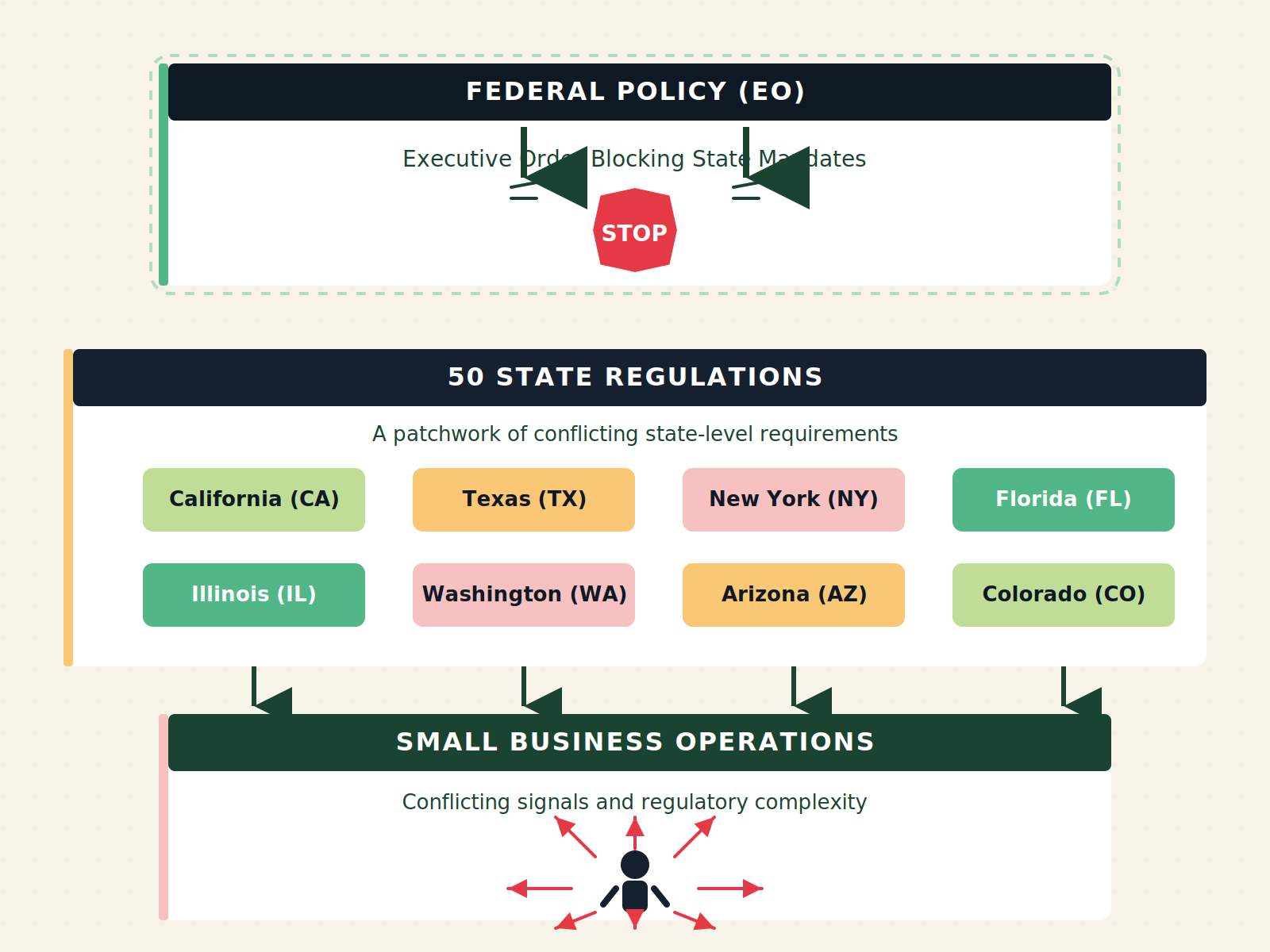
The regulatory architecture for AI in the United States is a hollow structure. There is no comprehensive federal AI legislation. The only federal action of substance is an Executive Order signed in December 2025 that restricts states from regulating AI beyond a “minimally burdensome national policy framework.” The order allows the attorney general to sue or withhold funds from states that step outside that framework. But it offers no replacement. It does not create a federal regulatory body. It does not set safety standards. It does not preempt existing state laws—it attempts to prevent new ones, but its legal standing is uncertain.
What this means for a small business owner is simple: the rules are being written in 50 separate legislatures, all moving at different speeds, with different definitions of “high-risk AI,” and different penalties. By late 2025, 38 states had enacted some form of AI-related legislation. In 2026, the pace has accelerated—over 1,200 new bills in just the first quarter. The [Business Roundtable](https://www.businessroundtable.org/) has explicitly called for federal preemption of state AI laws, citing “uncertainty” and “fragmentation.” They are not wrong about the problem. But their solution—broad preemption without a federal alternative—serves companies with legal departments, not the owner who is also the bookkeeper.
The architecture that results is a three-layer problem: a federal policy that blocks state action, a state-by-state scramble to fill the gap, and a small business sector that must navigate both. This is the policy vacuum. It is not empty—it is filled with conflicting signals, compliance obligations, and legal risk that hit hardest at the smallest scale.
The Workflow Math
The operational question for a small business owner is: what is the cost of regulatory uncertainty? To answer that, we have to look at three numbers: the time cost of compliance, the risk cost of non-compliance, and the opportunity cost of inaction.
Compliance time cost. The [Cicero Institute](https://ciceroinstitute.org/) reports that compliance requirements add roughly 17% overhead to AI system costs, based on industry estimates. For a $20/month bookkeeping tool, that is $3.40. For a $500/month marketing automation suite, it is $85. But the percentage masks the real burden: the small business owner does not have a compliance team to absorb that 17%. They either pay it in the subscription price (if the vendor passes it through) or they spend their own hours figuring out if the tool violates a law in their state. A large corporation—Business Roundtable members—assigns a compliance analyst to track all 50 states. A small business owner has zero analysts. The time cost of staying informed is often higher than the tool itself.
Non-compliance risk cost. Colorado’s SB 205 imposes fines up to $20,000 per violation for each day a high-risk AI system operates without an impact assessment. Washington’s HB 2157 has no size exemption—a five-person shop faces the same compliance burden as Microsoft. The probability of enforcement against a small business might be low today, but it is non-zero, and a single fine can wipe out a year’s worth of AI savings.
Opportunity cost of inaction. The same source notes that small businesses using AI tools added roughly 1.7% more staff within six months compared to non-adopters. For a five-person shop, that is 0.085 new hires—but the revenue gains are meaningful. AI bookkeeping alone can save 10-15 hours per week. At $50/hour billable time, that’s $500-$750 per week in reclaimed capacity. Multiply by the months of delay caused by regulatory uncertainty, and the lost opportunity dwarfs most compliance costs.
Here is the math that matters: if you run a five-person plumbing business in Colorado and you use an AI scheduling tool, you might be operating a “high-risk” system under SB 205 if the tool makes decisions about which jobs to prioritize. Compliance audit: 4-6 hours of your time or $500 to a consultant. Non-compliance fine: $20,000. Inaction: you keep manually scheduling, losing 5 hours a week forever. The rational operator chooses to adopt with careful vendor selection, but the uncertainty itself is a tax on their time.
| Scenario | Time Cost | Monetary Cost | Outcome |
|---|---|---|---|
| Compliance audit | 4-6 hours | $500 (consultant) | Low risk, but ongoing monitoring needed |
| Non-compliance fine | 0 hours | $20,000 | One-time shock, potential further legal costs |
| Inaction (stay manual) | 5 hours/week | Lost revenue ~$25,000/year | Guaranteed productivity loss |
Where It Breaks
The vacuum breaks in predictable places. First, decision paralysis. When the rules are unclear and change every quarter, many small business owners simply stop evaluating AI tools. They freeze. This “wait-and-see failure” means you lose ground to larger competitors who can afford to move anyway.
Second, vendor market exit. Hawaii’s S.B. 2923 would require “affirmative proof” of safety for any AI product, including a scheduling assistant, before it can be used in the state. When compliance is that onerous, software companies skip the state. They don’t build for Hawaii. Small businesses in heavily regulated states get the worst version of AI—if they get any at all. This creates the two-tier system: large corporations get custom enterprise agreements; small shops get nothing.
Third, unintended liability. Illinois’s HB 3773 applies to any employer with one employee and requires notice when AI touches an employment decision. If you use an AI resume screener for one hire, you trigger the law. Most owners will not know that until they receive a demand letter.
Fourth, the Business Roundtable’s own proposal for “regulatory sandboxes” sounds promising, but sandboxes are designed for companies that can afford to apply for waivers and navigate federal coordination. A small business cannot apply for a waiver in every state. Sandboxes help large tech firms test products; they do not help a plumber adopt a bookkeeping tool.
Fifth, the political pendulum. The Trump EO could be reversed by the next administration. State laws could be struck down or upheld. The only certainty is that the rules will change again. No small business can build a five-year AI strategy on that foundation.
The Friction Box
- Owners cannot predict compliance costs 12 months from now.
- Each state defines “high-risk AI” differently; a tool that is safe in Texas may be illegal in Colorado.
- No single database tracks all state AI regulations with small business exemptions (where they exist).
- AI tool vendors rarely provide state-by-state compliance guarantees; the burden falls on the buyer.
- Hiring a compliance lawyer for a $20/month tool is absurd, but ignorance carries risk.
- Political whiplash: what is permitted today may be retroactively deemed illegal tomorrow.
- The time spent reading about regulations is time not spent on customers or growth.
Frequently Asked Questions About Regulatory Lag and Small Business AI
What exactly is the regulatory vacuum for AI?
The vacuum refers to the absence of a cohesive federal regulatory framework for artificial intelligence, combined with a federal policy that attempts to limit state-level regulation. This leaves small businesses facing a patchwork of conflicting state laws and no clear national standard to follow.
Which states have the most aggressive AI regulations affecting small business?
Colorado (SB 205), California (CCPA amendments, SB 53), Washington (HB 2157), Illinois (HB 3773), and New Jersey (S 1802) are among the most active. All require some form of impact assessment, disclosure, or risk management for AI systems, often with no small business exemption.
Do small businesses really face fines for using AI?
The risk is real but uneven. Colorado’s law carries penalties up to $20,000 per violation per day. Actual enforcement against small businesses is still rare, but the legal possibility exists, and a single fine could be devastating. The more immediate cost is compliance overhead and lost time.
How can a small business owner stay compliant without a lawyer?
Start by using a compliance checklist from the [International Association of Privacy Professionals (IAPP)](https://iapp.org/) or services like [OneTrust](https://www.onetrust.com/) that offer AI governance modules. Focus on the specific use cases (hiring, credit, health) that state laws target. Many states offer guidance documents for small businesses.
Will federal AI regulation eventually simplify things?
Possibly, but not soon. The current political divide makes comprehensive federal AI legislation unlikely in the near term. Even with the Trump EO, the administration has not proposed a detailed federal framework. Small businesses should plan for several more years of state-level fragmentation.
What AI tools are safest to adopt right now?
Tools that are used for internal productivity (scheduling, bookkeeping, email drafting) with no direct impact on customers’ rights carry the lowest regulatory exposure. Avoid AI tools for hiring, credit scoring, insurance underwriting, or health decisions without first checking your state’s laws. Choose vendors that offer state-specific compliance documentation.
The Straight Talk
This piece is for the owner of a 2-to-20-person business who is considering AI tools to reduce manual work. If you are a solo operator using only simple AI for email drafts or social media, your regulatory exposure is low—skip the fine print and focus on the tool’s capabilities. If you are a larger business with a legal or compliance team, you already have the resources to navigate the patchwork; this article won’t add to your toolkit.
Your next action: audit your current and planned AI use for “consequential decisions” as defined by the states where you operate. If you use AI for hiring, credit, health, housing, insurance, or any outcome affecting a person’s rights, you are in high-risk territory. Check the laws in California (effective 2026), Colorado (SB 205, effective 2026), Washington (HB 2157), Illinois (HB 3773), and New Jersey (S 1802). If you are in one of those states, consult with a lawyer or use a compliance service. Do not let uncertainty freeze you—but do not adopt without understanding your exposure.