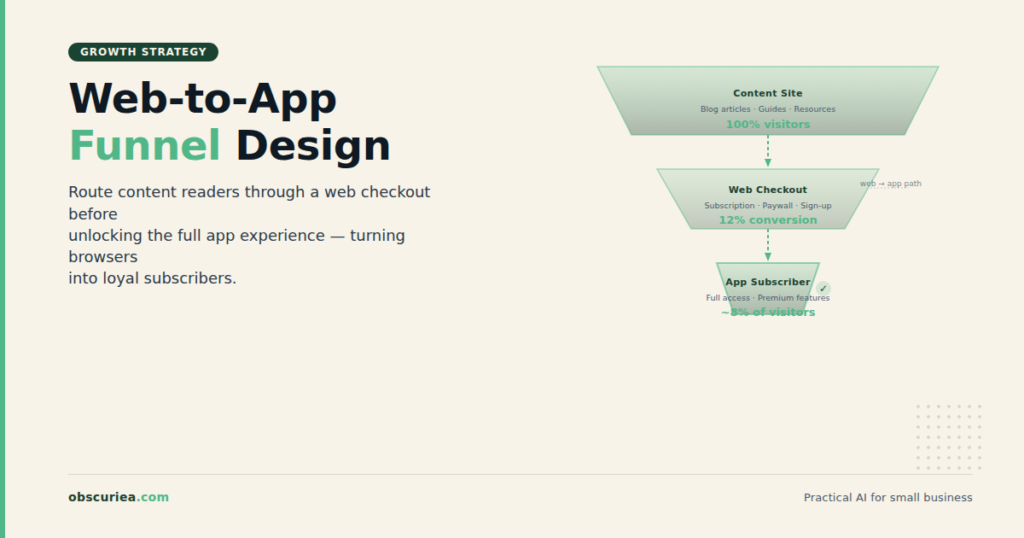
The Web-to-App Funnel: How to Monetize Your Content Without Relying on Display Ads
Display ad revenue is collapsing. CPMs that paid $8 in 2021 are paying $3 today on the same traffic. If your entire monetization strategy is a banner at the top of the page and a sticky footer ad, you are building on sand — and the tide already came in.
The web-to-app funnel is not a new idea. Health and fitness app companies have been running this model since before most content creators discovered Substack. But the mechanics have become accessible enough that a solo operator with a content audience can now build one without a dev team, without a six-figure ad budget, and without handing 30% of every transaction to Apple.
Here is what the income model actually looks like, what the setup phase costs you, and where the ceiling sits.
TL;DR: A web-to-app funnel converts your content audience into app subscribers by routing them through a web checkout before they ever touch an app store. You keep more revenue per subscriber, your retention numbers run higher than in-app acquisition, and you retain full control over pricing experiments. The setup phase takes 4–8 weeks and requires a landing page, a payment processor, and an app worth subscribing to. The income ceiling without paid acquisition is roughly $3,000–$8,000/month for a focused niche content audience. Scaling past that requires either paid traffic or a content-led SEO flywheel.
Environment: Research drawn from RevenueCat’s 2025–2026 web-to-app guides, Paddle’s Web2App Funnel playbook (Nathan Hudson, Perceptycs), and Calm’s documented quiz funnel structure. No personal app tested; model analysis based on documented operator case studies and funnel teardowns. Analysis conducted June 2025.
How the Web-to-App Funnel Income Model Actually Works
The core mechanism of the web-to-app funnel is simple. A user finds your content — through search, social, or a newsletter — lands on a web page you control, subscribes or purchases there through a standard payment processor like Stripe or Paddle, then downloads your app.
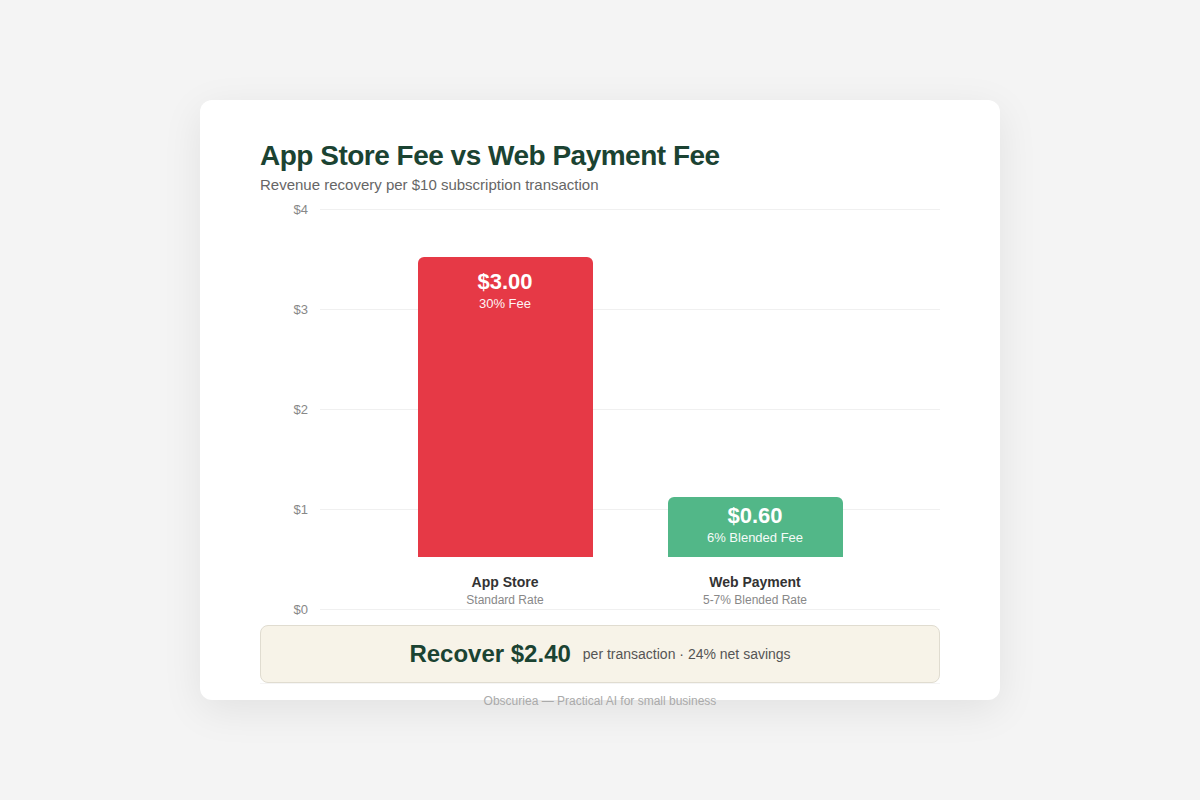
No app store fee. No 15–30% cut to Apple or Google on that transaction.
Web payment processing costs run roughly 2–3% in direct fees. Blended across refunds, chargebacks, and processor overhead, real-world operators report 5–7% total. Compare that to the 30% Apple takes on a standard subscription in year one (dropping to 15% after year one for qualifying developers). On a $10/month subscriber, you are recovering $2.30–$2.50 per month per user that would otherwise be gone. At 500 subscribers, that is $1,150–$1,250 back in your pocket every month.
That is the fee arbitrage story — and it is real, but it is not the main reason to build this funnel.
The better reason is retention. Web subscribers cancel at lower rates than app store subscribers. The mechanics are straightforward: on a phone, all subscriptions sit in one place. One cancellation session in January wipes out five services at once. Web subscribers have to find your cancellation page, log in, and take a deliberate action. That friction is your friend. [RevenueCat’s data](https://www.revenuecat.com/blog/growth/web-to-app-funnels/) consistently shows web subscribers renewing at higher rates, which translates directly to higher lifetime value per acquired user.
The third reason is pricing control. On the web, you can test a $7/month plan against a $12/month plan against a $99/year plan against a $1 trial against a money-back guarantee structure — all without submitting anything to an app store review queue. Calm’s funnel, for example, runs a 7-day trial tied to an annual subscription. If you want to test a $0.99 trial week, you change a number in your payment processor. Done. No review. No waiting.
The Setup Phase: What Happens Before Revenue
Do not skip this section. The setup phase is where most content operators underestimate the work and burn out before the funnel generates a dollar.
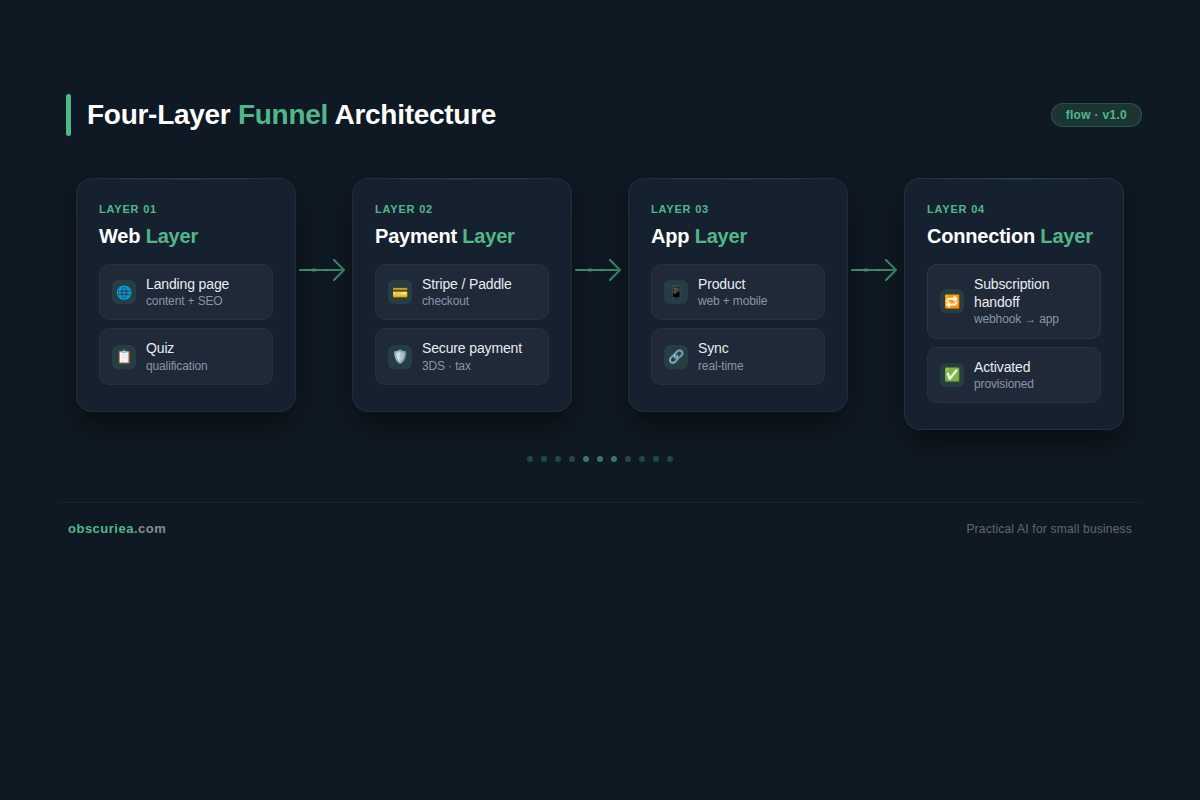
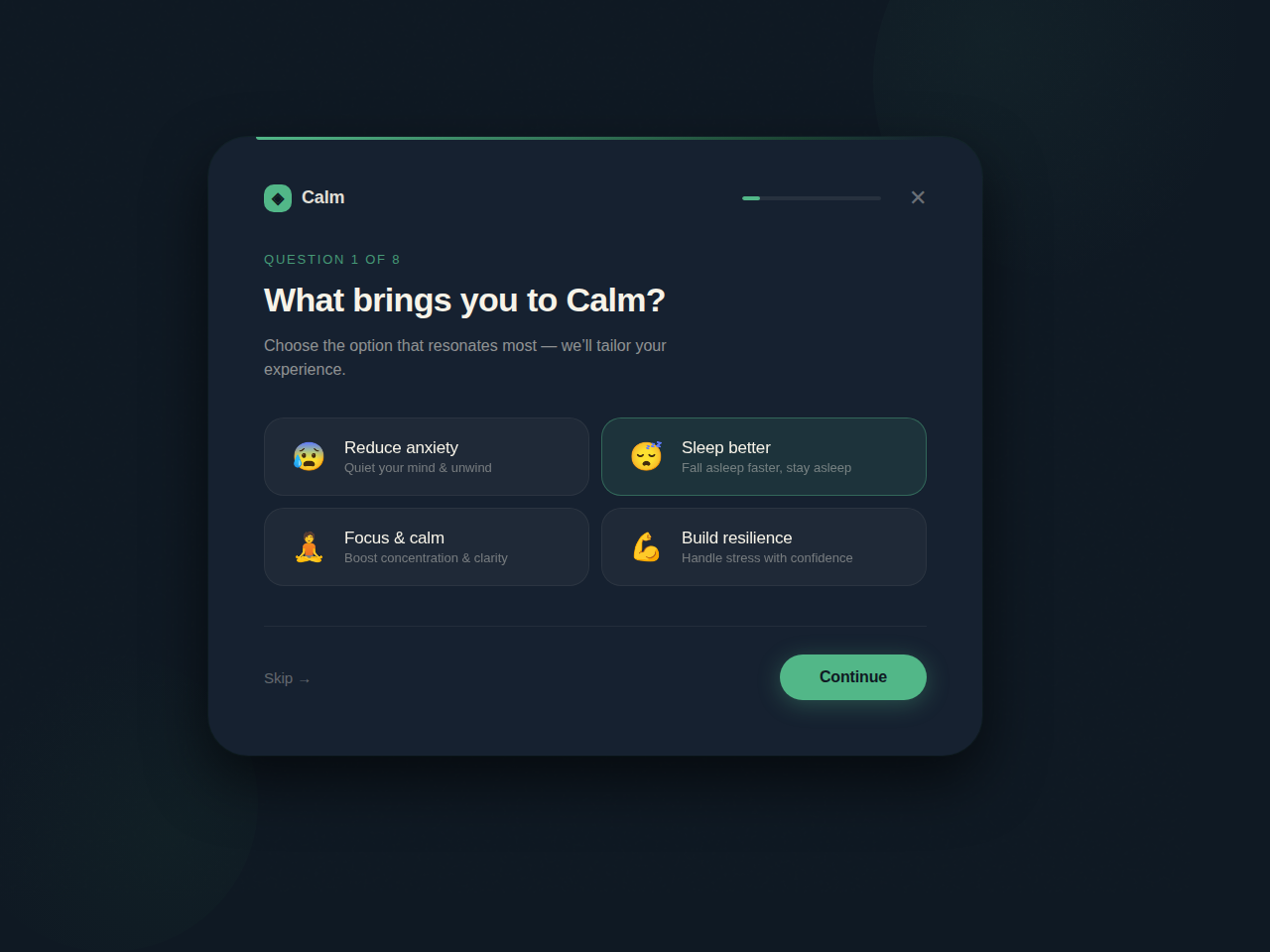
Phase one is the web layer. You need a landing page that explains your product, a quiz or onboarding flow that qualifies the user, and a checkout page. If you are building this without a developer, tools like Webflow or Framer handle the landing page. For the quiz or survey layer — which dramatically improves conversion by making users feel understood before they see a price — Typeform works at early stage. Calm’s entire funnel starts with a quiz that segments users by intent before showing them a single dollar amount. You can replicate the bones of this in a weekend.
Phase two is the payment layer. Stripe handles straightforward subscription billing. If you are selling internationally and want someone else to manage VAT, GST, and tax compliance across jurisdictions, [Paddle operates as a Merchant of Record](https://www.paddle.com/resources/web2app-funnel-fundamentals) — meaning they handle the tax paperwork, not you. This matters more than most people realize when your audience spans the US, EU, and Australia simultaneously.
Phase three is the app itself. This is the constraint most content operators hit hardest. You need an app worth subscribing to. Not a repackaged RSS feed with a splash screen. An actual product with a reason to open it three times a week. If you do not have this, the funnel is a bridge to nowhere — users subscribe on the web, download the app, open it once, and cancel. The web-to-app model amplifies the quality of your app product. It does not substitute for one.
Phase four is the connection layer. After someone subscribes on the web, they need a frictionless path to download the app and have their subscription recognized. This is where tools like RevenueCat come in — they manage subscription state across web and app so the user experience does not break at the handoff. A broken handoff (user subscribes, downloads app, app shows a paywall) kills trust instantly and drives immediate refund requests.
Realistic timeline: 4 weeks minimum to launch a bare-bones version. 8 weeks to launch something you would not be embarrassed to send your best 1,000 readers to.
Executing the Web-to-App Funnel: Step by Step
Step one: Define the content-to-product bridge. Your content attracts a specific reader with a specific problem. Your app must solve a deeper version of that problem. If your blog covers personal finance for freelancers, your app might be a tax tracking and invoice management tool. The funnel works because the content earns trust, and the app captures that trust as recurring revenue.
Step two: Build the qualifying quiz. Do not send traffic directly to a checkout page. The data from Calm’s funnel and similar health app funnels consistently shows that users who complete a quiz before seeing pricing convert at higher rates and retain longer. The quiz does two things: it makes the user feel understood, and it creates micro-commitment — by the time the price appears, they have already invested time and answered personal questions. Walking away feels like leaving something behind.
Step three: Keep the pricing page simple. One primary offer. A trial period if your product earns repeat sessions quickly. An annual plan if your content is evergreen. Do not put three tiers on the page at launch — you do not have the data to justify them yet. Test the single offer for 60 days before adding complexity.
Step four: Set up the post-purchase handoff sequence. The moment someone pays, they receive an email with their download link, their account credentials, and one sentence explaining exactly what to do next. No paragraph of congratulations. No three-step onboarding PDF attached. One action: download the app and log in with this email address.
Step five: Track the right metrics from day one. Conversion rate from landing page to checkout start. Checkout completion rate. App install rate among paid subscribers. 30-day retention among web-acquired subscribers versus any in-app-acquired subscribers. These four numbers tell you where the funnel is leaking.
What Limits the Web-to-App Funnel Income Ceiling
The income ceiling on the web-to-app model without paid acquisition is a function of your organic traffic volume and your content-to-subscriber conversion rate.
At 10,000 monthly visitors with a 1% web-to-app conversion rate and a $10/month subscription, you are generating $1,000 in new MRR per month before churn. With a 5% monthly churn rate, your steady-state MRR stabilizes around $20,000 — which sounds good until you account for payment processing, app maintenance, customer support, and the cost of the tools holding the funnel together.
Real-world solo operator ceiling: $3,000–$8,000/month net before you add paid acquisition or significant content infrastructure. Scaling past that requires one of two things: a paid acquisition channel that generates positive LTV:CAC at scale, or an SEO content flywheel that compounds organic traffic month over month without proportional labor cost.
The app store ranking problem is also real. Every subscriber you acquire through the web funnel is a subscriber who did not come through the App Store. Fewer App Store installs means fewer ratings, fewer reviews, and lower organic App Store ranking. This is not theoretical — operators running aggressive web-to-app programs have documented declining App Store visibility. You are trading one growth channel for another, not adding to your total surface area.
Finally, international tax compliance grows in complexity as revenue grows. At $1,000/month, you can probably manage it manually or through Stripe Tax. At $15,000/month across 40 countries, you need a Merchant of Record solution or a tax consultant. Build this cost into your model before you hit the threshold, not after.
The Friction Box
- Setting up the web-to-app handoff without a tool like RevenueCat breaks subscription state — users who pay on web show a paywall in-app. This is the most common early failure and the hardest to diagnose.
- Free trial conversion from web is structurally different from in-app: web users often enter cards with zero balances. A $1 trial offer converts and qualifies better than a 7-day free trial in web contexts.
- Quiz funnels take 3–5 weeks to build properly. Rushing this phase produces a quiz that feels like a survey and does not create the commitment loop that drives conversion.
- App quality cannot be papered over by funnel quality. A good funnel with a weak app produces high subscription rates and high 30-day churn — net result: expensive refunds and App Store review damage.
- The April 2025 Epic v. Apple ruling allows US App Store apps to link to external payments without Apple fees, but this only applies to the US store as of June 2025. EU operators still pay 17–20% under DMA rules. Model your fees by geography before assuming full arbitrage.
- Paid acquisition math changes completely when running web funnels. Your CAC calculation now includes landing page testing costs, quiz optimization, and payment processor fees that did not exist in a pure in-app model.
The Straight Talk
This model is built for content operators who already have an engaged audience — newsletter, blog, or social — and have built or can build an app that delivers ongoing value beyond the content itself. If your app is a wrapper around your content feed, this funnel will generate trials and produce churn. If your app solves a problem your content audience has every week, the retention numbers justify the setup cost.
Skip this if you are at zero audience. The funnel amplifies existing trust — it does not manufacture it. Building a web-to-app funnel before you have 5,000+ engaged readers or followers is building the distribution infrastructure before the product-audience fit exists.
If you have the audience: spend two weeks mapping your content-to-product bridge before writing a single line of copy. That bridge — the specific problem your app solves for the reader who trusts your content — is the only part of the funnel that cannot be templated or copied.