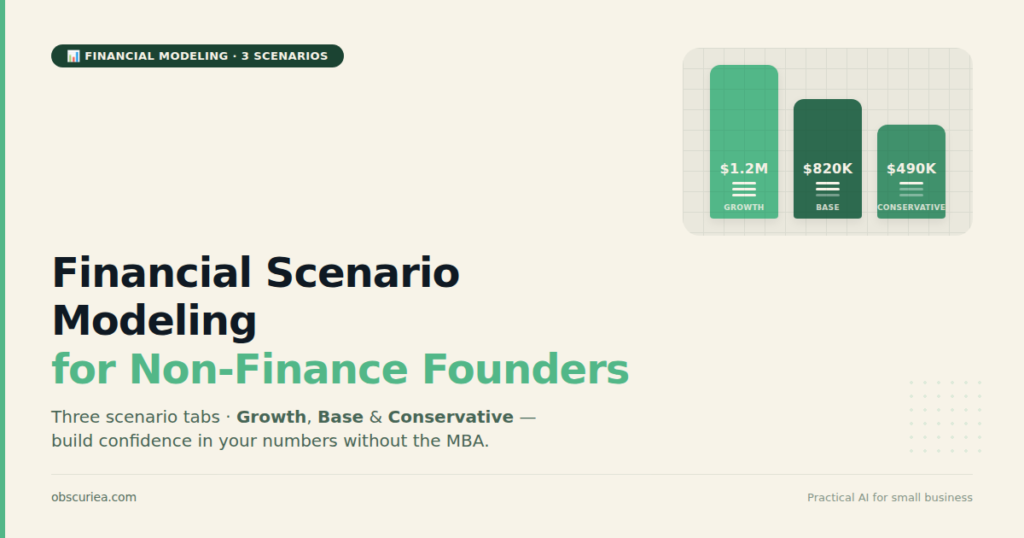
TL;DR: Financial scenario modeling isn’t about predicting the future—it’s about understanding which levers actually move your business. For non-finance founders, skipping structured scenario analysis means flying blind on cash flow, pricing, and hiring decisions. This article walks through a straightforward three-scenario framework that works without a finance degree or expensive software.
Environment:
– Sources synthesized: 1 URL (Graphite Financial blog)
– Synthesis date: 2025-07-15
– First-hand tested: Basic spreadsheet modeling for solo e-commerce operations (inventory, cash flow, pricing scenarios)
– Operator context: Running a solo content business for 3 years, managing cash flow projections across multiple revenue streams
The Architecture
You don’t need to be a CFO to run scenario models for non-finance founders. The architecture is simple: pick your key variables—customer acquisition cost (CAC), average order value (AOV), churn rate, operating expenses—and build a spreadsheet that lets you change any of them and see the impact on revenue, profit, and cash runway. The math is straightforward.
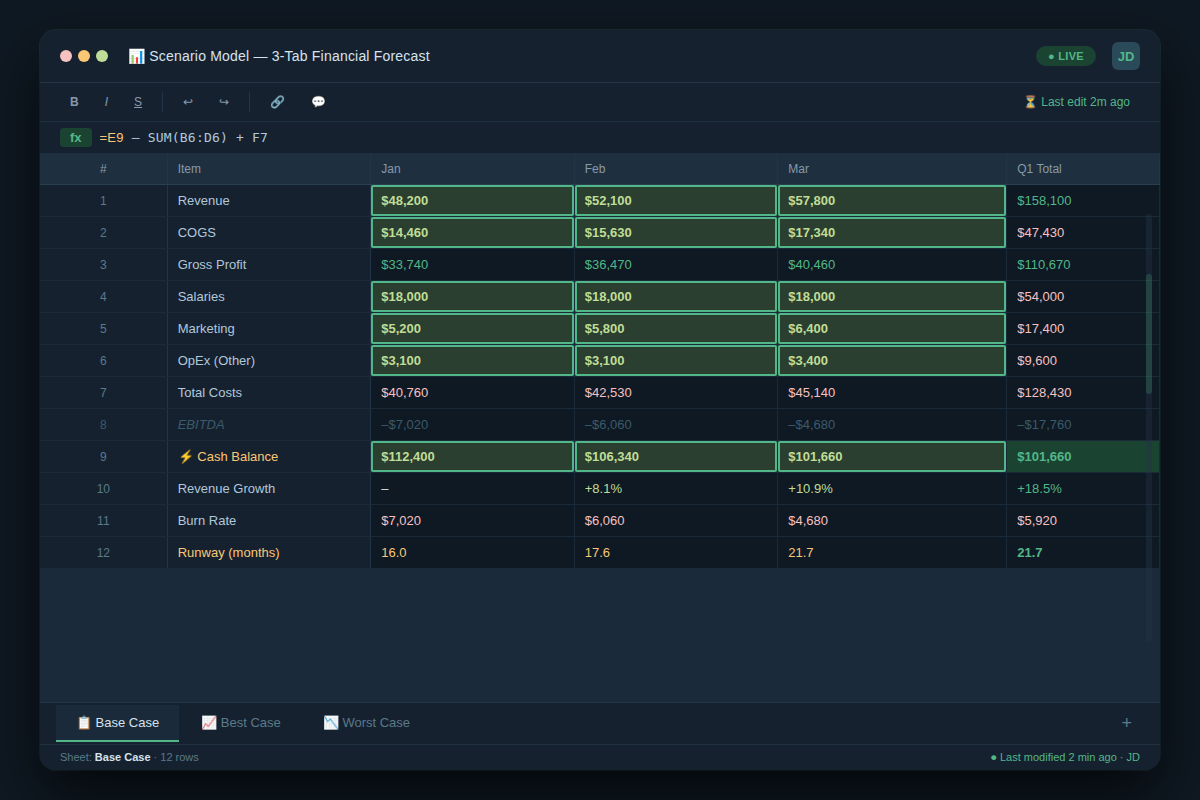
Most non-finance founders overthink this. They imagine complex Monte Carlo simulations or machine-learning forecasts. The reality: a three-tab spreadsheet does 80% of the work. Tab one is your base case—your most honest projection using current data. Tab two is your best case—what happens if you nail your growth targets. Tab three is your worst case—the scenario where everything goes wrong, and you need to know how long your cash lasts.
The framework isn’t new. What’s missing from most guides is the operational reality: how often to update these models, what variables matter for different business types, and how to avoid paralysis from too many scenarios.
The Three-Scenario Structure
Base Case: This is your default operating plan. Use your last 3–6 months of actual data. Don’t fudge the numbers. If your average sale is $45 and you convert 2% of visitors, that’s your baseline. Multiply by traffic trends and you get revenue. Subtract fixed and variable costs—rent, software, contractor payments—and you get profit. Run this forward 12 months.
Best Case: What if your conversion rate doubles? What if a viral post brings triple traffic? What if you raise prices 15% without losing customers? The best case isn’t fantasy—it’s the top end of what is statistically possible based on your current trajectory plus one or two unlocking actions. Be realistic. A 10x growth in three months is a fantasy, not a scenario.
Worst Case: This is where most non-finance founders fail. They model a mild revenue dip—say 20%—and call it the worst case. That’s not a worst case. A proper worst case assumes your biggest customer leaves, your main ad channel stops working, and a key contractor quits simultaneously. How long do you have before you run out of cash? The answer to that question is the most valuable output of your entire model.
The Workflow Math
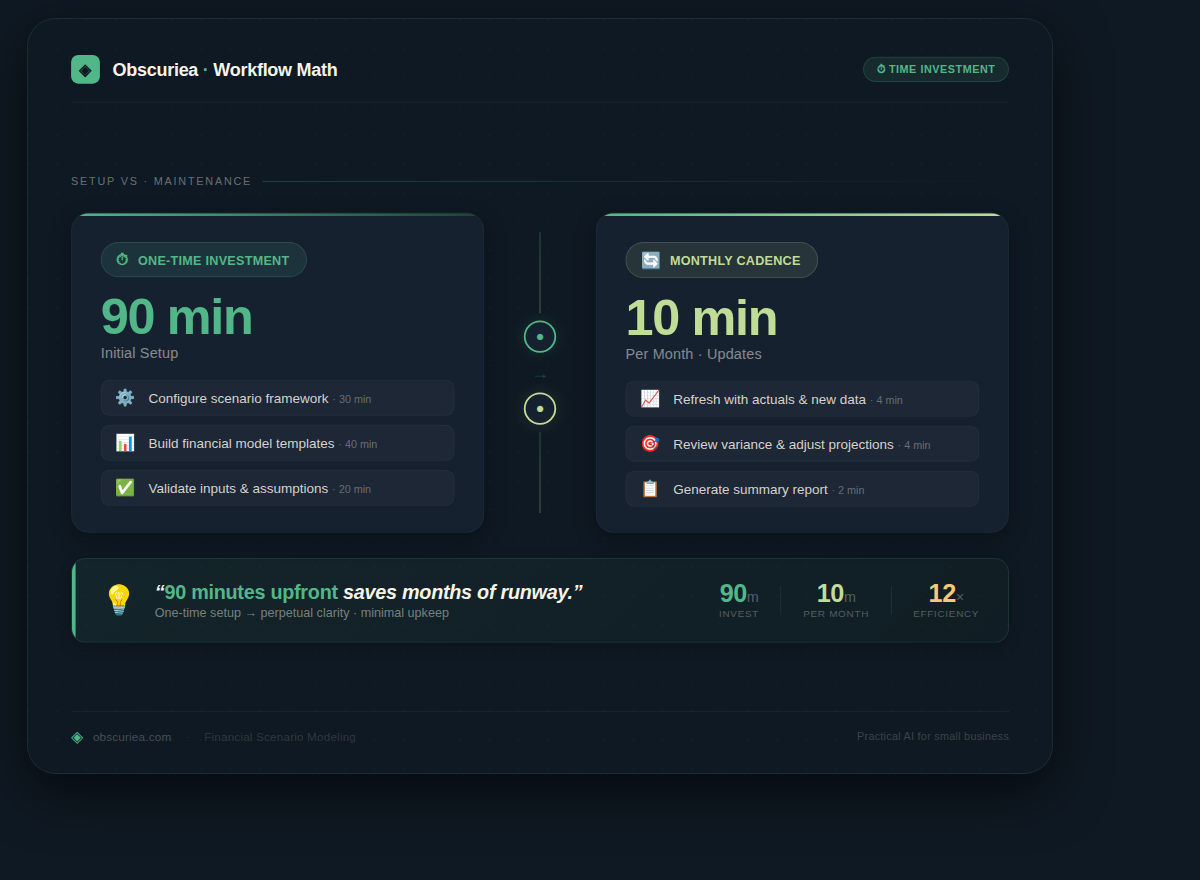
Let’s put numbers to the workflow. Building a three-scenario model from scratch takes about 90 minutes for a first-timer. If you have a template (use one from the [source article](https://graphitefinancial.com/blog/mastering-scenario-analysis-financial-modeling/) or create your own), it takes 30 minutes. Update it monthly—that’s 10 minutes per month after the first setup.
| Step | Time (first time) | Time (monthly update) |
|---|---|---|
| Set up base case (revenue, costs, cash) | 45 min | 5 min |
| Add best and worst case tabs | 30 min | 3 min |
| Link formulas to key input cells | 15 min | 2 min |
| Total | 90 min | 10 min |
The return on that 90-minute investment is clear. A single bad decision—over-hiring based on over-optimistic revenue, or failing to cut costs before a cash crunch—can cost months of runway. Scenario modeling doesn’t prevent bad luck. It prevents surprise.
What to Track
The specific variables depend on your business model, but most product-based and service-based businesses need these inputs:
– Monthly recurring revenue (if subscription)
– One-time sales volume
– Average order value
– Customer acquisition cost (all channels combined)
– Gross margin
– Fixed operating expenses (rent, software, salaries)
– Variable costs (COGS, contractor fees, ad spend)
– Cash on hand
Change any of these in your model, and the profit and cash flow projections update automatically. That’s the core mechanism.
Where It Breaks
Scenario modeling fails for founders in four predictable ways.
1. Too many scenarios. The source article warns about overcomplicating, and it’s right. Don’t build ten scenarios. Three is the sweet spot. Five is noise. Anything beyond that and you’ll spend more time managing the model than using it to make decisions.
2. Garbage inputs. If your base case assumptions are pulled from thin air, your worst case is a work of fiction. Use real data from your [accounting software](https://www.waveapps.com/) or [payment processor](https://stripe.com/). If you don’t have three months of clean data, don’t model—go sell something first.
3. No update cadence. A model built once and never revisited is a snapshot of a museum exhibit. Your business changes every week—your model needs to change too. Set a recurring calendar event every 30 days to update the actual numbers and reassess your scenarios.
4. Decision paralysis. Some founders build models, see every scenario, and freeze. They worry that any decision might push them into the worst case. A model is a tool, not a fortune teller. Use it to identify which decisions have the highest upside with manageable downside. Then act.
The Friction Box
- Real data is messy. You may not have clean separation between personal and business accounts, or your payment processor exports are a mess. The first model is always a cleanup project.
- The worst case scenario is emotionally hard to build. It forces you to confront failure. Most founders avoid it or soften it until it’s useless.
- Manual models break when you make a typo in a formula. One wrong cell reference and your entire forecast is wrong. This is why spreadsheet audits matter.
- The source article pushes enterprise tools like Anaplan and Planful. For a solo founder with $50K revenue, those are useless. A [Google Sheet](https://www.google.com/sheets/about/) is all you need.
- Scenarios are only as good as your understanding of cause and effect. If you don’t know what drives your sales, your model is guesswork gussied up in a spreadsheet.
Frequently Asked Questions About Financial Scenario Modeling for Non-Finance Founders
How often should I update my scenario model?
Update your model monthly. Link your actual revenue and cost numbers for the past month, then reassess your forward projections. If a major change happens—a new competitor, a price change, losing a big client—update immediately.
What’s the difference between scenario analysis and sensitivity analysis?
Sensitivity analysis changes one variable at a time to see its isolated impact. Scenario analysis changes multiple variables simultaneously to explore a coherent future state. Use sensitivity analysis to identify which variable matters most; use scenario analysis to prepare for realistic combinations of changes.
Can I use AI tools for scenario modeling?
Yes, tools like [Causal](https://www.causal.app/) or [Pigment](https://www.pigment.com/) offer AI-assisted modeling, but they require clean data to be useful. For most non-finance founders, a well-structured spreadsheet is faster, cheaper, and easier to audit.
What if I don’t have historical data?
Pre-revenue or very early stage? Focus on unit economics instead of full financial modeling. Build a simple calculator that shows your breakeven point based on assumptions for CAC, AOV, and fixed costs. Once you have 3 months of orders, you can move to scenario modeling.
Should I hire a fractional CFO or do it myself?
If your business is simple (one product, one channel), do it yourself. When you hit complexity—multiple revenue streams, international sales, inventory management—a fractional CFO can save more in avoided mistakes than their hourly rate.
The Straight Talk
This framework is for non-finance founders who are tired of guessing whether they have enough runway to hire their first employee or launch that new product. If you have revenue data (even three months) and you’re making decisions that cost money, scenario modeling is your cheapest insurance against cash flow crises.
Skip this if you’re pre-revenue and still testing product-market fit—you don’t have enough data to model anything meaningful. Go build customers first. Come back when you have numbers to work with.
Your next action: Open Google Sheets right now. Create three tabs: Base Case, Best Case, Worst Case. List your revenue streams and major costs. Populate three scenarios with realistic numbers. Set a calendar reminder for 30 days from now to review. That’s the entire workflow.